If the dead really becomes resurrected one day,
I will be amazed.
I will say hallelujah.
But I'm not so concerned about that.
Even if there is no resurrection of the dead,
Even if when you die,
That's the end of the body,
That's it.
That's fine with me because the point is not to be self-centered.
Why do we care so much about the resurrection of the dead in the literal sense?
Because we're self-centered,
Because we don't want to die.
We don't want our bodies to die.
But what happens when we shift that?
We're no longer self-centered,
But we're God-centered.
We recognize,
Oh,
But God doesn't die.
I'm part of God.
God's not gonna die.
We can bring ourselves to this.
There are really two things that have to work together because you can take some LSD or something.
Hush,
Give a moment.
I don't know.
Aloha.
Shalom.
Welcome to the Torah of Awakening Jewish Meditation podcast.
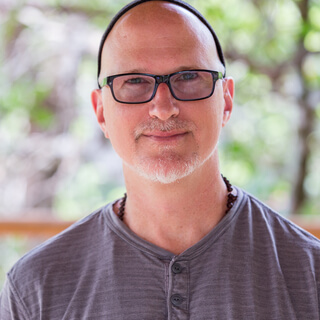
I'm Rabbi Brian Yosef Schachter-Brooks.
In this episode,
We'll explore gorgeous teaching from Netanya on the connection between the messianic prophecies in Isaiah and the festival of Shavuot,
And how this all hints at the inner dimension of spirituality,
Which is not so much about beliefs and rules,
But about how we perceive what is before us in the moment,
And even deeper,
How we feel and know ourselves to be the boundless field of consciousness that perceives.
Then we'll not just talk about it,
We'll actually practice it with some guided meditation.
Enjoy.
All right,
This is from the Tanya,
Which is the Bible of Chabad Hasidism.
A little section bringing in some deep insights on Shavuot.
Your teacher shall no longer be concealed from you,
Which is the Altarebbe's paraphrase of the original text from Isaiah 30.
20 that says that divinity will not be concealed from you with robe and garment,
But rather your eyes shall see your teacher.
And it is also written,
They shall see Another passage from Isaiah.
Okay,
So what are these?
Why is he bringing all these passages from Isaiah?
You may have figured out that all of these descriptions of what will be our of what's called Yomot HaMashiach,
The days of Messiah,
The messianic era.
And they're all pointing to,
There are many prophecies about the messianic era,
But all of these are really about the same thing.
They're all about the recognition on our part of human beings,
All human beings of the divine.
And it's interesting that it says that God is normally concealed by robe and and clothes.
Like there's like it gives an image as if we have like clothes on and then over the clothes there's a robe.
There's like two levels that are blocking our perception of the divine.
So first thing we want to ask is well what is that what are that's a metaphor the robe and the clothes.
What's it a metaphor for?
And the ordinary way that These ideas tend to be taken by the non-esoteric mind.
It's simply that God is an objective reality that we can't see,
We can't perceive it because there's something blocking it.
But we understand from the perspective of working with consciousness that the thing that blocks it is actually just our conditioning.
In other words,
It's our thoughts our thoughts,
Our preconceptions,
And our psychological disposition,
Which is used to stuff existing.
We're just used to life.
We're used to it.
And that's actually the block.
So it's not as if there's some,
If the blinders were to be taken away,
All of a sudden we would see something completely different.
Yes,
We would see something completely different,
Different other than that perhaps the colors would be a bit brighter,
Perhaps things would look a little bit more clear,
But mostly it's our connection with what we're perceiving around us in the moment that changes.
This is thought of as the Yemot HaMashiach,
The days of the Messiah,
Because everybody will reach this state,
But we're not waiting for Yemot HaMashiach.
This is what meditation is all about.
It's about working on ourselves,
Doing the practices,
So that when we wake up in the morning,
Instead of feeling kind of groggy and grumpy and thinking about whatever and I didn't get enough sleep or something,
It's like waking up into a new world.
Like everything around us is alive and everything is a miracle and everything is a blessing.
That's why we do this work.
All of us have had some kind of taste of this.
Or maybe some of you are not even sure if you've had a taste,
But nevertheless,
There's an intuition.
There's an intuition that there's something there.
There's at least enough trust to get onto the Zoom and say,
Okay,
Let's try again.
So,
It's an amazing thing.
I think that these prophecies.
.
.
About the days of Mashiach and many many things that are in the scriptures are images,
Ideas,
Words,
Forms that emerge from this deep unconscious intuition that we have that of what life would be like if we were to become free from all of this psychological conditioning that we have and experience and behold the miracle of the moment.
Fulfillment and culmination of the creation of the world,
For which purpose it was originally created.
" So here he's again,
He's talking about the prophecies that are in Isaiah,
But it doesn't say explicitly in the prophets that the world was created for the purpose of these prophecies.
This is an idea that is expressed a lot in Hasidic thought,
And the thing that's emphasized about the days of Mashiach is that there is this uncovering of our eyes to be able to behold the grandeur of the divine.
And so another way of saying this,
The way I would say it,
Or one way I would say it,
Is that the purpose of creation,
The reason why we're here in the first place,
Is the evolution of consciousness.
Somehow,
Some single-celled organisms emerged some number of billions of years ago on the planet and then continued to develop from there and plants and different creatures and coming up to human beings.
And we as human beings now have a consciousness that's developed enough to recognize that there is something utterly beyond what our minds can comprehend and that something is both within us and around us and not separate from us.
And so we use this imagery that comes to us from ancient humanity humanity of these deities,
You know,
The idea of a deity,
We have that imagery in order to awaken us a little bit,
In order to get us to pay attention a little bit more.
But really,
It's not about,
Ultimately,
It's not about our mental conceptions of these things,
It's about the development of consciousness up to the point of recognizing the unity of being that becomes part of our lived experience.
And so that's what he's referring to.
The days of Mashiach are really the purpose of why we're all here first place.
The GOM.
And also,
There was already something like this for the worlds,
All right?
So the days of Mashiach,
Even though we're not there yet,
Even though all people aren't unified in their perception of the divine,
Nevertheless,
We had a taste of this in history when,
At the time of Matan Torah,
The giving of the Torah,
As it is written,
You've been shown to know that Hashem is Elohim.
What does that mean?
Hashem is the name which comes from the verb to be.
It's just a permutation of the letters of the verb to be.
So existence is Hashem.
Elohim means the gods,
But it's understood and conjugated in sentences as a singular.
So it's like all the plurality of divine forces are actually a unity.
Guess what?
Ein od mil vado,
There's nothing else besides this.
Okay,
So then he says,
You have been shown mamash,
With actual vision,
As it's written,
And the people saw the sounds.
That is,
They saw what is normally heard.
And this is a quote from the Torah.
It actually says that they saw the sounds,
They saw the kolot.
And the rabbis of blessed memory explained about this,
That they looked eastward and heard the speech issuing forth.
What speech did they hear?
And here he quotes just the beginning.
Of the Aseret Hadibro,
The Ten Commandments,
Where God says,
Anochi,
I,
And the am is included in that.
So God basically says,
I am.
So why,
Out of all of the Aseret Hadibro,
Why is this sufficient just to say the first word,
Anochi?
Because this is the whole point,
That the divine is beingness,
That we're recognizing all of a sudden,
Oh my God.
Oh my god,
Literally,
This existence,
This reality,
Is something that we can relate to with an attitude of reverence,
Devotion,
Radical amazement,
As Heschel said.
And so this speech,
This Anochi,
This I am,
Was coming from the four points of the compass and upward and downward.
They're hearing this proclamation of divine being coming from everywhere,
As explained in the Tikkunim,
Which is referring to the Zohar,
That there was no place from which Hashem did not speak to them.
That's amazing,
You see?
So the Zohar is telling us that this I am-ness,
The divinity of being,
Is coming from everywhere.
These are all different ways of saying the same thing.
And this is so because the revelation of the divine will of the Blessed Holy One in the Aseret Hadib wrote,
The Ten Commandments,
Constituting the essence of the whole Torah,
Which I think is a wonderful hint here,
That the Ten Commandments,
That all of the 613 mitzvot are somehow contained within the wholeness of the Aser HaTibrot,
And that that's the innermost will,
The Peninit Ritzono.
Peninit Ritzono means like the essence or the innermost,
The essential,
The inside of the inside.
Of the Blessed One and the Divine Wisdom wherein there is no concealment of the face at all.
As it is written,
And this is a line from the Amidah,
He's bringing in the prayers that are said every day,
Traditionally three times a day.
Because you gave us the Torah of life.
And so he's connecting the resurrection of the dead that will happen in the future with Torah as the source of that resurrection,
Torah as life,
Connecting this prophecy,
This future legend in a sense,
This legend that happens in the future,
With something that we can directly experience right now.
Because what does it mean to open our eyes in the morning and just be in a state of wonder at the living reality as it blossoms all around us?
It means that we're alive.
That's the resurrection of the dead that I'm concerned about.
If the dead really becomes resurrected one day,
I will be amazed.
I will say hallelujah.
But I'm not so concerned about that.
Even if there is no resurrection of the dead,
Even if when you die,
That's the end of the body,
That's it.
That's fine with me because the point is not to be self-centered.
Why do we care so much about the resurrection of the dead in the literal sense?
Because we're self-centered,
Because we don't want to die.
We don't want our bodies to die.
But what happens when we shift that?
We're no longer self-centered,
But we're God-centered.
We recognize,
Oh,
But God doesn't die.
I'm part of God.
God's not gonna die.
We can bring ourselves to this.
There are really two things that have to work together.
Because you can take some LSD or something.
So you can take some hallucinogen and you can have this experience.
All of a sudden your conditioning drops away,
And you're blown away by the miracle of being,
And that's a wonderful spiritual experience.
But it doesn't,
Just because you have that experience,
Doesn't necessarily mean it's going to become a way of life,
A way of being for you.
Because that's on the level of Chokmah,
That experiential level of Chokmah,
When consciousness opens up and beholds.
But then,
We need Torah,
We need Binah,
We need to contemplate,
We need to remind ourselves When we feel groggy,
We feel annoyed,
We feel judgmental,
We feel jealous,
We feel,
What am I doing with my life,
Whatever,
All these different negative thoughts and feelings that come up,
We need to use our minds,
Our thinking minds,
To bring ourselves into a re-centering around that divine miracle.
And that's not Chokmah,
That's Bina.
That's the sphere of Bina.
So we need Chochmah and Bina together.
They need to work together.
This is how Avodah and Talmud Torah,
That is the spiritual practice,
The essence of which is really presence and the expression of which is Tefillah,
Prayer.
We need to bring that together with contemplating,
With creating an inner map that supports spiritual realization rather than squashes it and covers it up.
That's Binah,
Which in the way I understand the holidays in the Sphirod,
Binah is Shavuot.
Let us.
Nourish the seeds of Bina within with the Kavanah,
I am contemplating,
I am discerning,
I am discernment.
And by the way,
By discerning,
B note represents this quality of discernment that we can bring to anything that we need to.
However,
In the spiritual sense,
It means discerning.
What is this?
What is this?
What is this moment?
Is it not the divine oneness?
Enclosed in the robes and the clothing of everything we are experiencing,
Everything we are perceiving.
This body,
This world that appears around us,
That's the discernment to make.
And so chanting I am contemplating.
I am discerning.
I am discerning.
I'm contemplating I am discerning I am discernment.
Our chant for Bina coming from the morning blessing.
Blessed are you,
Hashem,
Asher natan lasech vivina.
Who gives us bina,
Who gives us understanding,
Lehavchin,
To distinguish and discern between day and night.
That is between consciousness and unconsciousness so that we can once again choose consciousness again and again.
Baruch atah Hashem.
Baruch.
Tashkent Asher Natan L'asich V'vina L'havchin Ben Yom Uvin L'aylah B'Avruch HaTashef Maha Bukhata Hashem.
I share.
Yom Kippur,
Yom Kippur.
Power.
Asha.
Bhārataśa Ahasuer natan lasech vivina,
Le'avchin b'n'yom uv'n'la'eg la'ah.
Aha.
Atah Shalom.
Tomorrow Shabbat Shalom Asher natan asech b'vina le'afchim.
One more time,
Really bringing to mind the gift of our minds that are able to contemplate and to come from unconsciousness to consciousness,
Giving thanks.
Shabbat shalom.
Namaskaram.
Namaskaram.
Asher Natan Asech Vivina Rehavchin Vein Yom Uvein Layla and preparing for meditation.
Noticing the position of your body,
Adjusting as you need to to be in a position that's comfortable,
Conducive to stillness.
And yet has some energy infused in your muscles and your posture so that you're sitting relatively straight.
Letting go of excess tension,
Just enough tension to be alert,
Have the spine be relatively straight.
Not leaning or slouching.
And this attitude of alertness,
Bringing it forth from the heart,
Bringing your right hand to your heart.
Offering loving presence to the fullness of what is arising and experience knowing that all of it is Hashem.
Hashem appearing to us in infinite forms.
Right now,
The revelation.
We stand at Sinai right now.
And offering your attention with Lecha,
Deep breath in.
Bringing left hand to your belly,
Dropping awareness down into your belly,
Filling your belly with a light of consciousness.
Awareness flowing down through your legs filling the inner space of your legs with a light of awareness extending downward connecting into the earth.
And rising up chest,
Upper back,
Shoulders and neck releasing any excess tension that might be there.
Flowing down arms,
Hands,
And fingers,
Connecting back with your heart and belly.
Bringing that attention more deeply into the flow of the breathing,
Each breath.
Each breath is like we are being breathed into life by the divine.
Awareness rising to your face,
Facial muscles,
Brain and nervous system,
Bringing a little smile to your lips.
Being that loving,
Benevolent,
Indwelling presence.
I say,
Deep breath in.
Oh.
Say.
Bringing right hand to lightly touch forehead as awareness opens up into the miraculous space around you.
To recognize not only do you have the freedom to move about in this space that is.
The place in which you inhabit,
I'm a calm,
A divine space,
But you actually at the deepest level are this space,
The space of consciousness within which all experience comes and goes.
Deep breath in.
V'nishma Kissing your fingers,
Relaxing your hands.
Bless us to meditate deeply and powerfully.
Let this practice today.
B.
A.
Receiving of your gift to be able to practice,
To be able to participate in our own conscious evolution.
And recognition of you.
Ah,
Duh.
Coming into the silence of avodah.
Resting in the tefila.
Ooh.
Bringing some movement to your body,
Taking a nice stretch.
May we incorporate and integrate the sphere of Bina,
This contemplation of Hashem in and as everything,
More and more so in our moment-to-moment lives.
May this holiday coming up of Shavuot,
Be auspicious for us to recognize what it's like to stand in the presence of revelation and bring that to each moment and each experience.
Shalom.
I hope you've enjoyed this Torah of Awakening.
I'm Rabbi Brian Yosef Schachter-Brooks.
Until next time,
All blessings.