So welcome.
Now the bloom.
Welcome to this meditation and Dharma talk.
Called ocean breath.
And we'll be exploring Ujjayi breath meditation today.
So this is an ancient yogi practice,
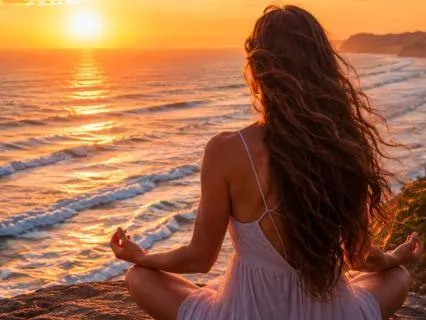
Which we often refer to ujjayi breath as ocean breath because of the soft wave-like sound it makes.
And this breath is one of the foundations of our yoga practice.
It helps us cultivate presence,
Steadiness,
And connection between the body,
Mind,
And spirit.
In yoga philosophy.
Our breath is far more than oxygen moving through the body.
The breath is prana.
It is our life force energy.
It influences the way our nervous system,
Our emotions,
Our focus and the quality of our awareness.
Many people first encounter ujjayi breath in a yoga class and often spend years trying to fully understand it.
As movement in our yoga practice becomes more dynamic or more challenging.
The breath can become shallow,
Rushed,
Or forgotten altogether.
Yet yoga invites us to move differently.
Rather than letting the mind move the practice,
It's our breath that moves us around the mat.
The breath is the rhythm beneath the movement.
The anchor beneath distraction.
And the ocean tide that continually brings us home.
Without awareness of our breath.
Yoga is simply exercise or stretching.
And that's also part of the learning.
When the breath and movement unite together as one.
Then the breath becomes meditation in motion.
In our yoga practice,
Our breath is often reflecting our state of mind.
So if the mind is rushed or busy,
Distracted or unsettled,
Then the breath often follows.
And when we begin to soften and steady the breath.
The mind gradually begins to soften also.
And this is the practice of yoga.
And this is also one of the great teachings of Pranayama.
We are not just breathing to calm the body.
We're using our breath to learn to cultivate steadiness within ourselves.
Even as life continues to move and change around us.
Breath is our anchor in the present moment.
Brings us home to our body.
Ujjayi breath is linked to pranayama,
The fourth limb of yoga in the eightfold path.
Pranayama refers to expansion and direction of life force through conscious breathing practices.
And what makes Ujjayi so beautiful is that it supports us both on and off the mat.
When we learn how to connect with this breath.
It helps to steady the mind during stressful moments.
It can help us to soften anxiety.
To soothe insomnia and support deeper sleep.
It helps us to maintain steadiness through intensity,
Sensation,
Emotion,
And change.
And perhaps most importantly,
It teaches us how to remain connected to ourselves while moving through the waves of life.
So today's practice is an invitation to slow down.
To listen inwardly.
And to reconnect with the natural intelligence of your breath.
So for this practice,
I invite you to take a seated position.
Allow the spine to lengthen gently towards the sky.
Relax the shoulders.
And soften the muscles of the brow.
And close down the eyes.
And take a slow,
Easy breath in.
And exhale all the air out.
Just allow the breath to find its natural rhythm.
Inhale.
And exhale.
Just noticing the gentle rise and fall of the chest and belly.
Now Ujjayi breath is performed by making a very gentle constriction in the back of the throat.
A little bit like fogging up ski goggles.
And so let's take one together,
Take a nice big inhale,
Fill the lungs,
Open the mouth,
And simply.
Yeah,
And just make that soft sound.
We can hear the distinctive sound at the back of the throat.
That's step one.
And so what we're essentially doing there is closing off the airway slightly.
That makes the air passage a little bit smaller and helps us to control the rate of exhale.
So now let's make that same constriction,
But we're going to make the breath real slow.
And then we'll do three together with the mouth open.
The full breath is actually done with the mouth closed.
But for beginners,
It's a little bit easier with the mouth open to learn.
So we're looking for a repetitive breath loop,
Yeah?
And so every breath,
Slow and steady with this gentle constriction.
Take a nice big inhale,
Fill the lungs.
Open the mouth,
Constrict the throat and exhale as slow as you can.
Listen to the sound.
Close the mouth.
Inhale slowly through the nose.
Open the mouth constrict the throat and And how slowly through the nose.
Open the mouth constrict the throat and a close amount.
Inhale slowly.
Now we keep the mouth closed and exhale through the nose.
We may still make the sound.
Good.
And again,
And now we're looking for that repetitive loop.
So every breath,
Slow and steady.
And now continue,
And you'll see why they call this the ocean breath,
Because the sound is like ocean waves lapping on the shore.
Slow,
Steady,
Rhythmic.
And just continue with this breathing and try to keep the rhythm steady with the constriction.
Now in full ujjayi breath,
The constriction also happens on the inhalation.
But as a beginner,
That can sometimes feel a little bit strange.
For some,
It'll happen right away.
And for others,
It sometimes just takes a little more time and practice.
So if it's not feeling comfortable on the inhale,
Just skip it for now and focus only on the exhale.
Try to still breathe in slowly.
And then focus on constricting the exile.
When that becomes more comfortable,
The inhale will gradually start to happen on its own when the exhale becomes more comfortable.
Now,
If you're doing this for the first time,
You're probably already noticing it takes concentration.
You have to focus.
The moment that you're not focused,
Then the breath will return to its shorter,
Natural rhythm.
And so in yoga,
We are actively cultivating a slower breath,
And this constriction helps us to do that.
And this is pranayama,
Breath control.
Ocean breath.
And you may notice also,
If you're doing this especially for the first time,
That you may start to feel a little lightheaded.
And that is part of the practice.
The more that you do it,
The more easy it becomes.
And so allow yourself to just move in and out as needed.
Now just keep coming back and try to stay focused on keeping this breath consistent for the duration of this practice.
As the breath is settling into its natural oceanic rhythm.
Begin to feel yourself become quieter within.
More spacious,
More present.
And how.
And exhale.
With the ocean sound.
And also noticing the pauses between the breaths.
So as you follow the inhalation to the top,
You'll notice there's a gentle pause.
And follow the exhalation to the bottom.
And there's another pause.
And so there's four parts to the breath.
The inhale,
The exhale,
And the two pauses.
These pauses are referred to as kumbhaka.
Little suspension.
And so I invite you to pay attention to all four parts of the breath.
And without trying to change the nature of the Kumbhakas,
We don't want to hold the breath,
But we want to allow those Kumbhakas to become a little more spacious so there's more of a separation between the inhale and the exhale.
As we follow the inhalation to the top,
Allow the breath to just settle into that space before it becomes an exhalation.
And so I like to invite special attention to those pauses.
We're only observing the inhales and exhales.
We become distracted very easily.
And by watching all four parts,
The breath is then a moving meditation point.
So we'll now move into a little visualization.
Of our yoga practice.
Sometimes really challenging to learn when you're on the yoga mat.
And so we'll just visualize that we're on our yoga mat so that we can learn more deeply how this breath is connected to our yoga practice.
Now imagine yourself standing at the top of your yoga mat.
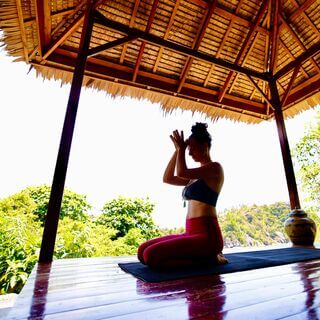
A beautiful open-air platform suspended above the ocean.
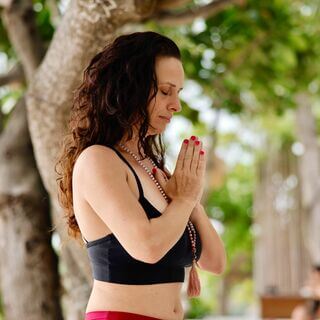
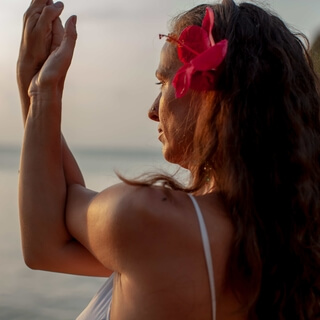
And your hands are resting together at the heart in Anjali Mudra.
The sky is glowing with soft gold and pink light.
The sea stretches endlessly before you.
Gentle breeze brushing against your skin.
The ocean waves are constantly arriving.
Constantly returning.
Notice how your ocean breathing is mirroring the rhythm of the sea.
Every inhale rising like a wave swelling towards the shore.
And each exhale releasing back to the vastness of the ocean.
The mind soften.
And the body also softens.
Every breath,
You feel yourself becoming more connected to this present moment.
More aware of the quiet spaces within yourself that are so often overlooked.
Breathing in.
And breathing out.
Ocean breath.
Listening to a sound.
The ocean breath.
Soft hollow sound at the back of the throat.
Allow the sound to calm the body,
Mind,
And spirit.
Take a slow Ujjayi Inhale.
And as you exhale,
Feel the body softening into ease.
And now let's gently visualize ourself flowing through our yoga practice.
Every movement perfectly synchronized with the breath.
As you inhale,
The arms rise up above the head.
As you exhale,
The body folds forward.
As you inhale,
The body lifts and lengthens.
And as you exhale,
You soften a little deeper.
As we move towards the sky,
We inhale.
As we move towards the earth,
We exhale.
Find that dance between breath and body,
Moving together in perfect unison.
Hear how the breath is the gentle rhythm beneath each transition.
And how the breath is the soft companion that helps us remain present within stillness and sensation.
Inhale.
And exhale.
Ocean breath.
Making the sound.
The soft ocean sounds.
Again and again.
The breath invites us to stay connected to ourselves within the experience.
And rather than forcing the body through the postures,
Through the rhythms.
You begin listening to it.
You move with awareness.
With steadiness.
With presence.
This is the essence of yoga.
The union.
Breath and body flowing together.
Mind and spirit aligned in the same movement.
As your inner rhythm deepens.
Feel a profound sense of calm washing over you.
Your nervous system settles.
Your thoughts begin to soften.
Your awareness opens like a vast horizon before you.
Inhale and exhale.
And now imagine your physical yoga practice coming to completion.
And gently lowering yourself to the ground.
Into Shavasana.
And just resting comfortably on your back.
As the sound of the ocean surrounds you.
As we come into Shavasana,
This is where we let go of ocean breath.
And you'll notice if you keep your ocean breath continuous through your physical movement on the mat.
That when you rest into Shavasana,
This is where you have really deep,
Profound Shavasanas.
Almost out-of-body experience as the body takes deep breaths.
Visualize the platform beneath you swaying ever so slightly Your body is held.
Support it.
And at ease.
Allowing the breath to now slow and fine,
But steady rhythm.
Allow yourself to receive the stillness.
And let's take a final deep inhale.
And exhale slowly.
Gently begin to wiggle your fingers and toes.
And softly.
Opening the eyes.
Thank you so much for joining me for this ocean breath meditation.
Like the ocean,
The breath is always moving,
Always returning.
Each time we come back to the breath.
We come back to ourselves.
And so I encourage you to continue exploring ujjayi breath during your physical yoga practice.
And through meditation.
And through everyday life.
Even a few conscious breaths can completely shift the way we experience a moment.
And this is also a really nice practice.
An insight timer,
They have the timer.
And so you can set the timer and just sit in stillness and practice this breathing for five or 10 minutes,
Gradually increasing the time.
And when you're on your yoga practice to really.
.
.
Know that this is part of the practice.
It's cultivating this breathing that allows you to find steadiness when you're trying to balance.
And yoga poses help bring you into steadiness.
As I said,
This pranayama is the fourth limb of yoga.
Ujjayi breath is a form of pranayama.
There's many different forms.
And this is just the cornerstone for most yoga practices.
I do have an eight-day course going deeper into the eight limbs,
So you're welcome to explore that.
And I also have another meditation on my profile on Drishti.
So this is another practice that I really encourage you to explore if you don't really know about Drishti,
Which is focal point.
And this is mostly linked to the Sixth Limb of Yoga,
Which means single-pointed concentration.
These two practices are really worth spending some time with off of the mat,
We're on our mat there's just so much going on and these are really fundamental practices that are really going to help you is when you understand Drishti and when you understand Ujjayi breath.
The whole world of yoga really opens up.
So thank you again for joining me.
Namaste.