In today's class we are going to be looking at the wonderful practice of yoga nidra.
So what is yoga nidra?
Yoga nidra or also called yogic sleep is a guided meditation technique designed to bring you into a state of conscious relaxation.
You can think of it as a deeply restorative rest where your mind stays alert and aware much like a nap where you're fully conscious of your surroundings and inner states.
This practice allows you to drift into a unique state of consciousness balancing profound relaxation with active awareness.
A space between wakefulness and deep sleep where you can explore your subconscious mind with clarity.
The practice of yoga nidra has ancient roots in Indian traditions but was modernized by Swami Satananda Saraswati in the 20th century.
And while this practice is grounded in the ancient wisdoms of texts like the Upanishads and Tantras it was Saraswati who refined and popularized it making it accessible and relevant for our lives today.
His contributions helped yoga nidra evolve into a structured practice that combines traditional techniques with modern insights.
So now let's explore the core principles of yoga nidra.
At its essence yoga nidra is all about achieving a deep state of relaxation while maintaining conscious awareness.
This is facilitated through a guided meditation process that helps calm the body and mind while keeping you present.
By focusing on physical sensations and breath yoga nidra fosters a deep sense of inner peace and helps to release both mental and physical tension.
One of the most compelling aspects of yoga nidra is its ability to access the subconscious mind.
This state of conscious relaxation opens the door to emotional healing and personal growth allowing you to explore deep seated patterns,
Emotions and beliefs.
Yoga nidra also integrates seamlessly with other practices.
While physical yogas and its postures focuses on the body,
Yoga nidra centers on the mind creating a holistic approach to wellness.
Its structured approach which includes guided meditation,
Visualization and mindfulness makes it suitable for both beginners and experienced practitioners.
In today's fast-paced world yoga nidra is an invaluable tool for managing stress and enhancing mental well-being.
Its deep relaxation capabilities are very beneficial for those dealing with daily anxiety and stress.
Additionally yoga nidra finds application in therapeutic settings supporting mental health,
Stress reduction and improving sleep quality.
It's a very versatile practice that can be adapted to various needs including those who may find physical yoga to be a little bit too challenging.
So in this class we will cover how to practice yoga nidra,
Its benefits and practical steps for how you can incorporate it into your life.
You will also learn how to set a sankalpa or intention to enhance your practice and support your personal growth.
And I hope that by the end of this class you will have a clear understanding of yoga nidra and how to harness its benefits.
I will also guide you through a yoga nidra healing practice allowing you to feel the deep relaxation and inner exploration that this practice offers.
So let's start and uncover the transformative potential yoga nidra holds for our lives.
So let's start by looking into the benefits of yoga nidra and how this practice can make a real difference in your life.
First of all yoga nidra is fantastic for reducing stress.
Just imagine as you settle into a yoga nidra practice your body and mind start to unwind.
It triggers the relaxation part of your nervous system leading to lower stress hormones like cortisol and the result is that you will find yourself feeling calmer throughout the day with less tension and fewer headaches.
Then moving on to sleep yoga nidra isn't quite the same as actually sleeping but it's a great preparation for a good night's rest.
By helping you to relax deeply it sets the stage for better sleep and this means you're more likely to fall asleep faster and enjoy a more restful night.
Waking up refreshed and ready to tackle your day.
Yoga nidra also has benefits for physical pain.
When you enter a state of deep relaxation your muscles let go of tension and discomfort.
For those who deal with chronic pain or muscle strain yoga nidra can be a soothing relief helping you feel more at ease.
Yoga nidra especially shines on the mental and emotional front.
It's known for enhancing focus and clarity.
As your mind clears away the clutter and stress you will find it easier to concentrate and to think clearly and this boost in focus can make you more effective at work or in any task that you take on.
Emotionally yoga nidra provides a safe space for healing.
In this relaxed state you can explore and process your emotions making it easier to release negative feelings and past traumas.
This process can lead to improved emotional health,
Increased happiness and better relationships.
And if you're looking to spark your creativity yoga nidra can help with that too.
By reducing mental blocks and stress it opens up the space for new ideas and innovative solutions.
Whether you're working on a creative project or just want to enhance your personal expression yoga nidra can be a valuable tool.
Spiritually yoga nidra offers its own set of benefits.
It promotes self-awareness by helping you connect deeply with your inner self and this increased self-understanding can lead to personal growth and a clearer sense of what truly fulfills you.
For those on a spiritual path yoga nidra can facilitate deeper spiritual experiences.
It helps you access layers of your consciousness that might otherwise remain hidden contributing to a greater sense of peace and purpose.
Practically speaking incorporating yoga nidra into a daily routine can be a game-changer for managing stress.
Even just a few minutes can make stressful situations feel more manageable and help you to stay calm.
It also serves a supportive practice for mental health.
For those dealing with anxiety or depression yoga nidra offers a calm practice that complements other therapies helping you feel more balanced and relaxed.
Overall the combined benefits of yoga nidra physical mental and emotional contribute to the richer sense of well-being.
It helps you feel better in many aspects of your life making everyday activities more enjoyable and fulfilling.
So if you're looking to reduce stress,
Improve sleep,
Heal emotionally,
Enhance your creativity or spiritual growth yoga nidra has something to offer to you.
It's a practice that supports holistic well-being and enriches your life in multiple ways.
So now after knowing what the benefits are let's move into the practice itself.
Before you start with your yoga nidra session it's important to set up the right environment.
Start by finding a quiet and comfortable space where you can relax without interruptions.
This could be a peaceful room in your house or even a cozy corner with some cushions and blankets.
A calm setting makes it easier to let go and enjoy the practice.
Next think about the timing.
While yoga nidra can be practiced at any time many people find it especially effective in the evening or just before bed.
It's a wonderful way to wind down and prepare for a restful sleep.
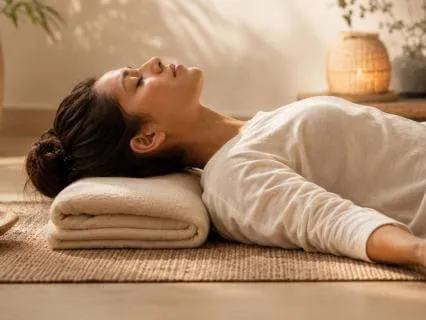
As you begin your practice lie down on your back in a comfortable position.
Place your arms by your sides with your palms facing up.
You can use a pillow for added support under your head or knees if it feels better and you can use a blanket to make you feel all cozy and warm.
Comfort is the key to staying still and focused during your session.
Then before you start set a positive intention.
This is called sankalpa in yoga nidra.
It is a short affirmative statement about a goal or quality you wish to develop.
For example I am calm and confident or I embrace peace and joy.
Repeat this intention silently to yourself at the beginning and end of the practice.
This helps align your mind with your personal goals.
And then once you're settled the practice usually begins with a body scan.
This involves focusing your attention on different parts of your body starting from your toes and moving up to your head.
This step helps you release any tension and prepares your body for deeper relaxation.
Then turn your attention to your breath.
Simply observe the natural rhythm of your breathing,
The rise and fall of your belly without trying to change it.
This helps calm your mind and deepen your state of relaxation.
And after that you will become aware of the different sensations around you.
You might notice sounds,
The texture of your clothing or any sensations in your body.
This sensory awareness grounds you in the present moment and enhances your overall experience.
Visualization is another key part of Yoga Nidra.
You might be guided through calming images like a serene beach or a peaceful forest.
These visualizations deepen relaxation and help give rise to positive feelings helping you to access more profound levels of calm.
And at the end of the practice you will reaffirm your intention,
Your sankalpa.
Repeat your intention again to reinforce your positive goals and aspirations.
This repetition strengthens your intention and integrates it into your practice.
And then at the end gradually begin your awareness back to the present.
Start gently wiggling your fingers and toes.
You can stretch your arms and legs and move your head from side to side.
And then slowly open your eyes.
This helps you transition smoothly from deep relaxation back to your daily activities.
And then finally spend a few moments in stillness before getting up.
Reflect on your experience and enjoy the calm you have achieved.
This final step helps you carry the sense of relaxation and peace into the rest of your day.
To get the most out of Yoga Nidra try to practice it often.
Whether it's daily or a few times a week,
Consistency will deepen your relaxation and enhance your well-being.
Be patient with yourself and keep an open mind.
It's normal to find it challenging at first,
But with time you will experience the full benefits of Yoga Nidra.
Using guided sessions can also be very helpful,
Especially if you're new to Yoga Nidra.
These recordings provide structure and support,
Making it easier to stay focused and relaxed.
So now let's talk a little bit about Sankalpa.
Sankalpa is a Sanskrit term meaning resolve or intention.
It is a fundamental part of Yoga Nidra.
Essentially it's a positive affirmation or goal that you set for yourself before beginning your practice.
Think of Sankalpa as your personal guide throughout Yoga Nidra,
Steering you towards a specific positive change or goal.
To set your Sankalpa,
Start by crafting a positive statement that reflects what you want to achieve.
It should be something meaningful to you and stated in the present tense.
For instance you might choose an intention like I am confident and relaxed or I am at peace with myself.
By phrasing your Sankalpa as if it's already true,
You create a strong mental and emotional connection that helps your subconscious align with this positive goal.
During your Yoga Nidra session your Sankalpa will be gently reinforced.
As you relax deeply you become more open to these positive suggestions.
The deep state of relaxation in Yoga Nidra makes it easier for your mind to absorb and integrate your intention,
Making it a powerful tool for personal transformation.
And at the end of your practice you will reaffirm your Sankalpa,
Repeated silently with a sense of belief and commitment.
This final repetition strengthens the intention,
Embedding it more deeply into your subconscious mind and enhancing its effectiveness.
So when crafting an effective Sankalpa,
Keep a few key points in your mind.
First frame it positively,
Focusing on what you want to achieve rather than what you want to avoid.
For example,
Say I am calm instead of I am not stressed,
Because positive statements are more motivating and more effective.
Then use the present tense always.
Phrase your Sankalpa as if it's already happening.
I am confident and happy.
Don't say I will be confident and happy,
Because this helps your mind fully believe and internalize the intention.
Then make sure to keep your Sankalpa simple and specific.
Choose a clear and focused statement that resonates with you personally.
For instance,
I am focused on my goals.
It's more effective than a vague statement like I am successful.
Simple and specific intentions are easier for your mind to focus on and to achieve.
So here are a few examples of Sankalpa you might want to use.
For stress relief you could say I am calm and relaxed in all situations.
For boosting self-confidence you can try I am confident and capable.
And for health and wellness you may choose I am healthy and full of energy.
Each of these intentions targets a different area of personal growth and well-being.
And to make the most of your Sankalpa,
Try to integrate it into your daily life.
Start your Yoga Nidra practice with your Sankalpa and remind yourself of it throughout the day.
This reinforcement throughout the day will help make your intention a natural part of your mindset and behavior.
Also in regular intervals make sure to reflect on your Sankalpa to ensure it still aligns with your evolving goals.
It's always okay to adjust your intention as your needs change over time.
This keeps your Sankalpa relevant to you and effective as you continue your personal growth journey.
Additionally consider combining your Sankalpa with other practices like journaling or goal-setting.
This approach can enhance the impact of your intention and support your overall development.
So to sum up Sankalpa is a powerful affirmation or goal that you set before Yoga Nidra and it's designed to focus your mind on positive change.
By keeping it positive,
Specific and phrased in the present tense you can create a strong foundation for personal transformation.
Reaffirming it during and after your practice turns Yoga Nidra into a focused journey towards your goals making the benefits even more profound.
Yoga Nidra often raises a few questions so let's address some of the most common ones.
The first question is what if you fall asleep during Yoga Nidra?
Well that's perfectly okay.
In fact falling asleep can be quite common especially if you're feeling tired.
Yoga Nidra is meant to be deeply relaxing and sometimes your body just takes this opportunity to rest.
Even if you do fall asleep you're still benefiting from the practices and restorative effects.
If staying awake is important to you try practicing when you're more rested and consider a shorter session.
The next question I often get is how often should you practice Yoga Nidra?
For the best results always aim for a regular practice.
This could be daily or even several times a week depending on what fits your schedule and needs because regular practice helps you experience the full benefits of Yoga Nidra like reduced stress and improved relaxation.
Start with shorter sessions such as 10 to 15 minutes and then increase them over time as you get more comfortable with practice.
You might also wonder if Yoga Nidra can help with specific issues like anxiety or insomnia.
For anxiety Yoga Nidra can be particularly effective.
The deep relaxation it offers helps calm the mind and reduce stress which can help to alleviate anxiety symptoms over time.
Also if you're dealing with insomnia practicing Yoga Nidra before bed can be really beneficial because it helps promote natural relaxation and prepares your body for sleep making it easier to fall asleep and stay asleep.
If you have any physical limitations or injuries you may be concerned about practicing Yoga Nidra but the good news is that Yoga Nidra is really adaptable.
You can modify your practice by choosing a more comfortable position.
If you don't like lying down in your back you can try sitting in a chair or lying in a way that suits your own needs.
Another question is how do I know if I'm doing Yoga Nidra correctly?
Well during practice you should feel deeply relaxed and calm.
You might experience a dreamlike state but with full awareness.
It's totally normal for your mind to wander.
Just try to gently bring your focus back to the practice.
If you're feeling relaxed you are likely practicing effectively.
And just remember practice is key and it may take a few sessions to fully understand and benefit from Yoga Nidra.
So in summary Yoga Nidra is a flexible and adaptable practice.
Whether you're addressing sleep issues,
Managing stress or looking to enhance your overall well-being it can be a really valuable tool in your wellness toolkit.
So as we wrap up today's Yoga Nidra class remember that it's a journey towards deeper relaxation and self-awareness.
It's a practice that when embraced with patience and consistency can really enhance your overall well-being.
And as you continue your Yoga Nidra practice keep in mind the importance of creating a comfortable space,
Setting a positive intention and approaching the practice with an open mind.
So thank you for joining today's class.
I hope it inspired you to try out Yoga Nidra for yourself and I hope that you will find out for yourself that this practice will bring you wellness,
Relaxation and a huge benefit to your life and your spiritual journey.