Ah,
Hello.
Welcome.
Make yourself comfortable.
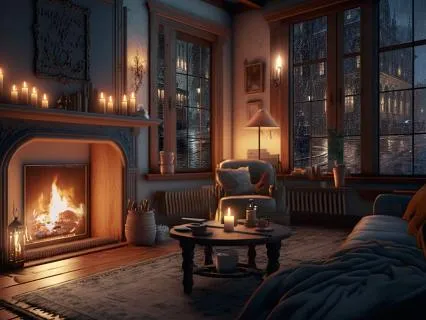
I'm just about to get the fire going.
We have a beautiful,
Rustic brick fireplace,
And plenty of logs to keep us warm through the night.
Hmm.
Oh,
It didn't light properly.
Okay,
Hang on a moment.
I'll give that another go.
I think that's starting to catch light.
Mm-hmm.
Ah,
There we are.
Right.
Let's settle in for a bit of bedtime poetry by the fire.
Tonight,
I'm going to be reading some poems from The Prophet,
A book by Khalil Gibran.
He was born in what is now northern Lebanon,
But was then Ottoman Syria,
And he moved to the United States as a young boy,
Where he developed into an artist,
A writer,
Mystic,
And an imperfect human being.
What I particularly appreciate about this book is that it was originally written in English,
Which means it doesn't suffer from the sometimes problematic reinterpretation and cultural adaptation which can come with some translated works,
Particularly those that try to reproduce Persian poetry for our Western ears,
When it has its origins deeply rooted in Islamic tradition and Sufi mysticism.
Khalil manages to produce something that feels easily relatable,
Retaining a mystical lyricism,
While combining with philosophy and a good dose of romanticism.
The book itself is made up of 26 poetic sermons,
Spoken by a wise man,
A Mustafa,
As he waits to set sail for his homeland,
Having spent the last dozen years in exile.
Each sermon is a response to a crowd of people that have gathered to beg him not to leave.
A range of questions are asked of him on many of the great themes of human life.
I've chosen to read a few of my favourite poems from the book.
Ah,
The fire's going nicely now.
It's almost as if those flickering flames slide out from behind the smouldering logs.
Emerging white-hot,
Before painting the air with shades of yellow and orange,
Dancing to the pop,
Sizzle and crackle of the glowing embers.
Hmm.
Okay,
Let's start with the first poem.
Then said Almitra,
Speak to us of love.
And he raised his head and looked upon the people,
And there fell a stillness upon them.
And with a great voice he said,
When love beckons to you,
Follow him,
Though his ways are hard and steep.
And when his wings enfold you,
Yield to him,
Though the sword hidden among his pinions may wound you.
And when he speaks to you,
Believe in him,
Though his voice may shatter your dreams,
As the north wind lays waste the garden.
For even as love crowns you,
So shall he crucify you.
Even as he is for your growth,
So is he for your pruning.
Even as he ascends to your height and caresses your tenderest branches that quiver in the sun,
So shall he descend to your roots and shake them in their clinging to the earth.
Like sheaves of corn he gathers you unto himself,
He threshes you to make you naked,
He sifts you free from your husks,
He grinds you to whiteness,
He kneads you until you are pliant,
And then he assigns you to his sacred fire,
That you may become sacred bread for God's sacred feast.
All these things shall love do unto you,
That you may know the secrets of your heart,
And in that knowledge become a fragment of life's heart.
But if in your fear you would seek only love's peace and love's pleasure,
Then it is better for you that you cover your nakedness and pass out of love's threshing floor into the seasonless world where you shall laugh,
But not all of your laughter and weep,
But not all of your tears.
Love gives naught but itself,
And takes naught but from itself.
Love possesses not,
Nor would it be possessed,
For love is sufficient unto love.
When you love,
You should not say,
God is in my heart,
But rather,
I am in the heart of God.
And think not you can direct the course of love,
For love,
If it finds you worthy,
Directs your course.
Love has no other desire but to fulfil itself.
But if you love,
And must needs have desires,
Let these be your desires,
To melt and be like a running brook that sings its melody to the night,
To know the pain of too much tenderness,
To be wounded by your own understanding of love,
And to bleed willingly and joyfully,
To wake at dawn with a winged heart,
And give thanks for another day of loving,
To rest at the noon hour,
And meditate love's ecstasy,
To return home at even tide with gratitude,
And then to sleep with a prayer for the beloved in your heart,
And a song of praise upon your lips.
Then Elmitra spoke again,
And said,
And what of marriage,
Master?
And he answered,
Saying,
You were born together,
And together you shall be for evermore.
You shall be together when the white wings of death scatter your days.
Ay,
You shall be together even in the silent memory of God.
But let there be spaces in your togetherness,
And let the winds of the heavens dance between you.
Love one another,
But make not a bond of love.
Let it rather be a moving sea between the shores of your souls.
Fill each other's cup,
But drink not from one cup.
Give one another of your bread,
But eat not from the same loaf.
Sing and dance together and be joyous,
But let each one of you be alone,
Even as the strings of a lute are alone,
Though they quiver with the same music.
Give your hearts,
But not into each other's keeping,
For only the hand of life can contain your hearts.
And stand together,
Yet not too near together,
For the pillars of the temple stand apart,
And the oak tree and the cypress grow not in each other's shadow.
And a woman who held a babe against her bosom said,
Speak to us of children.
And he said,
Your children are not your children,
They are the sons and daughters of life's longing for itself.
They come through you,
But not from you,
And though they are with you,
Yet they belong not to you.
You may give them your love,
But not your thoughts,
For they have their own thoughts.
You may house their bodies,
But not their souls,
For their souls dwell in the house of tomorrow,
Which you cannot visit,
Not even in your dreams.
You may strive to be like them,
But seek not to make them like you,
For life goes not backward,
Nor tarries with yesterday.
You are the bows from which your children as living arrows are sent forth.
The archer sees the mark upon the path of the infinite,
And he bends you with his might,
That his arrows may go swift and far.
Let your bending in the archer's hand be for gladness,
For even as he loves the arrow that flies,
So he loves also the bow that is stable.
Then said a rich man,
Speak to us of giving.
And he answered,
You give but little when you give of your possessions.
It is when you give of yourself that you truly give.
For what are your possessions but things you keep and guard,
For fear you may need them tomorrow?
And tomorrow,
What shall tomorrow bring to the overprudent dog,
Burying in bones in the trackless sand,
As he follows the pilgrims to the holy city?
And what is fear of need,
But need itself?
It is not dread of thirst when your well is full,
The thirst that is unquenchable.
There are those who give little of the much which they have,
And they give it for recognition,
And their hidden desire makes their gifts unwholesome.
And there are those who have little and give it all.
These are the believers in life,
And the bounty of life,
And their coffer is never empty.
There are those who give with joy,
And that joy is their reward.
And there are those who give with pain,
And that pain is their baptism.
And there are those who give and know,
Not pain in giving,
Nor do they seek joy,
Nor give with mindfulness of virtue.
They give as in yonder valley the myrtle breathes its fragrance into space,
Through the hands of such as these God speaks,
And from behind the eyes he smiles upon the earth.
It is well to give when asked,
But it is better to give unasked through understanding,
And to the open-handed the search for one who shall receive is joy greater than giving.
And is there aught you would withhold?
All you have shall someday be given.
Therefore give now,
That the season of giving may be yours,
And not your inheritor's.
You often say,
I would give,
But only to the deserving.
The trees in your orchards say not so,
Nor the flocks in your pasture.
They give that they may live,
For to withhold is to perish.
Surely he who is worthy to receive his days and nights is worthy of all else from you,
And he who has deserved to drink from the ocean of life deserves to fill his cup from your little stream.
And what desert greater shall there be than that that lies in the courage and the confidence,
Nay the charity of receiving?
And who are you that men should rend their bosom and unveil their pride,
That you may see their worth naked and their pride unabashed?
See first that you yourself deserve to be a giver and an instrument of giving,
For in truth it is life that gives unto life,
While you who deem yourself a giver are but a witness.
And you receivers,
And you are all receivers,
Assume no weight of gratitude unless you lay a yoke upon yourself and upon him who gives.
Rather rise together with the giver on his gifts as on wings,
For to be over-mindful of your debt is to doubt his generosity who has the free-hearted earth for a mother and God for father.
Hmm,
The fire needs a little prod and poke.
I'll just be a moment.
Okay,
Perhaps I'll shuffle some embers around.
Another log on top of the charred ones.
There we are.
Hmm,
How cozy it is to be swaddled by this dreamy light.
Even the darkness feels softened,
As shadows leaping from the golden glow to dance and play on the walls around us.
So where were we?
Oh,
Then a woman said,
Speak to us of joy and sorrow.
And he answered,
Your joy is your sorrow unmasked,
And the cell saying well from which your laughter rises was oftentimes filled with your tears.
And how else can it be?
The deeper that sorrow carves into your being,
The more joy you can contain.
It's not the cup that holds your wine,
The very cup that was burned in the potter's oven,
And it's not the lute that soothes your spirit,
The very wood that was hollowed with knives.
When you are joyous,
Look deep into your heart,
And you shall find it is only that which has given you sorrow that is giving you joy.
When you are sorrowful,
Look again in your heart,
And you shall see that in truth,
You are weeping for that which has been your delight.
Some of you say joy is greater than sorrow,
And others say nay,
Sorrow is the greater.
But I say unto you,
They are inseparable.
Together they come,
And when one sits alone with you at your board,
Remember that the other is asleep upon your bed.
Verily you are suspended like scales between your sorrow and your joy.
Only when you are empty are you at standstill and balanced.
And when the treasure-keeper lists you to weigh his gold and his silver,
In these must your joy or your sorrow rise or fall.
And an orator said,
Speak to us of freedom.
And he answered,
At the city gates and by your fireside,
I have seen you prostrate yourself and worship your own freedom.
Even as slaves humble themselves before a tyrant and praise him though he slays them,
I,
In the grove of the temple and in the shadow of the citadel,
I have seen the freest among you wear their freedom as a yoke and a handcuff.
And my heart bled within me,
For you can only be free when even the desire of seeking freedom becomes a harness to you,
And when you cease to speak of freedom as a goal and a fulfillment.
You shall be free indeed when your days are not without a care,
Nor your nights without a want and a grief,
But rather when these things girdle your life,
And yet you rise above them naked and unbound.
And how shall you rise beyond your days and nights unless you break the chains which you,
At the dawn of your understanding,
Have fastened around your noon hour?
In truth,
That which you call freedom is the strongest of these chains,
Though it links glitter in the sun and dazzle your eyes.
And what is it but fragments of your own self you would discard that you may become free?
If it is an unjust law you would abolish,
That law was written with your own hand upon your own forehead.
You cannot erase it by burning your law books,
Nor by washing the foreheads of your judges,
Though you pour the sea upon them.
And if it is a despot you would dethrone,
See first that his throne erected within you is destroyed.
For how can a tyrant rule the free and the proud,
But for a tyranny in their own freedom and a shame in their own pride?
And if it is care you would cast off,
That care has been chosen by you rather than imposed upon you.
And if it is fear you would dispel,
The seat of that fear is in your heart and not in the hand of the feared.
Verily all things move within your being in constant half-embrace,
The desired and the dreaded,
The repugnant and the cherished,
The pursued and that which you would escape.
These things move within you as lights and shadows in pairs that cling.
And when the shadow fades and is no more,
The light that lingers becomes a shadow to another light.
And thus your freedom,
When it loses its fetters,
Becomes itself the fetter of a greater freedom.
And the priestess spoke again and said,
Speak to us of reason and passion.
And he answered saying,
Your soul is oftentimes a battlefield upon which your reason and your judgment wage war against your passion and your appetite.
Would that I could be the peacemaker in your soul,
That I might turn the discord and the rivalry of your elements into oneness and melody.
But how shall I,
Unless you yourselves be also the peacemakers,
Nay the lovers of all your elements?
Your reason and your passion are the rudder and the sails of your seafaring soul.
If either your sails or your rudder be broken,
You can but toss and drift or else be held at a standstill in midseas.
For reason,
Ruling alone,
Is a force confining.
And passion,
Unattended,
Is a flame that burns to its own destruction.
Therefore,
Let your soul exalt your reason to the height of passion,
That it may sing and let it direct your passion with reason,
That your passion may live through its own daily resurrection and,
Like the phoenix,
Rise above its own ashes.
I would have you consider your judgment and your appetite,
Even as you would two loved guests in your house.
Surely you would not honor one guest above the other,
For he who is more mindful of one loses the love and the faith of both.
Among the hills when you sit in the cool shade of the white poplars,
Sharing the peace and serenity of distant fields and meadows,
Then let your heart say in silence,
God rests in reason.
And when the storm comes and the mighty wind shakes the forest and thunder and lightning proclaim the majesty of the sky,
Then let your heart say in awe,
God moves in passion.
And since you are a breath in God's sphere and a leaf in God's forest,
You too should rest in reason and move in passion.
And a woman spoke,
Saying,
Tell us of pain.
And he said,
Your pain is the breaking of the shell that encloses your understanding,
Even as the stone of the fruit must break,
That its heart may stand in the sun.
So must you know pain.
And could you keep your heart in wonder at the daily miracles of your life,
Your pain would not seem less wondrous than your joy.
And you would accept the seasons of your heart,
Even as you have always accepted the seasons that pass over your fields.
And you would watch with serenity through the winters of your grief.
And much of your pain is self-chosen.
It is the bitter potion by which the physician within you heals your sick self.
Therefore,
Trust the physician and drink his remedy in silence and tranquility.
For his hand,
Though heavy and hard,
Is guided by the tender hand of the unseen.
And the cup he brings,
Though it burn your lips,
Has been fashioned of the clay which the potter has moistened with his own sacred tears.
And then Almitra spoke,
Saying,
We would ask now of death.
And he said,
You would know the secret of death.
But how shall you find it unless you seek it in the heart of life?
The owl whose night-bound eyes are blind unto the day cannot unveil the mystery of light.
If you would indeed behold the spirit of death,
Open your heart wide unto the body of life.
For life and death are one,
Even as the river and sea are one.
In the depth of your hopes and desires lies your silent knowledge of the beyond.
And like seeds dreaming beneath the snow,
Your heart dreams of spring.
Trust the dreams,
For in them is hidden the gate to eternity.
Your fear of death is but the trembling of the shepherd when he stands before the king,
Whose hand is to be laid upon him in honor.
Is the shepherd not joyful beneath his trembling that he shall wear the mark of the king?
Yet is he not more mindful of his trembling?
For what is it to die but to stand naked in the wind and to melt into the sun?
And what is it to cease breathing but to free the breath from its restless tides,
That it may rise and expand and seek God encumbered?
Only when you drink from the river of silence shall you indeed sing.
And when you have reached the mountaintop,
Then you shall begin to climb.
And when the earth shall claim your limbs,
Then you shall truly dance.
And that seems like a good place to pause for the night.
I love how the poems play with the human experience.
The inescapable bonds between pain and pleasure,
Joy and sorrow,
Love and loss,
Life and death.
And how we must embrace and appreciate the breadth of our experience,
The whole of our existence.
Sleep well,
My friend.
Sleep well.