Hello everyone.
So congratulations on joining in.
Congratulations for showing up and I hope that this benefits you.
Before the practice,
I want to say two things,
Two important things,
Okay.
I want to remind all of you that it's very much natural that your mind wanders,
Okay.
It's okay if your mind wanders,
It's okay if you have self-doubt or doubt about the practice while you are doing it.
Those thoughts are common,
Okay.
And it's also very okay if you feel uncomfortable in your body.
A little bit discomfort is okay.
But at the same time,
If you start feeling overwhelmed,
Okay.
Or if you have a history of trauma,
Then in that case,
Choose an anchor,
Okay.
An anchor is something that would make you feel like safe or a bit calm down,
Okay.
So if the practice start to feel like too overwhelming that you cannot just,
You know,
Practice or you want to leave.
So that kind of a feeling.
Then you can,
You know,
Bring your attention back to that anchor.
So in most cases,
The anchor is breath.
But since this is a,
You know,
Practice of breath,
Then you can choose other anchors also.
Because breath is not always the right anchor for everyone,
Especially those with like anxiety or trauma,
Okay.
Other anchors,
I'm just giving you alternatives,
Okay.
So other anchors can be becoming aware of the surface beneath you,
Okay.
So where you are sitting or lying down or standing,
Okay,
Whatever position you are in.
So the surface beneath it.
So notice it and feel that the earth is holding you,
Mother Earth is holding you,
Okay.
It can be your palm placed one over other.
So sometimes like we do this,
You know,
There are different mudras.
So wherever your hand is placed.
So if your hand is placed on your knees,
If your hand is one over other in your lap like this,
That can also be the anchor.
It can be any place in your body that feels pleasant.
So when that overwhelm come,
You can take refuge in that place for certain amount of time until you feel like a bit settled and then come back to the practice,
Okay.
The surface beneath you,
Any body part that is feeling pleasant,
Where your hands are placed.
You can even place your hands on your like,
You know,
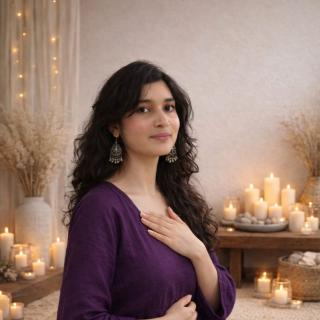
Chest and feel that warmth or even tap it if it is becoming like a bit overwhelming.
You can even,
You know,
Move a little because movement helps when we are feeling,
You know,
Difficult sensation,
Then it helps.
And these are not the methods to avoid the feeling.
But sometimes,
Especially when people have trauma or have other mental health disorders who are doing this,
Then it becomes very difficult to stay with the sensation and it can also be re-traumatizing.
So that's why it's important to have an anchor,
Okay.
And if still you are not feeling better,
You can open your eyes,
Notice your environment that you are safe right now.
No matter what memory is coming,
No matter what is coming,
It is in the past,
Right now you are safe.
So observe the objects around you,
This will help you calm down.
And if nothing helps,
Stop the practice.
Because compassion is a very main element of practice,
Okay.
So you need to be compassionate to yourself,
You cannot force yourself.