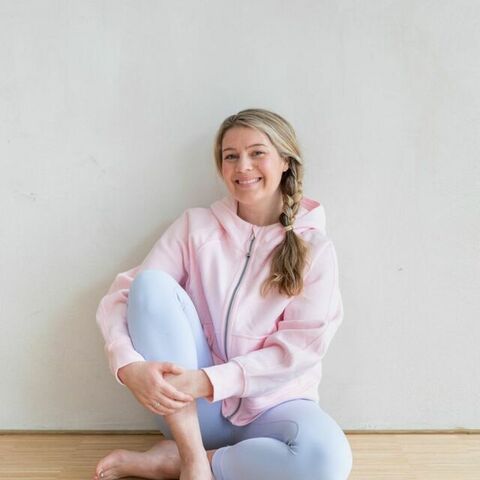
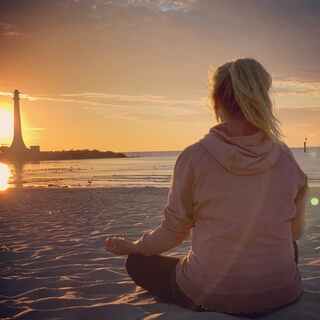
Welcome to a guided meditation designed to ease the mind and calm the body.
In week one we look at how best to approach meditation and explore three simple principles to make your time more relaxed and enjoyable.
The first principle and thing to do is to make yourself as comfortable as possible.
Let go of the idea that there's a perfect meditation posture to adopt and instead put your comfort first.
You might be cross legged on the floor on a cushion or feeling the support of a chair.
If you choose a chair ensure your feet are flat on the floor hip distance apart.
Place the hand somewhere that feels natural.
Maybe lightly resting on the knees.
Your palms can be facing up or down.
Try both and sense what feels right.
Now is the perfect moment to draw the attention inwards and close down the eyes.
If this feels uncomfortable for you a soft gaze works just as well.
Meditation is all about experimenting with what works for you.
However you're sitting it's important to keep your spine upright.
Notice as you lengthen your spine and crown up to the sky your shoulder blades naturally draw together and down your back creating length and space across your chest.
Feel heavy and grounded through your sit bones and pelvis.
Your belly is soft and relaxed.
Bring awareness to your face losing any tension from the forehead,
Around your eyes,
Cheeks,
Softening your jaw,
Relaxing your teeth.
Take a moment to notice how you feel after making these adjustments to the body.
The principle of prioritizing your physical comfort in meditation means that you're free to move,
To shuffle position,
Itch,
Cough,
Sneeze,
Yawn whenever you need to.
Be confident to honour your instincts there's no need to make yourself uncomfortable for the sake of keeping rigid and still.
Trust that your body will naturally settle into stillness when it's good and ready.
Now that you've made yourself fully comfortable start to sink deeper into the body.
Given we lead such busy lives and are often juggling multiple priorities before we come to meditate,
A relaxing way to settle in is to take three deep breaths.
On the next breath in feeling the lower belly,
Upper belly and chest expand.
On the breath out open the mouth and loudly sigh everything out.
Two more times deep belly breath in lungs expanding with fresh energy.
Long slow cleansing sigh out the mouth.
One more round taking the deepest breath in you've taken all day.
Long slow soothing sigh out the mouth.
Take a moment to absorb the afterglow of those three breaths on the body and mind.
Checking that your spine is still tall.
Gently tuck the chin towards the chest opening up the back of the neck.
The second principle we'll explore is to welcome any distractions including thoughts.
It's very normal to notice our incessant mental chatter during meditation.
Remembering,
Planning,
Rehearsing,
Imagining and predicting.
See if you can make some room for this within your experience.
The goal is not to stop thinking but to become more aware of our thoughts.
Give yourself a moment to pause and notice what's going on just beneath the surface.
You'll spend the next few minutes noticing what's going on in your mind.
Notice the types of thoughts you're having.
Whether the thoughts are about past,
Present or future.
Are your thoughts jumping around or going over the same topic?
Thoughts may be pleasant,
Neutral or even uncomfortable.
As you start to pay more conscious attention to the content of your mind,
Know that any thoughts that seem uncomfortable or strange are part of a normal healthy functioning mind.
The best way to approach this is to make room for them within our practice.
Neither pushing them away nor fueling them with energy.
Instead seeing if you can be a compassionate witness.
A common thought that people have during meditation is wondering whether they're doing it right or how they'll know when they've entered a meditative mindset.
Meditation is a natural human state so rest assured this isn't something you can get wrong.
No matter how busy your mind may feel or how distracted you are,
If you've set aside the time with the intention to meditate then this is it.
You're doing it right now.
By releasing any expectations of how a meditation is supposed to look or feel,
You'll invite more curiosity and room for your experience to unfold naturally.
Let go of the pressure to achieve anything.
Even the expectation to be relaxed can add pressure so let this go too.
For the next 60 seconds of silence welcome all thoughts giving yourself full permission to think about all of the things that you want to.
Let the mind run free.
Alright.
Let go of any conscious observation of your thoughts now and bring awareness to your breath,
Balancing the natural rise and fall of your belly as you breathe in and out.
The third principle to help you make the most of your time in meditation is bringing curiosity,
Letting go of any preconceived ideas of how meditation should feel,
Releasing all expectations.
We'll explore this by becoming curious about sensations within the body.
Draw your attention inwards and notice a general sense of how the body feels in this moment.
If you could describe how your body feels in one word,
What would that be?
Often in meditation,
We notice tightness and tension in the body.
This noticing is a good thing as it means we're cultivating a deeper level of awareness.
Try and experiment and hover your attention on any areas that feel uncomfortable.
Take some deeper breaths and observe what happens.
For the next few moments,
Continue to be curious about any sensations arising and making themselves known.
Make note of any parts of the body that feel still or relaxed and let that sensation spread throughout the whole body.
Some sensations may be deeply familiar and some may be new.
Bring awareness to subtle sensations in the face now and into the arms.
Hands.
Chest.
Belly.
Ears.
Feet.
Over the next few long slow breaths out,
Sense the edges of your body dissolving into the space around you.
Give into a sensation of softness and ease in the body and mind.
Before this meditation comes to a close,
We'll rest here for a few moments.
Give yourself full permission to relax and let go.
I'll guide you back out shortly.
Bring some deeper breaths back into the body.
Taking a moment to notice how the body and mind are feeling.
Spending the next few moments absorbing any final sensations of calm and clarity.
Gently wriggling the fingers and toes,
Bringing some energy back into the body.
Briskly rubbing the palms of the hands together to generate some heat.
Placing the palms over your eyes and feeling that warmth being absorbed into your skin.
When you're ready,
Bringing the hands down and gently opening up the eyes.
Taking a moment or two to come back into the space around you.
I hope you feel relaxed and refreshed.
This meditation is now complete.