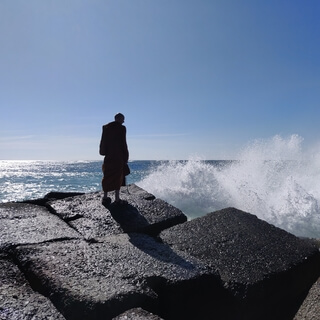
I have noticed that we had our walking meditation a little bit longer today,
Stopped a little bit earlier with the sitting because I wanted to talk about walking meditation,
Chankamati and Pali,
Walking up and down and the really important first point I want to make,
This is not a second class,
Secondary or inferior form of meditation I think many people have the wrong conception that the real meditation,
In inverted commas,
Is sitting and only for those,
Maybe you can't really sit,
Or a little bit additional,
Then you can do some walking not at all,
It's a 100% valid form of meditation and the Buddha himself used a lot of walking because he walked all over the central Ganges plain and that's one advantage,
If you develop the ability to meditate by walking,
You can use it whenever you are walking around particularly those days before cars and when they would travel by walking so the Buddha did a lot,
And if you go to Bodhgaya,
Of course,
Some asambodhi occurred sitting under the Bodhi tree but even nowadays on the northern side of the Mahabodhi temple,
Stretching from the Vatrivasana on the eastern side of the temple to the western side,
There's a long walking path it's like a big shrine now,
Ascribed to the place where the Buddha practiced walking meditation and reflected on dependent origination,
Formulating the best way as far as it's possible to express his experience and how to get there verbally in concepts by dependent origination,
The links of paticca samuppada and while walking he did that.
There's reports of monks attaining complete release,
Nibbana,
While walking we even find reports of monks attaining parinibbana,
Passing away,
Avahants passing away while walking the commenter is a famous example of a monk widely regarded as an avahant and he asked his disciples how they have seen avahants attaining parinibbana and of course they had seen them in the lying posture on the right side,
It's the most common because when people die they're often very sick or very old and lying is the most suitable but some had seen sitting,
I think one monk or something had also seen someone passing away,
Parinibbana standing but no one had seen anyone parinibbana while walking so he drew a line on his walking path and walked to one side,
Came back and passed away and when he just stepped over the line he had drawn,
So he could perfectly time,
He had the ability to see the exhaustion of his life span the moment of death approaching and then timed it perfectly so it's not inferior at all and if it works better for you than sitting then by all means you can do 90% of all your meditation time walking,
There's nothing wrong with that there's nothing inferior about that in fact certain problems are easier to be dealt with with walking a common issue is when people get into nodding or they get,
Even if they don't outright nod,
They're in a kind of very hazy,
Not clear,
Half sleepy mind state that's much more difficult to do when walking it's not impossible,
One can fall asleep walking but you've got to be really sleepy but usually it's much easier to maintain a higher level of mindfulness at least not to fall asleep while walking it is also in our society usually difficult for most people to sit cross-legged in particular full lotus,
Even half lotus that was never really the idea in traditional societies that people sit on the ground since they are young the hips in particular are usually flexible and the half lotus,
Even full lotus posture is often completely easy for them it's not meant to be a difficult posture it was meant to be a very stable and suitable posture but not difficult and people could easily do that because from a young age,
Sitting on the floor it's often not the case for us nowadays I remember when I started living in a monastery I would do stretching exercises sometimes twice a day,
Every day for years till I finally could sit half lotus,
Not full lotus I tried full lotus but I noticed that my knee joint started getting strained and doing strange things when I was walking so I better stop that there is also often a lot of restlessness,
Particularly in younger people often for men more difficult,
Both in terms of restlessness and in terms of hip flexibility hip flexibility seems to be on the average less in males so if one struggles with that,
Either this restlessness or simply physically you can't really sit very well on the floor try walking meditation,
It's great so a very important first point,
It's not inferior and if you want to do mostly walking because it works better for you in terms of being at ease,
In terms of not having pain in terms of keeping awake,
Having good mindfulness,
Go for walking in terms of what exactly to do there are two principal approaches to walking meditation,
Two different ones first approach you make the walking itself the meditation object so the feeling,
The sensation of walking for example under your feet is maybe most prominent so you can focus on the feeling under the feet although similar to breath meditation,
Anapanasati I like to recommend to have full body awareness being aware of the whole body walking you are not walking only with the feet but one has a sense,
A certain sensation,
A certain experience while walking throughout the whole body and one can focus on the whole thing if you find that difficult,
Just the sensation of the feet touching the ground and then similar again to breath meditation to make that very smooth,
Make the experience a very beautiful,
Very pleasant walk in a pace which is very natural for you,
Which you find enjoyable and just stay with the sensation of walking the other principal approach is that walking is simply the posture and you use any of the other meditation objects which you may be using when sitting like buddho,
Buddho,
Buddho it can be done very well while walking that one can even be combined if you have a mantra like buddho,
You could even combine it with a stepping but you can use metta,
You can use anapanasati even the breath meditation while walking just like when you are sitting meditation,
Your meditation is the breath or buddho or metta or the 32 parts of the body or the elements but your meditation object is not the sensation of sitting so the same with walking when you are sitting meditation,
You focus on the breath and the body is quite capable of maintaining the posture while you focus on a different meditation object it's a little bit more difficult with walking but again the mind can handle that the walking is sufficiently automatic,
Needs only a small amount of our attention and most of our attention is whichever meditation object you want to pursue and this way the meditation,
Walking meditation becomes simply a change of posture and if you feel restless or again if you find it difficult to sit long time it's not a big problem if you can stretch it ideally to half an hour and then you just change and then you sit again when you get tired from walking you may be quite happy that you can sit again after 3 hours walking meditation so these are the two principle approaches either you use the sensation,
The experience of walking as your meditation object or walking is simply the posture and you focus on any of the other meditation objects while walking another very important point there are some forms or some particular method or techniques being taught where one walks ultra slow,
Like super slow motion in television or movie just like really like one step taking 15 seconds or something this is not how it is usually taught in our tradition or in the Thay Forest tradition and I recommend you to walk natural,
Walk naturally I'm often amazed now how people can tie themselves into a knot the moment they start meditating,
In inverted commas it's the same with breath meditation,
People breathe all their life we can't be alive without breathing so everyone who is around here is able to breathe and it happens now all the time the moment you ask them to watch their breath it becomes some big thing and then they feel that they can't notice the breath or is there any breath and they become worked up and nervous same with walking,
People are usually,
Most people it can be people with disabilities or sick or very elderly but most people can walk quite fine,
It's an easy thing to do for most but then you ask them to do walking meditation and they are doing something very unnatural and weird and stressful and tense you can see that even just looking at them so there is nothing weird or stressful or tense about walking meditation it's just like walking normally it doesn't have to look different from when you are going on a walk in the park or when you are walking back from shopping or something maybe not quite so high speed because we are often under time pressure but no need for time pressure in walking meditation if you just walk up and down and up and down there is no point in pushing for getting anywhere anyhow but otherwise just like walking normally just like breath meditation,
Just breathe normally and the exercise if you use the walking itself as the object is simply to be aware,
To feel,
To experience the sensation of walking or if you use another meditation object just to be aware of that and to walk completely normal in fact if you are tired or you feel hazy or sleepy you can even walk faster than normal,
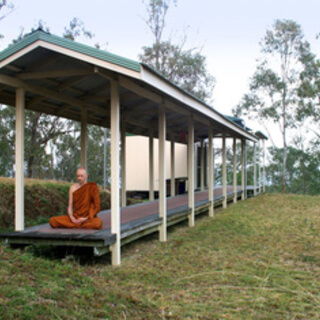
There is nothing wrong about that normally we walk up and down this is why we often have walking meditation paths like we have at Dhamma Giri this is a little bit more modern development to have a special wooden walking meditation path but I have to say once one gets used to that it's very difficult to let go it's just so nice because it's clean,
Very easy to clean,
Sweep feet don't get particularly dirty,
You can easily return to sitting and it's a little bit springy if it's built well so you don't damage the joints even if you walk a lot and even if you walk barefoot walking say on concrete or on very hard surfaces even the normal earth once it has been trampled and it's hard it can go into the joints if one does it a lot the ideal walking path is something like 20 to 25 paces so the ideal length depends on your body height and the length of your legs and your pace so 20 to 25 paces is considered ideal once you go beyond 30 paces the turnarounds become too rare to really get into a groove if you walk up and down after some time you really get into this rhythm and the turnaround becomes kind of naturally integrated it just flows but if you have too long distance,
35 paces and whatever then it becomes a little bit disruptive you can't really get into this groove anymore similar once you go under 20 and under 15 it gets too frequently that one has to turn around the stepping time is a little bit too short so let's say minimum 12 is usually good of course I'm aware that there can be situations where it's difficult I sometimes even walk a little bit in my kuti which diagonally may give me 6-7 paces if I make small paces which is too short but maybe still easier than going out in a heavy thunderstorm and it's really heavily raining or if it's really ice cold and windy in winter just as a short break from sitting but usually 20 to 25 paces is the best and if you can manage east-west direction so this year is actually pretty good the east is roughly there it doesn't have to be 100% east-west Ajahn Man considered about 45 degrees around east and west still acceptable so roughly east-west and fascinatingly the traditional walking path of the Buddha at Bodh Gaya is also exactly east-west and according to Long Ther Mahabhura Ajahn Man was very strict that monks should make a big effort to arrange walking path with this rough east-west orientation which is almost a little bit counter-intuitive because you look directly into the morning and evening sun the morning and evening sun can be a bit blinding so nevertheless if the Buddha walked like that and Ajahn Man was insistent that the monks should be doing it there must be a very good reason Ajahn Man said that there was actually a very good reason but unfortunately he couldn't remember it and asked Ajahn Man he couldn't remember it and although monks usually should be frugal the Buddha nevertheless in our vinaya in the discipline for the monks and nuns has actually words and prescriptions and instruction how to build walking meditation path and even a raised walking meditation path is quite allowable and possible and even a covered walking meditation path so that you have a roof already in the Buddha's time they had that and there is even the term of a Chankamasala a walking meditation hall so already in the Buddha's time apart from the eating hall,
Meditation hall they actually sometimes had even walking meditation halls just as another piece of evidence that's a fully valid meditation if walking meditation was only something unimportant secondary the Buddha wouldn't have made the effort to give all these instructions and to encourage the monks to even erect a walking meditation hall the Buddha also pointed out five special advantages in walking meditation Adhana Kamo someone who does a lot of walking meditation can endure walking long distances was important in ancient India because all travel was usually on foot particularly for monks and nuns and if one is used to doing walking meditation one is very trained and can walk long distances nowadays some people may feel not so important,
I can go everywhere in the car or even in these little kind of buggies which people are used to shop in Walmart and so on,
That you don't even have to walk when shopping mobility scooters and things like that unfortunately we live in a time where some people find one kilometer already a challenge walking one kilometer becomes a big challenge so it's great if we do walking meditation that we will be able to walk quite some distance Padana Kamo one is enduring for putting forth effort for striving,
For working hard in one's practice because to walk a lot does take effort and it helps to develop that attitude of putting forth effort it helps to develop that important quality in a Samma Vajnama,
In a striving meditation going against the stream of craving going against the grain of the defilements,
The kilesas that's mentally the most difficult thing you can do in the whole universe nothing more difficult than going against the natural defiled tendencies of the mind,
The desire,
Aversion laziness,
Conceit and so on to try to constantly counter that in one's Pavana it's really toughness,
So the quality of wide effort of determination,
Of persistent determined striving can be supported by a practice of walking that is counted as laziness lazy people are not known to walk a lot,
Isn't it?
Couch potatoes,
This is what we don't want to be we don't want to be couch potatoes and if you do lots of walking meditation you become used to maintaining the effort,
Mindfulness of your inner self Abbha Bhādur Hoti you will have few sickness nowadays we would say you would be very healthy but the Buddha acknowledges no one is healthy as long as you are walking around in this body dragging around 5 liters of blood and all the other,
Don't even have to mention all the other stuff which we carry in our body which normally in the toilet we consider as flush it away immediately but we carry it around with us all the time this is why the Buddha uses the expression few sicknesses,
Only a little bit sick but nowadays we would usually express it as it's good for health we all know exercise is good for health and it's a big problem in modern society sedentary professions sitting in front of computers sitting in front of gadgets and so on,
And people don't have enough exercise and it doesn't have to be marathon running or 100 meter sprints or pushing 200 kilos walking is just an excellent exercise particularly once one is no longer that young it's great,
It's much less straining than jogging and running it trains the whole body and it's a great boon for our health so people complain they don't have enough time this is what they call synergies so you cover your exercise and your health your efforts in maintaining health and your meditation,
All in one go that's what's called synergies and once you do that more you will really appreciate that all your efforts in exercising and all your efforts in meditation can be done at the same time on top of that you have good health which means you can do even more meditation and exercise because a healthy body finds it easier to put forth effort and meditate the next one is that the food which is consumed is properly digested we all know when we are cooking you have to stir it will not really work to cook if you don't stir the food and it's similar for your internal cooking,
Internal digestion the worst is having a really big heavy meal late in the evening and then lying down and sleeping the Buddha is quite close there in the two even what we still have nowadays in Ayurvedic Indian traditional medicine they say that the external fire element obviously is strongest at noon and is weakest at midnight and like in many things what's in meditation externally and internally are connected and in particular if you have a reasonably natural biorhythm sometimes people don't have that anymore because with the artificial lighting and then the artificial screen the natural biorhythm may be disrupted but if one establishes a natural biorhythm which is the most healthy one it will sync with the normal solar system or solar cycle and it means that your digestive power is strongest at noon another reason why the Buddha gave the words for monks and nuns and eight preceptors that one can eat only between dawn and noon because it means you will have your digestion and the digestive fire,
The digestive energy in the body is the strongest and very healthy and if additionally you support that by walking so that the whole food is nicely shaken through like a milkshake we digest much better the movement,
The blood flow,
Blood circulation so in particular after eating walking meditation is really good you may have noticed if you try to sit particularly on eight precepts usually you eat a bit more if you don't eat in the evening you eat a bit more at noon can be quite difficult for a few hours afterwards to keep awake and walking is great and it's very good to avoid eating at night time or if one eats on five precepts eat as early as possible the evening meal and as light as possible and rather have a good breakfast and the main meal around noon as early as possible because often nowadays people perceive two o'clock to be noon but twelve is noon ideally before noon in the Ayurvedic system a lot of sicknesses according to that description is caused by not completely digested food even in western medicine we have atherosclerosis there is this stuff which is slowly blocking up your blood vessels,
Arteries and people get heart attacks and so on that would be one example where even in western medicine it's kind of known that there is stuff floating around according to Ayurveda that is often food that hasn't been perfectly digested so these two things are conjoined the third and the fourth benefit properly digesting food and the good health both are connected and finally any samadhi that has been developed while walking tends to last a long time you may have noticed if you sit and your mind becomes very peaceful very calm,
Very refined once you get up one can easily lose that quite a bit even more so if you not only get up but if you have to in a phase,
Maybe your normal day you meditate in the morning and then out into traffic,
Into the office,
Into the emails and so on the meetings,
The deadlines can be quite difficult to transfer that very refined mind state samatha mind state from sitting into the busy activities of the day with walking meditation that is a bit easier because you are already used to develop samadhi samatha and you still have to maintain the body walking and looking around a little bit I forgot to mention,
Usually when we walk up and down in walking meditation the idea is to have the gaze a little bit downcast maybe 2-3 meters in front of us not widely looking around just a few meters in front of us but obviously one has to keep the eyes open as you may bump into the wall at the end or on walking path at R.
Kuti you may have a little bit of fall there so it's important to still look and check you have to do your little turns at the end but because of that activity if you can still build up samadhi it's also easier to transfer that samadhi in whatever other activities you do after your formal walking meditation maybe 5 o'clock,
So a few words to hopefully encourage everyone to use walking meditation a lot it can be very enjoyable,
You may feel like walking on clouds and cotton down,
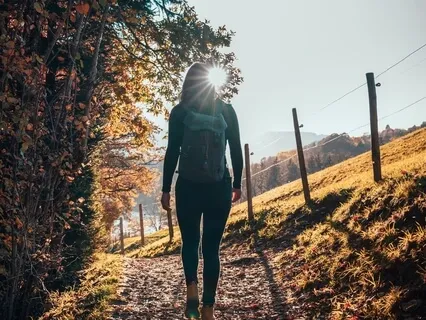
People get that experience it's so beautiful not to walk to get anywhere that's the advantage of our circumambulation or from walking up and down,
To and fro,
To and fro you don't really get anywhere anyhow,
Especially actually one yogi once when she was doing first time walking meditation she later reported how much joy and contentment she had because she was only used that she had to walk to get from A to B and then always having this performance attitude and time pressure and you only walk to get there and once you're there then you have to do the next thing and get there that's a big problem anyhow,
We're always washing ahead mentally but if you're walking,
Circumambulating,
You're not getting anywhere anyhow if you walk to and fro,
To and fro,
You're not getting anywhere so there's no point washing or trying to get anywhere you can just tune in and being in the present moment,
Just walking just walking without walking to a certain point or having to get anywhere it can be a great attitude for more successful meditation yes,
Yes Do you think that 20-25 paces in your walking is more ideal than circumambulating?
Circumambulating,
Yes that is a traditional one usually we walk to and fro,
This is how walking path is usually built in a monastery so better depends on what you like better,
What works better for you but definitely that is how walking path is built in a monastery,
Basically everywhere 20-25 paces is not ideal,
Often it's maybe more towards 20 paces because it's obviously more difficult to build longer and usually I've never seen a circular walking meditation path but there's a practice of walking around stupas circumambulating is usually around stupas your question brings me to one point I wanted to mention often walking meditation is neglected because it's technically more difficult to organize even now I'm talking about walking meditation while sitting I would have liked to give an example and do that all while we're walking technically we have microphones with cords and even if I had the cordless ones it's a bit still difficult to have the reception while you're walking and it's a bit more difficult if you have say 20 people here and to find suitable places where they can walk 20-25 paces to and fro so the circumambulation here is coming more from practical reasons there's a disadvantage that we basically all have to walk in the same pace,
Same speed if we all have our own path to and fro and if we can find our own most suitable rhythm but in a group setting it's much easier not to teach while sitting and the others are sitting it's much easier to teach guided meditation where everyone is sitting and then the wrong impression is created this is a real meditation and walking is only whatever,
Something in the third grade it's difficult for technical reasons to counter that so thanks for that question,
The most common one is obviously two and four but I find it a bit difficult to organize and then also you kind of disperse the energy and we're building up this kind of group energy and in this place and then we're all dispersed walking here and there and you lose it a little bit it's a short circumambulation that maintains it and it's also still traditionally and then you also make good karma by doing an act of paddakinam to the Buddha because if you're actually circumambulating all Buddhas that you.
.
.
And this is the reason why the monks have the white shoulder,
Huin,
As a sign of respect so you're circumambulating by having the object of renovation on your right side another synergy,
So you practice walking meditation and you get the good karma similar to bowing to the Buddha do you do much walking meditation?
I've started doing more recently since when you were away,
Ajahn Buneo yeah I've started to do it especially after the New Year's or Space Eve and it's been very very good I asked about the inner circle,
Because in my apartment,
Circular seems to be the best but I've figured out because I think I've tried doing some outside walks near me that it's quite populated around me and I find that at this stage it's harder to not be self-conscious anyone can walk in a park or anywhere once your walking meditation is quite well established but it's obviously more difficult because there are many more sense impressions in particular if quite a few people are around it makes it much more difficult on the other hand it's not easy in many homes even in Australia where we already have more space still it's not easy to find a 20 to 25 meter suitable path and if you only have a bed set or a little apartment it's not so easy to find that and if you find some suitable place to circumambulate it's great I was quite intrigued being in Nong Hwa Monastery of the 6th Patriarch and in the Zen retreat style,
Chan retreat style,
They do walking meditation circumambulating inside the hall and they have the Buddha statue in the center and then they're circumambulating around the Buddha statue but I was fascinated that they walk maximum speed and I'm already a fast walker and it was very difficult even for me in particular our robes are not designed,
Our robes are not very ideal for maximum speed walking but they have these Chinese style robes which is these long sleeved arms,
You know these long sleeved arms they have?
And they also deliberately teach you to throw the arms as much as possible so with these long sleeved arms they're really throwing them while they're walking very fast I was walking,
When you walk so close,
Circumambulating the Buddha at maximum speed,
I actually got dizzy I literally got dizzy because it was a very small circle and then I had the brilliant idea,
Usually they would start the walking meditation gradually there's a little break and then they restart meditating where people one after the other coming in,
There's no clearly defined starting time there's this 15-20 minutes super fast walking and some coming a bit later so I came in very early and now being very smart I decided to walk at the very outer perimeter of the hall next to the benches where they're sitting because then you have got a very big circle so to speak and it worked much better,
I didn't get dizzy and I was walking along and happily throwing my arms at super high speed and trying not to lose my robe and being quite occupied with that,
I didn't notice there were many more people coming in and finally one of the guiding Chan masters came and backed me with a bamboo stick so I really got the Zen bamboo stick backing and he shooed me off to the central area and when he did that it actually didn't hurt me,
He didn't really hit me but I realized what was the problem,
It was actually a privilege to be able to walk so close to the Buddha and only the monks can do the inner circle and then the next I think was the nuns,
A little bit larger,
And then the next is the male lay people and the biggest circle is the female lay people which also worked out very neatly in terms of numbers because the biggest numbers were female lay practitioners and they had the biggest circle but I ended up walking with the girls,
This is why I got backed and shooed back and shooed back into the center so sometimes a privilege is not really a privilege I was close to the Buddha when walking but the result is that I got dizzy I didn't fully get you,
You better stay away from the river so you don't fall in there,
I would agree on that but if you can walk on the river that would be really impressive and your walking meditation is taking really off if you're doing walking meditation you notice now I'm walking on the river and it works really well this is a sign of a deep samadhi Normally I walk about a few kilometers and then I return,
So it's maybe too long Again the most important,
The same with the north-south and whether you have your hands in the perfect posture or whether you have exactly the 20 paces,
The most important thing is doing your walking meditation and now if someone tells you you should be walking shorter then you may feel a lack of motivation and then you may try that and you may not feel so happy with it and then you end up not walking so the most important thing is to do it and even if you're not walking to and fro,
More like a normal walk through the park but you find it very enjoyable and you do it every day and it's good for your health and you can maintain good mindfulness and that's already very good and I wouldn't worry too much don't worry too much about the perfection there of the direction and the paces and so on,
The most important thing is doing your walking meditation The most important thing is doing your walking meditation