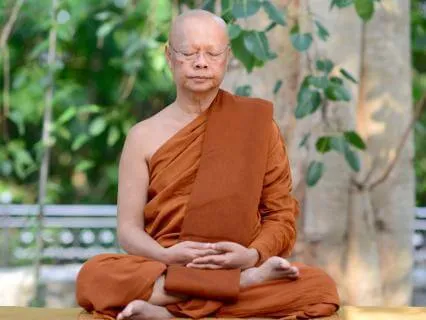
The mind is the knowing element,
The element that perceives objects of the mind.
The mind isn't anything in itself.
It's just the element that perceives the mind objects.
Once it perceives an object,
Ignorance arises and fabricates the mind.
That fabrication is called cetasika.
It fabricates the mind.
But because we lack knowledge,
We misunderstand and take those fabrications to be ourselves.
Distorted by ignorance,
Filled with greed,
Anger or delusion.
So we must cultivate mindfulness and recollect,
What state is my mind in right now?
The mind is being conditioned by this mental object.
Delusion is fabricating it and the mind is being deceived.
That's how it is.
The mind is becoming defiled.
So we teach the mind,
This isn't certain.
It's impermanent.
Don't cling to it.
Don't hold on.
Don't take it seriously.
What's there to crave?
What's there to hate?
What's there to be deluded about?
When we see others consumed by greed,
Anger,
Or delusion,
We reflect.
Why such chaos?
Chasing after greed,
Anger,
And delusion like that is no good.
Wouldn't it be better to let go?
When we realize this ourselves,
Our mind can be peaceful.
And when our mind is peaceful,
We also know,
Ah,
My mind is calm now.
Through contemplation.
Which method is it brought to peace by?
By the method of contemplation.
We recognize when our mind is unpeaceful as well.
We follow with awareness like this.
As the saying goes,
Whoever guards their own mind will be freed from all suffering.
Freed from the trap,
Which is suffering.
In Pali,
It's said they escape the trap of Mara,
The destroyer of peace and happiness of our mind.
We come to understand this.
So whether standing,
Walking,
Sitting or lying down,
We maintain mindfulness and guard the mind.
The eye sees a form and it has liking to it already.
Do you see that?
Whether it's an external form or our own body,
When we feel pleased,
This is the light arising.
When we see an external form,
Sometimes we dislike it.
When we see our own form,
Sometimes we're dissatisfied.
So we must be mindful and recognize,
Now a feeling of liking or a feeling of aversion has arisen in me.
This is not the right path.
Then we instruct the mind again.
Who is the one aware of this?
The mind is being conditioned by the mind objects,
Isn't it?
The feeling of liking is uncertain,
Impermanent.
The feeling of disliking is also impermanent.
We keep teaching the mind like this.
We don't trust these feelings.
If we hate something,
That's uncertain.
If we're afraid,
That's also uncertain.
Keep teaching like this.
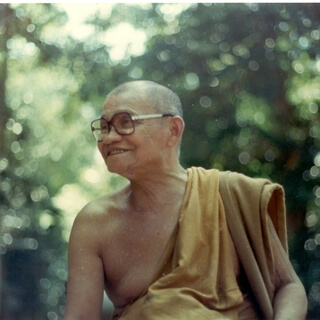
Venerable Ajahn Chah taught us this way.
He kept reinforcing this understanding.
Keep teaching the mind until,
Oh,
It really is impermanent.
It really is uncertain.
Then the mind lets go and gains wisdom,
Realizing that it's simply just the mind.
It's no longer seeing it as a being,
A self,
A person,
Me or other.
Oh,
So it's not me after all.
That person's mind that is defiled by defilements,
That's not them either.
This mind,
Which I call mine,
Tainted by defilements,
That's not me either.
There's nothing there.
But ignorance,
Craving and clinging insist,
Yes there is,
There must be.
They like to create self and other.
Why?
Because it's enjoyable,
It's pleasurable.
But it also brings suffering.
It never ends.
And so the cycle of birth and death continues,
Arising and ceasing,
Arising and ceasing,
Right within our own minds.
Therefore,
Every day since the day we are born,
Our eyes,
Ears,
Nose,
Tongue and body constantly encounter forms,
Sounds,
Smells,
Tastes,
Touches and mental objects.
This is how it is.
The notions of self and other persist.
The moment we lapse in mindfulness,
Self and other arise.
Right and wrong emerge.
Venerable Ajahn Chah taught beautifully and profoundly When the mind is deluded by its objects,
It's deluded by the world.
A mind lost in the world is a mind lost in its own sense objects.
So what must we do?
We must train the mind to rise above its sense objects,
To transcend the world.
How?
Through practice.
Cultivating our minds to have wisdom.
Venerable Ajahn Chah gave an analogy.
Imagine sitting on the only chair in your house.
If a guest enters and you don't rise from that seat,
They'll have nowhere to sit.
There's just one seat.
This means guard the mind with mindfulness.
When mindfulness is steady with the mind,
External impressions cannot intrude.
They can't enter.
We have mindfulness to look after our mind.
When the mind proliferates to this and that subject,
We follow with knowing,
Follow with seeing,
Follow with teaching it,
Not letting it get deluded like that,
Until the mind gets firmly established and peace arises.
Then the mind can separate from the sense objects.
It sees that objects are one thing,
The mind is another.
Samadhi,
Concentration arises.
Bhanya,
Wisdom arises.
Awakens.
We see,
Oh,
It really is simply just the mind.
We sit and watch it,
Sit and reflect.
There's no need to force anything.
We maintain mindfulness with the mind.
If the mind proliferates to that subject,
We say,
It's not sure,
Not sure.
If the mind proliferates to that subject,
We say,
It's not a sure thing,
It's not sure.
If it spins to that subject,
We say,
It's Not sure.
Not sure.
It's all the same.
It's impermanent.
It's not us.
The sense and mental objects are not us.
We are not the sense and mental objects.
Even the mind clinging to those objects is not us.
Teach the mind.
This is ignorance weaving its illusions.
When we practice this consistently,
Samadhi concentration becomes steady and established.
We gain clear vision,
Able to observe and know the mind directly.
The moment mental agitation arises,
Mindfulness catches it immediately.
Before we even need to correct it,
The disturbance settles on its own.
Maintain this continuous awareness of the mind.
Know our mind constantly.
Day after day,
It's just this.
The mind keeps fabricating.
Greed one moment,
Anger the next,
Then delusion.
Clinging fiercely to these as me and mine.
All of it is mere convention.
When we perceive all things as being conventions,
Then liberation arises right there.
This is the path of practice to realizing the Dhamma.
We can develop calm first,
And then investigate.
Or we contemplate this body directly.
It's just a lump of elements,
Not me.
When we are really angry at them,
And this won't subside,
Despite our repeated reminders,
Ask it,
Do we have to die?
When the breath stops,
Do we die?
We die.
So if we have to die,
Why get angry at them?
Why love?
Why hate?
Arises,
Examine.
Is this truly beautiful?
Contemplate its repulsiveness.
The mind comes back.
Watch the mind,
Whether it is excessively deluded,
Excessively in love,
And then contemplation proves difficult,
Then switch to contemplating the body.
Seeing the body and seeing it as not beautiful,
One may even attain Arahantship.
But remember,
The foundation remains.
It is still steady awareness of the mind's movements.
Just like the fully enlightened arahants in the Buddha's time,
They constantly guarded their minds and maintained their concentration.
They lived so peacefully,
So contentedly.
One day,
There was one monk who would become a Narahant.
He went on arms round and saw the hand of the most beautiful laywoman in that city,
In Rajagir,
The capital of the Mugdaha kingdom.
This woman was exceptionally beautiful,
Though already advanced in years.
Just seeing her hand was enough to captivate his mind.
Returning to the monastery,
He found he couldn't eat.
And he hadn't even seen her face,
Just her hand.
The mind proliferating.
At her age,
She's still this beautiful.
How stunning she must have been in youth.
Like a celestial goddess being reborn,
She must have been incredibly beautiful.
The more his mind proliferated,
The more desire arose.
But he still had Samadhi.
The defilements couldn't defeat him,
But he couldn't defeat the defilements either.
It was a battle.
The blessed one,
The perfectly self-awakened Buddha,
Surveying with his wisdom eye,
Perceived that this monk possessed the disposition to attain to Arahantship.
The Buddha then announced,
Today there's an invitation.
The Sangha is invited to a ceremony of that laywoman.
And this monk was currently desiring that laywoman was invited as well.
Coincidentally,
That laywoman had just passed away.
And so they needed to spread metta,
Loving kindness for her.
The monks proceeded to Sitawana forest,
The charnel ground outside Rajagir,
Where corpses were simply wrapped in cloth and abandoned without cremation.
That monk,
Unaware of her death,
On the way there,
Was delighting greatly at the prospect of attending the ceremony and seeing her once more.
But upon arrival,
That laywoman he was desiring over had already died.
The Buddha then taught,
How much is she worth?
One kahapana coin?
In modern terms,
Maybe $50.
Who wants her now?
Would they want the corpse or the money?
The Buddha progressively raised the hypothetical price.
20,
000,
200,
000,
Even a million.
Yet none desired her.
The Buddha then gave a talk on the body,
How both male and female forms are equally unbeautiful.
And amazingly,
The monk who had been so infatuated with that form suddenly felt profound samveka,
Dispassion.
Seeing the body as unbeautiful,
Dispassion arose.
Seeing the body as unbeautiful,
Dispassion arose.
The mind grew calm and in samadhi.
The mind detached from the chaos coming from the defilements of sensual delight that had gripped him.
Through body contemplation,
His mind settled into samadhi,
Then progressed to vipassana insight,
Realizing impermanence,
Suffering and not-self,
Anicca dukkha anatta.
The mind that had before been able to reach the high samadhi,
Then again it felt delight,
But then once more found peace.
He saw the mind as simply being a mind.
And he attained Arahantship,
Precisely because he had followed and guarded his mind.
So,
Even when strong anger arises in us,
Observe it closely.
Empty of self.
We separate out the elements and aggregates.
There is no you.
We're right now being deceived by defilements.
Keep reminding yourself.
Contemplating like this often,
More and more,
Wisdom arises because we train the mind.
See,
Teach your mind and it doesn't get deluded.
When the mind gets deluded,
We teach it,
Like we're teaching a child.
Venerable Ajahn Chah taught us to constantly teach the mind.
Thing.
It's not certain.
It's not permanent.
Clinging to anything brings suffering.
If you like it,
It's not sure.
We dislike it,
It's not sure.
All are conventions.
Whatever we attach to,
It is that thing that brings us harm.
It will be suffering to us.
We can't attach to anything.
Whatever we get so caught up in,
Then that thing will become our suffering.
This is mindfulness following and guarding the mind.
Watching the mind.
Whoever follows and guards the mind will escape from suffering.
Being,
Person,
Self,
Me or other.
This is seeing the Dhamma,
Realizing the Dhamma.
So every day may you follow and guard the mind.
Whether at the monastery,
Work or home.
When the sense and mental objects have arisen,
They've entered our mind.
Then follow and guard your mind.
May you grow in blessings.