Today is the 11th of May,
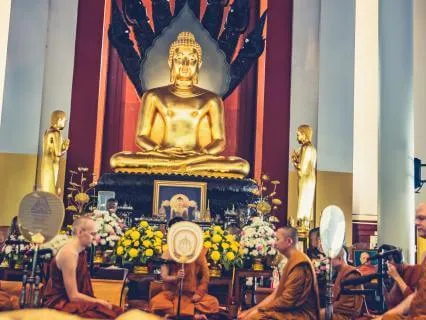
Which coincides with the anniversary of Vesaka Puja Day,
The full moon of the 6th lunar month.
It has now been 2613 years since the Sama Sambuddha,
The supremely self-awakened Buddha,
Attained enlightenment.
If counted from his birth,
We would add another 35 years,
Making it 2648 years.
Since the Buddha's birth into this world.
When the Buddha was born in Lumbini Grove,
All the flowers bloomed in full,
Even though it was not yet the season.
This was due to the power of his merit and spiritual perfection,
Which came to uplift the hearts of all beings.
Even nature responded to the arrival of the Buddha.
The supremely enlightened Buddha had made a solemn vow to help all minds,
All sentient beings to escape death,
To be freed from birth,
Aging,
Sickness,
Death,
Suffering,
All sorrows,
And the pain of separation from loved ones and cherished things.
After one is born,
One encounters what is unpleasant and unwanted.
So every citta,
Mind,
Experiences this kind of suffering.
Once born,
We cling to the idea of a self and ours,
Only to inevitably part from them,
Even though we do not wish for it too.
Those who still remain feel sorrow and longing,
Wishing that they didn't pass.
Depart,
Do not wish to leave what they have in this world.
And this is suffering.
Every birth brings suffering time and again.
Every mind,
Consciousness,
Wishes to escape this suffering,
But does not know how to find the way out.
Only the Supreme Bodhisattva,
The supremely enlightened Buddha,
Had made the vow to rescue all beings who suffer in this way.
Thank you.
So he resolved to cultivate the Bāramīs,
The spiritual perfections of wisdom,
For 20 asaṅkhāyas,
Innumerable periods of time and 100,
000 aeons.
Even after receiving the prophecy of his future Buddhahood,
He still had four more innumerable periods of time and 100,
000 aeons to complete his spiritual perfections.
Accepted countless births and deaths for the sake of all beings.
If the Buddha had sought enlightenment solely for himself,
He would have attained it long ago,
No longer being bound to the cycle of birth and death.
Had he chosen the path of being a noble disciple of the Buddha,
He would have become an Arahant since the lifetime that he was the ascetic Sumedha.
But from the boundless and immeasurable compassion of the supremely enlightened Buddha,
Which is known as Appamano Bhutto,
The Buddha sacrificed everything in order to cultivate his Barami,
Spiritual perfections.
Beings were his countless little children.
Imagine how many.
And when danger arises,
The Buddha would carry them down from a tall building to safety.
Just think how long that would take.
An incredibly long time.
But the Buddha never stopped.
The Buddha kept working tirelessly,
Perfecting every one of his spiritual virtues and even giving up his life in the process,
In order to fully complete his spiritual perfections.
The Buddha's cultivation had to be of the supreme type.
The Buddha's perfection of patience had to be extraordinarily enduring,
Beyond what anyone else could achieve.
And as for the perfection of loving-kindness,
He practiced it to the point of mastery.
Then we can reflect on the Buddha's perfection of virtue,
Sila,
Barami.
It required immense endurance.
For example,
When the Buddha in a past life was born as Buridatta,
The great Naga king,
He was captured and tortured.
Yet he did not retaliate because he was upholding the eight precepts.
Just think about it.
When we take on the five or eight precepts someone mocks or insults us or even tries to harm us,
Choosing not to retaliate is not easy at all.
If we lack the strength or means to fight back,
Perhaps we are simply forced to endure.
But when we do have the power and the means to respond,
And still choose not to,
That is the kind of perfection of forbearance and perfection of moral conduct of the highest order.
And until one can do this,
It has to be developed and trained in.
All the ten paramis,
The ten perfections,
The perfection of generosity,
Morality,
Loving-kindness,
Equanimity,
Truthfulness,
Resolution,
Energy and effort,
Renunciation,
The practice of the celibate spiritual life,
All of these must be fully developed by a Buddha.
This is what true self-sacrifice means.
When the Buddha's spiritual perfections were complete,
The Buddha was then born in Lumbini.
As he grew up,
He continued his quest,
Knowing that this would be his final life.
And when the Buddha was born,
He made the great proclamation that he was the foremost,
The most supreme,
The most developed in the world.
Having made that declaration,
The Supreme Bodhisattva pursued the path of liberation until he finally discovered the end of suffering.
And before he could renounce the world,
There was Princess Yashodhara and Prince Rahula.
But the Buddha saw clearly how attachment to them brought immense suffering.
This shows how deeply calm,
Still and peaceful his mind truly was,
Filled with profound happiness.
This was the power of his perfections.
Even the slightest disturbance would be deeply felt,
Yet he remained heedful and sought a way out.
The Buddha-to-be trained and tormented his body through extreme austerities,
Fainting three times,
Yet never losing his life.
And it was on the full moon of the sixth lunar month,
Vesaka day,
That he fulfilled his perfections and contemplated the law of dependent origination,
And at last he attained enlightenment and became the supremely self-awakened Buddha.
Even after becoming the supremely enlightened Buddha,
He did not simply remain in peace.
Instead,
He continued to show boundless goodwill and compassion for the whole of 45 years,
Where he tirelessly taught monks,
Nuns,
Laymen,
Laywomen,
As well as celestial beings and Brahma gods.
Teen enlightenment.
He never cared about his own physical fatigue or exhaustion,
Despite having already endured so much in previous lifetimes.
In this final life,
He gave everything he had,
Teaching with complete dedication,
Never seeking personal comfort or happiness for himself.
The teachings of the Buddha aim to guide those who lack generosity to develop generosity,
In order to overcome the mental defilements.
People are born with attachment,
Possessiveness,
Stinginess and greed.
The Buddha taught them to let go of greed through the practice of dāna,
Giving.
And when people are filled with greed and anger,
They lack sila,
Moral conduct.
So the Buddha taught them to have sila,
To observe precepts,
Such as the five precepts or at times the eight precepts.
By committing to the five and the eight precepts,
One's mind is gradually refined,
Becoming a good and virtuous human being.
The word individual means that in a single day we experience a duality of emotions.
We may feel greed,
Anger or delusion,
And sometimes we don't have greed,
Anger or delusion.
All sorts of emotions are mixed into the mind of this individual,
Constantly mixed up and lacking sufficient mindfulness.
But upon becoming a proper human being with improved mindfulness,
One becomes a kalyāṇa-jana,
A noble or virtuous person,
And they begin to recognize the value of Dhamma practice,
Develop generosity,
And keep sealer moral conduct.
Benefits of generosity and sealer bring about peace,
Happiness and contentment.
For example,
When we go to a place where people observe the precepts,
We might forget a diamond ring worth a hundred thousand dollars,
A million dollars,
Or we have left some money there.
Yet in that place,
There may be a hundred or one thousand people,
All having sealer.
Then,
No matter how valuable the item or phone is,
It will not be lost.
The items will remain there,
And people will kindly announce that if anyone is missing something that they left behind,
Please come and claim it.
Why is that?
Because people recognize that Scylla is more valuable than wealth.
Wealth is something we can only use in this world,
And we can't take it with us.
It has little lasting value.
But Sila holds greater value,
Bringing about happiness and prosperity.
This is the importance of moral conduct.
There's a story I'd like to share about a disciple of Venerable Ajahn Chah who was farming rice.
However,
He did not use pesticides on his rice fields because he was afraid it would be a sin,
Killing small creatures.
While other fields used pesticides,
His field was cultivated with sila.
And it was remarkable because his rice field grew very well,
Thriving and yielding bountiful harvests.
This is the merit of observing the precepts.
When we truly follow the precepts,
We will achieve success and abundance.
It becomes a source of wealth and prosperity through our virtue.
Therefore generosity and moral conduct bring the merit that leads to happiness.
And the Buddha also teaches us further to understand about the happiness we experience.
That we must be cautious and not be careless.
We should strive to train our minds to be still and calm.
Meaning,
The mind must be one that renounces sensual pleasures.
The mind is calm and peaceful.
This allows us to learn and understand the nature of the mind.
Be carefully watched.
We must guard against emotions and sense objects that lead us to have delight,
Sensual desire,
Irritation,
Delusion and intoxication.
We have to be careful.
This is what it means to have sati,
Mindfulness.
In the final teachings of the supremely enlightened Buddha,
He instructed all the monks and laypeople who saw the danger in the cycle of samsara,
Birth and death,
To not be negligent,
Heedless.
All the teachings of the Buddha can be summed up in the practice of heedfulness,
Which is having mindfulness and guarding our hearts in a way that is appropriate for our station in life.
When we are not careless in the Dhamma,
When we are restrained and careful,
Then we become individuals who possess the qualities of moral conduct,
Wisdom and concentration.
We must be cautious of emotions and sense experiences that cause irritation and troubles.
We must establish our mindfulness well.
When emotions and experiences arise that can lead us into intoxication and confusion,
We must establish our mindfulness well.
Similarly,
When emotions rooted in fear arise,
We must establish our mindfulness well.
When we follow the teachings of the Buddha in this way,
We will eventually understand the four noble truths,
Dukkha,
Suffering,
The origin of suffering,
The cessation of suffering,
And the path.
Walking the path of morality,
Concentration,
And wisdom is maggha,
The path.
It is the way to overcome the mental defilements.
And then,
Cessation of suffering arises in the heart.
Longer create the causes of suffering,
So suffering does not arise,
Because we are walking the path.
If there is ignorance,
Craving and clinging,
Then suffering arises.
But when we walk magga,
The path,
Wisdom arises and suffering does not arise.
So,
In our hearts,
There will be a battle between the noble path and the mental defilements.
Once we understand this,
We strive to cultivate mindfulness,
Meditate,
And increase our faith bit by bit.
As the morality,
Concentration and wisdom come together,
We will begin to see that all phenomena,
Both material and mental,
As being empty.
Feelings,
Perceptions,
Mental formations and consciousness become emptiness.
Everything becomes emptiness,
Even if only temporarily.
This is a momentary experience that is starting to allow us to let go in a small way.
Then we continue practicing onwards and there is more letting go through samadhi concentration.
And then later it is letting go with wisdom.
We will then see and truly understand the Dhamma that should be known and seen.
The mind will then flow towards Nibbana.
It can see the Dhamma.
After that one continues one's meditation.
There is the goal that there is no eighth life for those who have realized and seen the Dhamma in this way.
We must eradicate ignorance to get beyond the cycle of birth and death.
Therefore,
Every life is a journey,
A long journey,
And we don't know when it will end.
As we travel far,
We must accumulate our spiritual goodness.
We practice a lot of generosity,
Morality,
And meditation.
We must not be careless,
Because in the end,
All beings must pass away.
Even the supremely enlightened Buddha laid down his aggregates and entered final nibbana.
And so what about us?
Will we die?
We must constantly remind ourselves not to be careless,
Heedless.
So let us set up our good intentions on this important day of Vesaka Puja as it comes around once more in the Buddha's calendar.
Let us commit ourselves to practicing Dhamma and to give homage to the Buddha.
We do this today and tomorrow and continue this practice until the next year's Vesaka Puja.
So we are heedful like this.
The Buddha wishes for us to give him homage by practicing the Dhamma so that we will have spiritual goodness and have the path and fruits of Nibbāna arise,
Leading to the purified heart and liberation from within us.
This then accomplishes the Buddha's wishes for us to find happiness and be freed from the cycle of renewed birth and death.
May you grow in blessings.