So today is the second day of the meditation retreat,
And Venerable Ajahn Anand gives his welcome to everyone here,
Those who have come to Bodhmabhjan and those that are joining online.
And so at this time,
You can make the mind firm in samadhi,
Develop your meditation,
And just know the in and out breath.
And even this language,
The Thai language that I'm speaking,
Even if you don't understand it,
You can just have mindfulness and make the mind peaceful,
Because then the current of the Dhamma may enter your heart,
And this is something that's very amazing,
Which comes from a peaceful mind.
And so then after we listen to the Thai,
And then we can hear the translation,
Which are played together in Chinese and English.
So today,
I will talk about the mind and what is this mind.
This mind is simply an element of knowing.
It has a duty to receive and experience sense objects,
What we call aramana.
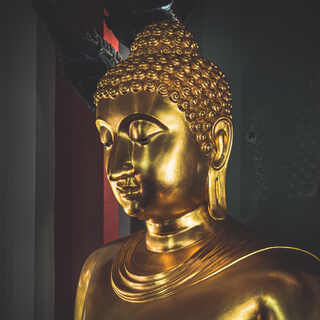
And so the Buddha taught us that this mind of ours is originally radiant.
But the problem is that when the aramana,
The sense objects,
They enter afterwards,
They contact the mind,
And then that radiance is not there all the time.
This is because the delusion of the mind is still present there.
So then attachment and clinging arise,
And this lowers the mind and pollutes the mind.
So this contact or sense contact we call passa,
And every time it occurs,
Then the mind gets defiled,
Polluted.
And so then this is when greed and the delusion,
The defilements cover over our minds.
And so then the mind that originally was radiant,
Its brightness is covered up and it can't shine out.
And so therefore,
We do need to practice the Dhamma.
And so we can have the mind to have wisdom,
And then the radiance can be present all the time.
So the Buddha,
He taught us the method in order to make the mind to be radiant,
To have that passara,
This radiance,
Fully,
Completely,
So that there is no more of becoming defiled again.
And this is through the development of wisdom.
We can see the drawbacks and dangers of the mind that does not have sila or moral conduct.
And so then we come to restrain the body,
Our actions,
And our speech.
And this requires us to keep sila,
The five precepts,
The eight precepts,
The 10 precepts,
227 precepts,
Or the precepts of a nun.
And so in the Theravada and the Mahayana traditions,
They will teach of having control and restraint over one's actions and speech in order to make them peaceful.
And then we train our mindfulness to take care of our minds.
We try to make our samadhi concentration to be firmly established,
Because when the sense objects,
They enter the mind,
And if the mind that does not have mindfulness and wisdom,
Then it will have delusion arise.
So we need to have firm mindfulness,
Firm sati.
Then we're able to separate out the mind and all the sense objects,
The arammana.
So the arammana here is the forms,
Sounds,
Tastes,
Odors,
Bodily contact,
And all the thoughts of the mind.
But if we have the mindfulness to know in time,
Then as these things arise,
Then we're able to separate out that the mind is one thing,
And those arammana,
Those sense objects,
Are another thing.
We're able to separate it.
But if the mindfulness there is not present,
Then we won't be able to know these sense contact when it arises,
And we can't separate out.
And there's just the sense of me and mind,
Feelings of self coming up.
This is a person who has greed,
Anger,
Delusion.
But if we have mindfulness and wisdom,
Then we can separate the mind and those sense objects out and see sense objects are simply sense objects.
That means we don't follow them and we don't proliferate onwards with them.
We're able to let go of those sense objects in a natural way.
So if we haven't then developed our mindfulness and wisdom,
Then we won't be able to separate out the mind from the arammana,
These sense objects.
But we still have to put an effort in,
Be determined to do it.
At least we know that the mind and the sense objects,
They are the sense objects.
They're two separate things.
Because if they were one thing,
Then there would be no way that we'd be able to make the mind purified.
So this training of the mind,
We are training to develop wisdom.
It's wisdom that sees the drawbacks and dangers.
And then we develop sila.
We have restraint without actions and speech.
We have wisdom to see the drawbacks of the mind that is constantly restless and thinking and going all over the place without stop.
And then we train then to develop samadhi or concentration.
We're developing mindfulness and samadhi.
So this element of training is something very normal in this world.
We have to train ourselves when we go about leading our life and we're moving about,
We're changing postures.
And so try not to do things so quickly.
Try to have mindfulness along with it.
When you're listening to the dhamma,
Like at this time,
Then just be focused,
Have your mindfulness listening to the dhamma.
Don't let the mind go out to other thinking and proliferations.
When you're at home and you're cleaning,
Sweeping,
Mopping or washing the dishes,
Have mindfulness in the present moment with what you're doing.
And so there's no need to explain so much about it.
We just develop mindfulness in our activities.
If we're walking in the walking posture,
Then we are aware of the left foot and then the right foot stepping.
We are aware when we're standing,
We know that we're in the posture of standing.
When we're sitting,
We know when we're lying down,
We also know we're in that posture.
And so these days,
People,
They don't have much mindfulness in their body and mind.
It's always going out to something else and it's going very quickly.
You can see,
For example,
That people are on their phones a lot and their focused awareness is on their phone,
But they don't have mindfulness along with their walking posture.
And so something like this can be a danger to one's life.
So we do need to take care of our minds.
We develop our mindfulness to be at a good level.
And the greater that we can develop mindfulness,
Then the closer we come to the Buddha,
The closer we come to seeing the Dhamma.
If we train in developing mindfulness to be well-established,
To be continuous,
Sometimes we may find that wisdom just arises.
There is the wisdom that comes from learning and listening.
This is a type of wisdom as well.
Like we learn that rupa and nama,
Materiality,
Mentality,
Mental phenomena,
They are impermanent,
Unsatisfactory,
And they are not unsatisfactory and not a self.
We learn about that the mind is originally papasara,
Radiant.
But we're not sure really what this means,
Because this is learning from the texts,
The suttas.
But when we practice,
Then we're making the mind peaceful.
And then when the mind becomes peaceful,
We're able to gain some understanding into what we've learned theoretically from the texts.
We have more wisdom arise because we're developing mindfulness to be present continuously,
To have samadhi well-established.
So then wisdom does start to arise.
We're able to see more into this proliferation of the mind that it isn't a self there.
All good proliferations or thoughts or bad thoughts,
They're not self,
They're not ours.
And if we start to know like this,
Then the mind becomes more radiant.
And this is then usually the mind that is covered over with greed,
Anger,
Delusion,
It starts to lessen these defilements bit by bit.
And so the mind then starts to become brighter through having wisdom.
So this is the wisdom that arises from our Dhamma practice.
So we need to train the mind like this,
So that this radiance is there constantly.
And we may then have this wisdom arise and we can see and know that this mind then has great value if that is if we have wisdom.
So there will be enough for the Dhamma talk on this session and then those in the monastery can have their meal and we'll come back together at 10am.