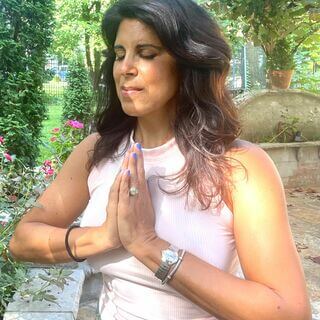
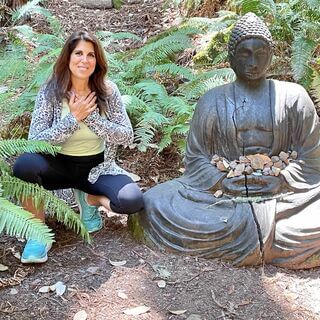
I'm Jonna and I am here.
To respond to the question.
Why can't I meditate?
Why can't I meditate?
Said every person ever.
Or at least every person who has ever tried to meditate.
As a meditation teacher.
I hear this question a lot.
It's usually in my own head,
But also from my students.
And my answer.
Is this?
You can meditate.
You just can't stop thinking.
And the most common meditation myth is that meditation means not thinking.
And I used to think that too.
Obviously while meditating.
Brains create thoughts and because of this neurobiological fact.
Meditating can feel difficult.
Especially if your intention is to not think.
But thinking,
Even overthinking,
While meditating.
Doesn't mean you're not meditating.
Brains reflexively or automatically do inconvenient things like.
Creating thoughts.
And most of us with brains find meditation challenging at times because.
.
.
Thinking is a distraction to meditation.
However,
Distractions do not negate the fact that you're meditating.
Thoughts will always arise and they'll distract the process.
Yet,
The moment that you notice that you are distracted,
You become aware of what your mind is doing.
So meditation is like a GPS of the mind.
When you lose your mind,
Meditation is how you practice finding it.
Becoming aware of what the mind is doing.
So meditation does not need to be painful.
Several skeptics of meditation have told me that meditation looks like pointless suffering.
And I have news for them.
It can feel even worse than it looks,
But fortunately this changes with practice.
And meditation as a practice.
Is quite the opposite of pointless suffering.
It has a point.
And that point is found in the suffering or the perceived suffering.
In fact,
Meditation is a practice of how to suffer less in life.
Because the suffering in meditation and in life often based on resistance.
To what's happening.
Or to what our mind believes should be happening.
So in meditation,
The suffering can come from a belief that meditation is supposed to be effortless and simple.
And you may try to resist having thoughts during a meditation.
So the thoughts arise and you naturally resist harder.
And resistance is effortful.
And in fact,
It can be exhausting.
To meditate is not to resist more.
It is to learn to allow more.
So you allow the mind to notice the resistance,
The thoughts and the distractions and maybe the emotions that arise.
As you meditate.
Because meditation is a deliberate training.
Of attention toward whatever is happening now.
Even resistance is a part of meditation when you're aware of it.
So thoughts,
Feelings,
Beliefs,
Stories of the Mind are all welcome.
During meditation.
Stillness will happen automatically between distractions.
With practice.
So meditation is not an absent of thoughts.
Simply a training of your attention toward an anchor,
A single gentle focus.
So it can be done walking or lying down or listening to music or really doing anything where your attention is focused on that anchor.
In a guided meditation,
The guide's voice is that anchor.
So each time you get distracted,
You notice the distraction and then you intentionally bring your attention back.
To the anchor.
Now having an anchor does not eliminate all other thoughts from happening,
Nor does it mean you'll immediately enter a deep focused state.
Meditation is simply this deliberate practicing of noticing what you're noticing.
And it benefits all who practice it.
Especially fidgety overthinkers like me.
Possibly you.
Meditation is based on the act.
Of practicing,
So there's no required outcome,
No gold star for meditating well.
There is just.
Practice of meditating.
And I know that's a big ask in our culture that often strives for an end game of perfection.
And that may be why you think you can't meditate.
Perhaps you assume others do it better or that it's just a story.
Of the mind that's not supposed to happen if you have thoughts.
But these stories of the mind do happen.
And meditation is the practice of quieting the mind.
When these stories happen.
It doesn't mean you suddenly enter a trance.
In fact,
The trance is what seasoned meditators often call our warped perspective.
In daily life when we are not present or connected to others and we're in this kind of trance of separateness with screens of all sizes to distract us from real life sensations.
And it is easy to spend much of our days in trance.
By all these triggering thoughts from social media's lore or distractions around us from from what we believe others think distractions from what is happening here and now in the present.
So meditation is the opposite of this lure away from what is real and present.
Meditation actually lures us back into our own body and mind and what we are experiencing in that moment.
So when meditation becomes a regular practice,
You move away from that kind of separatist trance and you can begin to know yourself better what you're thinking and feeling and you become naturally more connected,
Compassionate,
Connected to others,
Nature,
Yourself.
And slowly with practice,
You will find less distractions.
And this is the gift behind the myth of pointless suffering.
So to meditate,
You let the mind.
.
.
See itself clearly.
You embrace curiosity and try to let go of that fear.
Thick fog of judgment.
And you open your mind to what is here now through.
A lens of compassion.
You detach from outcome,
From getting that gold star.
And each time you notice the mind judging itself or its performance,
You let go.
Of past and future and shoulds and should haves.
And you don't have to should all over yourself.
You just begin to observe.
The passing of thoughts and emotions.
Until you are no longer.
Trap.
In the stories of the mind.
And you start to see that you are separate from these thoughts.
And stories and judgments that the mind creates.
So you repeat this distancing process between you and your thoughts as two separate things over and over.
And you intentionally train the brain to create a habit or a reflex of that gentle,
Single focus.
Returning to that gentle,
Single focus.
And the brain has this incredible capacity to change in response to repeated experiences.
Called neuroplasticity.
Basically means brain changeability.
So our brains can strengthen the circuits that make meditating easier,
The more we meditate.
And in meditation.
You can choose your anchor.
Could be your breath.
To be your single,
Gentle focus.
So each time the thought arises and lures you away,
You practice noticing the distraction.
Releasing it and returning to the anchor,
That gentle single focus in the meditation.
And.
.
.
You start to even notice the thought emerging.
You can name it,
Thought,
Distraction,
Whatever it is,
Letting it go.
And then returning to this process.
Of your single focus of quieting the mind without judgment.
With curiosity.
And with compassion in the present moment.
Perspective is very important in meditation.
So try to have compassion with yourself.
Remember that in meditation This is always a practice,
Never a perfection.
So often the most daunting meditation is the first one.
The battle is often just to begin.
And once you've meditated even one time,
You have begun the practice.
And you cannot fail at meditating.
You can only fail to try.
So next time you catch yourself asking,
Why can't I meditate?
Your answer can be.
Well,
I already am.
I'm just experiencing.
A distraction.
Thank you for joining me.
And hopefully we'll meditate together soon.