Hi,
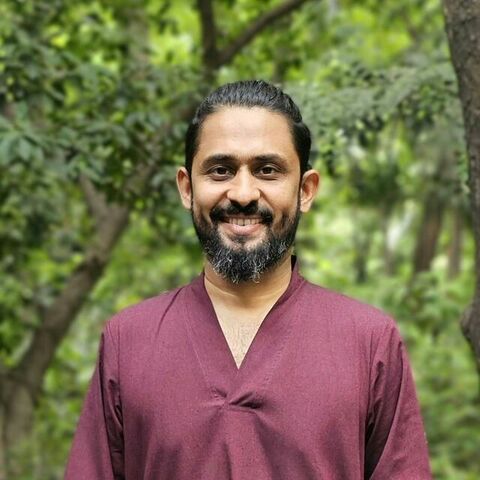
I'm Jerry.
I'm a meditation and mindfulness teacher based in Fort Kochi,
India,
And I run Nishrayasa,
A holistic wellness studio where I share meditation,
Mindfulness,
And sound-based practices.
Thank you for being here.
Have you ever arrived somewhere and realized you barely remember the journey?
You know you drove the whole way.
You stopped at the traffic lights,
You took the turns.
You probably even noticed the road.
But when you try to remember the journey,
There's almost nothing there.
And it's not just driving.
You eat a meal and suddenly realize the plate is empty.
But you can't really remember tasting it.
Someone is talking to you and you are listening.
But at the same time You are already thinking about what you are going to say.
You walk into a room and forget why you went there.
You pick up your phone without really knowing why.
These things are so ordinary that we hardly think about them.
But there is an interesting question.
How much of our lives are we actually present for while they are happening?
We use the word autopilot.
Quite casually.
Planes have autopilot.
Cars have cruise control.
Machines are designed to take care of repetitive tasks.
So that we don't have to consciously manage every little thing.
And our brains do something very similar,
Thankfully.
Imagine having to consciously think about every movement involved in brushing your teeth,
Or tying your shoelaces,
Or walking,
Or driving a road you have travelled a hundred times.
We would be exhausted.
So the brain automates things.
It builds habits.
And this is a wonderful ability.
Running on autopilot isn't the problem.
The problem is when we forget that it is switched on.
Think about cruise control in a car.
It's incredibly useful on a long,
Familiar stretch of road.
You don't need to keep your foot on the accelerator every second.
And yes,
We now have a few cars that can do a lot more than cruise control.
Some of them can practically drive themselves.
But even then,
You still have to enter the destination.
The car can take you there,
It just doesn't decide where you want to go.
And I think our habits work in much the same way.
They can carry us through large parts of the day without requiring much conscious effort and that's helpful.
But sometimes.
.
.
They begin carrying us through our lives as well.
You wake up and reach for your phone because your hand just knows what to do.
You start your morning,
Move through the routine,
Eat something while looking at the screen.
Leave home,
You take the same route.
Get to work,
Do what you normally do.
You come home,
Have dinner,
You scroll,
Go to bed.
And perhaps nothing particularly bad happened that day.
But you reach the end of it and wonder,
Where did the day go?
I think that is a very different problem from being busy.
You can be busy and completely present.
You can also have a relatively quiet day and barely experience any of it.
The difference is participation.
Are you actually participating in what you are doing?
Or are you simply moving through a familiar sequence?
I remember hearing someone once describe this.
They said that sometimes they feel as though they were constantly preparing for their life rather than actually living it.
Preparing for the next meeting,
The next holiday,
The next weekend,
Next project,
Next stage.
And when that next thing finally arrived,
Their mind had already moved on to something else.
I think many of us know that feeling.
We are always slightly ahead of ourselves or slightly behind ourselves.
And the present gets squeezed somewhere in between.
This is where mindfulness becomes interesting to me.
Not as a way of becoming intensely aware of every single thing we do.
That would be exhausting.
Mindfulness isn't asking you to notice every step you take or analyze every thought you have.
It's simply giving you the chance to catch yourself,
To notice,
Oh,
I have drifted.
Maybe you're eating,
But you're not tasting.
Someone is speaking,
But you are not really listening.
You have opened your phone without any particular reason.
You are irritated,
But you haven't even noticed that irritation has been building.
Maybe you've been worrying for 20 minutes about something that hasn't happened.
The important moment isn't what happened before.
It is the moment you notice.
Because noticing gives you the choice.
You might still pick up the phone,
Still take the same route home,
Or decide that you are angry and need to say something.
Mindfulness doesn't mean you have to change whatever you are doing.
It simply means you are no longer doing it completely unconsciously.
There is a difference.
You are choosing.
And that difference matters more than we realize.
Because our lives are made up of these tiny moments of choice,
Not the dramatic ones,
The ordinary ones.
Do I actually want to check my phone right now?
Am I listening to this person?
Do I need to answer immediately?
Am I hungry or am I simply eating because it is lunch time?
Am I tired or am I reaching for another distraction?
Do I actually disagree with this person or am I reacting because I am already irritated?
These aren't profound questions.
But sometimes they bring us back to ourselves.
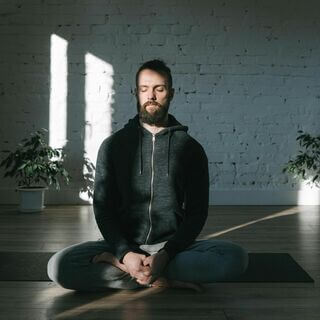
And this is also what happens when we meditate.
You sit down with the intention of being present.
And almost immediately the mind starts doing something else.
You think about work.
You remember something from yesterday.
You plan dinner.
You wonder how long you have been sitting here.
You get distracted.
And then you notice,
You come back.
That's the interesting part.
Not that you managed to stay focused perfectly,
You didn't.
The important thing is that you noticed you had gone somewhere else and you came back.
That same ability becomes useful everywhere else.
You notice you are no longer listening.
Come back.
You notice you are eating without tasting.
Come back.
You notice you are halfway through an argument in your head.
Come back.
You notice your hand has reached for the phone again.
Bars.
You don't have to become a different person.
You don't have to eliminate your habits.
You just become a little more awake inside them.
And this is the difference between living efficiently and living consciously.
Efficiency is useful.
We need it.
We don't want to reinvent our morning routine every day.
We don't need to consciously think about how to brush our teeth.
But there are parts of our lives that deserve more than efficiency.
A conversation with someone we love.
A meal we are sharing with friends.
A walk through a place we have seen a hundred times.
The first few minutes after waking up,
The feeling of sunlight coming through the window.
The expression on someone's face when they are telling us something important.
These are not big moments.
There's no notification saying,
Pay attention,
This moment will never happen again.
And that's what makes them so easy to miss.
A few months ago,
I found myself walking through a place I have been or many times before.
Nothing unusual was happening and for some reason I decided to put my phone away and simply look around.
I noticed the sound,
The people,
The light,
The buildings,
A smell coming from somewhere nearby.
Nothing extraordinary.
It was an ordinary walk,
But I remember thinking,
How many times have I walked the same route without actually seeing it?
Maybe we don't need more extraordinary experiences.
We just need to become more available for the ordinary ones we already have.
The good news is that you don't need to wait for a retreat or a meditation session to practice this.
You can start with the next ordinary thing you do.
When you drink something actually taste it.
When someone speaks.
Listen until they are finished.
When you walk somewhere familiar,
Look around.
When you reach for your phone,
Pause for one breath.
When you notice irritation.
Feel it.
Before deciding what to do with it.
And when you realize you've been somewhere else in your mind,
Don't make it another reason to criticize yourself.
Just come back.
That's all.
Because you will forget.
I forget.
You will get distracted,
You will find yourself halfway through a meal before remembering that you wanted to be present.
That's no way of failure.
The noticing is the practice.
And that's what mindfulness really gives us.
The ability to recognize when we have handed the steering wheel over to autopilot.
And take it back.
Because your life isn't waiting for you somewhere in the future.
It's not waiting for the next holiday,
Or the next promotion,
The next weekend,
The next big experience.
It's happening in the very ordinary things you are doing right now.
The person you are speaking to,
The food you are eating,
The road you are travelling,
The breath moving through your body.
The silent moment between two things.
These moments don't look important when they are happening,
But they are your life.
And each one passes only once.
So ask yourself,
Am I here?
And sometimes that's enough to bring us back.
Thank you for listening.