In this practice,
You will train to make diaphragmatic breathing your default way of breathing,
Facilitating relaxation and calm.
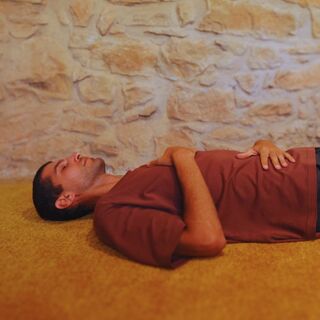
A lying posture is recommended,
As it relaxes the abdominal muscles,
Facilitating the movement of the diaphragmatic muscle.
Let us begin by relaxing our body.
Become curious how your body feels.
Notice any tension in your forehead,
Eyes,
Jaw,
Tongue,
And see if you can release any excessive effort underlying those parts,
Facilitating them to become softer.
Notice any tension in your neck,
Shoulders,
Arms and hands,
And see if you can release any excessive effort underlying those parts,
Facilitating them to become softer.
Notice any tension in your back,
Chest,
Abdomen,
Releasing any excessive effort,
Becoming softer.
Noticing your hips,
Legs,
Feet,
Releasing excessive effort,
Becoming softer.
Good.
Let us develop sensitivity to your breathing.
Where do you find it?
It may be in the belly,
Ribs,
Chest,
Shoulders,
Or anywhere else.
Not changing it.
Noticing it.
What about the rhythm?
It may be calm or fast,
Or in between.
What about the movement?
It may be staying in one place,
Moving from the chest down or from the belly up.
Just noticing.
Good.
You will now start with the first phase,
Strengthening your diaphragmatic muscle by engaging it via slowly raising and lowering your lower belly during the inhale and exhale,
While keeping the ribs and chest disengaged.
You may picture the inhale being pulled down from the base of your ribs,
Down to your lower belly.
Now,
Place both of your hands just below the belly button,
One hand on each side.
They will help you in being more sensitive to the movement of the breathing.
Now,
Take a slow,
Gentle inhale into your lower belly.
The fingers lift.
Slowly exhaling.
Fingers drop.
Slowly inhaling into your lower belly.
Fingers lift.
Slowly exhaling.
Fingers drop.
Gently inhaling.
Fingers lift.
Gently exhaling.
Fingers drop.
Inhaling.
Exhaling.
Inhaling.
Exhaling gently.
Continue practicing in this way,
Allowing your belly to gently fill with air.
No strain,
No struggle.
Gentle.
Easy.
Good.
The diaphragmatic muscle is strengthened by slow,
Gentle movements,
Rather than filling up your belly greatly.
If possible,
Gently slowing down your breathing.
Inhaling into your lower belly.
Fingers lift.
1,
2,
3.
Exhaling.
Fingers drop.
1,
2,
3.
Inhaling.
Lower belly lifts.
1,
2,
3.
Exhaling.
Lower belly drops.
1,
2,
3.
Inhaling.
1,
2,
3.
Exhaling.
1,
2,
3.
Inhaling.
1,
2,
3.
Exhaling.
1,
2,
3.
Continue practicing in this way,
Slowing down your breathing at your own comfortable pace.
A guide is a feeling of gentleness and easiness,
Rather than of strain.
If you feel strain,
This may be a sign of excessive effort.
See if you can let go of struggling or forcing the breath to be a certain way,
And allow the breath to slow down at its own comfortable pace.
If comfortable,
Slowing down the breath even further to 4 or 5 seconds.
If you feel lightheaded in any way,
This may be a common sign of adjusting to this new breathing.
Simply pause and allow your breathing to become natural again,
Until you feel ready and then start again.
Good.
Now you will practice phase 2.
Opening up your ribcage,
So that the breath can flow properly from the lower belly up into the ribs.
You do this by actively pushing up your ribs,
So that they open,
Allowing the air from the lower belly to move up into the ribcage.
Place both of your hands on the side of your ribcage,
Fingertips slightly touching each other.
During the inhale,
The ribcage expands,
Fingertips distancing themselves from each other.
During the exhale,
The ribcage deflates,
Fingertips coming closer,
Touching each other.
Breathing in,
Lower belly slightly lifts,
1,
2.
Now actively opening up your ribcage,
Allowing the breath to naturally move up,
Ribcage expands,
Fingers separate.
Exhaling slowly,
Relaxing.
Breathing in,
Lower belly slightly lifts,
1,
2.
Actively opening up your ribcage,
Allowing the breath to naturally move up,
Ribcage expands,
Fingers separate.
Exhaling slowly,
Relaxing.
Breathing in,
Lower belly lifts,
1,
2.
Opening up your ribcage,
Air moves up,
Ribs expand,
Fingers separate.
Exhaling slowly,
Relaxing.
Continue practicing in this way,
Being curious about how gentle you can be when allowing the air to move up from the lower belly to the ribcage,
Rather than forcing.
Breathing in,
Lower belly slightly lifts,
1,
2.
Actively opening up your ribcage,
Allowing the breath to naturally move up,
Ribcage expands,
Fingers separate.
Exhaling slowly,
Relaxing.
Breathing in,
Lower belly slightly lifts,
1,
2.
Actively opening up your ribcage,
Allowing the breath to naturally move up,
Ribcage expands,
Fingers separate.
Exhaling slowly,
Relaxing.
Good,
Now you will practice phase 3.
Having a complete breath from the lower belly moving up to the ribs and filling up the chest.
Place one hand just below the belly button,
One hand on your chest just below your collarbone.
Inhaling,
Lower belly,
1,
2.
Ribs open,
Air rises,
Ribs expand.
Allowing the air to continue rising,
Filling up the chest.
Exhaling slowly,
Relaxing.
Inhaling,
Lower belly,
1,
2.
Ribs open,
Air rises,
Ribs expand.
Air rises,
Filling up the chest.
Exhaling slowly,
Relaxing.
Inhaling,
Lower belly,
1,
2.
Ribs,
Chest.
Exhaling,
Relaxing.
Inhaling,
Belly,
Ribs,
Chest.
Exhaling,
Relaxing.
Inhaling,
Belly,
Ribs,
Chest.
Exhaling,
Shoulders drop,
Relaxing.
Continue practicing in this way,
Being curious about how good and natural it may feel to allow the air to move up,
Filling your ribs and chest,
Rather than a forcing.
Good,
Place your hands on the side of your body,
So that it is comfortable for you.
You will continue having complete breaths,
While now exhaling more deeply and relaxing more deeply.
Inhaling,
Lower belly,
Ribs,
Chest.
Slowly and gently exhaling,
Allowing your shoulders to drop,
The body to deflate,
Relaxing.
Inhaling,
Belly,
Ribs,
Chest.
Slowly and gently exhaling,
Shoulders drop,
Body deflates,
Relaxing.
Inhaling,
Belly,
Ribs,
Chest.
Slowly and gently exhaling,
Shoulders drop,
Body deflates,
Relaxing the whole body.
Inhaling,
Belly,
Ribs,
Chest.
Exhaling,
Letting go of effort,
Relaxing.
Inhaling,
Belly,
Ribs,
Chest.
Letting go of effort,
Exhaling deeper,
Relaxing deeper.
Continue practicing in this way,
Relaxing all effort during the exhale,
Enjoying the calm that may become available to you.
Good.
Now we will practice the final phase,
Witnessing your natural diaphragmatic breathing.
Allow your breathing to become natural again,
Letting go of any effort to control,
Or wanting it to be in any specific way.
Start noticing the movement of your breathing,
How your lower belly gently lifts,
And gently drops.
Lower belly gently lifts,
And drops.
Gently lifts,
And drops.
Just being aware of it,
Knowing that it is there.
Noticing how your breathing is happening naturally,
By itself.
Lower belly lifts,
And drops.
Lifts,
And drops,
By itself.
Just being aware of it.
You may notice how good it feels,
Just being here,
Being with your natural breathing,
Letting go of effort on every belly drop,
Relaxing on every belly drop.
As the lower belly drops,
Letting go of effort,
Relaxing.
As the lower belly drops,
Releasing effort,
Relaxing,
Becoming heavy.
Become curious about how relaxed your body feels,
How calm your mind feels.
Does your diaphragmatic breathing support relaxation and calm?
Lower belly lifts,
Lower belly drops,
Relaxing,
Calming.
Lower belly lifts,
Lower belly drops,
Relaxing,
Calming.
Continue practicing in this way,
Being curious about and enjoying the relaxation and calm on every exhale.
If you notice your diaphragm not engaging,
Intentionally take a few diaphragmatic breaths into your lower belly,
And then allow your breathing to become natural again.
Good.
Become aware of how your body and mind feels after this practice.
Is there calm?
Relaxation?
Is there restlessness or agitation or anything else?
Being curious,
Reflecting how it feels to be you after this practice.
As we transition out of this practice,
A reminder that this breathing and relaxing on the exhale is available to you anytime throughout your day.
Thank you for practicing.
Take care.