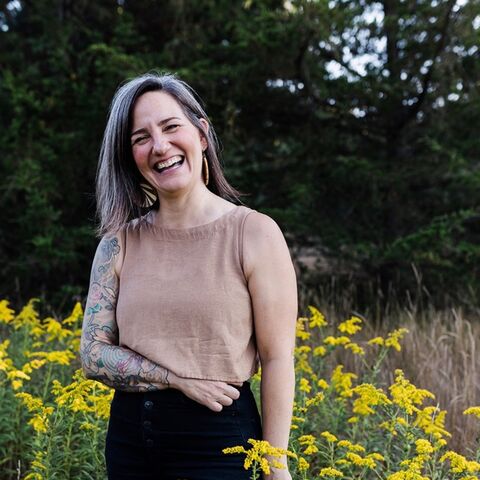
My name is Larissa.
We're going to practice together for about 15 minutes.
Just take a little bit of time here to settle in.
Make any adjustments you need with your body.
The smallest little thing is a kindness to yourself.
Swirling out your neck or stretching your arms.
These are little things we do constantly throughout the day that we barely even pay attention to.
It's just a good reminder that you're always taking care of your body.
Sometimes we notice when our mind is judging instead.
Just notice how your body is caring for you.
How you've chosen to care for yourself.
Putting on a sweater on a chilly morning.
Noticing those little details.
Can be really helpful as the foundation.
We're practicing being kind or gentle with ourselves as we stay.
It's something you're always doing,
But sometimes we don't even notice it.
It's just such a habit.
And a really delightful habit.
Smallest thing.
Again,
Like putting on a sweater on a chilly morning.
Drinking a glass of water when you're thirsty.
As we're settling in,
Just remembering that.
These are things you already do for yourself,
So when we talk about being kind to yourself.
This is something we're always practicing.
Now we're just paying attention to it.
Starting to notice when at times our mind takes us on a non-optimal thought loop and we start being unkind.
Either to ourselves,
Or we start judging somebody else,
And we start judging a situation.
These are all really important things that our brain does to try to keep us safe.
It's just the witnessing of it.
And landing back in that nature of care and tenderness that exists within all of us.
If you haven't already done so,
Letting your eyes be closed or letting them be softly downward.
Even that,
Just letting your eyes be really quiet and still.
Resting on something but not focused on it.
That's a tip I learned a long time ago in a painting class as a way to see something more clearly.
Not as the way that we think we see it.
Just noticing here.
All the different experiences of Right now.
Gravity beneath you.
A sense of stillness and firmness.
But also movement is happening with your breath,
With your heartbeat,
Digestion,
Blood flow.
There's likely many things happening outside of you that influence your experience.
Different sounds.
The way the light plays behind your closed lids.
And our mind is also deeply involved with how we experience things.
Practice here is just to receive what's present and notice when our mind is making interpretations about it.
Breath by breath.
We return to the present moment.
Because invariably our mind will shift us to future,
To past,
To planning.
To remembering.
And none of that is good or bad.
It's just something that's happening.
The more that we can see the way that our mind moves and works,
The more clearly we can actually be in the present.
Seeing what's truly in front of us.
Experiencing what's truly happening versus our mind's interpretation of what it thinks is happening.
And this is a really subtle difference and no one could.
.
.
Make this subtle difference clear to you.
We all see things in a slightly different way.
Something obvious where you have a beach day planned and it rains and you feel sad about it but Your neighbor who's been hoping for rain for their garden is really excited about it.
So it's obvious differences in the way we see things.
There's a lot of subtlety,
And sometimes we don't even recognize it anymore.
Again,
That painting analogy.
I'm remembering this this morning.
I remember the first time I.
.
.
Painted on black.
And an apple.
Just thinking,
Oh I know the color of the apple and yes I know that it has some pinks in addition to the reds.
But not really recognizing what I'm seeing.
It's my mind's interpretation of what I think I'm seeing.
And my teacher gave me the tip to turn my head sideways to look at it from a different perspective.
And sure enough,
Suddenly,
Oh,
There's blue in there.
I've never seen blue in an apple before.
And when I move the light,
Suddenly that blue disappears.
Very often we just trust what our brain is telling us and we miss what's actually happening.
And again,
It's never to make your brain wrong.
Your brain is brilliant.
Taking in hundreds of millions of bits of information per second,
And your brain choosing to show you somewhere between 10 to 50 of those bits of information.
According to what's important to us,
According to what we've decided is important to us.
My husband used to be a mechanic.
Point out a carbureted car and I don't even know what that means.
I would never see that.
Just because that's not how my brain thinks.
I'll point out different kinds of flowers and he'll say oh I didn't even notice that.
But that's what my brain looks for.
So part of our meditation practice is witnessing.
What is my brain doing?
Because there's patterns,
There's software running in the background of my mind.
That I'm not even aware of.
Sometimes it's supportive and beneficial and sometimes it's less than helpful.
And it's not up to anyone to decide or tell you what is helpful or unhelpful.
It's just you witnessing yourself.
And to the best of your ability,
Witnessing yourself with that innate kindness and gentleness that lives within you.
So we don't accidentally add layers of judgment upon the judgment that's already in our mind.
As we practice,
There's a clarity that comes.
It's not something we can grasp onto.
And it's not something that's outside of us that we have to try to get to.
It's just here in the present,
These tiny moments of ease.
Oh yeah,
That's right.
I'm just noticing my breath.
So there goes my mind in a worry loop.
What happens?
What if?
What's next?
Let me just rest here in this present moment,
Noticing the sunlight playing across my closed lids.
It's a moment to let your mind rest and just be present again.
What are you experiencing here as you breathe?
As you take in sensory information through your fingertips,
Your ears.
That subtle sense of smell.
Instead of your mind interpreting it,
We go up into our mind.
Stay for a while.
So your whole body's wisdom can speak to you.
Notice where your thoughts might have headed.
You're just returning.
Not because your thinking is wrong or that you have to fix it,
It's just movement away from the present.
And right now we're practicing noticing what's present.
It's a form of seeing through your true self versus through the many lenses of who we think we are.
And like that first painting that I did,
It's this green box and this red apple.
And I know somehow that there is white and pink in the apple.
Maybe some yellow in that green box.
But when I pulled back,
Why does this look so flat?
And then my teacher saying,
You're missing all of the other colors,
You just can't see them yet.
And it seems such a funny thing.
I'm like,
I'm looking right at it.
How am I not seeing this?
Into somebody else's perspective,
Giving me insight.
Oh,
You can see this differently.
I didn't understand that I could.
It's just that invitation.
And from there,
When I put my paintbrush on and I added some blues and the white shadow and.
.
.
Added some browns and some blue in the apple,
All of a sudden it starts to look more realistic.
I realized at that time,
How is it just now that I'm learning how to see?
But that is kind of what our meditation is about,
Learning how to see things freshly.
In the Buddhist tradition,
The Eightfold Noble Path,
The first step on the path is wise perspective,
Wise view.
Wise seeing,
Wise insight.
And our meditation gives us an opportunity to be curious.
There are ways that we've seen ourselves.
Maybe you see yourself as never having done enough at the end of the day.
That maybe you see.
And believe that other people don't show up for you in the right way.
And it's not even that we consciously think those things all the time,
But if that pattern runs in the background,
It skews our true seeing.
Instead of making any of that good or bad or right or wrong.
We just have the opportunity to witness.
So yeah,
My mind is making a judgment right now.
And when we witness the judgment,
Suddenly we can start to see a little more clearly,
Just bit by bit.
So I invite you to take a moment,
Just really slowly open your eyes and let them rest on your hands.
Just noticing the different textures,
Shadow and light.
Your brain will make little interpretations.
Or little judgments.
It's taking a moment to really witness yourself.
And then from that external vision,
Letting your eyes close again and bringing your hands into any of your closing habits or practices.
Moving away again from that external vision that's so trained in a particular direction.
Often when we close our eyes,
There's a softness.
So we need both.
We need both.
The texture.
The pinpointedness of our external vision,
But also the softness of our inner vision.
We'll end with a few loving kindness phrases,
Just repeating them back as they make sense for you.
May I remember the gentleness that lives within me.
May I see more clearly the lenses.
Through which I see the world.
May my vision be clear and open.
And when action is needed.
May I choose to move with ease and peace.
May the merits of our practice ripple out to benefit all beings.
And then go slow if you can.
Take a moment to thank yourself.
And movement if that feels good.
Whenever you feel ready,
No rush.
As always,
Thank you for being here,
Supporting each other.