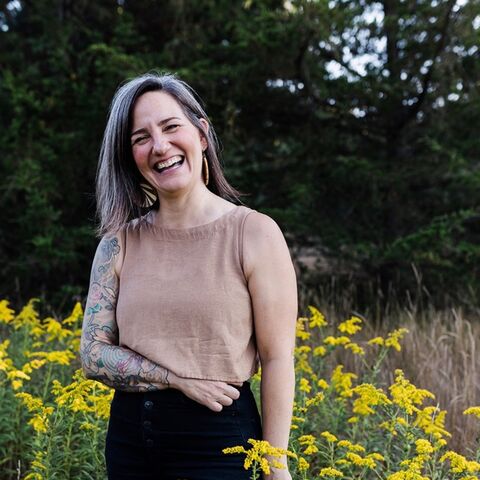
My name is Larissa.
We're going to practice together for about 15 minutes.
Just a reminder to take these first couple of moments to check in with your body.
That's always where we start.
Just something physical,
Something tangible.
Just choosing a posture that feels supportive for you.
And very often we have a familiar posture.
Maybe you have a familiar cushion or chair or place that you meditate.
And that's so helpful for our brain.
Our brain loves habits and rituals,
Things that are consistent.
And something I often share in teaching is that repetition is the key to learning.
So repetition is what our mind needs for us to stop making a decision about every single little detail.
And it starts to become more automatic.
But we also need points of novelty and playfulness.
We need points where we can really check back into those habits.
So no matter how familiar your posture,
No matter how comfortable,
Just notice,
Does my neck feel supported?
Can I take a big deep breath without restriction in my abdomen?
And just noticing,
Are there any tensile qualities in my body?
Sometimes it's the softest,
Subtlest thing.
But they're hard to notice when we have busyness throughout the day.
So just to notice for a moment,
Is there any tension in my cheeks?
Can I soften my jaw?
The smallest little neck roll can help you find maybe where there's the smallest point of tension.
And the movement itself helps release it.
Notice your abdominal container.
And that's a place where we tend to hold a lot of tension.
Just breathe.
Breathe deeply enough you can feel your ribs expand out to the side.
And then look for some softening.
Everywhere in your body as you exhale.
To even your eyelids.
And then bring some curiosity to these next few rounds of breath.
To the movement itself.
Because very often we end up breathing upward a bit into our chest.
See if you can allow the majority of your breath to be in your abdominal container.
Your chest certainly holds your lungs.
But the very top of your chest,
That part where our shoulders rise a bit when we inhale.
That part of your lungs is the smallest part.
And as your lungs expand at their base,
At their largest part.
That very subtly,
Your diaphragm pushes your abdomen out a bit to create space for your lungs to expand.
Just looking for enough ease in your body that you can allow your abdomen to press out slightly.
Your ribs to expand to the side a bit.
And maybe at the very last moment,
There's a rise in your chest.
Seek this for a few rounds of breath.
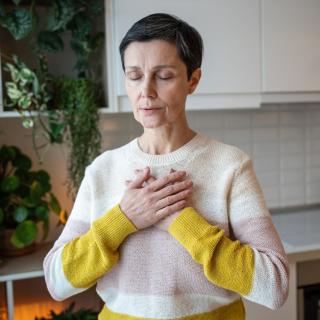
You might even place one hand on your abdomen and one hand on your chest.
Letting your lower hand move quite a bit as you inhale.
And then maybe at the very tail end of your inhale,
Your upper hand moves just a touch.
In this deep diaphragmatic breathing,
It's not only a way to help soften your whole body.
That tension we tend to carry in our chest and shoulders and jaw.
And even that subtle tension we might carry on our abdomen.
We need a bit of strength just to hold ourselves upright or walk around.
Very often that tension comes from thought patterns,
Stress in our body.
And eventually it starts to affect our breathing.
Something as simple as taking the deepest breath you can and letting your whole abdomen push out and around to the sides.
Something that simple can help shift us from stress in our mind to presence in our body.
Just notice what's present in your body right now.
Some different layers of sensation.
Pressure beneath you.
The movement of your breath.
The subtler movement of your heartbeat.
Temperature,
Balance,
Sound.
All of these layers of sensation.
And we've got a bit of slow time here just to really witness and really notice.
Your breath is the closest and simplest way to turn on calming systems.
So when we're in stress,
Fight,
Flight,
Freeze,
Or fawn.
When we're in that sympathetic nervous system that's looking for ways to keep us safe.
We start to create tension in our body.
That tension is a way for us to flee or fight.
But very often we hold that tension unconsciously.
Your breath,
Not only is it always right here,
But we don't always have to fix the external stressors.
Or figure out why they said that thing or why I said that thing and think so hard about everything.
Our breath is right here and our breath is deeply connected to our calming systems,
To our stress systems.
We don't need to be afraid of stress.
There's a benefit of stressing our muscles and making them stronger.
We can probably all think back to a stressful situation in our life that we learned something from.
But it's this low level stress that we carry that we never are able to dissipate that starts to accumulate.
As these little tensile points in our body.
At some points even restricting our breathing.
But if you slow down your exhale a couple of times.
It's your body telling your mind we're not in stress right now.
We can slow down a bit.
If you take that big deep diaphragmatic breath letting your abdomen expand and then soften.
That's your body telling your mind we're safe.
It's okay to slow down right now.
Just letting go of your brilliant mind's way of trying to think through everything and figure everything out.
And just let your body take over.
Often what this requires is slowing down for a moment.
A momentary pause.
Sometimes the wisest thing you can do is simply pause.
While the world is telling us be more productive,
Take more action.
But right here.
Pause for a moment.
Where do I feel my breath in my body?
Let me slow it down and appreciate all that my body does for me.
That might be perhaps the most important moment in your day.
And you can repeat it a million times just by slowing down.
Oh here it is.
Here's my breath right here.
Just witness it.
Just notice how this breath moves through you.
You might notice where your thoughts just were.
And there's nothing you need to do with that.
Simply invite your attention back to your breath.
It's all thinking that's happening.
Here's my breath.
Let it be deep and full.
Let your exhale be slow and luxurious.
Just one breath at a time.
This.
Just this breath right here.
This is part of our emotional intelligence.
Emotional intelligence isn't about always getting better at communicating,
Getting wiser at experiencing your feelings.
Although those things are helpful.
It's not always about becoming.
It's also about just being.
Can I just stay with myself?
Can I just be with myself?
In a moment of joy.
In a moment of sorrow.
In a moment of boredom.
Can I just stay for this moment and just witness?
Letting go of any judgment.
To the best of my ability.
And just be right here with this breath.
I invite you to bring your hands into any of your closing habits or practices.
I'm going to end with a few loving kindness phrases.
Just repeating them back as they make sense for you.
May I be healthy and supported.
May I seek and find contentment today.
When action is needed.
May I choose to move with ease and peace.
And may the merits of our practice ripple out to benefit all beings.
Go slow if you can.
There's no rush.
Whenever you feel complete.
Flutter your eyes open.
Find a little movement.
Taking a moment to thank yourself.
Just for showing up.
And as always,
Thank you for being here.
Supporting each other in this community,
This sangha.