Hi,
I'm Jeremy.
In my work with the nervous system,
Small signals matter.
The nervous system is incredibly sensitive.
It doesn't respond best to force.
It responds to precision.
So before we do anything else,
Choose a steady position.
You can sit,
Stand,
Or lie down.
There's no correct posture.
Just make sure your body feels supported,
Enough to stay here for a few minutes without fidgeting.
Stability first.
Now something's slightly overlooked,
Mostly because you can't see it working.
The nose.
We tend to think of it as airflow,
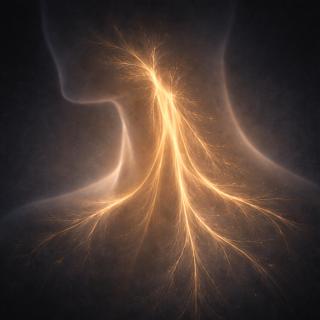
But it's actually neural tissue.
The olfactory nerve passes directly into the brain.
The trigeminal nerve maps the sensations across the nasal passages and the face.
Breathing through the nose isn't just moving air.
It's sensory input.
It's filters,
Warms,
Humidifies,
And releases small amounts of nitric oxide from the sinuses,
Which supports circulation and oxygen exchange.
Your mouth,
Useful as it is,
Doesn't do any of that.
The mouth is excellent for conversation.
The nose is excellent for regulation.
So this reset is simple.
We breathe through the nose,
And we adjust one thing.
The exit.
Before we do,
Make one intentional decision.
Your hands.
Rest them comfortably.
Palms up if you'd like to signal openness.
Palms down if you'd like to signal grounding.
Neither is better.
Just choose.
Now your eyes.
You can let them gently close,
Or you can keep them softly open.
If open,
Let your gaze rest somewhere neutral.
Not scanning.
Not searching.
Just seeing.
Orientation changes physiology.
Now let your breath move quietly in and out through your nose.
Don't improve it.
Your body has been breathing quite a while without your management.
Just notice the inhale.
Notice the exhale.
Now in your next exhale,
Let it leave slightly slower.
Not longer by counting.
Just less rushed.
Like you're placing something down carefully instead of tossing it.
Inhale naturally through the nose.
Exhale naturally through the O's.
Two percent softer.
When the exhale slows gently,
Carbon dioxide rises slightly within the normal range.
That subtle shift nudges the system away from urgency.
Heart rhythm adjusts.
Blood vessels respond.
You're not forcing calm.
You're signaling safety.
Again,
Inhale.
Exhale.
Exhale naturally through your nose.
Unhurried.
If your mind tries to perfect it,
That's just habit.
Most of us run fast breathing patterns without noticing.
Mouth breathing,
Jaw tension,
Shallow loops.
We're not fighting the pattern.
We're adjusting one variable.
The exit.
Notice your hands again.
Palms up.
Maybe a sense of receiving.
Palms down.
Maybe steadiness.
The body reads that.
Notice your eyes.
If open,
Soften the focus.
If closed,
Widen the space behind them.
Now soften the jaw.
Let the tongue rest gently.
A surprising amount of stress lives in the face.
When the face eases,
The system often follows.
Two percent.
That's enough.
Small signal.
Clear shift.
Take one final in-breath through your nose.
And let it go without trauma.