Hello,
Welcome to Ablaze Mental Training.
Today we're going to set our hearts ablaze to our breath,
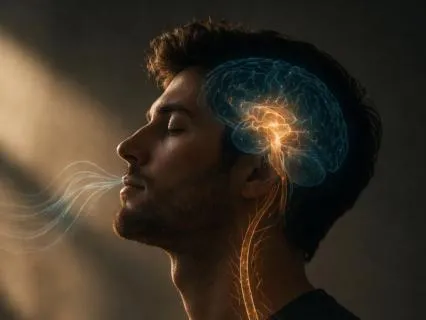
We're going to talk a little bit about the nervous system and your ability to control your internal state.
So let's find a comfortable position,
Seated or lying down,
Allow your body to settle into this moment.
Let's take a slow breath in through your nose and a gentle exhale through the mouth.
Again,
Slowly inhaling and fully exhaling,
Letting your shoulders drop,
Let that jaw relax,
Anywhere you're feeling tension,
Just let that go.
Before we dive in deep,
We're going to anchor ourselves in awareness like we always do.
I want you to do that by bringing your attention to your breath,
No need to change it,
Just observe the natural rhythm.
Open that awareness to your breath by noticing where you feel it the most.
Whether it's your chest,
Your stomach,
Your nose,
Just open that awareness to where you feel it the most.
This right here is your starting point and awareness always comes first.
Now let's deepen our understanding a little bit of the breath and the nervous system.
Your breath is directly connected to your nervous system and your nervous system controls how you experience stress,
Focus,
And performance.
There are two primary states your body shifts between.
The sympathetic nervous system,
Which is your fight or flight response,
It's your activation system and the parasympathetic nervous system.
That's typically known as the rest and relax system.
As your body shifts between these two states,
It affects a bunch of different parts of the body.
For example,
The sympathetic nervous system,
When we're getting activated,
It will dilate our eyes,
It will stop secretion of saliva in our mouth,
It will dilate the bronchioles in our lungs,
It will speed up our heart rate,
Secrete adrenaline,
It will decrease the secretion in our stomach,
And slow down the mobility in our lower intestine.
When we're activated and we need to act,
Our body shuts down specific processes that we don't need and it will increase blood flow to vital organs and things that we need.
On the flip side of that,
The parasympathetic nervous system will start secreting saliva,
It will constrict our bronchioles in our lungs,
It will slow down our heart rate,
It will increase secretion in our stomach,
And increase that mobility in our lower intestine.
These systems are also not perfect.
Our prefrontal cortex in our brain,
In layman's terms,
Deals with attention regulation,
Inhibition,
And decision making.
Under acute uncontrollable stress,
High ketocholamine release can rapidly weaken our prefrontal cortex function and bias our behavior toward more reflexive habit systems.
In other words,
If we're over activated and our sympathetic nervous system is turned up to 100,
It shuts down that part of our brain that is able to make clear decisions.
You think back to a high stress event in your life.
We all have that moment where we don't really remember why we did something.
You're like,
I don't know,
My instincts just took over.
I don't know why I did that.
It's because our body is shutting down our decision making center and it's relying on the habits and systems that it already has in place.
Obviously,
These systems aren't perfect.
They aren't designed for specific situations that they can be turned on for.
If you're going into a big meeting to do a presentation to a board,
You're going to need your prefrontal cortex to make decisions,
To be able to not be reactive and to be able to respond with clarity and with confidence.
Our breath and our heart rate is correlated with our nervous system.
Breathing is one of the few body rhythms that is both automatically regulated and voluntarily steerable.
Our breath is always with us,
It's always on in the background,
But we can always bring it to our conscious mind and take control if we'd like.
Because of this,
It can act as a controllable entry point into brain-body systems,
Such as the nervous system.
Our breathing is two-fold as well.
It's mechanical and chemical.
Mechanically,
It moves air in and out of the body.
It deals with lung inflation and diaphragm action.
Chemically,
When we're breathing,
It's regulating our CO2 levels,
Our oxygen levels,
And our acid-base balance in the body.
Breath work changes both mechanical and chemical,
And the nervous system listens to the mechanical and the chemical to switch between the sympathetic and parasympathetic nervous system.
A silly way I like to look at it is,
Your sound system at your house,
But your friend is the DJ,
And they have control of what music is being played and the volume.
As a DJ,
You've got to be able to read the room,
Right?
Your friend is not so great at that at times.
Also,
With a high-quality sound system,
If you turn the knob up,
The volume knob,
To 100,
It can get really loud,
The sound might get muddied,
And the systems inside this high-quality sound system aren't going to work perfectly.
On the flip side of that,
If you're throwing a house party,
That DJ needs to turn the music up enough,
Right,
So people can hear the music.
It shouldn't be too quiet where there's no music.
Through breathwork,
You can take control of these systems and processes,
And essentially take control of that sound system,
So you can control the volume level of these systems,
And how your body reacts to different scenarios,
Instead of having your DJ friend take control and may not be the best at.
So this is why breathwork is so powerful in performance.
Before a competition,
Before a big moment,
Or during pressure,
You can use your breath to calm yourself down,
To reset your focus,
And to regain control of how your body reacts to things,
Turn that prefrontal cortex back on,
And be able to make decisions that are more effective.
Instead of being controlled by your internal state,
You begin to control your internal state.
Now we're going to experience this directly in this next section.
I want you to bring your attention back to your breath.
We are going to shift into a specific breathing pattern known as residence breathing.
Residence breathing refers to inhaling and exhaling at a rate of around 5 to 6 breaths per minute.
A very easy,
Common approach is a 5 second inhale,
And a 5 second exhale,
With no breath holds.
This breathing technique is called residence breathing because it harnesses the natural cardiovascular resonance frequency,
A point where your heart rate oscillations,
Via your baroreflex,
Sync up with breathing oscillations,
And it maximizes your heart rate variability.
It kind of allows us to enter a calm,
Yet alert state.
We talk about awareness so often,
And being in this state,
That you're calm,
But alert,
It allows for your body to be primed and ready,
But it also gives you those small windows of opportunity to be aware,
And to make decisions,
To respond,
And not to react.
We're going to do 6 rounds of this,
Spanning for just 1 minute.
We're going to start with a slow inhale through the nose for 5 seconds,
And an exhale for another 5 seconds.
I'm going to let you continue this rhythm on your own for the next minute,
And if your mind wanders,
Totally normal,
Just gently bring your awareness back to your breath.
Whichever breath you're on,
I want you to finish that rep.
Once you've done so,
Just return to your natural breathing state.
I want you to take notice of how you feel compared to when you started.
Maybe you're more grounded,
More calm,
More present.
This is the result of intentional breathing,
And we just did it for 1 minute.
Imagine the effects that you can have if you train this consistently.
And you're doing this for 5 to 10 to 15,
Up to even 30 minutes.
As we close,
Let's take one deep breath in,
And a slow exhale out.
I'll always remind you,
Your breath is always with you.
Always available,
And always trainable.
The more you practice,
The more control you develop over your internal state.
This is where performance begins,
Not just in the body,
But in the nervous system.
When you're ready,
Return back to your environment.
Take this awareness with you throughout the rest of your day.
Have a great day,
And as always,
Set your heart ablaze.