Hi,
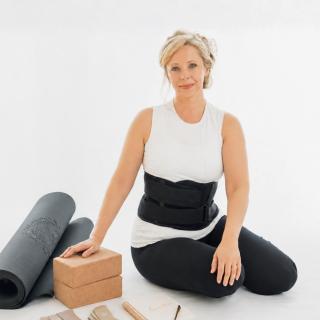
I'm Katie and welcome.
So lately I have been seeing the word embodiment everywhere.
Embodied breathing,
Embodied self-care,
Embodied parenting,
Embodied spirituality,
And it all sounds very lovely.
Yay,
Let's all be embodied,
Right?
But what does it actually mean?
So here's the definition that I like to use and share,
Is that embodiment is the capacity to feel and sense and experience what your body and nervous system are holding from one another.
Moment to the next.
That's the good stuff,
The hard stuff,
And everything in between.
And it's how experience,
Our experience of this life actually lands in our body.
And it is the place where you can begin to meet your own needs from.
So I will be honest,
It took me a long time to understand this.
I remember going to a therapeutic dance workshop many,
Many years ago.
Think patchouli in the air and tie dye everywhere.
And the teacher was standing at the front of the room swaying,
Talking about us having an embodied experience.
Yeah,
Like,
All right.
I nodded along and I went home.
And then I thought about it.
I thought about it a lot and that was the whole problem.
I was trying to understand it by thinking,
By thoughts,
By cognition.
And there is an old saying that you can study the ocean for years and still stay dry.
So it was somatics,
Learning somatics and nervous system work that finally helped it land for me.
Embodiment is a felt experience.
It's something you feel,
Not something you think.
And sensation comes first,
And then the words show up second.
So let's try it right now together,
If you'd like.
Just a brief micro practice.
But for a moment,
You're welcome to let your attention maybe drop to your feet.
And see if you can feel the floor.
Underneath you.
And notice what that experience is like.
And maybe notice your breath and where it's moving today.
Maybe it's the chest,
Maybe it's lower or somewhere else.
But just notice.
And maybe checking with your body,
Your jaw and your shoulders.
Or something else and just let them be as they are.
And this is embodiment.
I know that was a short practice.
It's simple.
You just did it,
But you can practice more.
And in daily life,
It might look like catching the tension in your shoulders before it turns into a migraine or muscle pain.
Noticing that you're tired and you need to rest while you still have the choice and the option to do so.
Or maybe it's feeling something good and letting yourself actually receive it and feel it inside and have that experience.
Or maybe sometimes it's sitting with something hard,
Just giving it a little bit of space before you reach to fix it.
So here is a question I love to sit with and I'd like to leave it with you today.
How do you know?
What is the experience?
Of being calm and being present.
What is the felt experience of that?
What is your body and your nervous system telling you?
Is there a warmth in your chest?
Can you take a longer exhale?
Is there a softness behind your eyes?
And maybe what tells you when something else is moving through you.
You know,
Once we can catch our own signals.
We can catch the shift early and we still have room,
A little bit more room to respond.
So one last thing.
Please let this come slowly.
If turning inward feels unfamiliar or uncomfortable or maybe even a little bit scary,
That's information and it deserves a gentle pace.
Embodiment is a practice.
It grows over time.
It's a process of discovery.
But we do it at a pace that your nervous system agrees to.
You're welcome to just stay curious this week.
Notice what it feels like when something good happens.
Lands inside.
And just get curious about the felt experience of that.
It's a fun practice.
It's one of my favorite practices.
I hope you enjoy it.
Thanks so much for being here.