So the diaphragm,
It's a pretty cool muscle.
In many different ways.
One of those ways is that it's not only influenced by the somatic nerves but it's also influenced by the autonomic nerves.
What that means is that you can be asleep or,
I don't know,
Watching Netflix or having a chat with your friends and you're not having to consciously think,
Okay diaphragm,
Contract,
Relax,
Contract,
Relax.
On the other hand,
We can have an influence on our diaphragm.
And one of the ways we can do that is with our breath by simply pausing the breath or by changing the tempo,
Changing the rhythm of our breath.
Will be having influence on the way that our diaphragm is moving.
The other amazing thing is that the diaphragm,
It is tucked deep inside our body.
However it has.
A ripple effect all the way through to the periphery of the body.
So the way that the diaphragm moves will be rippling through your body right as we speak.
So sometimes what can happen is we maybe start to adapt a certain posture or maybe we're a little bit stressed and our diaphragm doesn't move to the best of its ability.
And one thing we can do here is a bring awareness to this.
And then B,
Bring in a little bit of movement.
To start to allow the diaphragm to flow.
Back to its best ability.
And one of the movements that we can do is the very classic yogi cat cow.
Now normally cat cow is done on our hands and our knees on all fours however We can also do cat-cow seated or standing.
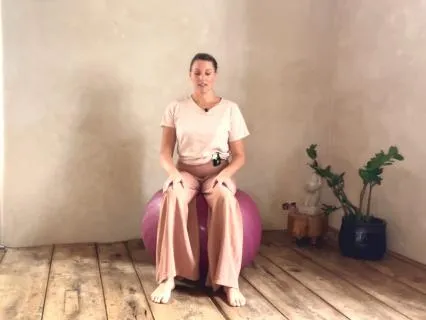
And today I'm going to be doing it on my bouncy ball.
So even when I was working in an office,
I worked sitting on a ball.
But you may be seated on your chair and that's absolutely fine.
And all we're going to be doing to start with is just noticing the way that the spine and the ribcage naturally move with our breath,
So you might like to bring your hands here just around the bottom of the ribcage and as you inhale.
You may notice that there's not just an expansion in the front of your ribcage,
But all around.
It's a 360 expansion.
And that's because your diaphragm expands 360.
And then plunges down.
So you may also find that it's not just your ribcage that expands,
But also your belly.
You might also find that your chest expands and that's because your lungs are expanding as they now have space.
Did you say?
On your exhale,
You'll find that the ribcage gathers in.
As your diaphragm is naturally lifting back up.
It requires no effort to do this.
It just naturally raises back up.
And that also feels good.
Like your chest is releasing here.
So let's do this a few times.
Feeling that expansion.
On the inhale And on the exhale.
The release.
When you bring your awareness here,
You might even notice that one side of your body is.
.
.
Responding more than the other.
You can tune into that if you'd like to.
Now in Cat-Cow,
Basically what we're doing.
.
.
Is enlarging the movement.
By maybe,
I don't know,
98%.
So what we do is on the inhale,
It's probably going to be better if I move to my side for this.
On the inhale.
There's an example.
Tension through the front body so you're going to lengthen up through the front body,
The chest lifts towards the sky,
The chin lifts towards the sky because the head and your arms are an auxiliary.
To your loan.
And on the exhale.
Rounding the spine.
Letting the head drop down.
So here.
We,
Once again,
Are basically.
.
.
Doing the exact same movement that our body is naturally doing.
The ribcage and the spine naturally move like this.
It's just not as dramatic.
So this is a natural movement.
With the breath.
So,
Here we're.
.
.
Accommodating the diaphragm,
Allowing it to flow.
To its best of its ability.
You might notice now as you inhale that your ribcage is flaring into your hands.
And as you exhale,
Hugging in.
Drawing in of the left and right side of the ribcage is a little bit more dramatic.
Now,
As I mentioned,
The head and the arms are an auxiliary to the lungs,
So you could also,
On your inhale,
Reach your arms out and rotate the palms until they face towards the ceiling so you get this lovely opening through the collarbones.
On the exhale,
Rotate the arms the opposite direction.
So the shoulders hug in.
Helping you to squeeze your exhale out.
So the more of an exhale that you're able to let go of.
And more of an inhale you can draw in.
Your arms are getting tired.
Bring them back onto your knees and as we continue now our cat cow.
I wonder if you can notice.
The relationship between your ribcage and your pelvis.
You'll notice that your ribcage juts out in front of your pelvis on the inhale.
And then the exhale,
It draws a little beyond the front of the pelvis.
And Maybe you can notice that moment,
It'll be like a microsecond.
When your ribcage comes in line once again with your pelvis.
And that might feel really lovely,
Really effortless.
Maybe the next time that you find that moment.
Just pausing there.
Most likely to be your centred space.
Where the head,
Once again the crown of the head,
Is in line with the tailbone.
The ribcage is in line with your pelvis.
And as you breathe here now.
You may be even more aware of that 360 expansion.
Without needing to use your hands.
And the full release on the exhale.
And it's a relief.
Yet there's a gentle lift and gathering.
You might be able to sense.
Around the lower abdomen.
And down towards the pelvic floor.
So.
.
.
Simply by doing this.
You know,
Every now and again.
Your A coming back into alignment,
The spinal alignment.
And be revisiting the movement of your diaphragm.
And finding a full healthy movement here.
So I'll leave you here.
And you're welcome to sit for as long as you want,
Feeling into the flow of your breath.
And your centered space here.
I wish you a lovely day.