Hello,
And welcome to the session,
I invite you to take a seat,
Or lay down,
And get yourself comfortable.
You can close down the eyes if you wish,
And take a deep,
Slow breath,
In through the nose,
And out through the mouth.
So today we're going to be looking at a practice from the book,
The Dice Man,
By Luke Reinhardt.
Now if you want to do this practice,
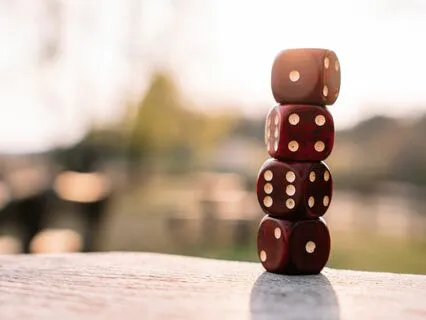
You're going to need a dice,
And a pen,
And a notepad.
But considering the nature of the practice,
You may instead prefer to just use the practice itself as a trigger,
Or a contemplation.
In the book,
The main character is going through a crisis of sorts.
Their life is not that exciting,
And they're not really living in the way they want to be living.
They're a bit indecisive,
Not that popular,
Not that successful.
So on a whim,
The main character decides to let the dice decide what they're going to do.
They get a pen and a paper,
And allocate to the faces of the dice,
From one to six,
Different options that they could do,
With one of those options being something they very much would love to do,
Another option being something they very much would not want to do,
And other options in between.
And they roll the dice,
And the practice in this book is to,
Well,
Do what the dice tell you.
Now I'm not advocating necessarily doing this,
Because you are taking choice out of your own hands,
And in the book the practice gets significantly more complicated,
And the plot expands and it becomes a whole thing.
And you know,
When this book was released,
There was a collection of groups all over the world that developed dice man clubs,
That started this as a practice,
And was actually doing it.
So that option is definitely available to you,
Were you to choose it.
But instead,
What I'd like to do with this session is use this practice,
The idea of allocating choice to fate,
As a way or a contemplation of free will,
Of choice,
Of determinism.
So for the next minute,
I just want you to sit with the concept,
And ask yourself the question,
Could you?
Could you consider doing this practice?
What would it mean to give up your choice to the dice,
To write down the options,
Something good,
Something bad,
And everything in between,
And then roll,
And then actually enact it?
So this concept of giving up control to the dice is interesting,
Because it's not purely a decision to give up free will.
You get to choose what's on the dice,
What each dice roll represents.
And in the book,
They start implementing,
You know,
The roll of two dice,
And you know,
Probability,
It's like,
Well,
You'll put heaps of weight behind this choice,
Not much weight behind that choice,
But the dice still have a say,
Chance can still make you do X,
Y,
And Z.
So it's not purely free will,
It's not purely fate,
It's not purely giving up control.
But there certainly is an aspect to it.
But this practice makes me really consider the nature of making decisions in my mind.
The more I meditate,
The more I realize that oftentimes I make decisions without thought.
It's like the decision has been made for me,
I see the decision forming in my mind,
Then it lands,
And then I find myself doing the activity without really much mindfulness.
The more I'm mindful,
The more I'm focused,
The more I'm present,
The more I'm aware that oftentimes,
I'm not in control.
Oftentimes,
I'm sort of led down a path,
Led down a path by ostensibly the thoughts in my mind that are me,
But I find myself trapped by them.
If this sounds a little bit trippy,
Or obscure or abstract,
I do apologize.
But apparently,
It's a common factor of people that meditate more,
They start to see themselves and are detached from themselves enough to notice when they find themselves doing things based on impetuses outside of their control.
It's like,
Well,
Based on my past,
Based on the current events,
Based on a variety of different things that I can't quite place,
This is the course of action that I'm going to take.
And you do.
So there's something interesting there.
But beyond that,
This process of allocating choices to chance,
It's kind of terrifying,
But also kind of liberating.
You know how it's sometimes quite hard to make a choice?
You don't quite know where you want to act,
Or what you want to do,
Or what you want to be.
So you're like,
Oh,
Hey,
Flip a coin.
And as the coin is in the air,
You know the answer because you don't want it to land on heads or tails.
You know which one you want it to land on and what you want to do.
But until the coin was in the air,
You couldn't decide.
There's something about that.
There's something about an externality making a decision for you that is liberating.
It's freeing.
Well,
This is what fate decided because some of us want to defer responsibility,
Or we struggle to make that choice for whatever reason.
But also it's obviously terrifying because,
Well,
What if the dice lands wrong?
What if I have to do that thing that I might not want to do?
And once again,
Without spoiling the book,
The dice often lands on things that the characters don't want to do,
But they do them anyway.
And that has this way of opening their lives up to new and exciting and different possibilities.
It's not really necessarily good.
You know,
The plot of the book is the plot of the book,
But I want to sort of divorce this discussion of the practice from the plot.
But if you imagine if you were to follow these choices and do things you wouldn't normally have considered doing because it's out of character,
But the dice tell you to,
What does that mean for your life?
You are under no obligation to be the person you were five minutes ago.
I think it's an Alan Watts quote.
You're under no obligation to be the person you were five minutes ago.
You're under no obligation to sit with the choices you've previously made.
You can change.
You can be whoever or whatever you want to be in any moment,
But we get stuck in these comfortable ruts.
And this practice,
This idea of being the dice man,
Is like an external tool that will allow us to potentially look at life from a different perspective.
What if I did something different in this moment?
What if I choose left instead of right?
What if I gave up choice?
What would that mean?
What would it mean to live life without choice?
There's some deep philosophical questions here of what it means to be a person,
Of what it means to be a human in this world.
So whilst I'm not advocating that you do this practice,
What I would suggest is that it would be good to contemplate what it would mean to give up choice or to allocate choice to an externality,
To chance.
Let's sit with that for another minute.
So,
How'd you go?
I'm curious to hear what the dice man practice would mean for you,
Or giving up choice would mean for you.
So I invite you to write down your answers in the classroom and ask any questions there,
As well as check out the responses from other students,
As well as the ones that I'm giving daily.
Because in this way we can create a form of synergy and connection and growth in which the sharing of wisdom and insight will help each and every one of us to further levels of attainment.
I look forward to seeing you there.
This track was taken from the course Finding Enlightenment Through Fiction.
It's out now via my profile on Insightama,
And I invite you to check it out.