Hi,
Everybody,
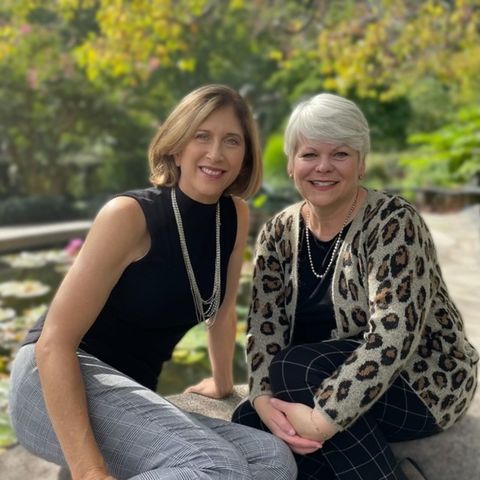
And welcome to Two Eyes Women Talking.
My name is Shira Khan.
Hi,
Everyone.
This is Diana Zahir.
I'm so happy to be here with you and with Shira.
We've been together for 30 years as friends and students and teachers.
We're so excited to talk about the mystery and the path and this present moment.
So let's get started.
I have the privilege right now to bring our attention to the energy of safety,
To bring our attention to our breath and to inner quiet.
This is one of my most favorite things to do when I'm alone with myself or I'm with my students.
So let's all do that together for a moment.
I want you to get comfortable in whatever way feels right to your body.
I want you to feel the chair or the bed underneath you.
It's the only reason for existing in form right now is to support you,
To hold you,
To show you that right now in this present moment,
You are safe.
We don't need to believe that with our minds,
But we want to check that out with our bodies.
What if that's true?
I want to invite you to put your left hand on your heart center and your right hand on your belly and to notice your breath.
You don't need to change anything.
The simple awareness of our breath can invite it to soften,
To spread out,
To take up a little more space,
To travel into the nooks and crannies where it needs to go.
I want you to notice the experience of having a body right now,
A body that's safe,
A body that feels the cushion against it,
A body that is in quiet,
A body that can feel gravity,
Simple,
Safe existence.
As we begin our podcast today,
Feel free to stay in this zone with yourself.
Whatever feels helpful can let that information come toward you,
Or if you would rather,
Just stay with this simple,
Quiet,
Inside of you,
Outside of you,
Wherever you locate it,
I'd like you to do that.
Shira,
I am so grateful that we are looking at the energy of our body,
The energy of our body,
The energy of our body,
The energy of our body,
The energy of our body,
I am so grateful that we are looking at the energy of safety together today.
Yeah,
I am too.
It's super important.
It's also such a gift to be introduced to the idea of safety,
Especially for those of us who didn't have it growing up.
I really want to encourage everybody to feel into whatever came up for them in that short safety meditation,
And to appreciate how courageous it is to feel that.
It takes a lot of courage to go into a part of us that we may not have spent that much time with,
Since we grew up feeling unsafe a lot of the time.
That's a great point.
So,
Some people may feel sensations of calmness and a quiet mind.
I invite people to note what sensations you had along those lines.
And for some people,
Just the act of turning inward can bring in a protective part of the psyche that doesn't allow us to drop in fully and doesn't allow us to feel safe.
Yeah,
We need to name that,
Don't we?
Yeah,
We do.
So,
This unsafe part,
Diana and I teach about this a lot,
And we're going to be teaching in detail about it in a future podcast.
But for today,
Let's just say what it is so that people can recognize it and begin to see it not just as a phenomenon that takes over,
But as something that happens to everybody.
So,
What Diana calls the critical voice,
I talk about in my teaching as the inner critic,
Freud identified this part of the psyche as the superego.
So,
We may hear all three names.
Yes.
So,
The superego was designed to help us survive and to help us feel safe.
But what happens is it stays loud even when it doesn't need to.
So,
The superego works through the nervous system they work together and when the nervous system is triggered,
The superego gets big and loud.
But that alert system wasn't meant to stay on,
Yet it does if you have repeated dangerous experiences when you grow up.
Then you go into adulthood and the superego in being big and loud,
It could take the form of attacks and put downs and disparagement that actually make you feel bad.
They make you feel scared.
So,
It's like a protective system gone awry.
So,
We want to name that now while we're talking about safety.
We're about to delve into safety more,
But we wanted you to know that there's this thing that also happens that we can learn about.
Yeah,
That's really helpful.
And people might feel that today when we're talking about safety.
Your critical voice might be hovering.
Thanks for explaining that.
Yeah,
You're welcome.
And we look forward to giving you tools for that critical voice later on.
But for now to just know,
Oh,
There it is.
And to know that it's a part of your psyche,
It's not necessarily telling you the truth.
It's not necessarily telling you things that are true now.
So,
Just to know those couple of things that you're talking about,
So just to know those couple of things when you go into it,
I think that's a good foundation for the conversation today.
Perfect.
So,
In a weird way,
The critical voice is kind of helping us because it's ringing the alarm system.
It's part of that very old paradigm that's starting to get redesigned that we have to be in survival mode to be on this planet.
I don't think that's true anymore.
I think it's been really helpful and it's always there if we need it.
But what if the operating system of being here now was love and aliveness and curiosity and integrity and awesomeness instead of go to survival,
Go to survival.
We still can.
And I want to add to that empowerment instead of power over.
Yeah.
Yeah.
It's almost like the critical voice has company.
It's been this lonely guy or girl after going,
I can protect you,
But I'm exhausted.
Okay,
You too can come to the tea party.
That's really interesting.
It's really interesting invitation.
Yeah.
Yeah.
Like I've been working so hard trying to run everything,
Trying to keep everything.
Generations of humans I've had to keep on the planet,
Slapping them around,
Telling them how they suck.
I always think of that tea party of the Alice in Wonderland tea party,
That kind of wild mad hatter tea party.
It's not going to be a normal tea party.
Something really wild and creative and the tea is spilling,
But people are having a great time.
Why not?
Why not have all of our parts there?
Interesting.
Yeah.
Yeah.
We all want company.
Yeah.
Yeah.
To think of the super ego as wanting company or wanting a break.
And who has been the unwanted cast,
Uninvited cast.
We're all having a great time with the mad hatter.
Right.
And critical voice has been on duty in the survival lands.
That's like for a guy,
For a girl,
You want a cup of tea?
Just chill out.
It is a really interesting way of looking at things like,
Can't you tell I'm burned out?
I've been running on empty.
I'm doing crazy stuff now because I'm running on empty.
That's the pandemic though.
I mean,
In a nutshell,
People are so worn down.
People are so exhausted and there's hope and there's,
You know,
Good things coming,
But they just want to hug someone.
They want to go to a dinner party.
They want to go on a vacation.
Oh,
Really been pushed to this thin edge.
Yeah.
People who live alone,
People who live together,
Everyone is so exhausted.
Yeah.
Which we can feel so much compassion rising out of us for them.
And I think it's also kind of this genius of if we have that experience and form keeps being unreliable.
And how are we going to make sense of it only from the formless,
Which is where we came from and where we're going.
So we could get to know it now or not.
Yeah.
Well,
When we're not going out,
Not doing our normal things,
What choice do we have?
We're sitting with whatever is inside.
Yeah.
What's it like for me to be alone with myself?
Right.
Not always a question people are used to asking or comfortable asking.
And I think what we're talking about today is what's the first answer that comes?
Where do we begin?
Cause that's just a very little beginning.
That's the thread in the tapestry.
Let's start there and then see what else is possible to discover here.
Cause that's not all that's happening.
Especially if what I find when I turn toward myself doesn't feel good.
That's a little layer.
That's just a little teeny layer that can melt.
And then there's more and there's more and there's more and what's in there is good.
Mm-hmm well,
I think that's the thing that is scary is the idea,
The belief or the experience that if I sit still,
It's going to be very unpleasant.
Like what's going to come.
Or the beliefs will come and I'll believe them.
Like I'm bad or I'm unlovable or I'm not good enough.
And we're having a very probably sparse visit with the critical voice.
No tea,
Just maybe some water.
Like,
Well,
Let me tell you who you are.
It's like,
Ah,
Right.
Why would I stay in that conversation?
If I'm a person who is going through the pandemic and all of this crazy stuff has happened.
And then I'm wondering what else is there.
Right,
Like why am I here?
What's the purpose of my life?
What do I want to do with my days?
Because everything I knew before is really not there anymore in a reliable way.
And maybe I'm understanding that part of this journey is to turn toward myself and to have a moment in here,
Just me with me.
If that's so out of my known experience,
What can happen is I'm met by the critical voice.
The conversation that happens is not pleasant or welcoming.
Maybe I hear judgment,
Comparison.
Well,
You're not very good.
No,
No,
No,
No,
No.
You really should,
Your friend has this and da,
Da,
Da,
Da.
So if I know that's just the very beginning of the journey to drop into who I really am.
And I have that reference point and we're giving these cute ideas of this tea and it's splendid and abundant and delicious and all these people are there.
Maybe we'll even invite the critical voice who's always the one left out.
I think this first visit inside can often be just me with a critical voice giving me a hard time.
Yummy tea cakes,
Maybe some old water.
And if I encounter that,
It's like,
Why would I stay there?
Why would I do that?
And so what we're giving as a reference point is that's just,
It's like the guard dogs or something.
It's not true.
That's not who I really am,
But that's that survival level that I may have inherited from my family or my culture or the world.
And also to understand that.
To add in,
What if when I sit and turn inward,
What if it could be friendly?
Because I don't even think that question is posed or that I don't think that possibility necessarily is.
Even there.
And also,
I mean,
One of the things that we were taught by the way that they taught us Diamondheart and taught us to be with ourselves is that you don't have to go in unless it is friendly.
We're not going to make you go in so that you can be vulnerable to more attack.
That the first thing they taught us was working with the critic.
Right.
And that's where friendship and companionship come.
Because in the beginning,
I need this other voice.
I need this other presence that can hold both for me and say,
Wow,
I really hear that when you turn towards yourself,
This is the message you get.
And I know that's hard to hear.
And let's care for the part of you that feels that.
And I want to tell you,
That's not my experience of you.
You mean another person.
You need another person,
A teacher,
A counselor,
A guide,
A friend who's doing inner work.
We're getting those reality checks.
And that's where until it's friendly in here,
We've got to create the friendly support system.
But because it's who we are,
Remember things that aren't true,
They dissolve.
All these layers of judgment will dissolve.
What is true,
Like love and aliveness and curiosity,
Those keep flowing.
Those are the river.
And we can look at this through all different traditions.
I'm thinking of the Christian tradition when they're talking about wonderful counselor.
You know,
For a lot of people,
Jesus is that for them.
Or in other traditions,
Buddha or Muhammad or all these different ways we have an inner relationship with some loving and wise big brother or big sister.
Until we naturally know who that is,
Until we can drop into that,
We have to bring in our helpers.
Maybe it's some beautiful image from literature,
Some wonderful,
Generous,
Positive champion,
Or maybe nature spirits.
I mean,
Everybody's going to find their inner companion.
And that's creative.
That's so cool.
We can be creative together.
Or they hear your voice,
The people who learn with you.
For a while,
They're absorbing your voice in their heads.
That's what's so beautiful about being a human being.
We're designed to learn.
We're designed to evolve.
We're designed to grow.
And I think,
As we come to the end of our talk today,
What we're saying is,
We're designed to be friendly.
It's friendly in here.
But there may be a lot of protective layers that were about survival.
And we all know when you're in a crisis,
You're just doing what you got to do.
It's not about being friendly.
It's just like,
Take care of this.
So as this idea that we may be starting to have a time on the planet where survival isn't the main operating system,
There's friendly again.
Yeah.
Along those lines,
I was going to say this a minute ago.
So when you sit with yourself,
And then the first thing is some super ego,
Something or other,
So the super ego,
It forms and it says what it says,
Usually,
Based on a person's trauma,
Based on things that happened to them that were painful.
And then the super ego can be understood as coming in to try to actually help with that trauma.
And this is not to say that you should listen to what your super ego says and let it bully you.
I'm not saying that.
But when you look at the really big picture that that is there.
And I wanted to add that at this point,
Because if you know that when you sit with yourself that your trauma might come up,
Then you're not only ready for your super ego,
But you might be ready to have compassion for yourself and to know that whatever when you sit still,
Whatever still wants to be healed,
Whatever still needs healing and resolution is going to be there.
And if you know that,
Then that may open the door to some more friendliness also.
Yeah,
This is nice because I think you're pulling back in what we started with.
So it's a good takeaway,
Perhaps from today,
That focusing on safety is very friendly and very effective.
And that's what the critical voice,
The super ego did for us when we were little and we didn't know how to do it,
Or it's how our families tried to help us.
It's like a manufactured safety or it's a thing that it concluded from the trauma.
Like,
Okay,
If that's what's going to happen,
That's what happens to you.
Then this is what you need to do to prepare for that or to work with.
Absolutely.
It's a very particular way of trying to create safety for us.
So if we're aware of that and we're leveling up so much,
Learning how could I keep myself safe right now,
Or even more transformative,
I think is how am I actually safe right now?
Because if I can use my awareness to see all these different moments that give evidence of my safety,
I start to feel it.
Like,
Wow,
I hear the clock ticking.
It's making me feel safe.
I see my dog sleeping on the floor beside me.
I'm feeling really safe.
I notice everyone in my house uses quiet,
Calm voices.
I feel really safe.
I'm thinking into the experience of safety,
Knowing myself as being safe,
Having some meditations,
Talking to a teacher,
Being part of a community that feels safe.
We start to nourish ourselves with safety.
Then the critical voice can take a coffee break or maybe a couple of days off.
Then when I turn toward myself,
Then it's like,
Wow,
There's safety again.
Then there's more safety.
We never know what we're going to find because it's the river running,
But I can be creative.
I can learn these ways of caring for myself where my lived experience is this present moment.
It's not the historical,
Let's keep you safe just in case,
Which we appreciate.
That's always there if we need it.
But I start doing something differently in my understanding of right now.
Wow,
I'm safe right now.
What if I let myself have three breaths feeling safe?
I've shifted the pattern.
I've shifted the programming.
Little teeny moments are shifting.
I'm remembering in your house in Montclair that it had an alarm system and I had to learn how to put it on because I was taking care of the cats.
I'm remembering that you allowed a protective part of you to be,
You sanctioned it and acted upon it in a certain way that I hadn't figured out yet.
The way I took the inner critic work was that there was a zero tolerance policy for having the super ego.
You weren't supposed to have one.
And so I would,
In a certain way,
I don't think that's true anymore of how they teach it,
But in a certain way,
When I recognized critical voice is coming,
Then I would reject it.
And there were times that the critical voice was trying to warn me about something and I didn't listen.
So in general,
I think the critical voice has been too big and it's hurtful to people when they sit still.
But I think I just want to say from the beginning,
I think what people need is a small critical voice that gives reminders and suggestions,
But not attacks.
Yeah.
And you were really taking care of yourself by listening to that part of your psyche going,
Hey,
You should put an alarm on and you know what?
Everyone's going to feel safer if you put an alarm on instead of saying to that part,
Oh,
You're being too critical or invasive,
Or I'm not going to listen to you.
Right.
I first of all,
I want to thank you for taking care of my cats.
I love them.
My pleasure.
Thank you.
Thank you,
Sandy.
And what do you think you?
Yeah,
I think this is a nice topic and maybe we could have a conversation about safety in more depth in one of our visits.
Yeah.
But I think what comes up in me hearing that is that if we're aware that the critical voice has come into form and been handed down through the generations as a way to keep us safe.
And that I always love in your teaching this idea of finding the right size of critical voice.
I think that's really powerful because it can totally dissolve,
But I don't know that most people want to do that.
It's like,
Wait,
What about right and wrong?
And it's like,
Yeah,
Keep it at the size you like.
It's always there.
It's always there hanging out.
But the difference here is we're creating a whole team of helpers internally.
Exactly.
Not just that one.
Right.
That's right.
It's a friendly collaboration inside.
It could be a really big group.
But I think that example of the alarm system is a good one because each one of us knows nobody can decide this for us because they're not in here.
I don't know what you exactly feel,
But I know in my inner harbor how I'm feeling,
What I need,
All the nuances of that.
And part of that is here's what I need to feel safe right now.
That other person may say,
Well,
That's ridiculous.
You don't need that.
It's like,
Well,
Actually I do.
And I know because I'm feeling how it feels for me when I give that to myself,
Then I relax and I feel safe.
And what I need to be safe is really precious.
And it might just be right now.
I might not need that in two months or two years,
But today that's part of what I can discover when I turn toward myself.
Wow,
I really need this.
This would feel good to me.
And then what happens if I give that to myself?
Oh,
This is such an experiment.
It's an experiential feedback system.
Yeah,
When I turn this alarm system on and I go to sleep at night,
I can disappear.
I am really glad we're ending on this because I think it's something that we do a lot to ourselves of apart saying I need something.
You don't need that.
No,
That's not appropriate to need that.
You don't know.
And that's a major way that we're unfriendly to ourselves.
But we wouldn't say to a friend who's like,
I'm thirsty.
No,
You're not.
You don't.
That's too much trouble to get you something to drink.
We wouldn't do that.
And so this is a pervasive way that we're not friendly and something that if we add in is so welcoming to ourselves.
Yeah.
So,
Of course,
We're going to have a lot of talks about the critical voice in our podcast.
But just as one little caveat here that a lot of the people listening to us already know because they're doing such deep work in healing the critical voice.
What you just said,
It brings up so much compassion in me because that part of us that developed it says,
Nah,
You don't need to do that even though I'm really thirsty.
Right.
That is part of what has been absorbed when we're children by the people in our environment.
Our critical voice got shaped by the tone.
Somehow those adults had that mechanism operating in them.
So that's where it's that whole generational piece of survival coming down through all the human families,
Not to cause children any pain.
All parents love their children.
We want the best for them.
We want more than we had.
But there's all this distortion that's come down through the generations where if I'm a parent and I'm hard on myself,
That's going to get absorbed by my child on some level.
And then they're going to grow up being hard on themselves.
So this idea that we could be so radical,
We could be such renegades in our own lives of saying,
Hey,
That sounds pretty nice to me.
I think I'll try that.
We have shifted this energetic force that has come down probably since the beginning of time where we don't turn toward the self and see how I'm feeling,
See what I need.
And it's safe in there to do that.
And I can experiment and create more wellness,
More kindness.
That is so important for our own lives.
It's so important for the children we're raising.
It's so important for all the people that we'll be in touch with because we're shifting the mechanism.
The critical voice is such a huge part of that survival mechanism.
So it's really micro what we're talking about,
That little moment where I notice I'm thirsty and I override it.
That's a holy moment.
That's a holy moment for us,
For our bodies,
For the energy we're creating in our homes.
It's a holy moment for humanity.
The simplest little thing of,
Hey,
I'm thirsty.
What do I want to drink?
I think I'm going to give that to myself.
Because we had shifted,
We are shifting this force of survive,
Survive,
Survive.
Don't include the visit to the self.
How amazing.
And it can just be about my self-care.
It doesn't have to be bigger than that.
But it is so much bigger than that.
The emanation of living that way.
The concentric circles of good that come from that.
The concentric circles of good that come out of me doing something different with myself than my history did with me unconsciously.
And that also gives the critical voice a chance to go away and relax.
I don't need it to be alive.
I thought I did.
What if I don't?
What if we have other options?
What if we can make other choices for our lives?
Yeah,
We have a different way of relating to ourselves and to other people and to the world with the foundation of safety and being able to put the critical voice in perspective.
Super exciting.
More to come on this topic and many others.
I'm so glad we got to do this today.
Yes,
And I want to thank all of the listeners for engaging with us and with this material.
Have a beautiful day and a beautiful night,
Everybody.
And be sure to enjoy your closeness with yourself and with everything you love.
Bye for now.
See you next time.