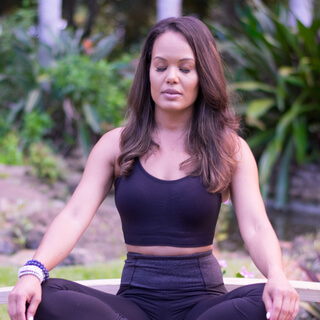
I invite you now to transition into the practice and I'm going to make a few adjustments here to get really comfortable.
If you're sitting in a chair,
You might find it helpful to just plant your feet firmly on the ground.
And if you're comfortable,
I'll invite you now to close your eyes or perhaps identify a spot on the wall in front of you or an object in front of you.
But find an area where you can really gather and anchor your attention and hold a low,
Soft gaze looking downward.
And so as we start this practice,
Really taking an opportunity to relax ourselves,
Relax our minds and our bodies and really sink into this moment.
Really allowing yourself to bring your back and your posture to a position that you can breathe with a sense of ease and a sense of calm.
And quickly scanning your body to see where in your body might you be able to cultivate a little bit more relaxation.
Where might you be able to soften?
And so let's start by maybe checking in with the muscles in your face and see where in your face might you be able to soften just a little bit more.
So bring your attention for a moment to your eyebrows and see if maybe you're knitting the brow and could benefit from really softening the forehead.
And perhaps you might be squinting the eyes or maybe pouting the mouth.
It might even be interesting to take note of where your tongue is right now.
And notice if it's affixed to the bridge of your mouth and if it is,
Just go ahead and allow the tongue to sink into the back of your throat,
Just relaxing the mouth a little bit more.
Checking in with the jaw and seeing if for some reason you might be clenching that area and see if you can just soften a little bit more.
And one of my favorite things to do is just bring the shoulders up to the ears and roll them all the way back.
Each exhale allowing yourself to just relax and let go.
Working now with your posture and see if you can make any adjustments to bring more comfort,
More ease to the posture.
You might even imagine stacking head over heart,
Heart over pelvis.
So bringing a relaxed and yet alert position to the back.
And then bringing your attention to your thighs and to the seat area,
Maybe even focusing on the knees and noticing if for some reason you might be tightening those muscles in your seat,
In your thighs or even in the knees.
This next breath,
Allow yourself on the exhale to just let go.
Now bringing your attention to your feet,
Just take note of your feet firmly planted on the floor.
If your legs are crossed,
You might just notice the point at which your feet are making contact with the floor or the bed or the chair,
The cushion that you're sitting on.
And so on the next inhale,
Quickly scan your body starting at your feet and making your way up to the knees,
To the thighs,
To the back and all the way to the head,
Identifying any area where you might be able to soften just a little bit more.
And on the exhale,
Allowing yourself to just let go,
To surrender.
Exhale and relax.
And then bringing your attention and your awareness and just noticing your state of being right now.
Noticing the state of your mind,
Noticing the state of your body.
You might notice that you're tired or a little agitated today or maybe you're a little achy or in pain.
Maybe you feel great,
Without judgment,
Just noticing how am I doing today?
And continuing to breathe,
We'll use our breath as an anchor for the practice.
And so let's take a moment now to establish the location of our anchor.
You might notice the part of your body where you can feel your breath the most.
Checking to see how easy would it be for you to listen to the sound of the breath.
Perhaps it sounds like the ocean.
You might also notice the sensation,
The tickling sensation of the breath entering the nostrils and to the back of the throat.
Maybe you can really feel the movement of the breath as your chest moves up and down.
Maybe placing a hand on the belly to really experience the movement of the breath as your belly pushes in and out on each breath.
So take a moment right now just to locate where is your anchor?
Where in your body can you identify your breath the most?
And in this next moment,
Just allow yourself to gather your thoughts,
Gather your focus and gather your attention.
Really tuning in to that part of your body.
Just noticing the breath without trying to change it or control it in any way.
Just noticing the breath.
And as we shift into the practice,
I'd like you to bring to your mind's attention a moment in recent weeks or months where you've had an experience that gave you a very strong emotional reaction.
Maybe a conversation,
Someone said something or did something.
You heard something indirectly.
With multiple scenarios emerge for you,
Just trusting your instinct to guide you to the one that deserves your attention right now.
And so take a moment to recall the details of this memory.
Really bringing to mind the space that you're in,
The people involved or the person involved,
If any.
Really bringing clarity to recalling this experience.
Continuing to breathe and just noticing any emotional reactions,
Even as you're simply recalling the experience.
Really leveraging the power of the breath hair to help you to calm your parasympathetic nervous system.
And so if at any moment you really sense yourself having a very strong reaction or maybe you find that you're getting really pulled back into the swirl of the event,
Just remind yourself that you're simply observing the situation as if happening on a screen.
And really allowing the power of your breath to help you to feel a significant sense of calm.
And so you might find it helpful to really deepen the breath.
Just allow yourself to breathe through this moment.
Breathe through the experience.
Having capacity to allow yourself to recall this memory.
And at any point,
If this gets too uncomfortable and your breath is not helping,
Really just trust yourself to go as far as you are willing.
And if it gets too hot to handle,
You can stand up,
Walk around.
Just trust yourself.
Remembering to breathe.
Now let's start to investigate the specifics of this scenario.
What is the moment?
Can you identify the flash?
What is the trigger that got you worked up?
Is it something that perhaps was said,
Something that was done,
Something that was not said?
What is that moment?
Go back to that moment where you can really sense yourself getting emotionally reactive,
Angry,
Frustrated,
Sad,
Disappointed.
Maybe even critical of someone else.
And how did you respond to that trigger?
What did you say?
What did you do?
What might have you been thinking?
What might have you been feeling?
Continuing to breathe through the experience,
Just observing the scenario on the screen of your mind without becoming the character,
Just watch the movie,
Just watch the replay of the scenario.
And as you watch this play out,
What do you sense might have been your unmet need?
What do you sense in that moment would have been most helpful for you to feel,
To know,
To have happen for you?
What did you need?
To be seen,
To be heard,
To be loved,
To be held,
To be validated,
Acknowledged?
I just needed.
.
.
Notice right now what is coming up for you.
Where is your mind going?
Are you blaming?
Are you criticizing?
And allowing yourself to let go of that and really returning,
Making that U-turn and bringing your focus and attention to you.
Forget about if there was someone else that was there.
What did you need in that moment?
The reassurance that it was going to be okay.
Knowing that you would be safe,
Knowing that you would be loved,
Knowing that you're cared for,
That your opinion is valid.
What did you need in that moment?
Now,
Taking this opportunity to really exercise your own resourcefulness,
The power within you,
To hold,
To comfort,
To support,
To love and care for yourself.
Take this opportunity now to give yourself the support and reassurance that you needed in that moment.
The need to belong,
The need to feel included,
Wanting to be appreciated.
How might you show yourself that gesture?
And as if this is a friend telling you what they needed,
How might you comfort that friend?
What might you do?
What might you say?
Go ahead and in this next moment,
Offer yourself a few words of reassurance.
What might you say to that friend who experienced what you did?
And you might find it helpful to maybe place a hand on the heart and really just hold yourself as a way of demonstrating,
I got you.
Continuing to breathe through the experience,
Remembering simply to just observe,
Not becoming the character,
Just watching the movie on replay.
And so looking back at this scenario in retrospect,
How might you have wanted to respond?
Feeling what you know now,
Feeling what you feel now,
How might you have responded differently?
What would the wiser,
More thoughtful,
Loving and compassionate version of you want to respond in that moment?
Continuing again to just breathe.
Really just taking a moment here to acknowledge yourself for taking this time or checking in with yourself to connect with yourself.
And regardless of the outcome,
Regardless of what you've experienced today,
Just really patting yourself on the back for taking this time for you.
And recognizing that this might be a scenario that you might need to revisit a few more times.
Just really celebrating the fact that you're able to scratch the surface and really be introspective about what happened and maybe identify an alternative to how you might have responded.
So go ahead now and take a few deep breaths in two,
Three,
Four and exhaling out.
Breathing in and breathing out.
And bringing our practice hair to a close.
When you're ready,
Just gently open your eyes,
Bring your attention back to the video.
And if you have a journal,
A notebook,
A piece of paper,
Maybe you can take notes in your book,
I'd like you to take a moment to document what you've noticed,
Whatever has been revealed to you through this practice.
And recalling if nothing else,
Were you able to identify what was the trigger?
What was it that got you worked up?
And how did you respond?
What was the emotion,
The thought,
The behavior?
What did you do in that moment?
And third,
Maybe the next time that you experience this,
That someone says this to you,
That you feel this way,
How might you want to respond in the future?
What might you be able to experiment with?
Thank you so much.