To your friends.
In this reflection,
I would like to introduce you to the Japanese art of Kintsugi.
Or golden joinery.
You will see how this technique.
Which involves the mending of broken pottery.
In such a way that the cracks and imperfections can be seen.
This is something that we can apply in our everyday lives.
But first we need to step back from the busyness and take a little while to relax and become present.
So let's just do that.
Relax.
Leave aside the list of things to be done.
And enjoy just one minute of quiet music before we begin this reflection.
Welcome back.
I suppose the normal method of fixing broken objects is to carry out the repair in such a way that the break cannot be seen.
Japanese idea of Kintsugi.
Adopts an entirely opposite approach.
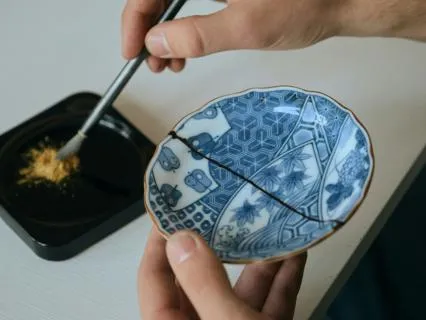
This ancient practice involves mending broken pottery with lacquer mixed with powdered gold,
Silver or platinum.
Not only does this restore the item,
But by highlighting the cracks and imperfections.
It also transforms the damaged piece into a work of art.
When you stop to think about it.
You come to realise that this approach can be applied to different aspects of our lives.
We see that it can be applied to the idea of recovery and personal growth.
It has applications in business.
It has lessons for us when it comes to organising society.
In our throwaway world,
Threatened as it is by climate change.
We need to practice the art of Kintsugi.
And it even has lessons for us when it comes to politics.
So moving forth beyond the minor matter of broken crockery.
Notice how in our daily lives we often strive for perfection.
We can come to believe that flawlessness is the key to success and happiness.
But the philosophy of Kintsugi reminds us that imperfections are not only inevitable,
But also valuable.
How many of our shelves and presses are occupied with what were sets of crockery,
But now missing cups and saucers and plates and bowls?
And have any of us ever managed to hold on to even one unbroken set of drinking glasses?
Cracks and breakages happen regularly in the case of cups and saucers,
And they also happen to us in the course of our lives.
We could avoid breakages by doing absolutely nothing.
But where would that leave us?
When a kintsugi expert mends a piece of crockery,
We see the golden lines in the repair.
These visible lines add character and uniqueness to the object.
In the same way,
Our imperfections contribute to our individuality.
They make us who we are.
Life at times can be filled with challenges and setbacks.
And these can leave us feeling broken and defeated.
But the practice of kintsugi reminds us that healing is possible.
And that we can emerge stronger and more beautiful because of our struggles.
Just as broken crockery doesn't have to be thrown out,
We with our own imperfections don't need to be written off.
Let's have a pause for reflection now before we move on to consider how this ancient Japanese art has application to business.
Welcome back.
Companies often face setbacks and failures.
But these challenges,
If looked at objectively,
Can be used as opportunities for growth and improvement.
You may have come across the story attributed to Thomas Edison.
When discussing his many attempts to invent the electric light bulb,
Edison reportedly said,
I haven't failed.
I've just found 10,
000 ways that won't work.
This quote illustrates his perseverance in the face of what might be seen as repeated failures.
An attitude of kintsugi for business,
Where everyone is encouraged to draw attention to the cracks.
Can save an organisation from disaster.
Quicker solutions and no cover-ups.
The Kintsugi idea even has application to society in general.
By embracing the beauty of imperfections.
We can learn to appreciate the varied backgrounds and experiences of all the people who make up our communities.
This mindset encourages a culture of acceptance and inclusivity,
Where differences are celebrated rather than judged or feared.
The Kintsugi philosophy reminds us that it's okay to be different.
It's okay to be imperfect.
We learn that healing is possible.
And that healing is a beautiful process.
Let's have another pause for reflection now.
Before going on to consider the environmental benefits of the Kintsugi philosophy.
Welcome back again.
In our throwaway culture.
Broken items are often discarded without a second thought.
Kintsugi encourages us to repair and restore,
Rather than simply click a button and replace.
Isn't it great to see the idea of repair cafes taking hold in many places?
These are gatherings where people can bring in broken items for repair.
In repair cafes there are volunteers who carry out repairs where possible.
And we can be taught the dying art of carrying out our own repairs.
In the political sphere,
The philosophy of Kintsugi encourages transparent and accountable government.
Isn't it refreshing when we see a government minister admitting that mistakes have been made?
Someone not hiding behind words and excuses.
The art of kintsugi is believed to have originated in 15th century Japan.
The story goes that Yoshi Masa,
A military ruler,
Sent a broken tea bowl to China for repair.
It was returned,
Mended all right,
But with unsightly metal staples,
Which seems to have been a common practice at the time.
Yoshimasa was dissatisfied with this and he asked Japanese craftsmen to find a more satisfactory,
A more aesthetically pleasing solution.
They developed the art of Kintsugi.
This technique of using lacquer mixed with powdered gold,
Silver or platinum to repair broken ceramics.
This approach not only restored functionality,
But it also enhanced the object's beauty by emphasizing its flaws.
And now centuries later.
When we think of this idea of celebrating the fixing of brokenness.
We see that it has application not only to cups and saucers.
But to so many aspects of everyday life.
Kintsugi reminds us that nothing and no one.
Is beyond repair.
So an idea for you to try out.
If a time comes when you are faced with a broken object.
See if you can imagine it being repaired in such a way that it tells the story of its life.
When it comes back repaired,
Treasure it and display it.
And if a day comes when you feel cracked or broken.
Remember that you too can be repaired.
You can begin again.
All of us can pick ourselves up.
Turn over a new leaf and begin again.
And there's no need for us to hide or be ashamed of the bumps we have received or the cracks that we've managed to overcome.
As the Leonard Cohen song reminds us,
There is a crack in everything.
That's how the light gets in.
Namaste.