Hi,
My name is Julie.
This practice is called When the Heart Feels Heavy.
It is essentially a practice for grief.
We'll be blending.
Poses and shapes from yin and restorative yoga.
To bring some attention to the heart center,
This area.
Uh which tends to feel heavy when we suffer loss and it's not necessarily always lost through someone passing away it can be lost in all kinds of circumstances so this practice is very much designed to bring some comfort around the heart center.
So we'll start after I've introduced our good old props.
You can use a bolster instead of this.
This is a back cushion off of my couch.
Does a wonderful job instead of an actual yoga bolster.
I've got a bunch of throw pillows also off of my couch,
Which will be helpful if you have.
Blocks you can use blocks absolutely feel free to use those i've also have a chair on standby we'll be doing a variation of legs up the wall using the chair towards the end of the practice.
So let's come,
Let me just move this out of the way and let's come in constructive rest.
For starters.
And just find your way down onto the mat.
Pointing your knees.
At the ceiling,
Bringing your feet mat width apart.
And just letting the knees fall into each other.
And here you can also move the arms.
Into a shavasana type of position where you open up the palms up to the sky.
And you may even lift a little bit of your upper back to bring your shoulder blades in towards another.
And open up the heart center just a little bit not too much And here just finding your breath or observing the rhythm of the breath.
By observing the belly.
Movements of the belly as it rises and falls.
And alternatively,
You could also focus on the sensation that you feel if focusing on the breath is not comfortable.
And we'll be here for a few minutes.
Making sure that you keep your neck long maybe tucking the chin in a little bit towards the chest And gently just bring your awareness back to your body.
Maybe.
Doing partial windshield wipers.
By swaying your knees from one side to another.
Maybe moving the arms a little bit.
Let's come down on our sides so we can sit up and lift ourselves next we're going to come into a supported child's pose or shape For this,
The supportive part will be the bolster which will be going underneath.
The front of the body.
Sometimes,
Childs can be a little rough on the knees if you've got some knee issues or lower back issues,
So this is where our pillows come in.
Handy.
So just.
Putting them like this.
Along your calves.
Just in the nook of the knee here,
The back of the knee.
And if you don't have an emotional support dog.
.
.
You might borrow mine for a second.
And so let's come into.
.
.
Supported childs.
Laying your torso down on the bolster or cushion.
You may also choose to extend your arm.
Or you can tuck them in.
And send the hands towards the back.
Bringing your right ear on the cushion or bolster.
Finding the support from the bolster and the cushion behind your knees.
You can choose to keep your eyes closed or open,
Or you can keep a soft gaze.
And focusing on the breath,
If that's comfortable for you.
Alternately,
You can focus on the rise and fall of the belly.
Feeling a constriction here because we're in a compressed position being folded over.
You also have the choice to focus on the sensations in your body.
Or an external anchor like sounds in the room where you are.
And about halfway through,
I will remind you to turn your head to the other side.
And if at any time there's discomfort in the knees,
Feel free to move.
Maybe lift to reposition the cushions.
And this would be a good time to turn our heads,
Bringing the left ear to the bolster or the cushion.
And just start unwinding from this,
Just bringing the face into the bolster.
Bringing the hands onto the mat and pushing yourself very very slowly off of the bolster and into a kneeling position moving the bolster aside.
Let's give our knees a little bit of.
.
.
Attention here before we move into the next shape Ooh.
That feels better.
Our next shape is melting heart.
And you might want to put a bolster.
Underneath your chest.
Maybe move these cushions a little bit out of the way.
And.
If your knees are still a little bit tender.
Actually use a blanket or some cushions underneath the knees because we're going to be on our knees.
What we'll do is use the bolster to kind of prop up the chest here as we reach and find a dog licking your face and also just find our way down so that the knees are at a 90 degree angle.
The hips are in line with the knees.
And we hinge at the hips and stretch the arms up front.
Letting your chest being supported by the bolster or the cushion.
You can choose to look forward into the bolster or turn your head to one side.
Here i have my right here on the bolster Let your heart center melt into the bolster.
And if you had your head turned to one side,
Change to the other side.
Just a few more moments here.
And begin slowly just walk yourself up kind of like how we did it with the child's bows just before and we'll Move the bolster aside for a second.
Mose.
Cushions back into their place.
Or actually keep them by our sides because we're going to come into reclined butterfly.
So you might want to keep those on either side of your mat to support.
The knees when we open up into butterfly And.
Where we are in a reclined position,
We may want to prop ourselves up again using the bolster.
Or that couch cushion and a throw cushion.
On top of the bolster so that it gives us a bit of an angle to be resting and so keeping those cushions nearby let's just Get.
.
.
Into the bolster and the cushion just laying down the back and then bringing the soles of the feet together and opening up.
Opening up the thighs,
The hips.
And the knees.
And using the throw cushions to prop up just underneath the knee.
On either side,
On both sides actually.
And again here just finding what's comfortable for you keeping eyes open closed or just in a soft gaze You might want to do Shavasana arms here.
Open up the arms with the palms facing to the sky.
Or you can put your arms in the position that's most comfortable for you.
And again focusing on the breath,
The movement of the breath.
A sensation or something like a sound.
As we stay here for a few moments.
Also feeling free to adjust the leg.
By sliding your feet either up or down.
Finding where that opening,
That rotation of the hips is comfortable for you.
And giving yourself permission to move as you stay here.
Find whatever version is comfortable for you at that moment.
Getting ready to exit this.
Let's bring our hands underneath the side of the thighs and just help the legs back together and knees together Bring your feet onto the mat.
Maybe scoot the hips off to one side and come on to your side.
Just pushing yourself with the hand that lands on the floor.
Into a seated position.
Let's move our little props aside.
We're going to next.
Actually,
We might want to keep one of these.
Do caterpillar.
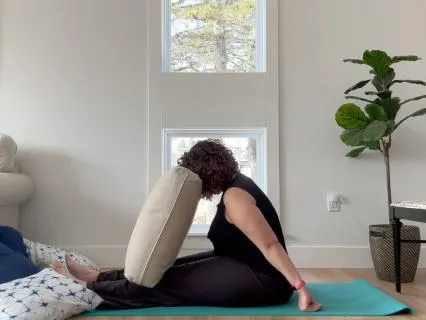
And this is a forward fold.
The forward folds are very grounding.
And they're very.
.
.
Um,
Comforting when Our hearts feel heavy.
In this case,
Because my cushion is a little bit wide,
I'm bringing my legs apart.
But if you.
.
.
Walk you can Keep your legs together.
And bring the cushion or the bolster like this.
If you have a bolster that's not quite as wide as this,
You can put it between the legs but the legs aren't quite as far apart.
I'm just going to go a little bit far apart,
Which is a little bit of a deviation from Caterpillar.
Um the The thing that I want here is to fold forward hinging at the hip.
And having this to kind of just catch me and support my fold so that it's not a very deep fold forward and I actually might want to use cushion on top of the bolster or cushion or sofa cushion and Just kind of.
.
.
Angle this a little bit more and bring it like this.
So I'll demonstrate just what it might look like with a bolster.
I'll just keep this on.
My uh legs and this is what it would look like And actually,
I might just stay here from.
.
.
My practice.
So finding the variation of this that feels most comfortable for you.
Making sure to hinge from the hip.
As you fold forward.
And it might help to just.
.
.
Give yourself a sense of where that might be by putting the hands backwards like this.
And pushing just ever so slightly.
And kind of keeping that.
Fold from the hinge of the hips.
Actually i might just keep my hands like this help myself into that fold.
And once again.
.
.
Your choice of keeping eyes open closed or in a soft gaze Your choice of focusing on the breath in,
Breath out,
Or the rise and fall of the belly.
Or other sensations that you can feel in your body or things that are external to you like a sound.
And we'll stay here a few moments.
As always,
Giving yourself permission to adjust by moving just a little bit.
So that you find what is comfortable at that moment.
And starting to lift yourself just stacking one vertebrae at a time.
Coming into.
.
.
A seated position.
We're going to keep the bolster because we'll move into a recline twist with the bolster.
And the way we're going to do that is we're going to Come into a reclined,
I'll just move that aside,
Come into a reclined twist.
Essentially bringing our backs down on the mat knees pointed to the sky and Let's go with this side to start with.
And just grabbing the bolster or the cushion and putting it between.
Between the legs.
And it might make keeping the back on the map a little challenging so you can certainly move around the position of the legs they could be staggered I find that this staggering is better.
And I find that I can better.
.
.
Find my back onto my mat that way.
So experiment with where exactly the placement might be.
And when you've found the point that's comfortable just turning the head to the opposite side of the leg If that's accessible.
And again here.
Just getting ready to settle in for a few moments.
Eyes closed open or otherwise.
Focusing on the breath,
The rise or fall of the belly,
Sensations or sound.
And giving yourself permission to shift around.
And slowly turning the head.
Back to center.
And bringing the legs also into center with the bolster between them.
We'll find the twist on the other side.
So before we do that,
Maybe lifting the hips and moving them a little bit to the left.
And letting the legs fall onto the other side.
Finding your back on the mat.
Finding what.
.
.
Comfortable with the legs,
Maybe staggering the legs a little bit shifting around the bolster.
And ringing.
Your head in the opposite direction of the light.
And once again.
Finding what's comfortable for you in terms of the eyes and the focus.
Bringing your head back to center.
Grabbing the bolster and bring the legs back center Coming on to the other side.
I'm putting this aside for now.
We're going to get into a variation of Legs Up The Wall that I really like.
Which is basically legs of the chair.
So bringing the chair.
See you next time.
And in order to find a way to put the lower legs on top of the seat of the chair,
Just kind of scoot.
Right to.
Side sidle up to the legs of the chair with your behind and then just lift yourself or lift the legs after you've been able to Lower yourself.
Onto the floor just kind of swing them up onto the seat of the chair.
And this is where you can adjust either whether you want to be closer to the chair or farther away.
It all depends on.
.
.
The seat of the chair and how deep it is and how long your lower legs are.
We're aiming for 90 degrees but it can be a little bit varying either at the hips or at the knees.
The point being,
You just want to be comfortable here.
And.
.
.
Word of caution,
If you.
.
.
Um battle against diabetes heart heart um high blood pressure glaucoma i would um Basically.
.
.
Recommend that you skip this position and get into shavasana instead And if you do not practice anybody at all,
If you do not practice this regularly,
We're just going to stay a few minutes here because this is an inversion and it is reversing the direction of blood flow.
In the body and we're going to exit this in an intelligent way so that we get the blood flow back.
Flowing the way that it should very gently.
So we're only going to stay maybe a minute or two here.
Oh,
Finding again.
Whatever makes you comfortable in terms of keeping the eyes open or closed or something in between.
Finding a point of focus that works for you,
Whether that's the breath or something else.
And just enjoying the sensation of this mispose this shape.
It's very tempting to stay here longer.
But let's keep it on the safe side and let's bring our legs back down on the ground Lying on your side.
Let's stay here for a little bit then you might actually feel the blood flow.
Going back down into the feet.
And we want to wait this little bit of time so that we don't get lightheaded when we get up.
So if you're ready,
Putting your hand on the floor to help yourself back up.
In a seated position,
We're going to move the chair away.
And we'll get into a supported shavasana to end the practice I like to use the bolster to support my knees.
And.
.
.
I also like to have a little bit.
.
.
Of cushioning for my head.
As a supported shavasana.
And you may choose to.
Omit the bolster or cushion under the Knees it's good if you've got some lower back issues.
You may skip the pillows under the head.
And just go for straight shavasana.
Whatever makes you comfortable is basically what I recommend that you do.
And obviously some adjustments are needed sometimes.
Here we go.
So hopefully you found.
A position that's comfortable,
An arrangement of props that's comfortable.
And feel free to let.
Your legs.
Open and fall to the side outwardly.
A little bit of a rotation of the hips outwardly.
Again let's do our savasana arms if that's comfortable with the palms facing the sky Maybe tucking in your shoulder blades underneath.
Avasana is practiced typically with the eyes closed but as always the choice is yours so your eyes may be closed open or slightly open then for the breath if that's comfortable for you focusing on the in-breath and the out-breath And the alternatives again are focusing on the rise and fall of the belly instead,
The sensation of the breath instead of the breath.
Or it can be other sensations.
You might still feel the blood flow circulating around.
It could be something external to you.
Maybe the sound of birds.
Sound of traffic.
Something that you fix your gaze on.
And we'll stay here for a few moments.
And I'll cue the end of Shavasana and the end of the practice at the end of those moments.
We're starting to bring yourself back.
Maybe taking a deeper breath removing the toes and the fingers Starting to move your arms and your legs.
Bending the legs,
Pointing the knees towards the sky.
Make it a nice big stretch.
And bringing yourself onto your side.
Staying there for a few moments.
Using your hands,
Push your.
.
.
Self-op.
Coming into a seated position.
That's comfortable for you could be cross-legged or not.
Let's bring our hands to heart center.
I'm hoping that this practice has been beneficial for your heart center And I thank you so much for practicing with me today.
Namaste.