The world’s largest free audio library for everyday wellbeing
Somatic & Body Based
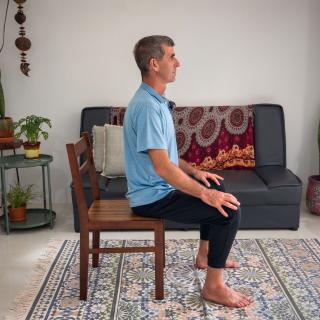
Sitting alignment awareness is a somatic practice of directing sustained attention to how the body is organized in a seated position, the sit bones, spine, shoulders, and head, in order to find a balanced, effortless upright posture.
Last Updated
4 Jul 2026
We are still reviewing this page. Our research team checks every technique page for accuracy and evidence quality before final release. Details may change as that review completes. The evidence badge shows our current reading of the published research.
RECOMMENDED DOSE
Session length is extrapolated from a closely related seated awareness practice: a comparison study used roughly 18-minute seated breath-awareness and quiet-sitting sessions and observed measurable short-term effects on attention and anxiety. A weekly frequency was not established in the dose literature, so the frequency shown is a conservative editorial starting point.
This range draws by overlap on a 35-minute seated breath-awareness session protocol used in a closely related practice. The weekly frequency remains an editorial estimate, as the underlying studies measured single-session effects rather than a sustained weekly dose.
Longer 45-minute seated awareness sessions and an 8-week sustained practice period appear in related breath-awareness studies, supporting this upper maintenance range by overlap. Daily frequency is an editorial recommendation, not a directly tested dose.
Session length
Session length: 10–18 minutes
10
MIN
How long each individual practice session should last from start to finish.
Frequency
Frequency: 3–4 days
3
DAYS
The number of days per week to fit a session into your routine.
Session length
Session length: 20–35 minutes
20
MIN
How long each individual practice session should last from start to finish.
Frequency
Frequency: 4–5 days
4
DAYS
The number of days per week to fit a session into your routine.
Session length
Session length: 40–45 minutes
40
MIN
How long each individual practice session should last from start to finish.
Frequency
Frequency: 5–7 days
5
DAYS
The number of days per week to fit a session into your routine.
About this card. Evidence is mixed: session lengths are extrapolated by overlap from closely related seated breath-awareness practices, while weekly frequency is editorial synthesis rather than a directly tested dose. These recommendations are not a substitute for personalised guidance from a qualified practitioner.
Quick answers to what people most often ask. Each card links to the deeper section below.
evidence
No randomized trials have tested sitting alignment awareness on its own; useful findings come from related body-awareness and mindfulness research. A systematic review across 12 trials linked brief embodiment practices with lower in-the-moment anxiety, though one meta-analysis found brief mindfulness reduced negative mood only modestly, shrinking further once publication bias was considered.
good for
Adults who sit for long stretches, feel disconnected from the body, or notice stress only once it has escalated may benefit from sitting alignment awareness. The closest evidence comes from adjacent mindfulness and body-awareness studies, not seated alignment itself. It supports steadier, more comfortable sitting, not treatment for pain, trauma, or mood conditions.
Read moresafety
Most healthy adults can practise sitting alignment awareness with low risk, stopping or shifting position the moment anything feels strained. People with back, hip, or neck pain should consult a physiotherapist before changing habitual posture, since new alignment loads the body differently. Those with a trauma history may find sustained inward attention intensifies distress; keep sessions light and brief.
Read morehow it works
Sitting alignment awareness appears to train interoception, the ability to sense and interpret internal body signals, so early flickers of tension become easier to catch. Directing attention to the press of the sit bones, the spine's curve, or a held breath is thought to strengthen this inner sensing and tighten the feedback loop between brain and body.
Read moreSitting alignment awareness is the practice of noticing how you sit, your sit bones, spine, shoulders, and head, and finding a balanced, effortless upright posture.
The practice centres on sustained attention rather than movement. Seated on a chair or cushion, you notice the contact of the sit bones with the surface, the curve of the spine, the placement of the shoulders, and the balance of the head on the neck, learning to feel the difference between habitual slumping, rigid over-straightening, and an effortless upright alignment that holds sitting with minimal muscular effort. Sessions can be brief, and attention is kept light rather than forced.
Although sitting is the most common meditation posture, sitting alignment awareness treats postural awareness as the practice itself rather than as a prerequisite for attentional or breath training. It is not physiotherapy, corrective exercise, or a prescribed ideal posture; the aim is sensing and easing how you sit, not achieving a fixed shape. It should not be read as a treatment for pain or a diagnosed condition.
Not to be confused with
Meditation posture as a prerequisite
In most meditation, sitting upright is preparation for focusing on breath or awareness. Here the postural sensing is the practice itself, not a setup for something else.
Sitting up straight / forced good posture
This is not about holding a rigid, straight-backed position through muscular effort. The aim is an effortless, balanced upright sitting, and rigid over-straightening is one of the habits the practice notices and eases.
Yoga postures (asana)
Yoga asana involves moving through and holding a range of shapes, often standing or on the floor. Sitting alignment awareness stays seated and treats attention to the sitting body, not the shape achieved, as the point.
Sitting alignment awareness appears to work by training interoception, the capacity to sense and interpret internal body signals, so that early flickers of tension or unease become easier to catch before they build. Directing attention to sensations like the pressure of the sit bones or a held breath is thought to strengthen this inner sensing; a randomized trial in veterans with PTSD found that interoception underpinned the benefits of mindfulness meditation, research on a related practice rather than seated alignment itself (Suk et al., 2022). This kind of body awareness is also proposed to support self-regulation by tightening the feedback loop between brain and body, a model developed for yoga broadly rather than for this specific technique (Gard et al., 2014).
Noticing what's happening inside as you sit, the pressure of the sit bones, the length of the spine, a held breath, gradually sharpens your ability to read what the body is telling you. Attending to these sensations may strengthen interoception, the sensing of internal states, so early signs of tension become easier to catch (Suk et al., 2022), and body awareness of this kind is thought to support self-regulation by tightening the feedback loop between brain and body (Gard et al., 2014).
The most measurable changes are in how clearly you sense your own body from the inside, what researchers call interoceptive accuracy, the ability to read signals like breath, muscular tension, and the press of the sit bones against the seat. In a randomized trial of a broader body-awareness and movement program in war veterans, this self-reported ability improved with a large effect (Cohen's d = 0.80 versus a waitlist group, meaning the average participant ended up sensing internal signals more clearly than roughly four in five people who simply waited), alongside a comparably large gain in self-regulation (Mehling et al., 2018). Neuroimaging of long-term meditators, research on meditation broadly rather than sitting alignment specifically, has also measured greater thickness and activity in the insula, the brain region that maps internal signals, so this is best read as expected rather than confirmed for seated practice (Chiesa et al., 2011). In the body, these shifts tend to feel like a clearer, quicker read on tension, breath, and posture as you sit.
That quiet sense of noticing exactly where your body is holding tension traces back to the insula, the brain region that reads internal signals; neuroimaging of long-term meditators has measured greater thickness and activity there (Chiesa et al., 2011). This finding comes from meditation research broadly rather than seated alignment work itself, so read it as expected rather than confirmed for this practice. In the body it may feel like a clearer, quicker read on tension, breath, and posture as you sit.
As you track the pressure of your sit bones, the length of your spine, and the balance of your head, your sense of the body from the inside grows sharper. Neuroimaging of related meditation practices links this kind of attention to more activity and thickness in the insula, the brain region that maps internal signals like breath and tension (Chiesa et al., 2011), which practitioners often feel as a clearer, more detailed read on what the body is doing.
Turning attention to your breath, heartbeat, and the press of your sit bones draws on the insula, the brain region that maps signals from inside the body. Neuro-imaging of long-term meditators finds greater cortical thickness here and in nearby regions (Chiesa et al., 2011), a change practitioners often describe as feeling more physically present and quicker to catch rising tension before it builds.
Reading the body's quieter signals, breath, tension, and the shift between effort and ease in how you sit, depends on interoceptive accuracy. In related body-awareness and mindfulness programs this has been measured to improve (Mehling et al., 2018), which people often notice as catching stress or discomfort earlier, before it builds into something harder to settle.

Moderate but indirect evidence links body-centred awareness practices, the family this technique belongs to, with reduced momentary anxiety, felt as the body loosening and settling (Chin et al., 2024). Limited and emerging evidence, including a small pilot in women with a history of sexual trauma, suggests such practices can help people build interoceptive skill, a sharper sense of internal body signals (Cynthia et al., 2019). What is not yet supported: any large trial of sitting alignment awareness on its own, long-term follow-up, or claims that it relieves pain, corrects posture as a medical outcome, or replaces care for a diagnosed condition.
The keyed-up, restless feeling of anxiety often shows up in the body before the mind can name it. Body-centred awareness practices, including attending to how you sit, have been linked in a review of brief interventions with lower in-the-moment anxiety, which can feel like the body settling, the breath loosening, and the sense of urgency quieting (Chin et al., 2024).
No randomized trials have tested sitting alignment awareness on its own; the useful findings come from closely related body-awareness, mindfulness, and breath-awareness practices. A systematic review of brief embodiment and mindfulness interventions across 12 randomized trials found reductions in in-the-moment anxiety (Chin et al., 2024), and the veterans' body-awareness program noted above improved people's ability to sense internal signals (Mehling et al., 2018). The limits are real, though. One meta-analysis found brief mindfulness reduced negative mood only modestly (Hedges' g = 0.21 versus control programs, a small effect meaning the average participant fared better than about 58% of controls), and that figure shrank to g = 0.04 once publication bias was accounted for (Schumer et al., 2018). Read this as reason to try the practice and notice its effect for yourself, not as a certain result.
1
Meta-analyses
2
RCTs
1
Systematic reviews
0
Observational
3
Pilot
Outcomes measured
A systematic review of brief respiratory, embodiment, cognitive, and mindfulness interventions to reduce state anxiety
n = 12
Finding: Reviewing 12 randomised trials of brief anxiety interventions, this analysis found that body-centered practices consistently produced moderate-to-large drops in in-the-moment anxiety, treating tuning into physical sensations as a core part of steadying emotion. For someone considering this practice, that points to body-focused attention as a genuinely useful way to settle nerves, though the review looked at embodiment techniques as a broad family rather than sitting alignment awareness on its own. It also found that breath-based methods gave mixed results, working well for some people and techniques but not others, so it is worth staying curious about what actually helps you rather than assuming every body- or breath-focused approach will calm you the same way.
reported narratively
A 12-week integrative exercise program improves self-reported mindfulness and interoceptive awareness in war veterans with posttraumatic stress symptoms.
n = 47
Finding: In a 12-week trial, 47 veterans with PTSD followed a program that blended aerobic and resistance exercise with mindfulness and yoga, and compared with those on a waitlist they reported large gains in their ability to notice internal body signals and to steady themselves when stirred up. In everyday terms, this points to how sustained body-awareness practice can sharpen your sense of what is happening inside you and your capacity to settle it. Because the program combined several elements at once, these gains cannot be traced to sitting alignment awareness on its own; the sample was also small and the results came from self-report, so treat this as an encouraging signal rather than proof for any single practice.
Sitting alignment awareness grows out of contemplative and meditative traditions, where an upright, balanced seat is treated as an embodiment of attentiveness and dignity, and it also echoes secular workplace ergonomics and its idea of sitting well. Here the posture is the practice itself rather than a setup for something else, which is what distinguishes it from meditation posture. These roots help explain the practice's form, the careful placing of pelvis, spine, shoulders, and head, not its clinical effects (Gard et al., 2014).
For most healthy adults, sitting alignment awareness is a low-risk practice, and you can stop or shift position the moment anything feels strained. Two situations call for mild caution. The first is ongoing back, hip, or neck pain: changing a habitual posture redistributes how weight loads through the body, and that shift can aggravate existing symptoms. The second is a tendency for inward attention to intensify distress. Sustained interoceptive focus, meaning close attention to internal body signals such as tension, breath movement, or discomfort, may heighten that distress rather than settle it. Both cautions come from practice experience and from body-awareness research in clinical populations, not from safety trials of seated practice itself.
Two groups should approach the practice with extra care. People with ongoing musculoskeletal pain or a structural injury of the spine, hips, or neck are wise to check with a physiotherapist before deliberately changing how they habitually sit, because a new alignment loads the body differently and can flare existing symptoms. People with a trauma history may find that prolonged inward attention amplifies distress instead of easing it, so keeping sessions light and brief, or practising alongside a clinician, is sensible. No safety trials of sitting alignment awareness exist, so these cautions rest on practice experience and related research rather than on measured adverse effects.
If you already live with back, hip, or neck pain, or a structural injury of the spine, hips, or neck, change your sitting gently. A new alignment loads the body differently than your habitual posture, and that shift can flare existing symptoms. Make only small adjustments, stop any position that sharpens pain, and check with a physiotherapist before deliberately changing how you habitually sit. This caution comes from practice experience and body-awareness research in clinical populations, not from safety trials of seated practice itself.
| Technique | Best for | Use with care | Evidence strength | Distinction |
|---|---|---|---|---|
| Seated mindfulness meditation | Cultivating sustained attention, present-moment focus, and general stress reduction across regular sessions. | If turning attention inward tends to intensify distress, longer silent sits can be harder to tolerate than brief postural check-ins. | moderate EVIDENCE | In seated meditation, an upright posture is the stable setup that supports attention to breath, thoughts, or awareness itself. In sitting alignment awareness, that posture and its felt organization, the sit bones, spine, and the balance of the head, are the object of attention rather than the container for it. |
| Body scan meditation | Releasing whole-body tension and building broad sensory awareness, often as a longer guided relaxation. | Like any sustained inward attention, a full-body scan can heighten distress for some trauma-affected people, so keep it light and brief if needed. |
It is a somatic, attention-based practice in which the seated body itself becomes the object of awareness: you sense your sit bones, spine, shoulders, and head, and let an effortless upright balance emerge. Unlike "sitting up straight," it isn't about holding a rigid, braced posture through effort; over-straightening is actually one of the habits the practice notices and eases.
+
Sitting alignment awareness means directing sustained attention to how your body is organized in a seated position, the sit bones, spine, shoulders, and head, in order to find a balanced, supported upright posture. The difference from "sitting up straight" is that the aim is effortless alignment held by your structure rather than a stiff back held by muscular effort, and rigid over-straightening is treated as a habit to notice rather than a goal. It also differs from seated meditation: here the postural sensing is the practice itself, not a setup for focusing on breath or awareness. This describes what the practice is, not any clinical outcome.
Partly, but it's not proven. No trial has tested sitting alignment awareness on its own, so its support is borrowed from related body-awareness and mindfulness practices, which show moderate effects on momentary anxiety and interoceptive skill (Chin et al., 2024). Reasonable to try and observe for yourself, not a certain result.
+
Partly, but the direct evidence isn't there yet. No randomized trial has isolated sitting alignment awareness, so every finding comes from adjacent practices: body-centred awareness has been linked with reduced momentary anxiety (Chin et al., 2024), and small pilots suggest such practices can build interoceptive skill, a sharper sense of internal body signals (Cynthia et al., 2019). The cautions matter too. One meta-analysis found brief mindfulness reduced negative mood only modestly, and that small effect shrank further once publication bias was accounted for (Schumer et al., 2018), while not all body- or breath-focused techniques produce reliable effects (Chin et al., 2024). Read this as promising and worth trying, not as an established or medical result.
The ability to sense and interpret signals from inside the body, such as breath movement, muscular tension, temperature, and the pressure of the sit bones against a seat. Sharper interoception often feels like catching stress or discomfort earlier, before it builds.
Central detection and appraisal of visceral afferent signals; often assessed by self-report (for example the MAIA) or heartbeat-detection tasks.
How clearly and reliably you can detect internal bodily signals. In body-awareness programs this has been measured to improve, which people often notice as reading tension, breath, and fatigue sooner.
The sense of where your body is in space and how its parts are positioned, drawn from receptors in muscles, joints, and tendons. It shows up as better balance and a grounded feeling of being physically present.
Aligning the body's structural segments, the head, spine, and pelvis, into balanced, efficient relationships so you are held up by structure rather than muscular effort. It feels like discovering a more effortless way to sit upright.
A brain region that reads and interprets internal body signals like breath, heartbeat, and tension. Neuroimaging of long-term meditators has linked practice with greater activity and thickness there, though this comes from meditation research rather than sitting alignment awareness itself.
A cortical region within the lateral sulcus involved in interoceptive representation, integrating visceral afferent signals into conscious bodily awareness.
The two bony points at the base of the pelvis that you can feel pressing into a chair when you sit. Noticing their contact is a common anchor for sensing seated balance.
Anxiety felt in the moment, the keyed-up, restless quality that comes and goes, as distinct from a longer-standing anxious disposition. Body-focused practices have been linked with lower state anxiety.
Phoebe Chin, Faye Gorman, Fraser Beck, Bruce R. Russell, Klaas Ε. Stephan, Olivia K. Harrison (2024). A systematic review of brief respiratory, embodiment, cognitive, and mindfulness interventions to reduce state anxiety. https://doi.org/10.3389/fpsyg.2024.1412928
Cited in: Benefits, Faq, Research, Roots and tradition
Mehling Wolf E, Chesney Margaret A, Metzler Thomas J, Goldstein Lizabeth A, Maguen Shira, Geronimo Chris (2018). A 12-week integrative exercise program improves self-reported mindfulness and interoceptive awareness in war veterans with posttraumatic stress symptoms.. https://doi.org/10.1002/jclp.22549
Explore guided sessions to deepen your Sitting Alignment Awareness technique.
As you tune into how you're sitting, small bodily shifts like a held breath or a tightening shoulder start to register sooner. Body-awareness training has been measured to improve interoceptive sensitivity, the ability to notice internal signals such as breath movement, muscular tension, and the pressure of your sit bones against the seat (Mehling et al., 2018). Many people experience this as feeling more settled in themselves and quicker to catch stress before it builds.
Many people start to feel more clearly settled in the body and catch early signs of tension sooner, before they escalate. This is interoceptive signal detection, the capacity to sense internal cues like breath movement, muscular tension, and the balance between effort and ease, which improved in programs that build body awareness, though the finding comes from broad body-awareness training rather than sitting alignment measured on its own (Mehling et al., 2018).
Sitting quietly and tracking your own body can give you a clearer, more immediate sense of what it is doing while seated, and an earlier read on rising stress or fatigue before it takes over. This is interoceptive processing, the brain's reading of internal signals like tension, balance, and the contact of the sit bones with the seat, and body-awareness practices that share this inward attention have been measured to improve it (Mehling et al., 2018).
| Outcome | Effect size | 95% CI | N | Comparator | Source |
|---|---|---|---|---|---|
| interoceptive awareness (Body Listening) | Cohen's d = 0.8 | — | — | waitlist | Mehling et al., 2018 |
| self-regulation | Cohen's d = 1.05 | — | — | waitlist | Mehling et al., 2018 |
| negative affectivity | Hedges' g = 0.21 | — | — | control programs | Schumer et al., 2018 |
No study isolates sitting alignment awareness, so every finding is borrowed from adjacent body-awareness, mindfulness, breath-awareness, and yoga research. The trials are typically small, lean on self-reported measures, study specific groups such as veterans, and show effects that are sometimes modest or inconsistent, so results may not generalize to every person or setting.
Cohen's d = 0.8
Brief mindfulness training for negative affectivity: A systematic review and meta-analysis.
2018
Finding: This review of 65 trials involving nearly 5,500 people found that brief mindfulness sessions, from one-off exercises to short courses lasting up to two weeks, produced only a small drop in difficult feelings like anxiety, stress, and rumination. When the analysis accounted for studies with weak or unpublished results, that already modest benefit nearly disappeared. For someone trying short body-and-mind awareness practices, this suggests the payoff from a quick or single session is likely to be gentle rather than dramatic, and worth pairing with a more consistent, longer-term routine if you're aiming for a noticeable shift in mood.
Hedges' g = 0.21
A pilot feasibility study of mindfulness childbirth education for women with a history of sexual trauma.
n = 12
Finding: In a small pilot with 12 pregnant women who had a history of sexual trauma, a mindfulness childbirth program that included body-scan and body-awareness practice lowered anxiety right after sessions and, over time, sharpened participants' ability to notice and read their own internal bodily signals; the women also rated the program highly. For someone drawn to alignment and body-awareness work, this hints that regularly tuning into the body can build a clearer sense of what it is telling you. That said, this was a tiny study with no comparison group, run with one specific group of people, so it offers only an early, indirect signal rather than proof that the practice works.
reported narratively
Potential self-regulatory mechanisms of yoga for psychological health
2014
Finding: This paper lays out a theoretical model for how body-based practices like yoga might support self-regulation, proposing that paying attention to physical sensations, including how the body is organized and positioned, feeds signals up to the brain networks that manage emotions and the stress response. For someone practising seated alignment awareness, it offers a plausible explanation for why tuning into the body could help you stay steadier under pressure. Keep in mind, though, that this is a proposed framework built from existing research rather than a direct test of sitting alignment itself, so it explains a possible mechanism rather than proving a measured benefit.
See full citation in referencesInteroception Underlies Therapeutic Effects of Mindfulness Meditation for Posttraumatic Stress Disorder: A Randomized Clinical Trial.
2022
Finding: In a randomized trial with veterans living with PTSD, mindfulness meditation sharpened the brain's response to internal body signals like the heartbeat, and it was this improved reading of the body, rather than general changes in attention or resting brain activity, that tracked with feeling better. In everyday terms, tuning into physical sensations seems to strengthen the pathways your brain uses to sense and interpret what is happening inside you, which is exactly the kind of body-awareness that sitting alignment practice draws on. Keep in mind this study looked at mindfulness meditation in one specific group, so it points to how attention to the body may work rather than proving that sitting alignment awareness itself was tested or that it treats any condition.
See full citation in referencesNeuro-imaging of mindfulness meditations: implications for clinical practice
2011
Finding: This review of brain-imaging studies found that long-term mindfulness meditators had a thicker insula, the part of the brain that helps you sense what is happening inside your body, compared with people who did not meditate. That fits the idea that regularly paying attention to bodily sensations trains the very brain areas responsible for that awareness, which is encouraging for anyone drawn to a practice built around noticing the body. Keep in mind, though, that these were snapshot comparisons rather than before-and-after tracking, so we cannot say meditation caused the difference, and the studies looked at meditation in general rather than sitting alignment awareness specifically.
See full citation in referencesSustained interoceptive focus, meaning close attention to internal body signals such as tension, breath movement, or discomfort, can amplify distress rather than settle it for some people, particularly those with a trauma history. Keep sessions short, soften or widen your focus, open your eyes if it intensifies, and stop if it feels overwhelming. Practising alongside a clinician is sensible if inward attention reliably makes things worse. This is a mechanism-inferred caution drawn from body-awareness research in clinical groups, since no safety trial of seated practice exists.
Sitting alignment awareness works best when you approach it as gentle noticing rather than a posture to force, beginning from a stable, supportive seat and a few unhurried breaths so you start from ease. For most people a sensible format is a short spell of a few minutes with your attention resting lightly on sensation, ready to soften, shift, or pause the moment anything feels strained or intense. If you carry ongoing back, hip, or neck pain, keep any changes small and light until you have checked in with a physiotherapist.
Sit on a stable, supportive surface and take a few unhurried breaths before changing anything, so you begin from ease rather than effort.
Bring attention first to your sit bones and their contact with the seat, then to the curve of the spine, the placement of the shoulders, and the balance of the head on the neck, noticing what feels held versus what feels supported.
Aim for the alignment that lets your structure hold you with minimal muscular work. If you feel yourself bracing or straining to sit tall, you have gone too far, so soften back toward balance.
Start with short spells of a few minutes and let your focus rest gently on sensation. If noticing internal signals begins to feel overwhelming, widen your attention to the room or open your eyes.
If you have back, hip, or neck pain, make only small changes, get guidance from a physiotherapist before adopting a new habitual posture, and stop any position that sharpens pain.
Shift position, pause, or end the practice whenever sitting feels physically strained or emotionally intense. The goal is easier, more sustainable sitting, not endurance.
This information is educational and is not medical advice. This practice is not a substitute for professional care and should not replace prescribed medication or treatment for any medical or mental-health condition. If you are managing a health condition or taking medication, talk with a qualified health professional before changing your practice. If you are in distress or crisis, seek professional support.
| A body scan moves attention systematically through the whole body, often lying down, to notice sensation and let tension release. Sitting alignment awareness stays with the seated structure, sensing how weight, spine, and head balance while upright rather than sweeping head to toe. |
| Alexander Technique (postural re-education) | Working with a trained teacher to change long-standing postural habits across everyday activities, not just sitting. | EVIDENCE | The Alexander Technique retrains habitual movement and posture with hands-on guidance from a trained teacher across sitting, standing, and moving. Sitting alignment awareness is a self-directed attentional practice confined to the seated position, with no teacher's touch involved. |
| Workplace ergonomic posture correction | Reducing physical strain during long desk-based workdays by improving external setup and support. | EVIDENCE | Ergonomic correction adjusts chairs, desks, and screens to reduce mechanical strain, an external, equipment-led fix. Sitting alignment awareness works from the inside, training your felt sense of balanced, effortless sitting rather than changing your setup. |
Borrowed. No trial has tested sitting alignment awareness on its own; the useful findings come from adjacent body-awareness, mindfulness, breath-awareness, and yoga research (Chin et al., 2024). Read it as suggestive by analogy, not confirmed for this technique.
+
Borrowed, not direct. Every supportive finding comes from closely related practices rather than seated alignment itself: a systematic review of brief embodiment and mindfulness interventions linked them with lower momentary anxiety (Chin et al., 2024), and a small pilot suggested such training can build interoceptive skill, a sharper read on internal body signals (Cynthia et al., 2019). The limits are real, samples are often small and self-reported, effects vary by person and technique, and one meta-analysis of brief mindfulness found only a small mood effect that shrank toward zero once publication bias was accounted for (Schumer et al., 2018). So the evidence is indirect and suggestive rather than established for this specific practice.
Likely by training interoception, your ability to sense internal signals like breath and tension, so you catch stress earlier. Body-awareness practices are also thought to support self-regulation by tightening the brain-body feedback loop, which can feel like settling (Suk et al., 2022), (Gard et al., 2014).
+
The proposed pathway is that giving attention a physical anchor, the press of the sit bones, the length of the spine, a slow breath, sharpens interoception, your read on internal body signals, so early flickers of tension register sooner. A randomized trial in veterans found interoception underpinned the calming benefits of mindfulness meditation, and body-awareness practice is separately theorised to aid self-regulation by strengthening the feedback loop between brain and body (Suk et al., 2022), (Gard et al., 2014). This is a mechanism hypothesis drawn from adjacent mindfulness and yoga research, not from trials of sitting alignment awareness itself, and it is not a treatment for anxiety or any diagnosed condition.
No. Sitting alignment awareness has not been shown to fix posture as a medical outcome or relieve back pain, and no trials of the technique exist. It may support steadier, more comfortable sitting and a sharper sense of internal body signals (Chin et al., 2024), but it is not a substitute for care if you have ongoing pain.
+
No. There are no trials of sitting alignment awareness on its own, so any claim that it corrects posture medically or treats back pain would overreach the evidence. What adjacent body-awareness research suggests is more modest, namely reduced momentary anxiety felt as the body settling (Chin et al., 2024), and early, not-yet-established signs that such practices sharpen interoception, your read on internal body signals (Cynthia et al., 2019). If you live with back, hip, or neck pain, changing a habitual posture can aggravate symptoms, so check with a physiotherapist rather than treating this as a fix.
Use care. For most healthy adults it is low-risk, but if you already have back, hip, or neck pain, changing a habitual posture redistributes how weight loads through the body and can aggravate symptoms. Make only small changes, stop anything that sharpens pain, and check with a physiotherapist first.
+
Use care. No safety trials of sitting alignment awareness exist, so this caution rests on practice experience and related research rather than measured adverse effects. If you already have back, hip, or neck pain, a new alignment loads the body differently and may flare symptoms, so the safe approach is to adjust gently, ease off at the first sign of strain, and get guidance from a physiotherapist before changing how you habitually sit. It is not a treatment for a diagnosed condition or a substitute for clinical care.
Use care. For some people, sustained inward focus on body signals can heighten rather than settle distress, so keep the practice light and brief, widen your attention to the room, or open your eyes if it intensifies. Stop if it feels overwhelming and consider working alongside a clinician.
+
Use care. Directing attention inward is thought to strengthen interoception, the ability to notice and interpret internal body signals, but for some people that same close attention can amplify anxiety or distress rather than ease it (Suk et al., 2022). This is a mechanism-inferred caution drawn from body-awareness research in clinical groups, not a finding from any safety trial of seated practice, since none exists. Practically, keep sessions short, soften or widen your focus, open your eyes, stop if it feels too much, and seek qualified support if inward attention reliably makes things worse.
Start with just a few minutes. Settle onto a stable seat, take a few unhurried breaths, then scan attention from your sit bones upward through spine, shoulders, and head, aiming for an effortless upright rather than a rigid, straight-backed hold. Keep inward attention light and ease off at any sign of strain or distress.
+
Start small: a few minutes is a sensible entry point, since no trials establish an optimal duration and this is a gentle starting suggestion rather than a fixed dose. Settle before you adjust anything, then scan from the base upward, your sit bones' contact with the seat, the curve of the spine, the set of the shoulders, and the balance of the head, looking for the alignment that lets your structure hold you with minimal muscular work. Keep your inward focus light and time-limited; if noticing internal body signals begins to feel overwhelming, widen your attention to the room or open your eyes, and shift position or stop whenever sitting feels physically strained or emotionally intense.
The object of attention differs. In seated meditation, an upright posture is the stable setup that supports attention to breath, thoughts, or awareness. In sitting alignment awareness, that posture itself, how the sit bones, spine, shoulders, and head organize, is what you attend to.
+
The object of attention differs. Seated meditation uses a steady upright posture as the container for attention to breath or awareness, whereas sitting alignment awareness makes the seated body's own organization, the sit bones, spinal curve, shoulders, and the balance of the head, the practice itself. Neither is presented as more effective here, since no study directly compares the two; the distinction is about what you are asked to do, not about outcomes.
Cited in: Research, Roots and tradition, What happens in the body
Maya C. Schumer, Emily K. Lindsay, J. David Creswell (2018). Brief mindfulness training for negative affectivity: A systematic review and meta-analysis.. https://doi.org/10.1037/ccp0000324
Price Cynthia, Kantrowitz-Gordon Ira, Calhoun Rebecca (2019). A pilot feasibility study of mindfulness childbirth education for women with a history of sexual trauma.. https://doi.org/10.1016/j.ctcp.2019.09.005
Tim Gard, Jessica J. Noggle, Crystal L. Park, David R. Vago, Angela L. Wilson (2014). Potential self-regulatory mechanisms of yoga for psychological health. https://doi.org/10.3389/fnhum.2014.00770
Cited in: Faq, How it works, Research, Roots and tradition
Kang Seung Suk, Sponheim Scott R, Lim Kelvin O (2022). Interoception Underlies Therapeutic Effects of Mindfulness Meditation for Posttraumatic Stress Disorder: A Randomized Clinical Trial.. https://doi.org/10.1016/j.bpsc.2021.10.005
Cited in: Faq, How it works, Research, Use with care
Alberto Chiesa, Paolo Brambilla, Alessandro Serretti (2011). Neuro-imaging of mindfulness meditations: implications for clinical practice. https://doi.org/10.1017/s204579601100028x
Cited in: Research, What happens in the body
Editorially curated. Tracks are not themselves clinically studied; evidence on the page applies to Sitting Alignment Awareness as a technique.
Beginner content for Sitting Alignment Awareness

★ 4.7
·
Guided
·
3 min
Donna Rucinski Harrington
How hard is Sitting Alignment Awareness?
Sitting Alignment Awareness belongs in effort 2 because the task is light, but it is still an intentional practice rather than passive sitting.
2
Mental Effort
2 / 4
▾Emotional Depth
1 / 4
▾Physical Intensity
1 / 4
▾Prior Knowledge
1 / 4
▾