Hello,
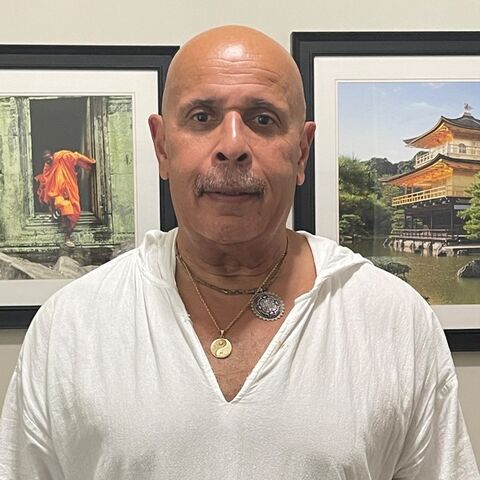
This is Alonzo Davis,
Also known as the Life Llama,
And I'd like to thank all of you out there on Inside Timer for taking the time to listen to this talk.
I've named this talk The Power of Meditation Alignment and How Science Meets Spirituality.
The reason why I thought this talk was important is because for all the things that we hope to get from a meditation practice,
We have to understand that without proper alignment,
The base,
That those things that we're trying to get out of meditation just can't happen.
So before we begin this talk,
I'd like for you to close your eyes for a moment and take a deep breath in and out.
Now notice how you're sitting.
Where's your weight?
Is your back straight?
Is your head balanced?
Or is there tension somewhere?
As I said before,
Many of us step into meditation seeking inner peace,
Clarity,
Or transcendence.
Yet despite our best efforts,
We often find restlessness,
Discomfort,
Or an inability to go deeper.
Why?
Because we built our practice on an unstable foundation,
Our posture.
The way you align your body in meditation is not just about comfort.
It's about energy flow.
It's about brain function.
It's about nervous system activation.
And it's about whether or not you truly drop into deep stillness.
Today,
I want to explore this alignment from both the scientific and spiritual perspectives,
Showing how they're not separate,
But in fact,
They're deeply intertwined.
Let's start with the foundation,
Your body as an instrument for meditation.
Think about a violin.
If the strings are too tight or too loose,
The music is strained or out of tune.
Your body works the same way.
If your posture is too rigid,
It creates tension.
If it's too collapsed,
It leads to sluggishness.
But when you find that perfect balance,
Stillness becomes effortless.
The biomechanics of the meditation posture.
Science has shown us that our posture deeply affects our breathing,
Circulation,
And the nervous system.
First,
The spine as a channel.
The spine is not meant to be rigid.
It has natural curves that should be maintained.
Too much slouching compresses the lungs and inhibits deep breathing.
Too much rigidity engages muscles that should be relaxed,
Which causes unnecessary tension.
Looking at the pelvis as the anchor.
The pelvis acts as the foundation of your posture.
If it's tilted too far forward,
Your lower back arches excessively.
If it tilts too far back,
Your spine collapses.
There are ancient yogic and Buddhist teachings that talk about this.
For instance,
In Taoism,
They talk about the Dao Dian.
Or the Hara,
Which is part of the Japanese Zen tradition.
These two things are the energy centers located about two inches below your navel.
This is the area where breath should originate.
If your pelvis is misaligned,
This natural energy center is blocked.
We know that there is a role of breath in oxygenation.
From a scientific standpoint,
Proper posture allows the diaphragm to expand fully,
Increasing oxygen intake.
More oxygen means better brain function and deeper parasympathetic activation.
The same thing from a spiritual view,
In traditions like the Prahayama or Buddhist breath work,
Breath is the bridge between the body and the mind.
Without proper posture,
The breath remains shallow and it keeps the mind restless.
We have to deal with head and neck alignment.
Your head should feel as though it's floating effortlessly above your shoulders.
A chin that juts too far forward creates neck tension,
Which increases stress levels.
The penile gland,
Or the third eye region,
Is often affected by poor head positioning.
Many spiritual traditions emphasize proper head alignment,
As it enhances awareness,
Concentration,
And energy flow through the crown chakra.
Let's go a little bit deeper.
The ancient yogic and Taoist tradition tell us that when we align our spine correctly,
Our subtle energy,
Prana,
Qi,
Gi,
Flows freely.
Science tells us that proper alignment improves the vagus nerve function,
Leading to deep relaxation.
When you converge these two perspectives,
They reveal the same truth.
A well-aligned body fosters an open,
Calm,
And deeply meditative mind.
Scientific evidence that supports energy flow.
We have fascia and nerve pathways.
Fascia is the connective tissue that holds everything together.
In Eastern traditions,
They're called meridians or nadis,
And they correspond to nerve and fascia pathways.
Studies have shown that when the spine is misaligned,
Fascia constriction leads to blocked energy flow and an increased stress response.
The human heart and brain emit measurable electromagnetic fields.
EEG scans show that meditators who maintain strong postural alignment enter theta and gamma brainwave states much more easily.
These states are associated with deep meditation and even mystical experiences.
Let's talk about some common postural mistakes and their consequences.
So let's talk about what happens when we don't sit properly.
Slouching.
The scientific consequences are compresses the lungs,
And that leads to shallow breathing,
Increased stress,
And poor circulation.
The spiritual consequences of slouching is that it lowers alertness and energy flow,
Making deep meditation harder.
Over-rigid posture.
The scientific consequence?
It over-engages muscles,
Activating stress responses rather than relaxation.
The spiritual consequences is that it creates tension that prevents letting go and dropping into deep stillness.
What happens when the head tilts too far forward?
The scientific consequence?
It puts strain on the neck,
Leading to headaches and muscle tension.
The spiritual consequence?
It blocks the natural energy rising toward the crown chakra,
And that will reduce your clarity.
So how do we achieve perfect meditation alignment?
And this is the real key and what you must get right.
Elevate your hips above your knees to create a natural spine alignment,
And use cushions or a bench to support yourself.
Your pelvic tilt and spine awareness.
Rock your pelvis forward and backwards until you find a natural balance.
Now imagine a string pulling the top of your head upward.
Where should your hands and shoulders be?
Let your hands rest comfortably,
No unnecessary tension.
Keep your shoulders slightly dropped,
Not hunched.
Now the breathing and relaxation techniques.
You can try deep belly breathing,
Which activates relaxation.
And also do a body scan.
That body scan will help you fine tune your alignment in real time.
Posture is the silent foundation of all deep meditation.
When we sit correctly,
Our body dissolves into the practice,
Rather than become an obstacle to the practice.
It's not just about sitting still.
It's about setting up the conditions for stillness to arise effortlessly.
If you've ever struggled to go deep in meditation,
Ask yourself,
Am I truly aligned?
And if not,
Fix your alignment and watch your practice transform.
Thank you all on Insight Timer for taking the time to listen,
And I look forward to your comments.