I am Simon Cole and I'm going to be talking to you about releasing yourself from your anxiety in a slightly different way to how we normally think about it,
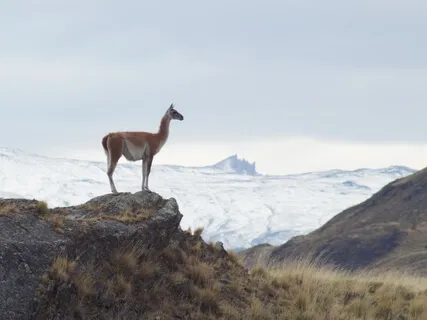
Because this will be about using the animal part which is in all of us to set you free.
And so I've called the talk Release the Animal in Your Soul.
The problem with anxiety is that it's part of us.
Okay,
That might sound too obvious to be worth saying,
But think again.
It's a part of us,
Not part of what is in reality out there in the outside world.
If you're feeling anxious at this moment,
There is nothing in what is actually present around you here and now that is responsible for your anxiety.
Only you.
It's all inside.
Fear is different.
Your fear is an emotional reaction to what is not intrinsically part of the you who you think you are right now.
The object that is responsible for your fear is outside that you.
And animals are different.
From us of course,
But also from each other.
Other mammals might be startled or alarmed.
I don't want to say afraid,
Because the basis of animal emotions is so vastly different to that of humans,
But they do not exhibit anxiety.
Rilke,
For some the greatest European poet of the 19th and 20th century,
First pointed us to the animal to learn from and invited us to consider this in his eighth elegy.
Where we see the future,
It sees all time and itself within all time,
Forever healed.
And we,
Spectators always,
Everywhere turned toward the world of objects,
Never outward.
The animal does not know itself as I,
But just as being.
Its own being going on,
Joined to everything else being.
No self.
Animals are not self-conscious in the way we humans are.
Self,
That boundary we put around ourselves to set us apart,
Make us individual.
We see it as our identity and we think it keeps us safe.
But there is a downside.
Anxiety.
Okay,
Let's take a walk on the wild side.
For a few minutes,
You are going to be animal.
That's absurd,
You say.
I can't be an animal.
No,
You can't,
I agree.
But I didn't say an animal,
I said animal.
So how are you going to be animal?
Well,
That's easy and difficult.
We cap a moment.
We said that animals are not conscious of themselves as solid objects in the way we humans are.
Even if they could speak,
They would not use I constantly as we do,
Because it would have little significance for them.
They know themselves as simply being,
A part of what is going on,
Connected into the creation of all living things.
No sense of self in our way at all.
So to be animal,
For the purposes of this exercise,
You would need to not have yourself in the centre of things.
Not to be the pivot around which everything turns,
But rather have a sense of being,
Simply a part of everything that is happening.
I would start to disappear from your self-talk.
Something else would happen in the self-talk too.
It would be more about the present.
You would hear that the verbs you used more often ended in in.
And this would mean you were starting to give yourself a picture of what is actually going on around you.
Not so much you in your world,
As you in the world.
Try it,
Now.
Without getting yourself tongue tied,
Keep in mind that saying things with in brings you into the present.
And even more,
If you drop the I that's usually there in most of what we say and think,
What's going around in our heads,
It feels like you are getting immersed in what is really actually going on.
And your anxiety will slowly dissipate.
So there we have it.
Two golden keys to banish anxiety.
Losing I and using ing.
Now of course we can't live our lives and function in all the ways we have to without ever saying or thinking I,
And we can't shoehorn all our utterances into a form which is confined to the present tense and the ing form of words.
But we don't have to.
Like most of these sorts of interventions,
This is a training,
Where we follow some rules regularly for a while,
A few minutes in different places or on our own a few times a day,
And start to notice how we can feel different and how different feels better.
So that gradually it becomes part of who we are,
Without even needing to think about it.
So what's happening in all this?
Well,
It's all to do with objects.
Human consciousness starts with self-consciousness.
We start by making an object of ourselves.
We have to,
So as to be able to make ourselves the subject of all that self-talk.
Because we can't talk about anything without making it a thing.
And this is how fear and anxiety get in,
Though in opposite ways.
When we fear something,
Even if it's not anything physical,
We hold it in our minds so vividly that it takes up all the space.
There is no room for any reasoned response.
Mentally,
We freeze.
But when we're anxious,
We import the possible source of a theoretical future into the present and we recreate it as a thing,
As an object.
And the result is chaos,
Because it doesn't belong here.
It isn't part of the flow that is really happening.
Now,
We don't freeze,
We panic.
Animals don't make things.
Their world is one of interconnected activity and being,
Of which they are an integral part.
For us,
On the other hand,
Our consciousness means we make objects from what we see and pull parts of our world out of this animal integration.
And sometimes we let those parts roam free and cause chaos.
That's called anxiety.
I usually start my mindfulness groups by reminding people that the most mindful beings on the planet are animals and very young children.
Not because it's an undeveloped or an uneducated state,
If anything,
Quite the opposite,
But because their world consists of what they're connected to and what is happening in that very moment.
So the development of an anxiety-free way of being,
Like I've described,
Is consistent with the path of mindfulness and being tuned into and more interactive with what is actually going on around.
There are other parallels.
A proposition that we lose eye,
Even for those short periods of practice,
I suggest,
Evokes a state similar to that sought by those who practice meditation from a Buddhist background,
Which they might call beginner's mind or Zen mind and is experienced as non-awareness of the self.
As for my challenge to try using only in forms of verbs,
Well,
Traditional Mandarin Chinese,
Which is probably the most complex language in the world,
Only has a present tense.
So that's it.
Lose eye and use ink.
Thank you.
I'm pleased you listened and I wish you well.