The Five Precepts and Anapanasati Meditation True Happiness Well,
Good evening everyone.
We've begun to talk about the practice of precepts in relation to Anapanasati meditation.
Remember the most commonly known set of precepts for lay Buddhists,
Lay practitioners are the five precepts,
Or sometimes called the five wonderful precepts,
I undertake to abstain from taking life,
To abstain from taking what is not freely given,
To abstain from sensuous misconduct,
To abstain from false speech,
And importantly for us,
To abstain from intoxicants,
As these tend to cloud the mind.
Living in these ways,
We directly address the effects of greed,
Hatred,
And delusion,
Which manifest in us as hindrances,
Clinging,
Aversion,
Spiritual drowsiness,
Worry,
Doubt.
Now,
I want to talk for a minute about a distinction between the parts of the Eightfold Path and these things that we identify as precepts.
We spoke last week about precepts having originated in the rules of the community,
Or Sangha,
That formed around Shakyamuni Buddha 2,
600 years ago.
Then,
As now,
They were meant to help followers of the way to develop both mind and character.
They formed a system of morality,
Of ethical conduct,
Through which,
Even now,
We can develop a structure of intention in relation to our thoughts,
Our speech,
And our actions.
We see this aspect of intention put forth in broad strokes in the Eightfold Path,
An umbrella of ideals that we use to guide our behavior,
Having right view,
Living with right intention,
Right action.
But precepts really speak to specific elements of human nature.
Anger,
Greed,
Ill will,
Jealousy,
Disappointment.
Things which we should avoid for our own betterment,
But that's too simple on its own.
These are defilements which alter our true basic nature,
Our Buddha nature.
Defilements which make us into something other than what our true selves are.
Observing precepts is said to be living the life of the Buddha.
Observing precepts is to live in our own Buddha nature.
But what does that really mean?
Is it simply about how we control our actions,
Or even how we allow ourselves to think?
I mean,
If that's the case,
I know that I'm bound already to an inadequate expression of precepts.
I'm subject to my own level of commitment at any given moment.
I'm subject to my feelings and to my automatic responses to different situations.
There has to be more.
Something which not only convinces us that living by precepts is the right thing to do,
But that helps us to know that living by precepts is inherently,
Directly,
Undeniably a better way of life.
And this is where a key idea in Buddhist philosophy comes in,
And that is interdependence.
I don't know if you know the image of Indra's net.
If you can imagine like a hammock net made up of squares of thread,
And each of these squares intersect at the corners in knots.
So if you can imagine that sort of cloth structure that is stretching throughout the universe,
Just boundless in all directions.
And in each of the knots of the net,
There is a jewel.
And in each of the jewels is the reflection of each every other jewel.
Each jewel in interdependent relation with all other jewels.
But taken further,
There is the idea of dependent co-arising.
The idea that things arise when conditions cause them to arise,
When conditions are right.
This is because that is.
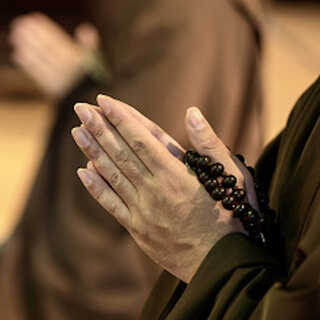
I can put my two hands together,
Palm to palm,
Because my two separate hands exist.
Our place and our role in community is only such because the presence of others give us a place to play that role.
I am because you are.
Interdependence and dependent co-arising teach us that everything is linked at the most fundamental level.
In Zen and other Mahayana traditions,
This is called emptiness,
Where no one thing can really be seen as having a separate existence.
Each thing,
A jewel occupying a place in the net,
And at once containing the light of all others.
And this really is the thing.
Honestly,
Modern physics bears this out as true.
We can know it intellectually,
And in time feel it as a lived reality as we gain clarity and insight through meditation.
This sense of connection becomes less an idea and more of a felt sense,
Which calls us into compassion toward others and into right action.
Using our thoughts,
Words,
And deeds to help prevent the suffering of others,
And in so doing,
Resolving our own suffering.
There is a Zen priest in the Soto tradition,
James Ford,
When speaking to precepts,
Says that precepts speak to the point in our lives where our formal meditation practice and our insight find vital expression.
This is an old path that we're walking,
And there are many guideposts along the way.
If we check in with friends who've also walked this way,
If we're careful and attentive,
We discover how we can discern the shape of our possibility and find our direction.
But it's not simply taking certain actions or even refraining from other actions,
But rather living in the reality of our interdependence with others,
Awakening what is called bodhicitta,
The desire to live in ways which better the lives of others through our own practice of precepts.
In the words of an 8th century Indian Buddhist teacher,
Shantideva,
We live with the intention,
Ocean of great good,
That seeks to place all beings in the state of bliss,
And every action for the benefit of all.
Such is my delight and all my joy.
I'd like to read a little bit more from Shantideva,
It's really in the form of poetry,
In about 6 or 7 stanzas.
For sentient beings,
Poor and destitute,
May I become a treasure ever plentiful,
And lie before them closely in their reach,
A varied source of all they might need.
May I be a guardian for those without protection,
A guide for those who journey on the road,
For those who wish to cross the water,
May I be a boat,
A raft,
A bridge.
May I be an isle for those who yearn for landfall,
And a lamp for those who long for light.
For those who need a resting place,
A bed.
For all who need a servant,
May I be their slave.
May I be the wishing jewel,
The vase of plenty,
A word of power and supreme healing.
May I be the tree of miracles,
And for every being,
The abundant cow.
Like the earth and the pervading elements,
Enduring as the sky itself endures.
For boundless multitudes of living beings,
May I be their ground and sustenance.
And thus for everything that lives,
As far as are the limits of the sky,
May I provide their livelihood and nourishment until they pass beyond the bonds of suffering.
Last week,
We talked about the first of the five precepts,
Worded simply in a Recovery Dharma book,
And elsewhere,
As to abstain from taking life.
We then looked at Thich Nhat Hanh's book Interbeing,
Where he expands the wording,
Helping us to see the applicability of this first precept in deeper areas of our lives.
He titles this first precept as Reverence for Life.
As the first of the five precepts,
In simple terms,
Is to abstain from taking what is not freely given.
Wise advice,
Simple and clear.
There again,
Thich Nhat Hanh expands the precept more deeply into our lives,
Giving it the title of True Happiness.
Aware of the suffering caused by exploitation,
Social injustice,
Stealing and oppression,
I am committed to practicing generosity in my thinking,
Speaking and acting.
I am determined not to steal,
And not to possess anything that should belong to others,
And I will share my time,
Energy and material resources with those who are in need.
I will practice looking deeply to see that the happiness and suffering of others are not separate from my own happiness and suffering,
That true happiness is not possible without understanding and compassion,
And that running after wealth,
Fame,
Power and sensual pleasures can bring much suffering and despair.
I am aware that happiness depends on my mental attitude and not on external conditions,
And that I can live happily in the present moment simply by remembering that I already have more than enough conditions to be happy.
I am committed to practicing right livelihood so that I can help reduce the suffering of living beings on earth.
Now this brings to mind the section of the Eightfold Path having to do with ethical behavior,
Wise speech,
Wise action,
Wise livelihood,
Also good and wise thoughts.
But it's not simply the stealing of money or physical objects,
Of which we must be aware,
But also to avoid actions which impact the rights and intrinsic worth of others.
Our thoughts matter.
Our speech matters just as much as our actions.
Not taking what is not freely given,
Yes,
But it's way beyond that.
Thich Nhat Hanh moves this precept into the realm of how we approach the world around us and our community,
How we dedicate our resources to our lives and to the lives of others.
I've always equated this precept to the first of the six paramitas,
That is,
The practice of generosity.
This precept seems to apply not simply to wrongly taking things,
But to the idea of withholding things as well.
What does it mean to practice generosity?
How do we choose to share our resources?
How do we choose to share our time?
On beneficial pursuits?
In ways that benefit those around us?
Where do we bring our energy,
Our right effort?
Do we share our material resources,
Our spiritual resources,
Our emotional resources?
Do we remember to smile at the grocery store clerk?
To see the connection between ourselves and others is at the heart of the second precept.
Taking only what is freely given and treating those around us with care.
Sharing our things,
Our time,
And our effort with those who are in need.
Happiness,
Thich Nhat Hanh writes,
Is only possible when there is peace of mind,
And peace of mind isn't possible without understanding and love.
And from where does our understanding come?
The processes of inquiry that we engage in meditation.
The insight we gain from knowing our own minds,
Gladdening our minds,
And building concentration,
Liberation.
And from where does love arise?
From our commitment to living by the eightfold path,
Treating others with honor and respect.
It builds from our commitment to living by specific ethical codes,
Living by precept.
To be a good practitioner,
Thich Nhat Hanh says,
We must re-examine our own idea of happiness.
Are we attached to things and ideas that we think will make us happy?
We're taught in the Anapanasati Sutra and elsewhere that insight into our own minds can give us the courage to release attachment.
Then we can find a sense of joy in living a life of generous service.
Gandhi expressed the same idea in this way,
Our ancestors knew how to stop in order to practice contentment.
They did not indulge themselves without restraint,
And did not drown in the enjoyment of sensual pleasures.
They saw that happiness depends on our own way of seeing things.
If the mind has love and understanding,
We shall have happiness.
So,
Let's go ahead and sit.
As usual,
We'll have a guided meditation,
Followed by walking meditation,
And a period of quiet meditation.
.
.