In the last podcast,
I suggested that we could be forgiven for feeling disorientated and fearful during this great period of uncertainty.
We're being thrown into some very uncomfortable places.
We're having to work out how we acclimatise to a completely different world.
And this includes finding new ways of living with each other and with ourselves.
So much we took for granted.
So many things which appeared reasonably stable are being shown to be vulnerable by the coronavirus crisis.
Joan Chittister,
In a book called Thanks,
Co-written with Rome Williams,
Has these wise words to say about crises.
She writes,
The Alleluia moment in crisis comes when we finally realise that life is not about one thing,
It is about many things.
It is about parts of ourselves that we have not recognised yet,
But it is also about parts of the self that are meant to go if we are ever to live life in ways we never thought possible.
Earlier this week,
Some friends suggested I share some reflections from a retreat I led last summer which had the title,
Establishing Peace in Ourselves,
Meditation and the Discovery of Peace in Daily Life,
And I hope some of these reflections may be helpful to you.
And we'll end with a ten minute period of silent meditation together.
All of us,
I think,
Are in one way or another searching for meaning,
For harmony,
For peace.
In everyday life,
We are bombarded with a constant stream of messages telling us that in order to be successful,
In order to have value,
In order to matter,
We need to get hold of things.
Qualifications,
The right career,
Money,
The right partner,
The right house,
Figure and clothes.
Our culture in so many ways is overwhelmingly about acquiring things.
It couldn't be more different with meditation in the Christian tradition where we don't need to acquire anything at all.
Rather,
We just need to realise what is always close at hand.
At the heart of the Christian message is a simple,
Radical,
Often challenging and sometimes mind-boggling message.
The peace we seek is already here,
Like the pearl of great price buried in the field of our lives.
Even if,
For a great deal of the time,
Our lives can feel very far from being peaceful.
Thomas Merton,
The Cistercian monk,
Wrote about this fundamental principle that in prayer,
And meditation is prayer,
We discover what we already have.
You start from where you are and you deepen what you already have and you realise you are already there.
We already have everything,
But we don't know it and we don't experience it.
Everything has been given to us.
All we need to do is experience what we already possess.
The peace we seek is already here.
Well,
You might be thinking,
Those are cheery sounding words,
But what might this mean practically for my life?
Well,
I want to address this very practically and suggest a simple practice you can use to test everything I'm going to say and explore this for yourselves.
So why is this peace hidden from us so much of the time?
Well,
The short answer is because we cover it over with a veil of mental noise and clutter,
And then we search for it in the wrong place,
As happens in this short tale which the teacher Gangaji gives us in her book The Diamond in Your Pocket.
There was an expert diamond thief who only stole the most exquisite of gems.
This thief would hang around the diamond district to see who was purchasing a gem so that later he could pick their pocket.
One day he saw a well-known diamond merchant purchase the jewel he had been waiting for all his life.
It was the most beautiful,
The most pristine,
The purest of diamonds.
He was very excited,
And so he followed the diamond merchant as he boarded the train,
Getting into the same compartment.
He spent an entire three-day journey trying to pick the merchant's pocket and obtain the diamond.
When the end of the journey came and he hadn't found the gem,
He was very frustrated.
He was an accomplished thief,
And although he had employed all his skills,
He was still not able to steal this rare and precious jewel.
When the diamond merchant got off the train,
The pickpocket followed him once again.
And finally,
He just couldn't stand it anymore,
And he walked up to the merchant and said,
Sir,
I am a renowned diamond thief.
I saw you purchase that beautiful diamond,
So I followed you onto the train.
Though I used all the skills of my art,
Which have been perfected over many years,
I was not able to find the gem.
I must know your secret.
Tell me,
Please,
How did you hide it from me?
The diamond merchant replied,
Well,
I saw you watching me in the diamond district,
And I suspected you were a pickpocket,
So I hid the diamond,
Where I thought you would be least likely to look for it,
In your own pocket.
We look outside ourselves when the jewel of peace is all the time in the pocket of our heart.
We lose sight of it by covering it with a veil of mental noise and clutter,
Then look for it in the wrong place,
In the wrong way,
Using the wrong tools.
Remember how Jesus was asked when the Kingdom of God would come,
As if it wasn't here and might suddenly appear at the right time in the future.
He answered,
The coming of the Kingdom cannot be observed,
And no one will announce,
Look,
Here it is,
Or there it is.
For behold,
The Kingdom of God is within you.
I think it's easy to pass over how deeply challenging His answer was.
It's not going to come,
Because it's already here.
It's not over there.
It's not over here.
It's not outside you.
It's within.
It can't be observed by the conceptualising mind.
It can't be objectified and made into an object of awareness,
Because it is the ground of awareness.
But it can be known,
Not by the intellect,
But by the heart.
Most of us,
For a large part of our lives,
Move through life simply reacting to what is going on around us.
We react to life's events on a sort of autopilot,
Running along well-worn tracks of habit.
We're mostly unaware we're doing this,
Or that our relationship with life could be radically different.
And one of the main aims of meditation is to train the attention not to automatically spin commentary in reaction to simple thoughts and feelings.
To recognise the difference between the simple presence of a thought or feeling,
And the enormous superstructure of reactive chatter and noise which we can quickly build around it.
What does this look like?
Well,
This short monastic tale,
Which you may know,
Describes the problem and its consequences really well,
I think.
Two monks were walking between monasteries.
They came to a ford in a river and saw that it had become swollen by heavy rain.
Standing by the ford was a young woman crying.
Between her sobs,
She told the monks that if she couldn't get across the river to sell some goods at a nearby market,
That her family would have nothing to eat.
Now,
Without hesitation,
The older monk picked her up,
Put her on his back,
And waded across the river,
Using his staff to help him.
And once across,
He put the young woman down,
And in her delight,
She gave him an enormous hug.
Now,
The younger monk was not happy at all with what had happened.
And as the two monks continued their journey,
The young monk chewed and chewed and chewed on his anger until he felt he might burst.
A short distance on,
Unable to contain himself any longer,
He leapt in front of the older monk and shouted,
Have you forgotten your vows?
How could you touch that young woman?
What sort of monk are you?
To which the older monk calmly replied,
I saw someone in trouble.
I carried her across the river,
And I put her down.
You are still carrying her.
Let's imagine we've managed to find some precious time to sit quietly and do something we love,
Perhaps to read a book or watch a film.
And some dear person comes and sits nearby,
And then,
Moments later,
Seemingly unaware of us,
They start to hum to themselves.
Very quickly we might be saying to ourselves,
Can't they see what I'm trying to do?
And then we might add a little more commentary.
How can they be so selfish?
I'm going to give them a piece of my mind.
Until before we know it,
We've filled our mind so full of our own reactive commentary that we can barely hear the humming we initially reacted to.
All we can hear is the self-generated noise in our head.
Does that ring even the smallest bell?
The initial feeling of fear or annoyance or whatever it is might be entirely natural,
A very understandable and healthy response.
But then we can quickly wrap it up in reactive commentary as it gets larger and larger like a snowball running down a hill.
And very quickly we can find ourselves having to deal with a monster snowball largely of our own creation.
An early challenge in meditation is learning to meet what is happening inside or outside our heads with stillness instead of commentary.
Because this commentary has a habit of getting between us and our simple direct experience of life.
We don't need to suppress thoughts or run away or hide from them.
Rather we just need to learn how to simply observe them without consent.
Because in this way we can,
Brick by brick,
Dismantle the noisy walls we erect between ourselves and those around us and life.
By way of a reminder,
When I say meditation,
I simply mean a practice which uses the mind's ability to focus narrowly in the present so that we might quieten the reactive mind and bring it to greater stillness.
And the simple practice I'm talking about today involves focusing our attention on silently,
Interiorly,
Reciting a prayer word or short phrase in unison with the inflow and outflow of our breath.
When we notice that we are distracted by a thought or feeling,
We simply bring our attention back to our practice.
Our focus on the prayer word clears a path for us.
We are training our attention to attend to what we want it to attend to.
And each time we turn back to our practice,
We are gently confronting our previous largely unconscious habit of just reacting to thoughts and feelings with yet more thoughts and feelings.
And in this way,
Our practice becomes a refuge,
A solid ground on which to stand and meet life,
However it is from moment to moment.
We learn to meet thoughts and feelings quietly and without comment.
Instead of running about watering and feeding them,
We simply observe.
We watch them come,
We watch them go.
Good thoughts,
Bad thoughts,
Embarrassing thoughts,
Holy thoughts.
The tradition teaches that all distractions during our practice should be met with the same steady,
Gentle silence.
It's that simple and that subtle,
Though not easy.
We have to work at this.
And through this simple practice,
A deeper aspect of ourselves starts to disclose itself,
Like the clear water of a spring,
Gently pushing its way into our consciousness,
Permeating it,
Soaking it.
As we learn to step back from the weather of our thoughts,
We come to see more clearly,
And increasingly we come to know the peaceful nature of the sky in which our thoughts appear,
Awareness itself.
We come to know a great stillness,
A great silent peace.
We come to know,
Like a sunrise within the mind,
That we are this silent peace.
So when I chose establishing peace for the title of these reflections,
I also meant unveiling.
An unveiling that is always a personal discovery,
A personal discovery of what is already here and always has been the case,
Our union with God,
The source of our being who is peace.
Remember the metaphor of the vine in the Gospel of John.
A branch is only a branch,
Inasmuch as it is one with the vine.
The life that a branch has,
It has because that life ceaselessly flows into it from the vine.
It has no life of its own.
The life it has is continuously given.
This is why we meditate.
To know we are one with the vine.
To know this in our own experience is the most extraordinary basis for joy and wonder and gratefulness for the gift of life,
And also the greatest basis for harmony between us.
Because to the branch that knows it's one with the vine,
All talk about difference and separateness becomes slightly silly beyond a certain point.
The peace that we encounter is an encompassing peace.
How does this encounter with encompassing peace register in our consciousness?
For St.
Teresa of Avila,
It is like rain falling from the sky onto a river or pool.
There is nothing but water.
It is impossible to divide the sky water from the land water.
When a little stream enters the sea,
Who could separate out its waters again?
To discover we are one with the vine is to discover that the person next to me and all creation is one with the vine.
In Julian of Norwich is clear and beautiful testimony.
The love of God creates in us such a unity that when it is truly seen,
No person can separate themselves from another.
Ultimately,
Meditation is just a simple path by which we may dispose ourselves to this gift of union,
To be one as Julian puts it.
This is why we meditate.
To know the peace that is union,
The union that is peace,
And to let this awareness permeate our lives,
That we may become places of peace in the world.
As I said earlier,
The method of meditation is extremely simple,
But it can be hard work.
We are learning to pay attention to what we are choosing to pay attention to,
Not just letting our surface mind chase whatever it wants.
So it is a little bit like taking your head to the gym.
You can expect to have to do some work.
And being distracted,
It is going to happen.
We should not mind this or struggle with it,
But accept it and patiently work through it.
Our only work is to return to our practice each time we notice we have got caught up in some thought or feeling.
It is precisely through repeatedly turning back to our practice over and over and over again that our relationship with what goes on in our surface mind is gently changed.
We are training the mind which,
Like a puppy,
Much prefers to run about wherever it wants,
Chewing on whatever it fancies and which,
Without training,
Can cause a great deal of trouble.
So during our time of meditation,
We try not to worry about our life,
Our past,
Our future.
We just make the decision to set out on the journey and keep making it.
The invitation comes from God and God brings everything about.
Our work is simply to cooperate with the process that God leads us through.
As we read in the book of Revelation,
Behold,
I have left an open door before you which no one can close.
No one can close the door before us.
It is here for each of us to walk through and we already have everything we need to take the journey.
Let's have a short period of practice together.
Make sure you're sitting comfortably and if you're able,
With your back as straight as you can,
With your body still and relaxed but alert,
Take a few slow,
Deep breaths to gather your attention and to help still yourself.
And then choose a word or phrase to recite silently,
Interiorly in your mind,
In time with your breathing.
For example,
It might be the Jesus Prayer,
Lord Jesus Christ with the in-breath,
Have mercy on me with the out-breath.
Or you might choose a single word like love or peace.
And if that's not your way,
Then just focus on your breathing.
Follow it flowing in and out through your nose.
Just do what works for you.
When distractions come,
Which they will,
There's no need to fight them and don't be discouraged.
This is entirely natural and in fact a good and necessary thing.
We're not trying to have a blank mind and we don't want to be mindless.
Whenever you notice your attention has followed a thought or feeling and you're busy watching it or chatting to yourself about it,
As soon as you notice,
Just gently take your attention back to the word or phrase or back to following the breath.
And very importantly,
Try not to place any demands or expectations on yourself.
You cannot judge or evaluate your meditation or anyone else's.
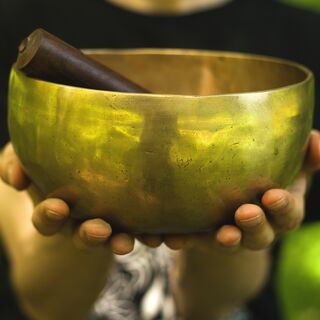
I'll ring a bell in a moment to signal the beginning of meditation and again when it's time to finish.
The following period of meditation is for ten minutes.
Thank you.
You you you you you you you you you you you you you you you you you you you you you you you you