Hello,
My name is Sam and welcome to this guided meditation for overthinking.
Overthinking is when we have persistent thoughts that are repeated over and over or that we dwell on for extended periods of time.
Often these can spiral into much bigger concerns than they started out as we add a little bit to each time we think about it.
This can lead to anxiety and worry.
Anxiety is the body's response to stress,
Usually presenting itself as fear or apprehension,
Leading to physical symptoms like a faster heart beat and tightness in the chest.
Thankfully meditation can be a real help.
So let's begin.
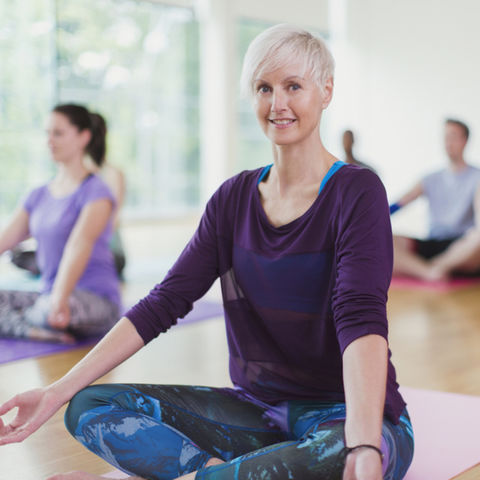
Find a position that you can relax in yet maintain a good posture.
A good posture is one where the spine is straight but relaxed,
The shoulders are down away from the ears,
The chin softly tucked and the belly and hips are released.
You can try this sitting in a supportive chair or lying down if you prefer that position.
Keep your feet apart around hips distance so that your legs can relax.
If you feel good doing so,
Close your eyes,
Though if it feels like you may fall asleep or that your thoughts will become too noisy,
Try keeping the eyes open and have a soft eye gaze towards the ground or at about 45 degrees below eye level.
Take a few minutes to relax and let your body feel.
Take a few moments to just notice how you feel,
Resting in this position.
Feel supported by your chair,
Floor or bed and allow your body's weight to sink into the surface.
Feel the muscles releasing their grip as you surrender yourself to gravity.
Bring awareness to the breathing and let's take a big deep breath in through the nose if possible and just let it go however you like.
Notice how the body softens a little more when you breathe out.
Repeat that deep breath and if you would like to,
You can make the in breath last the same amount of time as the out breath.
So try counting to four as you breathe in and count to four again as you breathe out.
Let's stop counting the breathing now and change the approach.
We're going to stay focused on the breath but we're going to become very aware of how we breathe.
As you breathe in,
Feel how your body moves to allow this to happen.
Notice a slight pause at the top of the breath and then observe how the body changes as the breath leaves the body and repeat.
So you're starting to notice the minutiae of the movement,
The lungs expanding,
How the skin stretches,
How the diaphragm moves lower,
How the belly lifts and so on.
And then notice the different types of sensations as the body exhales.
Continue to observe and note that we're not trying to change or judge anything here,
We are just seeing the breathing for what it is,
Like curious onlookers.
Now we're going to take a deep breath in and out.
We're going to judge anything here,
We are just seeing the breathing for what it is,
Like curious onlookers.
As you're doing this,
You might become aware of other sensations in your body that take your attention away from the breath.
You might have a little itch somewhere or a sense of warmth or your tummy might be rumbling.
If this happens,
Just assign the sensation with a label.
When it arises,
In your mind say to yourself,
Itch or warm area or rumbling noise.
You're literally stating what the sensation is with a label.
And then once you've given it the label,
Gently bring your attention back to the breathing.
There's no right or wrong way because you're simply allowing your mind to accept whatever it notes and observes.
So we're still noticing the breath and how it moves the body.
Though if you enjoy the counting of the breath,
You can also do that.
Now it might be that thoughts are popping into your mind right now and starting to distract you and that's okay.
It's completely normal.
It's what brains do.
Let's try applying the same labeling technique to these thoughts so we can change how we react to them so that we don't get drawn into the stories and led to the thoughts.
Now,
Let's start with the thoughts.
We're going to start with the thoughts.
Now,
Let's start with the thoughts.
Now,
Let's think about the thoughts.
Or feelings about the thought.
It's just a thought.
Oh,
There's another thought.
If a clear picture of something comes into your mind,
Without judging or getting drawn into this internal movie,
Simply think to yourself,
That's a visual representation of a thought,
Or that's a thought image.
At first,
It might seem like you're doing this every second,
And that's fine.
It's all part of the practice.
The important part of this exercise is that you're becoming aware of how your body and mind work.
The goal is to stop responding to thoughts as though they were real,
And instead see them as the sensory experience that they are.
So,
Let's say,
You see an image of a family member in your mind.
You would tell yourself,
This is a picture in my mind,
And then bring the focus back to the breathing.
If we can start to see thoughts for what they are,
Then we're able to become less reactive to them.
Take a few more breaths,
Labeling any other sensations or thoughts that arise.
Now,
As we start to reawaken ourselves,
We're going to start to see the thoughts that arise.
As you wiggle your fingers and toes,
Think to yourself,
Wiggling fingers or wiggling toes.
As you breathe in deeply,
Think big deep breath.
As you stretch your arms out,
Think stretching,
And so on.
Assign each movement with a label.
As you slowly open your eyes,
Think opening,
Opening,
Opening.
Think slowly,
And slowly,
And slowly,
And slowly,
And slowly,
And slowly,
And slowly.
You