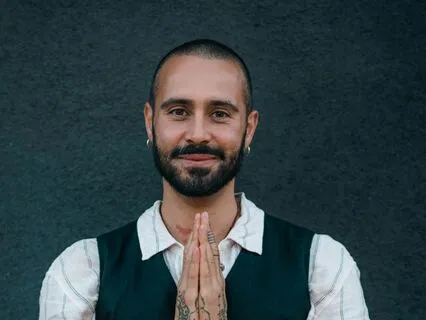
I'm your host,
Sadie Simone.
Gas is one of my best friends.
And as you get to know my new book,
You're going to realize that he's someone that is in my core five.
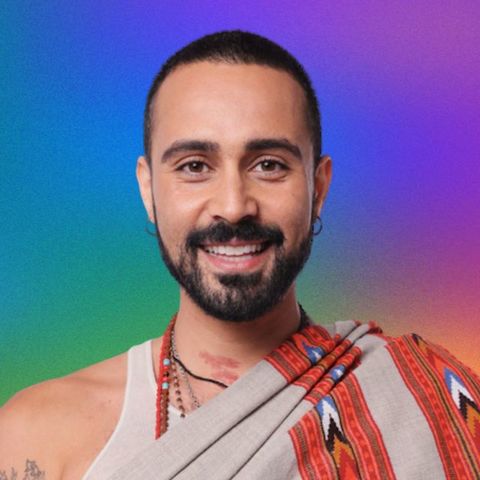
Shannon Algeo is here with us today,
My darling,
And he's a psychotherapist,
A public speaker,
And the author of Trust Your Truth,
And also a meditation teacher.
I'm currently training in somatic EMDR.
He's known by millions of people around the world for sharing his life experiences in ways that land in the hearts,
Minds,
And bodies of individuals who are seeking to learn,
Grow,
Deepen,
And heal.
And the reason why we're here together today,
It's because of his new book that he's currently writing right now,
Which is about compulsive smartphone use and attachment theory,
Which the reason why I felt like Shannon needed to be here today is because a huge culprit for us to not connect is our phones.
So no one better than someone who's wrote his master thesis on our addiction to smartphone to speak than Shannon Algeo.
Welcome to the show,
My darling.
Oh my goodness,
Sadie Simone.
Thank you for having me as always.
Wow.
Honored.
Thank you.
And the big question that I want us to develop on today's episode is why aren't people connecting in person?
What's happened in the last God knows maybe a couple decades that has severed our capacity to engage with people?
Yeah.
Well,
I was just thinking about this this morning knowing we were going to be recording this.
I was reflecting on this whole topic and I was just thinking about how hard it is to talk about smartphone use and compulsive smartphone use because two things happen when I talk about this.
One,
People say,
Oh my God,
That's me.
Oh my God,
I'm so addicted.
Oh my God.
I need that.
I need a smartphone detox.
I need a flip phone.
But then on the other hand,
We can't even see what's happening to us.
And I was thinking about how that's how dominant culture works.
Dominant culture works by erasing our visibility around what's actually happening.
So it's so hard for us to question our relationship with our smartphones because they've become so ubiquitous.
They've become such a part of our lives.
They move with us from the bed,
To the sofa,
To the kitchen,
To the bathroom,
To the car.
And because of the way that our brains are neurobiologically rewiring to be in relationship with these devices,
We are losing our sense of agency and choice around whether or not we're on them.
I know for me,
I can speak for myself,
There are many moments where I am outside of my window of choice about using the apps that I'm using.
And I'm actually in a pattern and habit of addiction that becomes so easy because I can carry that phone with me around wherever I go throughout the whole entire day.
So when I think about your question of how we are relating to one another,
I also think about the statistics around how our brains developed.
For millions of years,
Our brains became highly developed and skilled at picking up on subtle facial cues and tone of voice.
And when we are having communication with people over the phone,
Whether we're texting on a dating app,
Or texting a friend,
Or DMing,
Or going back and forth in the comment section,
Our brains are deeply dissatisfied with the human connection that we are receiving because there is no facial expression in a text message.
There is no tone of voice in a text message.
And yet,
Text messaging is becoming a place where a lot of people with insecure attachment styles are feeling more comfortable,
Quote-unquote comfortable,
Having conversations.
And yet,
The relational currency,
The relational exchange that is happening when that conversation happens over text,
Even though it may feel safe for that person who feels insecure about speaking their truth,
On a neurobiological brain level and on a human relational level,
There is so much that we miss when we don't see and hear each other.
Oh my God.
Keep going.
I'm like gagged.
I have like so many questions for you already.
Ask me a question because otherwise she'll spin out in a totally different direction.
She could go so many directions right now.
Help me come back to Earth.
Here,
Here,
Here,
Here.
We're having a human experience.
Oh,
Right.
Oh,
Wow.
Okay.
Listen,
I never heard such an honest answer to.
.
.
I never heard such an honest statement about we bring this thing with us from the bed,
To the bathroom,
To the kitchen,
To the living room,
To the car,
To work,
Everywhere.
It is traveling with us all the time.
That is so insane.
And it's,
We've normalized.
It's in today's world,
The way I see it,
It's this thing is a drug.
So we're normalized carrying around a bag of drugs with us.
It's almost like you carry around a bag of cocaine.
We are not normalizing that because we know that shit hurts ourselves and hurts other people and creates a whole trail of chaos,
But we have normalized.
I love the thing that you brought into the dominant culture,
Normalize it.
Yes,
Because you see people in the movies on their phone.
You see people on TV.
So much of people's content or the things that they're watching and experiencing in their lives comes from their phone,
You know?
All the streaming platforms are on your phone.
People are literally watching a whole movie on their phone.
It would normalize this thing in our hands,
Which is deeply hurting us,
You know?
And I want to hear you talk about this attachment style.
What was the word that you used,
The insecure attachment style?
Yes,
Yes.
And before we go into that,
I just want to,
I want to like,
You're reminding me of something as you're reflecting this.
And it's,
And this is where the dominant culture piece comes in.
We don't even see,
We don't even know what,
In most instances,
I'm saying we,
Because I think this is a thing that happens for a lot of people.
We don't even know what we're missing.
We don't know how different our lives would be without these devices.
And we have been robbed.
The human brain,
Individually and collectively,
Is being co-opted.
Our attention is being grabbed by these devices.
And we have,
And when I say we,
I'm really speaking from my own experience,
During periods where I've done like two,
Two and a half full days without any technology.
Or periods where I've completely let go of my smartphone for a number of weeks and only used a flip phone or a non-smart device.
All of a sudden,
It's like a portal into a different world.
And when I go to a cafe with my non-smartphone or without a phone at all,
I show up in my body in that space and in that community and with my journal in a totally different way.
I'm taking in details.
I'm making eye contact with strangers.
I'm writing more.
I'm having a different life experience that is an essential life experience for human beings because boredom is the birthplace of creativity.
And our creativity is being co-opted by algorithms that are harnessing our attention to be commodified and sold.
Like,
We are,
And I know so many people are out there saying this and yet it's not being said enough,
We aren't the customers of Meta,
Facebook,
Instagram,
TikTok.
We're the product.
We,
Our attention is what makes those platforms valuable.
And then those platforms sell our attention to their,
To their customers who are buying ads.
The customers are the companies buying ads.
What are they buying?
They're buying my attention.
Wow.
These apps are not developed for our well-being.
They're not developed for the well-being of humanity.
They're developed to keep these companies in a profit model structure.
And at the same time,
I don't want to underestimate,
Because the shadow of naming this and saying that this is a problem is it can,
It can quickly lead into a dystopian,
You know,
Technology is evil conversation.
And obviously there is also so much good that comes from this.
We wouldn't be recording this conversation in the capacity that we are right now.
There's,
It's not that all technology is bad,
But the degree to which the human psyche has been co-opted and people are not in choice around how they use these devices is having an impact on us intra-psychically,
Which means my relationship with myself internally has been impacted by my relationship with my smartphone.
It has impacted my relationship with the people that I love and the way that I show up in relationship.
And it's impacted our communities.
And if we're not tending to the shadow of technology,
Then we are getting swallowed by the ideals that,
You know,
I remember,
I remember when Facebook came out and I needed my Syracuse.
Edu email address to join because you had to be in college and there was a period of almost a decade where we were all,
Or many people,
Most people were in the ideal of social media,
The idealism of technology.
There was no wrong,
No bad.
It was bringing people together.
It was just like,
It was amazing.
And we didn't question where we were going until suddenly we were like.
.
.
Suicide rates,
Anxiety rates,
Depression rates,
Chronic illness,
You know,
Like chronic loneliness until a long-lived epidemic.
And that's when we start to question.
Yes.
Wow.
This is incredible,
Shannon.
Thanks for bringing all this into the mix too.
And I love what you said here.
Boredom is the gateway to creativity.
I've never heard it so clearly like that.
But lately I've been saying that,
I said this yesterday in one of my expressions,
Artistic expression of my process towards helping people understand how vital and how important the message of my new book is.
And I said,
You need friends that you can be bored with.
You need friends that you can allow a conversation to fizzle out and you guys both just stare in each other's eyes and just breathe together or can just be quiet next to each other.
Can you be silent with your friend without a phone?
How often do you pull out your phone when the conversation fizzles out?
And then you immediately associate that friend or that experience with boring and bored.
And therefore,
You put in a category of bad.
Therefore,
You put in a category of I don't need to seek for that experience ever again.
I don't need to see this person or try to engage because it was boring and I was bored.
And it really is hurting people from,
They're robbing themselves of the opportunity of catapulting into that creative space,
Into that deep space of devotion where the muse could walk in and can lead you to create something beautiful,
To say something poetic,
To move in a majestic way.
You know,
All the things that creativity,
You know,
The goddess of creativity,
The muse could like urge you when you allow the dust to fall and you allow yourself to be in your body,
Not out of your body.
One of the biggest things that I see with the smartphone addiction is we're hovering our lives.
We're not in our bodies.
We are watching ourselves live our lives through their phone,
You know,
And we're doing that ourselves and we're watching other people do it too.
So it's just,
It's a culture of disassociation.
It's a culture of hovering the body but not being in the body because when you are in your body,
You're going to feel the body receive the cue that you're missing a nutritional,
You're nutritionally deficient,
Which is friendship,
Connection in person,
Facial cues,
Voice tones,
All the things you said,
Smells,
Touch,
Physical touch,
A hug,
A hug,
A kiss on the cheek,
You know,
Holding a hand,
You know,
Like all the beautiful things that happen but the phone is robbing us of actually engaging and doing that thing that you have to reach over and grab your friend's hand or reach over and touch your friend's heart and say,
Your grief,
I can hold your grief with you,
You know,
Or you can let your friend lay their head on your lap and you could give her,
Give them a head massage while they are telling you about this really sad story that they're going through or maybe they may be celebrating something but we are robbing ourselves of the opportunity of feeling,
You know,
The physiological cue of hunger,
Like hunger in our bodies,
Which is loneliness,
To engage,
You know,
And I write about this in detail in the book that like social neuroscience speaks to social pain being translated in the brain as physical pain,
You know,
And it also says that,
It's what I said just now,
A couple moments ago,
It's when we feel hungry,
We go get some food,
We go get a snack,
We go get,
You know,
We need water,
We drink water,
Perhaps you're not eating the healthy things or drinking the good water,
Whatever,
Do your life,
Live your life,
But when it comes to the need for friendship,
This biological,
Psychological,
Spiritual,
Vital nutrient,
We are not facilitating ourselves,
We're not engaging with that need,
We are deflecting,
Rejecting,
Literally bypassing this cue for connection and the phone is at the forefront of why we're not doing it,
This is my view,
You know,
This is why I'm so excited for you to write this new book and this why I'm so excited about my new book,
Spiritually We,
To get people to understand like,
Yo,
Connection is the cure and boredom is the gateway to creativity and these things go together.
Mm-hmm,
Mm-hmm,
Yeah,
And like there's,
I love how Nikki Myers,
The founder of the yoga of 12-step recovery,
Talks about like how addiction is the disease of the lost self.
Oof,
Because I remember she said when I interviewed her on my podcast Soul Feed,
She said,
I lose myself,
Anything that takes my attention or causes me to lose myself is an addictive relationship,
If there's less self,
There is a dependency on something that is outside and so what this work is really about is reclaiming self,
But we have to understand how we got here and it's not just these technology companies that got us here and this was really the central question around my thesis,
I was curious because I was learning so much in school about substance use and attachment theory and addiction as an attachment disorder and there's actually this psychologist,
Philip J.
Flores,
Who writes addiction is the result of unmet developmental needs,
Which leaves certain individuals with an injured,
Enfeebled,
Uncohesive and fragmented self.
These individuals remain in constant need,
Hunger,
Object hunger,
You were just talking about HungerSaw,
Of self-regulating resources provided externally and he says when one obsessive compulsive type behavior is given up,
Another is likely to be substituted unless the deficiency in the self structure is corrected and so what I didn't realize when I set out to do my research on what is happening with my relationship with my phone,
It does feel compulsive.
I do feel compelled to pick up my phone.
There are now studies that are showing that teens and also adults are picking up their phones and unlocking their screens now up to 250 times per day.
250 times per day that is a compulsion.
We are being compelled to do that.
I am not convinced that those are 250 grounded centered choices to pick up one's phone.
Those are not 250 necessary times to pick up one's phone.
There is a cultural compulsion and to bring this back to attachment theory.
So if I have an insecure attachment style,
Which by the way throughout life our attachment styles change,
Maybe I should define what is an attachment style just briefly.
Please because I want to be educated and I also just want to name how legendary you are.
I'm like,
I'm like,
That's my best friend right there.
Oh my god!
Keep going.
Don't lose the plot.
I was just like,
Wow,
You are,
You are,
You are the voice of this,
Of this.
You are the voice that we can hear speaking to us about this,
This problematic thing that we are not even aware of the impact of bringing the phone from the bed to the bathroom to that.
We're not even aware of how cancerous this may be.
And I'm not saying cancer is as in cancer,
But I'm saying cancer is as in bad for us.
We are not fully aware of what is actually doing to the our neurobiology.
We know what's doing to our spirit,
You know,
We know what it's doing to our psychology,
But biologically,
I think physiologically,
I think there's a lot that we are not paying attention to that may be happening at a neurological,
You know,
Genetic level.
And what is being passed on is our addiction to our smartphones being passed on to our kids,
You know,
Like are they learning from a very young age to disassociate,
That this reality isn't as cool,
That the reality on their phone is better,
That the reality on TV is better.
Are they learning to not appreciate the flowers dancing in the wind?
Are they learning to not even feel the sun kissing their skin as they sit at the park?
Are they not,
They don't know how to look at a mother daughter sitting at a cafe laughing and holding hands.
Like they don't know how to be happy in that way for other people.
There's no sympathetic joy.
There's no evocative empathy because all these qualities must be learned relationally.
Take it away.
I just needed to drop in,
Drop that little bit.
No,
Thank you.
Thank you for dropping in.
It's making me want to read this,
This excerpt that was in my thesis because it speaks to,
We'll come back to the,
If you're listening,
Then obviously you are listening.
If you are listening,
Then you're listening.
We'll come back to many missed moments.
Sorry,
No,
We'll come back to attachment theory.
I'm going to read this section of the thesis.
It's short,
But it was a potent moment for me.
So I hope it resonates because it speaks to exactly what you're saying,
Sa right here about these connections and these moments and this section is called the moments we miss.
Is it okay if I read this?
Oh my God,
Please.
I'm already closing my eyes to receive it.
Please go girl.
We're all happy to hear that.
Yeah,
This was a reckoning moment for me around my process and this,
In the context of this,
I was in the midst of a 30 day smartphone fast.
I was doing a,
It was using a flip phone.
I was using myself as data for this experiment of like,
What can I and what happens when I get off my smartphone for 30 days?
And I was sitting at a cafe in Ojai and here,
Here is what I wrote.
So as I am sitting in a cafe in Southern California,
Wondering how I will ever muster up the courage or focus to write this chapter of my thesis,
I see four women in their 20s gathered at a table a few feet away from me.
One is talking loudly on her phone with what I imagine to be an older family member as the others are alternating between checking their phones and making 360 degree turns around themselves with smartphones outstretched as they selfie capture the charm of the cafe and each item of their feast as it is delivered to the table.
It becomes apparent they are celebrating a birthday when the attention at the table suddenly coalesces.
Okay,
Cheers,
Happy birthday,
One of them says in an almost enthused tone of voice.
Instantly,
Four outstretched arms reach toward one another as coffee mugs meet,
Making a mandala of Instagrammable latte art while their four other arms reach overhead,
Phones in hand to capture aerial footage of the making of this worthy moment.
As soon as the photo is snatched,
The moment of celebration comes to a quick halt.
I notice a wave of sadness come over me.
Where was the eye contact?
Where was the toast?
Where was the warmth of togetherness and birthday wishes for the next year beyond?
Where was the presence?
Where did that moment go?
Did it get snatched away,
Uploaded for what I imagine to be hundreds or even thousands of followers?
Did they get to be at this table at the expense of the presence of those who are actually here?
I feel a light sense of numb grief as I reflect on Sherry Turkle's comment that when a phone is present at the table,
The individuals are less invested in one another and conversation topics are skewed towards lighter subjects.
This scene is not foreign to me.
I am not a bystander,
A neutral researcher,
Or a judge of social etiquette and morality.
I have lived this scene.
I have been those girls.
I have missed those moments.
I grieve for them and I grieve for me because I know we as smartphone users don't realize we are missing moments while we are missing them as they get snapped and shipped off to be monetized by tech companies selling advertisements to the followers we claim as ours.
We are doing it for the gram,
As the influencers once said.
Replacing the richness of togetherness with being tethered to the alternate reality of the digital world has become normalized.
Anything and everything is fair game to be captured and curated to share with other people's eyes whose gaze may never be shared with our own.
And yeah,
That's,
Oh wait,
Sorry,
No,
I have to read this next part.
It's almost at the end.
Many of us who are classified as millennials or Gen Z merged with our devices before our brains fully developed.
We did not question our smartphones as they penetrated the fields of our relationships,
Dining experiences,
Pooping possibilities,
Or sleep schedules.
Instead,
We early adopted,
We explored,
We influenced,
We content created,
We dominated,
And we merged.
And now I mourn.
Who are you?
Oh my God.
Just having coffee at a cafe.
Oh my God,
Is everything okay?
Wow.
The depth of poetry and wisdom in this is mind-blowing.
As I close my eyes to hear,
I was,
You know,
I traveled to that scene and I traveled to that cafe,
That cute one that we've gone.
What was that?
The Duchess or something?
This was at the Duchess.
Okay.
Yeah,
I can see the beautiful decor.
I can see to my right,
To my left is the windows facing the cute street.
To my right is this glass case filled with pastries.
They're covered in powdered sugar and people making these fancy lattes and I can smell the baking bread and I can smell the chocolate cookies coming out of the oven and it's just a beautiful sight.
And we are missing experiencing it through our senses in order to gift something to other people that we are not ourselves gifting to ourselves,
Right?
We are so driven to live a life that's Instagrammable,
That is shareable,
That is beautiful on from the outside and that we are missing our inner beauty.
We're missing the beauty of what you said.
Where was the eye contact?
One of my dearest friends who is the mother of my goddaughter,
Tiffany.
She,
Her and I have been in a family since we're 19.
So we're talking many years.
And she said,
I was like,
You broke up with a hot Italian man.
She's like,
Yeah,
I did.
I was like,
Why?
You know,
I noticed that time after time we're going to these fabulous dinners and when we would do a cheers,
He wouldn't make eye contact with me.
And when I brought it up,
He would like argue back like,
What are you talking about?
Just get over yourself,
Like something like that.
And she didn't like that.
And then I,
I didn't think it was a big deal until I was like,
You know,
Much,
Much more deeper on my path and through self-editing,
Self-analysis,
You know,
Spiritual realization.
I started to understand like how these things that may seem miniscule,
Simple,
Small,
They actually have such big,
They really nurture you.
Now that I have a puppy and I walk in my neighborhood,
I am meeting all these pet owners,
You know,
All these pet lovers,
All these animal lovers.
And this morning I met Julie with her Husky that is blind of one eye.
And we just talked and I,
For a second,
When we were talking,
I zoomed out and I said,
Wow,
Look at this perfect moment.
She's standing in the garden with her big Husky and I'm standing right outside her garden on the street with my puppy.
And we're talking about how we are caring for these animals and how these animals are helping us and,
And teaching us and healing us and pissing us off and showing us our mind and the sun was shining beautifully.
And she says,
My name is Julius and my name is Sa and we made eye contact.
And I said,
I'll probably see you tomorrow.
She's like,
Okay,
Sa,
Take good care.
These points of social integration matter,
You know,
Like neurologically,
Psychologically,
Spiritually,
We are doing everything we can to not make eye contact with people.
We are doing everything we can to not engage with a stranger.
We're doing everything we can to not have to say hi to a person that triggers us or to not see somebody that annoys us.
But no,
When it comes to looking directly at the camera on our phones,
We do a great job at keeping perfect eye contact with a little green light,
You know,
Hi,
Yes,
You know,
Like we're doing a great job at that.
And yeah,
I just needed to name that because whoa.
Well,
I noticed the,
The D like moving from Ohio back to Los Angeles and being a pedestrian and passing people.
I feel in my body,
The dehumanization of modernity because I'm,
I have this,
Oh,
Hi,
I,
You know,
We're so adaptable.
We adapt so quickly.
And after being more in a small town,
I've adapted to the way that that culture relates.
And if you pass someone generally people say hi,
You know,
I,
You know,
Like,
Oh,
Hi.
And,
And here there's more people and people are,
It's the city and people are going and they are looking down or they're on their phones or they're just not open because sometimes a city requires that you have that shield up.
But I just,
I,
You know,
Without making it right or wrong,
I just,
I can feel the difference and yet,
You know,
Not everyone is like that,
Like the experience you're describing.
And it reminds me of a quote from the poet,
John O'Donohue because my thesis looked at poetry and,
And compulsive smartphone use and attachment theory.
And so a huge part of my thesis exploration was poetry.
And actually this field of poetry therapy that I had no idea about,
Which is often used as a treatment for substance use.
And it's used in substance use treatment centers,
Reading poetry,
Writing one's own poetry as an expressive art,
And also writing poetry in groups together as a collective relational experience.
And so I was diving deeper into my explorations of John O'Donohue,
The late great Irish poet.
And I found something in his book,
Anamkara,
Which is Gaelic,
Anamkara is Gaelic for soul friend.
And this quote,
I literally felt like I struck gold and I hope that everyone listening agrees because this,
I feel,
Speaks to what you're saying,
Saa,
About being present and noticing the beauty of these moments.
And he writes,
When you really look deeply at something,
It becomes part of you.
This is one of the sinister aspects of technology.
People are constantly looking at empty and false images.
These impoverished images are filling up the inner world of the heart.
To look at something that can gaze back at you or that has a reserve and depth can heal your eyes and deepen your sense of vision.
To look at something that can gaze back at you or that has reserve and depth can heal your eyes and deepen your sense of vision.
So these,
So like this,
The book that I am writing,
There are already books out there if you want to do a smartphone fast or like go,
Like everyone should read Digital Minimalism by Cal Newport,
Which is such an excellent book about questioning your relationship with your phone and practical tools to shift it.
The book that I'm writing,
While it will include the wisdom of the great people who are already doing this work,
Is touching on this like,
What feels like unfinished business in some of John's work of the soul impact of impoverished images that are,
Like when we were in the world before technology,
Our recent ancestors had to engage with something that Carl Jung referred to as the soul image,
Where we're actually connected to our imagination because we aren't filling up our psyches with Instagram feeds and images of terrifying war crimes being committed around the world.
I'm not saying we shouldn't look at those things,
But the fact that they could be in bed with me or with me while I'm taking a dump is insane because when I'm laying in bed or when I'm taking dump,
These are moments where we have the opportunity to connect with ourselves and our souls.
And the level of noise that we are now accustomed,
These are drugs.
These phones are stimulants.
They are causing dopamine responses.
We are addicted to a high level of dopamine.
That's why we're checking it 250 times because we want more.
And so,
This is a big question for me in the process of writing this book,
And I'm grateful for this conversation with you,
And to be in dialogues like this.
How do I shine light on something that is so hidden and that so many people,
Because of the addictive nature of this phenomenon,
Are invested in it staying hidden?
Are we ready to reckon with just how much these have infiltrated our own creative potential and psyches?
Well,
It comes down to looking at the loneliness,
You know,
And just looking at the statistics of it,
Too.
And I want to name one thing.
My connection with Julie would not have happened if I didn't leave the house with my phone in my back pocket,
Not in my hand.
The phone in the back pocket to know the time,
You know?
And if the phone was in my hand,
I would have not had an interaction with Julie.
I wouldn't have met a neighbor.
I wouldn't have met someone and had eye-to-eye contact and exchange of this energetic exchange,
This deepening,
This depth,
All these beautiful things that took place in a six-minute exchange.
You know what I mean?
Like,
It wouldn't have happened.
And so much of our lives is being missed because of the phone.
And then we can look at this invisible illness of loneliness.
You know,
We care for people with visible illnesses,
Right?
We see somebody who has lost all their hair and they're wearing a scarf on their head.
Oh,
They're probably going through chemotherapy.
Let me be a nice person.
Let me be kind to them.
You see somebody walking with a,
You know,
With a broken arm or in a crutch or something or in a wheelchair or whatever it may be or the visibly a visible scar.
We immediately care for people with visible illnesses.
But we have been so habituated into not reflecting on inner,
Our inner world,
Each other's inner worlds.
We don't know our own inner world.
We're not following through with the cue for loneliness.
The beginning of my book is just paving the path for people to understand that this is a vital need.
And then as we go on through the book,
It's really teaching people that,
Hey,
If you're not actually doing this thing,
You're missing freedom.
You're missing the true liberation.
You're missing the true nirvanic states,
Which is they're relational.
Freedom is relational.
You know what I mean?
And it's such an important thing to like merge with freedom,
Make freedom your goal,
Not Instagram followers,
Not a,
You know,
A shiny Instagram community,
But deep inside you're so lonely,
You know,
This invisible illness of loneliness.
It's really tearing our society apart.
You know,
The suicide rates have been up by 30% in the last few years,
You know,
60% of young adults report that they feel seriously lonely.
And chronic loneliness leads to depression,
Anxiety,
Addiction,
Cardiovascular disease,
You know,
All these things that,
And the problem with loneliness,
It's that it is a self-deprecating protective mechanism.
We don't reach out.
We don't engage because we don't,
We've lost our capacity.
We've lost the muscle to reach out and say,
I like your shoes,
Nice hair.
You look nice.
What kind of dog is that?
Oh my goodness.
I have this,
I have this dog too.
We've lost our capacity to relate,
Right?
Because we've been attached to these,
To the technology.
And now with AI writing our posts and writing our books and writing our lives for us,
A robot writing it,
We're severing,
And to use your language,
Something that you used with me before,
Atrophying.
It's atrophied our muscle of connection,
Which I love that you say this.
And then there's the other side,
Right?
We don't know how because we've lost the plot.
And then at a deeper level,
We're so afraid of being rejected.
We're so afraid of being abandoned,
You know?
We're so afraid of not belonging,
Which belonging is a basic human need.
We have a need to belong to something.
And I talk about in the book too,
Sometimes we belong to the wrong crowd that hurts us and hurts other people just to feel a sense of belonging.
Even if they are not living by your values,
Even if they're not doing good things and impacting the world and helping people,
But we want to belong so badly that we rather forego our ethics,
Forego our moral code to just be able to be around other people that we can say,
These are my people,
You know?
And this,
So when I speak about loneliness being an invisible illness,
I'm really addressing this psychological,
First there's this physiological dependency on something to soothe us at a somatic level and on our emotional level.
And then the psychological self-deprecating narrative,
Every time loneliness comes up,
Instead of us addressing and we go,
Oh my God,
I'm so lonely because I suck,
I don't have enough to show for,
I'm a bad person,
Blah,
Blah,
Blah,
Blah,
Blah.
And we go through all this list of stuff,
All reasons why we are alone,
You know?
Ah,
Yeah.
I just like to be so like,
Yeah.
Yes.
Yes.
Like,
Sorry,
So much is like flying as you're,
Like you're inspiring,
Everything you're saying is inspiring so much.
And it's like,
We were sold a false dream.
We were sold a dream of if we get the followers,
If we build the online thing,
We'll be connected,
We'll be making a big impact,
We'll be happy.
And in that,
There was a,
At least for myself,
I noticed,
Especially in hindsight,
A devaluing of the person right in front of me.
An overvaluing of this dream,
The technological online dream.
Oh my God,
Go off.
And a devaluing of the next-door neighbor feeding the squirrels,
Which is what I have here.
And this atrophy,
The atrophy is,
Cancel culture was created in an internet world.
Dr.
Brene Brown says in her book,
Braving the Wilderness,
It's hard to hate people close up.
Move in.
It's really easy to hate the troll online,
Because you don't see that someone's grandma with terminal cancer.
You don't,
And then you can so easily call them deplorables.
It's a deplorable person,
Scum of the earth.
No,
That's a human being,
Actually.
And yes,
Capitalism and the systems that we operate in,
Like technology,
If a city is dehumanizing,
Then what is the internet?
You know,
Like,
So we,
Relationally,
I have noticed,
I'm saying we so much,
Because obviously there's a collective theme here,
But I notice the training of my mind to swipe left,
Not just when I'm on my phone,
But I'm done with you.
To leave the relationship,
To exit,
Because that's how I'm training my mind when I'm on these,
You know,
Like dating apps.
I'm training my mind to be like,
To be a hunter and gatherer of human beings.
You go in my bucket,
You go in the trash.
You go in my bucket,
You go in the trash.
That is a mind training of how to relate to humans.
Wow.
And I just want to affirm something you've said a couple times in this podcast,
Saab,
Because in my research,
I was looking at what does the field of psychology say about smartphone use in relationship to the increase in symptoms that you named.
And beginning in the early 2010s,
Researchers began to see sharp increases in many of the things you've named,
Depression,
Anxiety,
Loneliness,
Self-harm,
Suicidal ideation,
Suicide attempts,
And suicide amongst teens.
And there is growing consensus in the field of psychology that these spikes and symptoms are linked to the radical shift in technology that emerged with the launch of the first smartphone in 2007,
The iPhone.
These symptoms started in the 2010s.
Ah.
And one piece that I want to come back to,
If it's OK,
We also need to talk about attachment theory.
Is that what you're getting at?
Is that?
Yeah,
Yeah,
Yeah.
Because what I didn't,
I was curious,
Because if addiction is,
Like the psychologist says,
Philip Flores,
That addiction is the result of unmet attachment needs,
Unmet developmental needs.
So I get addicted to the external cocaine,
Or the men,
Or the sex,
Or the drugs,
Or the food.
Because when I was,
And I'm sort of using I as an example,
I'm not saying this is my direct experience,
But like if there's those unmet attachment needs developmentally with our primary caregivers when we're growing up,
We learn through those early experiences whether we can feel secure that those people who love us will show up,
Not just for our physical needs,
But psychologically and relationally for our emotional needs.
And so if we learn that the primary caregiver,
For whatever reason,
Maybe because of their own trauma,
Is not attuned to our needs,
We start to compensate by shutting down,
Getting avoidant,
Panicking,
Getting anxious,
And crying out for our needs.
And those two styles of attachment are insecure,
Not bad.
A lot of people are like,
Oh,
I'm insecure.
Oh my God,
I must be bad.
What's wrong with me?
It's not that.
But there are secure attachment.
Secure attachment means I trust that the person I love is going to come back.
I trust that the person I love is going to be there.
I trust that I can go away and we will re-engage in a healthy way.
I trust that if I have a need met,
That that need will,
In some capacity,
Get met.
There's a relational trust currency.
Insecure attachment style is a reaction to,
You know,
I bet that's probably not going to get met,
So let me figure this out on my own.
It's a shutdown.
So I was surprised because I was kind of stewing on this possibility of,
Okay,
Smartphone addiction,
And I wonder how that influences people with attachment,
With insecure attachment styles.
And I was amazed because I found three research studies that were done recently by different groups of mental health professionals,
Psychologists,
Who found that,
Like in one study,
That smartphone addiction is defined as the inability to control smartphone use despite negative effects that it's having on the users.
And the,
Sorry,
I'm wanting to read this next part from the research that basically what I'm trying to say here is that there is a link between insecure attachment style and compulsive smartphone use.
So people who have an insecure attachment style are actually using their device as a secure attachment,
As a base.
Oh,
Because it gives you,
Okay,
It gives you the hit when you want it.
You got me.
Yeah,
Yeah.
It gives me the sense of security.
This thing doesn't turn off.
It never stops giving to me.
It never stops showing up.
So,
Oh,
Sa didn't text me back.
Oh,
Maybe Sa's annoyed with me.
Oh,
I'm just going to go on my phone.
I'm going to go on a dating app.
Oh,
That guy told me he's not interested in me anymore and doesn't want to date.
I'm going to download a new dating app.
Like,
So I'm going to manage my relational feelings of insecurity by using this device,
Which is providing insane amounts of stimulus to make sure that I don't need anyone.
I mean,
That's the real,
Like,
You know,
Like there's all variations of this.
Obviously I use my phone for a lot of reasons,
But the shadow of it is when I use it to what you were talking about,
To like dissociate,
To check out,
To not need people.
And then that feeds the culture of loneliness that you're talking about because now this device creates the illusion that like,
Oh,
Maybe I actually don't need people.
And yet my soul is craving for real human connection.
My soul is craving to know I matter to Sa.
And the development of the spirit,
The development of the soul,
The soul reaching its full potential to become a Buddha,
To reach these nirvanic states,
To enter Samadhi,
To become enlightened,
It's required to be in relationship.
So half of the work,
This is the basis of the book of Spiritually We,
Of my new book,
It's this equation that I'm about to share with you guys.
It's this exact thing.
Half of the liberatory equation has to be done between you,
Your body,
Your mind,
Your heart,
Your biography.
So,
You know,
Meet the shadows,
Meet the harm,
Meet the demons,
Have tea with all these parts of yourself.
And then once you find realization in some of these obscure parts of you that you deem as bad and shadowy and repulsive and that you hate,
And you can see these parts of yourself,
Instead of having disgust and hate,
You're just kind of like,
Okay,
This was a mistake.
It was a circumstance of the moment.
It was part of the context of the moment.
I'm no longer that person.
I've changed.
I've healed.
I've improved.
I've grown.
You have that sort of circuit of realization.
Now,
That realization is only a passing sensation if you don't test your material in relationship with someone else.
Can someone else make a mistake?
Can someone else cause harm?
Can someone else create a trail of chaos?
And can you still offer them love and care?
Could you offer a restorative approach,
Not a punitive approach?
And if you are able to offer a restorative,
Caring,
Loving approach to someone who's made a mistake,
Then the realization has now become embodied that you've had.
The realization that you had on your cushion that morning about,
Oh,
My God,
I can finally forgive myself.
Wow,
I'm free.
Oh,
My God,
It feels like such a,
Oh,
The weight is off.
I can finally put my chin parallel to the ground.
I can finally make eye contact.
My shoulders just dropped a couple inches.
I can walk around with a strut of a Parisian supermodel all of a sudden.
That strut of a Parisian supermodel will not last unless it's tested in the street,
In the community.
This is the basis of my work in what I've understood and what I have self-researched and obviously researched with thousands of people around testing.
Is this really working?
Is this the path to liberation?
Obviously looking at something that predates me,
Something that has ancient roots,
Something that leads back to a Buddhist lineage that has factually produced enlightened beings.
And there is the first school of Buddhism really emphasizes the self-liberation.
Do it by yourself.
Do it alone.
And that's the greatest gift you can offer people.
And I believe that there's validity to that,
And I believe it's very beautiful and very admirable to go off to a meditation cave in the Himalayas and disappear into selflessness.
And then that disappearing into selflessness then creates a mist of liberation for all beings.
And every time you disappear into selflessness in the meditation cave in the Himalayas,
You are sending a blessing wave to all people everywhere.
So that's a nice thought,
Right,
To sit back and be like,
Wow,
There's someone right now praying for my well-being that I don't even know and I will never meet.
It's a nice thought.
It carries you.
It can give you a little woof to get out of bed and go do the thing,
Even when your mother died and your world has flipped upside down.
And then there's the two other waves of Buddhism that have come.
Some people say that these waves of Buddhism didn't come later.
They just came in secret times.
The Buddha taught these tantric paths,
These relational approaches to liberation at secret hours,
At hours that the average people couldn't understand.
So he taught it at these secret points.
This is what some people say,
Right?
And some of the historical,
Archaeological facts about when and who and what was taught,
If the Buddha said this or was one of his disciples or whatnot,
I'm giving you what's being metabolized in me.
I'm not giving you,
Like,
You know,
A history class,
You know,
By no means whatsoever.
In all the research that I'm quoting,
I'm not a scientist.
Obviously,
You guys know,
But I've spoken to a lot of scientists to be able to have this research to point to.
But anyways,
There's the two other big schools of Buddhism that have,
That is technically what I practice,
Mahayana-Vajrayana hybrid.
It really shows us that community is the cure,
That relationship is the path to liberation.
And then there's a story that I've shared a million times here too that really informs the book is the Buddha had a disciple that asked him,
A really prolific,
Very,
Very,
Very advanced disciple.
He asked the Buddha,
How important is friendship on the spiritual path?
And the Buddha paused,
Took a breath,
Opened his eyes out of meditation and said,
Darling,
Friendship,
Spiritual friendship,
Community is the path.
So that is like a resounding yes for us to realize that it is purely,
If you just want empirical scientific data to upgrade your biology and making sure that your psychology is balanced,
And you're not even talking about esoteric means,
Esoteric anything in matters of the heart or spirit,
Right?
Or soul needs,
You could just look at your biology and your psychology.
Friendship is a vital nutritional need.
Now,
If you want to talk about esoteric needs,
Like the needs that we all have to become utterly liberated in one lifetime to free ourselves from all fear,
To be able to be fearless,
Not that we don't experience fear,
But we do it anyways.
We're no longer going against reality.
We're going towards reality,
You know,
With reality.
And in order for that to happen,
You have to be in relationship with other people in order for you to see your potential.
All right,
I went off there.
Go off,
Sis,
Sis of the light.
Yes.
There's a depth psychologist,
Donald Kalshed,
Who wrote a book called Trauma and the Soul.
And in that book,
He writes,
What has been broken relationally must be repaired relationally.
And that is what was surfacing as you were talking about how the friendship is the spiritual path.
And we,
I mean,
It's interesting because in this human experience,
We are both individuating and in the becoming of our own selfhood.
Oh,
My goodness.
Oh,
My goodness.
Time to go.
It's time for her nap.
It's this is my little light bone.
Time for her nap.
I need to learn how to silence that beauty.
Technology said,
Hello,
I'm still here.
And,
Yeah,
We're having these individual experiences.
And yet we aren't separate from one another.
We are separate and we are also deeply interconnected.
Like many cells,
Each of us a cell of one ecosystem of a living organism.
And that is a tension.
It's a duality that we have to navigate in this human experience.
There is me and I am deeply connected to you.
And there is also we.
And actually,
Dan Siegel,
I believe one of his books,
I think it's in the subtitle,
Is this concept of we.
We,
The me and the we together.
And he talks about this really powerful concept of interpersonal neurobiology that actually Sa's mind and Shannon's mind come together.
And neurobiologically,
We create a third brain.
We create a third mind,
A intersubjective reality that could not be created were it not for you and me bringing our energies together to create something that's even bigger than either one of us,
Which is what happens in relationship.
I always think about like,
Okay,
Like you think you are a boss who doesn't need anyone,
Who's independent,
Who's figured it out,
Who doesn't need anyone for anything financially stable,
Financially independent.
I'm,
You know,
I'm like,
Did you,
Did you,
Did you,
Did you do the plumbing for the city and all the water that comes through you?
You know,
Like,
Did you get all those vegetables and put them in the grocery store?
Did you,
You know,
Like,
Like we are so interconnected.
We need each other.
And self-made,
Nothing self-made,
No thing in this reality exists from its own side,
Independently of anything,
Of everything else.
It's a,
It's a baseline.
It's a base teaching in Buddhism.
Yeah.
There's interdependence and interconnection.
And I love that you're naming this go off.
How do we,
Yes,
Yes.
Interdependency and interconnection.
It's no one is self-made.
And yet,
And yet like,
Did I earn my master's degree?
Is that,
Is that from my hard work and my showing up and my commitment?
Yeah,
It is.
And could I have done that alone?
No,
I couldn't have.
And,
And so let's bring it back for a second,
Because we're talking about,
I want to be like really tender around this too,
Because when we're talking about attachment related wounding,
We're talking about the inner child.
We're talking about developmental wounds.
We are talking about ways that we learned to relate in order to maintain a sense of safety and security in unsafe and insecure conditions.
And so,
Yeah,
It's easy from the outside looking in to be like,
Like,
Girl,
You got attachment problems.
Like you're addicted to your phone,
But that the assessment that I have a problem is not the energy.
That's going to heal that problem.
So I can have all the awareness in the world,
But like,
Like the psychologist,
Philip Flores said that if I don't treat the,
The broken and feebled injured self structure,
The structure of my soul,
Then one addiction will just transfer to another because the problem is not the behavior,
The problem,
Or the healing is in the learning to trust and rely on other people's and others through corrective emotional experiences,
Where in areas where I would have shut down in the past,
I am able to stay present and stay open.
And the person who I'm in relationship with is able to give me an experience of freedom and healing through our connection.
When maybe in the past,
I would have expected that person to leave me and walk away.
And so we learn through relating to one another.
And a lot of that learning is reenacted hurt because part of the way that this works is we attract people to us that,
That,
That reconfirm our trauma.
So I'm in the relationship with the guy who's emotionally shut down,
Like the traumatic experience that I had in childhood.
And so in order to learn neurobiologically,
Emotionally,
Psychically,
Spiritually in order to learn to be worthy of something new,
We have to experience something new.
It's like kind of a paradox.
It's like the way to heal is to heal.
The way,
The way to make love is to make love,
Right?
Like you can only go on and sit on the mountain for so long before you like got to get out in the game.
That's right.
And test what you've learned and tested the depth of your liberation,
You know,
Is am I liberated or the moment you come off that mountain and you start to see those tourists taking photos of everything and wanting to take a photo with you.
And you just came out of like three year in,
In a meditation hut in the Himalayan mountains.
And then you see these tourists with these,
You know,
Taking photos and,
And,
And,
You know,
Leaving trash behind and all of a sudden you notice the little bubble of anger coming.
And then you really quickly realized that what you did in the mountain perhaps was just you protected your peace,
But you didn't embody peace.
And this is a great,
A really deep.
I'm getting hot.
Okay,
Good.
It's a really deep through line in my new book and we have to close.
Cause I could talk to you for a whole other hour.
Oh yeah.
I'm following your lead.
So shut me up.
We can keep going.
It's so amazing.
You know,
So amazing.
So,
So,
So amazing.
Shannon Algeo.
What a joy it's been.
You are my bestie.
You'll be my therapist.
Okay.
Cause you are so legendary in that space.
Oh my God.
So thank you for existing.
Thank you for being in my life.
Thank you for blessing us with your wisdom and your grace and your poetry.
Oh my goodness.
Thank you.
Thank you.
Thank you.
Thank you.
All right.
Peace.
Love you all.
Take good care.