Welcome to the Mindfulness Meditation Podcast presented by the Rubin Museum of Art.
We are a museum in Chelsea,
New York City that connects visitors to the art and ideas of the Himalayas and serves as a space for reflection and personal transformation.
I'm your host,
Tashi Chodron.
Every Monday we present a meditation session inspired by a different artwork from the Rubin Museum's collection and led by a prominent meditation teacher from the New York area.
This podcast is a recording of our weekly practice currently held virtually.
In the description for each episode,
You will find information about the theme for that week's session,
Including an image of the related artwork.
Our Mindfulness Meditation Podcast is presented in partnership with Sharon Salzberg and teachers from the New York Insight Meditation Center,
The Interdependence Project,
And Parabola Magazine and supported by the Frederick Lance Foundation for American Buddhism.
And now,
Please enjoy your practice.
Hello everybody,
Tashi Delake and welcome to Mindfulness Meditation Online with the Rubin Museum of Art.
I'm Tashi Chodron and I'm happy to be your host today.
We are a museum of Himalayan art and ideas in New York City and we are so glad to have all of you join us for our weekly program where we combine art and meditation online.
And this month's theme is openness.
When there's openness,
There is fluidity,
There is easiness.
And the art connection for today,
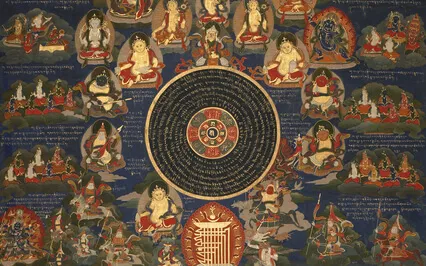
It's this beautiful protective astrological chart,
Origin from Tibet,
Late 18th to 19th century,
Mineral pigment on cloth,
A thangka painting.
It's a scroll painting and the size of this is 49 into 36 inches.
And this is a gift of bodhichitta art.
This Tibetan astrological chart is an auspicious talisman and an instructional tool that is believed to bring good fortune to all those who see,
Display or possess it.
Such charts can often be found hanging on the walls of Tibetan houses and are commonly engraved on amulets worn or carried on one's purses or on a wedding procession to ward off any negative energy.
The primary figure at the bottom center,
As you look at this work,
Is a tortoise,
A metaphor for creation.
On the tortoise's belly are concentric circles that illustrate from the inside out the nine magic numbers,
Which is called meva gu in Tibetan word and then the eight trigrams parkadje and the 12 animals of the zodiac,
Which combined with the five elements form the 60 year of the cycle of Tibetan calendar.
In Tibet,
Astrologers were usually highly trained lamas or teachers,
Either ordained or lay.
They were relied on heavily within various aspects of life,
Including determining favorable dates for ceremonies,
Marriages,
Launch of any major construction works,
Medical treatment,
Businesses and all sorts of both religious and secular activities.
Also determining the compatibility of partners through astrological profiles for marriages.
In some cases,
This would be even extend to calculating the most beneficial wedding date to ensure success in a certain aspect of the relationship,
Such as prosperity,
Health,
Etc.
And this astrological chart is also for giving advices on funerary rights for the deceased,
Including when to perform the funeral,
How to perform the funeral and what rituals to perform.
So,
As I mentioned,
Astrology played an important role in Tibetan culture,
From monastic affairs to medicine,
From birth to marriage to death and even agriculture.
The Tibetan astrology developed through an amalgamation of three distinct sources.
One that is Vedic or Indian astrology known as Karsi or white astrology,
And then the Chinese astrology known as Nazi or black astrology,
And then the Kalachakra Tantra.
Our teacher for today is Tracy Cochran.
Tracy has been a student and teacher of meditation and spiritual practice for decades.
She's the founder of Hudson River Sangha,
Which is now virtual and is open to all.
The link for her weekly meditation can be found on her website,
Tracycockran.
Org.
In addition,
Tracy has taught mindfulness meditation and mindful writing at the Rubin Museum of Art and the New York Insight Meditation Center,
As well as in schools,
Corporations and other venues worldwide.
She's also a writer and the editorial director of Parabola,
An acclaimed quarterly magazine that seeks to bring timeless spiritual wisdom to the burning questions of the day.
Her writings,
Podcast and other details can be found on her website and on parabola.
Org.
Tracy's just mentioned that her new issue of Parabola named Darkness and Light is Out.
Thank you so much,
Tracy,
For being here.
Yes,
Well,
It's a joy to be here.
And it's a joy.
Before we began speaking today,
Tasha came on and shared some of the material she had.
It touches me to remember that everywhere in all cultures,
Astrology holds an appeal.
It holds out a kind of magical draw and the promise of knowing more about ourselves and in relation to the stars and the planets.
It's also interesting to remember that astrology has a common root.
Some people trace it back to Mesopotamia,
Then it went to India,
To Greece.
And of course,
In this continent,
Tasha mentioned the image of the tortoise.
Native Americans refer to the Earth as Turtle Island,
Also the tortoise.
But it also invites us to be in front of the known or our yearning to know and the unknown at the very same time.
And as I was getting ready to come here today,
I took a walk and I stood down by a little lake where I live and I noticed how it felt to be standing right where I was today.
And you can practice this even as you listen to me wherever you happen to be sitting.
And I noticed in a very simple and direct way that it's cloudy today and everything looks very soft.
All the leaves are changing colors and dawn is a bit later.
And that had a different feeling than even just yesterday when it was sunny and it was warm.
It had a different effect on me.
It gave me a different kind of mood.
And I was also aware that in the development of this mysterious art,
This craft,
Astrology was once the same thing as astronomy.
And it was this notion in every culture that the planets and the stars moved around the Earth.
And of course,
Of scientists,
Actually many,
Many people just observing the stars,
Willing to put themselves into not knowing,
Came up with the extraordinary observation that the Earth actually moves around the Sun.
This great shift from a geocentric to a Sun-centered solar system.
And in our own day,
Of course,
With the James Webb telescope in space,
We're being invited to open to the vastness of the cosmos.
An unimaginable vastness.
So in the midst of all that,
Astrology keeps its appeal.
And Tashi will go into that in much more depth after we meditate.
But what's interesting for us to sit with as we just begin to get ready to sit,
We're not sitting yet,
Is this notion that there is something inside us that wishes to please ourselves,
To know ourselves in the center of the cosmos.
What is our relationship to life?
What are we doing here?
And our task in this practice,
The art of meditation,
Is to let go of fixed ideas of who we are.
And we can practice this even as we listen the next couple of minutes.
Here we're,
Notice,
Notice,
I won't tell you,
I'll invite you to notice how you know who you are.
And you might be sitting in an office right now,
You might be sitting at home,
And instantly the thinking mind begins to tell us who we are.
We live in a certain place.
We live in a certain country.
We have,
We're married or single,
We have children or we don't have children,
We're young or we're older.
All these ways of knowing ourselves.
And the invitation of the practice is to notice that there's also an awareness inside us that isn't bound by any of these things,
That simply sees,
That simply listens,
That is awareness itself,
That is our inherent capacity for openness,
For compassion.
And we can begin to see as we practice,
And many of the people here are from New York City and the roof is in New York City,
And one of the things I used to relish doing when I would teach life,
Which hopefully we will do again,
Is walking from my train at Grand Central Station down to the Rubin Museum,
Because I got to walk down Park Avenue in Manhattan and notice that every single person I passed on the street,
Young and old,
Some appearing to be rich,
Poor,
Sad,
Happy,
All ages,
All ethnicities,
That each of them,
Just like me,
Was in the center of their own private cosmos and their own private web of connection with relatives and loved ones and their own dramas,
Their own passions.
And remembering that each person I passed was the center of their own world reminded me to open,
To open to,
In a sense,
De-center myself and open to a greater unknown,
Life itself.
Just not concluding anything,
But just being open to how I am being influenced,
How I have been influenced.
Turning,
Just shifting in the gentlest way towards questioning now,
Might there be more to see,
Might there be more to know?
And that doesn't mean absenting myself and kind of numbing out,
It means opening to see that there are other capacities for awareness and caring in me right here,
Right now.
And we'll right now begin to relax and take a comfortable seat,
Knowing that this 15 or 20 minutes of practice will open us to further exploring what Tashi is so well equipped to bring with her illustrations,
With her understanding,
To help us forge a connection between the ancient past,
Between Tibetan culture and where we're sitting right now.
And notice,
Starting now,
As we close our eyes or gaze downward,
As we let our backs be straight,
Our feet on the floor,
Some people lie down,
That's fine too,
Noticing that as we come to sensation with eyes closed,
That we can open to what we're presented and we don't have to open with the thinking alone,
But with our hearts and with our inherent capacity to be with what's unknown.
So taking a comfortable seat with eyes closed,
Knowing that we're sitting with others and we can't see them,
We don't know them,
But we share something,
An opening.
We open to how it feels to be sitting here right now.
And notice that we don't have to think about this,
That we allow the thinking to be present,
We allow sensation and emotions to come and go,
But we don't have to cling to any of them,
We don't have to name them.
Realizing that there is an awareness inside you that's larger and more spacious than anything you think you know about yourself.
Realizing how it feels to just open and by opening you can substitute the word softening or relaxing,
Letting go of striving,
Of defining.
Noticing how it feels to rest in stoneness.
The physical stillness of not leaning forward,
Not tensing,
Not clinging even to thought.
Noticing that there's still a presence here,
An attention that listens,
That sees,
That doesn't come without comment,
Without rushing to conclude.
Just present.
Just listening.
This opening to what is here.
This channel Like NationalHuhIL environment K context Just let everything happen to you.
Thinking,
Feeling,
Pleasant or unpleasant or neutral.
Allowing everything to arise and pass.
Knowing that it came from somewhere.
From causes and conditions.
Large and small.
When you get taken by thinking or feeling or picturing,
Just come back to the body.
Back to sensation.
Allowing yourself to be anchored in this body.
Your portion of earth.
And notice that there is an attention that is also here.
An attention that's open like the sky.
Allowing yourself to be anchored in this body.
And notice if you wish,
The region of the heart,
The chest.
Without making the heart feel any particular way,
Just notice that feeling is also here.
The feeling of being here,
Alive,
On the earth.
Under the sun and the turning stars.
Noticing that under all our thoughts and emotions and difficult situations,
There is inside us a feeling of the goodness of life.
Of being alive.
Of being part of something greater than our thinking.
And notice that there is an attention that is also here.
And notice that this awareness,
This attention or feeling for life,
This sensation of being alive in the body,
Does not need words.
And notice that there is an attention that is also here.
And notice that there is an attention that is also here.
Noticing that we can open to the unknown.
To the mystery of life.
That is illuminated by compassion and an attention that sees without clinging.
And notice that there is an attention that is also here.
And notice that there is an attention that sees without clinging.
And notice that there is an attention that sees without clinging.
And notice that there is an attention that sees without clinging.
Notice how it feels to be asked in an awareness that's vast,
Open,
And kind.
As if the stars themselves were looking at us with love,
Acceptance,
And compassion.
And notice that there is an attention that sees without clinging.
And notice that there is an attention that sees without clinging.
And notice that there is an attention that sees without clinging.
And notice that there is an attention that sees without clinging.
Everything arise and pass,
Seeing it as natural,
Subject to causes and conditions.
And also seeing,
Sensing,
And awareness within you that's beyond anything conditioned.
That's open and unknown,
Cosmic.
And notice that there is an attention that sees without clinging.
Thank you.
Thank you.
Thank you so much for that beautiful session,
Tracy.
That concludes this week's practice.
If you would like to support The Rubin and this meditation series,
We invite you to become a member of The Rubin.
If you're looking for more inspiring content,
Please check out our other podcast,
Awaken,
A podcast that uses art to explore the dynamic paths to enlightenment and what it means to wake up.
Available wherever you listen to podcasts.
Thank you for listening.
Have a mindful day.