Welcome to the Mindfulness Meditation Podcast presented by the Rubin Museum of Art.
We are a museum in Chelsea,
New York City that connects visitors to the art and ideas of the Himalayas and serves as a space for reflection and personal transformation.
I'm your host,
Tashi Chodron.
Every Thursday,
We present a meditation session inspired by a different artwork from the Rubin Museum's collection and led by a prominent meditation teacher from the New York area.
This podcast is a recording of our weekly in-person practice.
In the description for each episode,
You will find information about the theme for that week's session,
Including an image of the related artwork.
Our Mindfulness Meditation Podcast is presented in partnership with Sharon Salzberg and teachers from the New York Insight Meditation Center,
The Interdependence Project and Parabola magazine and supported by the Frederic P.
Lenz Foundation for American Buddhism.
And now,
Please enjoy your practice.
Good afternoon and Tashi Delek.
Welcome.
Welcome to Mindfulness Meditation at the Rubin Museum of Art.
I'm Tashi Chodron,
Himalayan Programs and Communities Ambassador,
And I'm so happy to be your host today.
We are a global hub for Himalayan art with a home base in New York City,
And we're so glad to have all of you join us for this weekly program where we combine art and meditation.
Inspired by a collection,
We will first take a look at work of art.
We will then hear a brief talk from our teacher,
Swami Chidanandaji.
Then we will have a short sit,
15 to 20 minutes for the meditation guided by him.
Now let's take a look at today's theme and artwork.
The theme this month is liberation,
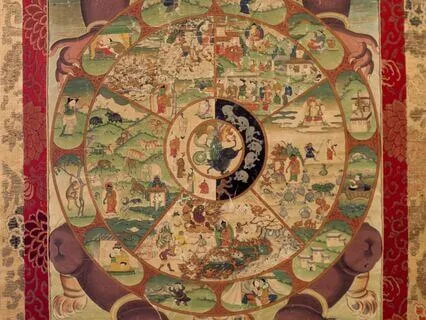
And the art connection for today's session is this beautiful Thangka painting of Wheel of Life,
Origin Tibet,
Dated early 20th century,
Mineral pigment on cloth,
About 65 into 41 into one and a half inches.
The connection to the theme,
The cycle of life,
Death,
And rebirth,
Is a process of continuous liberation.
The Wheel of Life,
Bhava Chakra in Sanskrit,
And Sipe Kolo in Tibetan,
Is a symbolic representation of cyclic existence known as samsara.
It is a popular painting found on the outside walls of Tibetan Buddhist temples and monasteries.
Wheel of Life is also translated as Wheel of Existence or Wheel of Becoming.
One of the reason why the Wheel of Life was painted outside the monasteries and on the walls is to teach this very profound Buddhist philosophy of karma and rebirth in a manner that can be understood by more simple-minded farmers or illiterate,
And to show us the path to liberation,
Which is awakening.
In fact,
Some Buddhist scholars believe that the painting existed prior to Buddha's statues.
Legend has it that the Buddha himself designed the first illustration of the Wheel of Life as a gift given to King Rudrayana.
The meaning of the main parts of the diagram,
The Lord of the Dead,
Yama,
Grips a wheel driven by the Three Animals,
Often known as the Three Afflictive Emotions or the Three Poisons,
Representing the mental poisons of Döcha,
Shedang,
Timu,
Which stands for Desire,
The Rooster or the Bird,
Anger,
The Snake,
And Ignorance,
Which is the Pig,
Which give rise to virtuous and non-virtuous action,
So that is the innermost circle,
And then the next circle is the half circle,
Clear in color,
And people moving upward to higher states of consciousness,
And the other half in dark,
Moving downwards to afflicted states,
Which in turn gives rise to the levels of suffering in cyclic existence,
That is the Six Realms,
The Three Upper Realms,
And the Three Lower Realms.
The Three Upper Realms,
In fact,
What you see here is actually in five different sections,
But on the Three Upper Realms,
There is one section that is God and Demigod in one,
And then the human,
And the Three Lower Realms are the Animal Realm,
And then the Praetor,
The Hungry Ghost,
And the lowermost is the Hell Realm.
The outer rim symbolizing the twelve links of dependent arising indicates how the sources of suffering,
Actions,
And afflictive emotions lives within cyclic existence.
The fierce being,
Yama,
The Lord of the Death,
Holding the wheel symbolizes impermanence.
The moon on the left of the painting,
Left top,
Indicates liberation,
And the Buddha on the top right is pointing to the moon,
Indicating that liberation that causes one to cross the ocean of suffering of cyclic existence should be actualized,
So the path to liberation.
So,
This is like a world map to showing the path to liberation,
Which is awakening or enlightenment.
Now,
Let's bring on our teacher for today.
Our teacher is Swami Chidananda.
Swamiji is a spiritual educator and monk initiated in the Vedic Hari Bhakta lineage,
Holding the distinguished title of Swami.
Through the study of scriptures such as the Bhagavad Gita and the Yoga Sutras of Patanjali,
Swamiji has gained a deep understanding of the science of yoga and has devoted his life to helping others on their inner journey.
Before entering the spiritual path,
Swamiji had a successful career as an investment banker and entrepreneur.
Now he uses his experiences to convey the ancient yoga systems in a relatable and accessible way for those seeking to reconcile Western and Eastern philosophies.
Additional information about Swamiji can be found by listening to his podcast,
The Path of a Swami.
Swamiji,
Thank you so much for being here.
Please help me in welcoming Swamiji.
Om Agnanante Mirandasya Jnana Jnana Shalakaya Chakshuron Melitamena Tasme Shigurave Namaha Welcome.
Nice to see all of you.
So,
There was a king and he had a very prosperous kingdom.
Very,
Very rich.
He was living a very good life.
One day he went to the doctor and the doctor said to him,
I'm very sorry,
But you only have two weeks left to live.
And the king was shocked.
He said,
How is this possible?
I'm in good shape.
I'm working out every day.
How can it be that I'm going to die?
And the doctor said,
I'm sorry.
It was just something that came out of nowhere and you only have two weeks.
So this king had four wives.
Then he had the second wife he also spent time with.
And the third he spent some time with.
And the fourth he didn't pay any attention to.
She was always ignored.
So immediately when he finds out that he's going to die,
He runs back to the palace.
He goes to the first queen,
The one that he spent all of the time with,
And said,
I'm going to die.
Will you come with me when I leave this body?
And the queen says,
Are you crazy?
I'm not coming with you.
Before you even die,
I'm going to leave you.
I'm going to leave you in the next few days.
Forget about when you die.
And so the king's shocked.
He spent so much time with her.
She's just going to leave me.
So he goes to the next wife,
The second wife,
And says,
Can you please come with me where I'm going?
The second wife says,
No.
I'm sorry.
I can't come with you where you're going.
The best that I can do is I'll arrange your funeral.
But after the funeral,
I'm not going to remember you.
I'm going to find somebody else.
The king is hurt by this.
He goes to the third wife and says,
Will you come where I'm going?
And the third wife says,
No.
The best that I can do is I'll be right by your side when you get cremated.
I'll stay with you till the moment your body is burned,
And then after that,
I have to go.
And all of a sudden,
He hears a voice from the fourth wife all the way in the corner.
He says,
I'll come with you.
I'll go where you're going.
And the king looks,
And he's shocked.
He says,
Why you?
I didn't spend any time with you.
I ignored you my whole life,
But you're the only one that will come with me.
She said,
Yes.
I will go wherever you go.
No matter how badly you treat me,
I will always follow you.
So here,
When you look at these four queens,
You see that the first queen that the king spent all of his time and energy on is material wealth,
Jewelry,
Land,
Kingdom,
All of his possessions.
That's what we spend so much of our time and energy on,
Is acquiring all of these things.
But when the time comes for us to die,
All of that is gone.
It goes to the children.
It goes to the government.
If you're not paying taxes,
I don't know.
It goes somewhere.
And before you even die,
The will is written.
Already,
Your children are looking,
Saying,
OK,
When is this person going to die so I can have all of these things?
The second wife is our friends and family.
They're with you.
They help us.
They support us.
They're there.
But your friends and family cannot follow you once you leave this body,
Once you leave this life.
They have to move on.
They will go with their life.
They'll forget about you after a few months.
If you're lucky,
Maybe a few years.
But afterwards,
It's finished.
The picture of you that they have at your home,
That will be replaced by their grandchildren or whoever it is.
That way,
Even the ones that we love will,
At some point,
Forget about us.
And the third wife is our body.
We spend so much time trying to take care of this body.
But when it's time to get cremated,
When it's time to go in the ground,
The body is also finished.
The body,
You can't take your body with you.
Where you're going,
You can't say,
Look how fit I am.
I'm working out.
I have a six-pack.
That body is finished.
And the fourth wife represents the atma or soul.
That's who we really are.
That's the eternal aspect of us.
Krishna says that the self is never born and it never dies.
It has always existed and will always continue to exist.
It cannot be cut.
It cannot be wetted.
It cannot be dried.
It cannot be burned.
That's our true reality.
But because of an influence referred to as maya,
An illusionary energy,
We get attached to this personality.
And we think this is all there is.
And this is what we see with the depiction of the wheel of life.
The wheel of life shows the cycle of birth and death.
And it's to show us that there's many things that we can do in this cycle.
We can become rich.
We can become poor.
We can have many,
Many experiences.
But at the end of the day,
We're going to continuously keep coming back into this limited reality.
But if we really want to escape this wheel of life,
Or what is referred to as samsara,
Then we have to spend some time with our atma,
With our true self.
We ignore it.
Not all of you,
Because you've made the time to come here.
So you are wanting to go deeper.
But for most of us,
We are so caught up in that wheel that for us,
It's all about going to higher realms.
So we go to higher realms in the wheel.
But even in the higher realms,
Even in the land or reality of the demigods,
They're still bound by the god of death.
And what is the god of death?
The god of death is time.
Oppenheimer talked about that destructive force.
Actually,
If you studied,
He's talking about time.
Time is that destructive force.
It is that energy which destroys worlds.
It is the energy that creates and destroys.
And the only thing that is not bound by time,
The only thing that is not bound by this god of death,
Is love.
We have many names for love,
Depending on the tradition we speak about with different names.
In the Vedic tradition,
We might call it Ishvara.
But this love,
When we connect to it,
That is when we can free ourselves from the cycle of birth and death.
That is when we can free ourselves from the wheel of life.
So we're going to do a very simple meditation that helps us to connect to love.
Ultimately,
There are many ways to connect to love,
Depending on the tradition.
Usually,
When we do it,
We do it in a circle.
And it's actually very representative of the wheel of life.
But because there's a time constraint,
We're not going to do the circle,
But we're going to do it when we're sitting down.
So these practices that we're going to do is part of something called Realization Theology.
So Realization Theology is a way of life where we say that for some influence,
We have forgotten our true nature,
And we're stuck in the wheel of life,
And we're trying to once again transcend it.
And if we don't do it in this life,
We'll do it in another life.
But at some point,
We will all go back to love.
It's not that eternally we are stuck in the wheel.
So Realization Theology is trying to feel and experience love right now.
It's not something that you have to experience after you die,
But right now you have to experience love.
And then you have something called Salvation Theology.
Salvation Theology is more the idea that we try to live a certain life in a certain way,
And after we die,
We either go to a realm referred to as heaven eternally,
Or we go to a realm called hell eternally.
So you have Salvation Theology,
And you have Realization Theology.
So Realization Theology is,
For example,
Buddhism,
Hinduism,
Sikhism,
Jainism.
So all of these are focused on trying to experience that love in this life,
And the good news is if you don't,
It's okay.
You'll come back in the next life,
And you'll get another shot.
So to experience love,
How can we do that in this world?
So in the Vedic tradition,
The great saints,
They have taken this energy of love,
Which resides beyond the wheel of life,
And they've manifested it into this reality in a form of frequency.
So that frequency that represents love,
For us,
Is referred to as Aum.
O-M,
Okay?
Aum.
So when we chant Aum,
We connect to love.
And the beautiful thing about this practice is as we're chanting it,
We are dropping from the mind to the heart,
We are experiencing that love within us,
But also love is not bound by time and space.
So you can also send that love to whoever in your life is struggling.
So if you know of anybody in your life that is going through a hard time,
As you're chanting that Aum,
Send that frequency of Aum to those people.
If you want to send it to a certain part in the world,
If you want to send it to those that are struggling,
Internally visualize the places and the people you want to send it to and continuously chant Aum,
Okay?
A lot of times,
Sometimes people might chant Aum as Aum,
A-U-M,
Aum,
But the purposes of this practice,
We're going to try our best to chant it as Aum.
So try and do it with me one time.
Aum.
Wonderful.
So as you're chanting,
You can keep your eyes closed or open as you wish,
And you can do a mudra with your hands.
This is called the Jnana Mudra.
You're going to take your thumb and your index finger,
And you're going to put it together,
And you can either place it on your lap or like this,
As you wish.
This is going to help to control your mind,
And I'll teach you another one where you take these three fingers and you put them down in this way,
And you keep this finger up,
And you take your thumb and you place it right at the bottom of the index finger.
This is called a Chakra Mudra,
And you can do this whenever you're around a space where there's a lot of negativity because this will create an energetic bubble around you,
And it will protect you from any type of negative influences.
So you can always do this if you ever feel negativity.
So you can either do this or this,
Either one as you prefer.
Now,
As we start to chant,
It's important that we try and do it out loud because this practice not only benefits us,
But it also benefits all of those around us.
So this energy will reach all,
It's at a two-mile radius.
So everybody in a two-mile radius will feel that love,
Okay?
Because we are short on time,
We are going to do it for approximately seven minutes.
I will keep track of the time so you don't even have to worry.
All you have to do is close your eyes and chant Aum.
Now,
As we're chanting,
Don't start and stop with me.
Go at your own pace.
It's important that as a group,
The sound of Aum is continuously being chanted.
So go at your own pace,
And as a group,
We'll just chant Aum.
I will chant three mantras,
And then as I start to chant Aum,
You follow me.
Babaji Namaha Aum Aum Aum Aum Aum Aum Aum Aum Aum Aum Aum Aum Aum Aum Aum Aum Aum Take your hands and place them in front of you the way that I'm holding my hands,
And visualize Mother Earth in your hands.
Visualize her breathing,
Pulsating.
Take all of that light and that love inside of you,
And bring it to your fingertips and your palms.
Now slowly start to share that love that you have with Mother Earth.
People of Mother Earth are going through a hard time.
Send them your love.
Send them your light.
Be in this moment.
Loka Samastha Sukhinam Bhavantu Loka Samastha Sukhinam Bhavantu Loka Samastha Sukhinam Bhavantu Aum Shanti Shanti Shanti Shri Gurubhyo Namaha Ariyo Thank you so much for that,
Swamiji.
That concludes this week's practice.
To support The Rubin and this meditation series,
We invite you to become a member at rubinmuseum.
Org and to stay up to date with The Rubin Museum's virtual and in-person offerings,
Sign up for a monthly newsletter at rubinmuseum.
Org I am Tashi Chodron.
Thank you so much for listening.
Have a mindful day.