Welcome to the mindfulness meditation podcast presented by the Rubin Museum of Art.
We are a museum in Chelsea,
New York City that connects visitors to the art and ideas of the Himalayas and serves as a space for reflection and personal transformation.
I'm your host,
Dawn Eshelman.
Every Monday we present a meditation session inspired by a different artwork from the Rubin Museum's collection and led by a prominent meditation teacher from the New York area.
This podcast is a recording of our weekly practice currently held virtually.
In the description for each episode,
You will find information about the theme for that week's session,
Including an image of the related artwork.
Our mindfulness meditation podcast is presented in partnership with Sharon Salzberg and teachers from the New York Insight Meditation Center,
The Interdependence Project,
And Parabola Magazine.
And now,
Please enjoy your practice.
Tashi dalek namaste and welcome.
Welcome to mindfulness meditation online with the Rubin Museum of Art.
I am Tashi Chardun,
Assistant manager to Himalayan cultural programs and partnerships.
We are a museum of Himalayan art and ideas in New York City,
And we are so glad to have all of you join us for our weekly program where we combine art and meditation online.
The museum is open to all and our staff on ground is following strict protocols such that our wonderful visitors can have a safe and enjoyable experience.
You can book your tickets in advance and come visit our beautiful exhibition,
Awaken,
A Tibetan Buddhist journey towards enlightenment,
Which explores the steps in the journey of self-knowledge and transformation from chaos to awakening and everything in between.
Basically,
In the Tibetan Buddhist teaching,
Every single being is born with that innate basic goodness,
The loving kindness,
Compassion.
But it says that because of the three poisons,
Which are called the duchashe dang thimu in Tibetan word,
Which is grasping,
Clinging,
Attachment,
And then anger,
Which leads to hatred and all of that suffering.
And the third one is ignorance.
Because of these three poisons,
The afflictive emotions,
Wisdom that each of us are born with is obscured.
So often it tells us to train our mind to reduce these afflicted emotions so that we can give rise to the wisdom that each of us are born with.
Now inspired from this exhibition,
We will take a look at work of art from our collection.
We will hear a brief talk from our teacher,
And then we will have a short sit,
15 to 20 minutes for the meditation guided by our guest teacher,
Rebecca Lee.
Let us take a look at today's theme and artwork.
Connecting to our most recent exhibition,
Awaken,
A Tibetan Buddhist journey towards enlightenment,
Which explores the steps in the journey of self knowledge and transformation.
We want to explore some broader themes from the exhibition for mindfulness meditation.
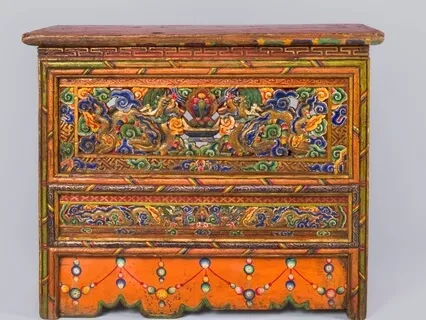
So this is the last of the theme of offering and the art connection for today is this tall offering table.
It's origin from Tibet and it's a beautiful 19th century mineral pigment on wood.
The dimension is about 28 and a half into 35 into 16 and a half inches.
It's a furniture of course,
And it's a gift by Sandy San Yang.
Offering tables like this hold offerings and ritual implements as a shrine setting or for a Lama to use during ceremonies.
The table is usually positioned to the right of the throne or seat of the Lama performing the ritual.
Offering tables vary in height and purpose in Tibetan religious settings.
This example is a tall table that was deeply carved and then painted.
You can find this style of offering tables in our museum's fourth floor gallery,
The Tibetan Buddhist shrine room.
The central upper section shows this symbolic three jewels flanked by dragons and cloud motifs.
This type of jewel motif is called Norbu in Tibetan word is the wish fulfilling jewel.
Using an offering table,
One can create an altar.
A proper altar holds images or representations of the Buddha's enlightened body,
Speech and mind,
Which serves as reminders of the goal of Buddhist practice to develop these qualities in oneself so as to be able to fully benefit all sentient beings.
Displayed on an offering table are several objects that serve as a teaching aid.
Often these offered objects include flowers,
Fruits,
Butter lambs,
Incense and so forth.
Flowers symbolize the cause as the blossoming of flowers results in the bearing of fruit.
This serves to remind us that there are consequences for our every thought,
Word and action.
And the fruits are not offered to the Buddha or Bodhisattvas to eat.
They remind us that if we want the sweet fruit or the good result,
We must cultivate and accumulate good deeds.
Therefore the flower reminded us the cause and the fruit reminded us of the effect or the result.
Therefore there is so much emphasis on cause and effect in Buddha's teachings.
Now the lamps often it's butter lamp back in the Himalayas or in Tibet.
The lamps have been now replaced with candles.
They symbolize wisdom and brightness.
They illuminate darkness and that is our ignorance.
So now let's bring on our teacher for today,
Dr.
Rebecca Lee.
A Dharma Heir in the lineage of Chan Master,
Shen Yan is the founder and guiding teacher of Chan Dharma Community.
She started practicing with Master Shen Yan in the 1990s and served as his translator until his passing in 2009.
She later trained with and received full Dharma transmission from one of his Dharma Heirs,
Dr.
Simon Child in 2016.
Currently,
Dr.
Rebecca Lee teaches meditation and Dharma classes,
Gives public lectures and leads retreats in North America and the UK.
Her talks and writings can be found at rebeccalee.
Org.
She is a sociology professor at the College of New Jersey where she also serves as faculty director of the Allen Dowley Center for the Study of Social Justice.
Her new book is Allow Joy into Our Hearts,
Chan Practices in Uncertain Times.
She will also be leading a five-day silent retreat in October.
More can be found at rebeccalee.
Org.
Thank you,
Rebecca.
Thank you so much for being here.
Thank you.
Thank you,
Tashi,
For a wonderful introduction.
And it's such a pleasure to be here practicing with everyone.
I can see there are folks joining us here from all over the country.
Welcome everyone.
It's really good to be here practicing with you.
And I'd like to share a little bit today with you about the theme today,
This month actually,
Of the theme of offering.
And it is actually a really good time for me to be reflecting on and talking about this theme.
I just returned home last evening from leading a three-day in-person meditation retreat at our retreat center in upstate New York.
And every day before mealtime,
We recite an offering.
And in this offering,
We make offerings to the Buddha,
We make offerings to the Dharma,
We make offerings to the Sangha.
And lastly,
We make offerings to all sentient beings.
And it is such a wonderful practice for us to practice remembering the source of the offerings that we are receiving,
That the fact that we are able to even learn about meditation,
To learn about the practice in this moment is not an accident.
It is because 2,
600 years ago,
Gautama the Buddha was determined to find a way to end suffering,
Not just for himself,
But for all sentient beings.
And he spent the rest of his life to share what he had discovered,
Skillfully,
Patiently,
With everyone he encountered,
And he never gave up.
And because of that effort,
Generations of practitioners were able to benefit from it.
But he was not the only person,
It was because of generations of practitioners after him,
Were willing to endure the difficulties in the process of practice,
And put the Buddha's teachings into practice in their own life.
So that the Dharma teaching is alive,
Still this very day,
2,
600 years later.
These people,
Most of whose name were not recorded,
Did not give up and held the teaching for us to benefit.
And of course,
The Sangha,
Like this one,
We are a part of here.
A group of practitioners,
Teachers,
Supporters,
Co-create this wonderful community that supports our practice,
Create the circumstances under which that makes our practice possible,
Such as all the people,
The staff who make this event happen.
And of course,
All of you who dial in,
Join us in the practice without everyone involved.
This is not possible for us to practice right here,
Right now.
So when we engage in the practice of making offerings to the Three Jewels,
The Buddha,
The Dharma,
The Sangha,
What we are doing is we are acknowledging with gratitude that the Buddha and past generations of practitioners and teachers made our spiritual growth possible.
And it is a very useful antidote to misguide the tendency for some people,
Especially,
To sort of believe that it is our own desire or our own effort for spiritual growth.
That's the only factor for our practice,
For our growth.
For example,
Then these folks may have this idea that,
Oh yeah,
I'm a very spiritual person,
Or I'm a very keen seeker,
And that's why I'm here.
Of course,
That's very much part of the causes and conditions that make this moment of practice and spiritual growth possible.
However,
If we forget that this moment also co-created by many,
Many people,
Other practitioners and teachers,
Then we are likely to,
Well,
When we think this way,
We can become very self-absorbed and self-centered.
And thinking this way becomes an obstacle for our cultivation of wisdom and compassion.
So when we engage in the practice of making offering,
We recognize that the Buddha's teaching is profound,
So deep and vast that we cannot quite contemplate with our mind,
Right here,
Right now,
Yet.
So when we recognize that there is much to learn,
And with this recognition,
Humility and respect arise,
Which is part of the mindset when we make offering.
So when we engage in the practice of making offering,
That is the offering of respect to the Buddha and all the teachers who had followed the Buddha's teachings and realize the true meaning of the teaching to help us get on the path.
So with this respect,
It is based on genuine feeling of humility.
That is a very useful antidote to the tendency of arrogance.
So some of you might have experienced this,
Right?
When we try to do some sitting meditation for a few minutes,
We realize how scattered and out of control and confused the mind is,
Is often a quiet,
Humbling experience.
Or when we notice after we practice for a number of years,
Trying to use the teaching,
We notice how we might make the same mistake,
Still over and over again,
Especially when we forget to practice,
When our mind is not clear and stable enough.
And that led us to succumb to the very entrenched and unhelpful habits of the mind.
So these moments of realizations are very useful,
And also very humbling.
When we cultivate the mindset of offering,
Engaging in the practice of making offering to the three jewels,
The Buddha,
The Dharma,
And Sangha in our practice,
There is this joy that arises in recognizing how fortunate we are to encounter the teaching and the practice worthy of our respect and reverence,
That they provide guidance and support for our growth.
So in this way,
In the moment,
We feel deeply humbled when we notice our mistakes,
Our mind that is still quite scattered and unsettled,
It is not despair.
When we notice the mind's unhelpful habits of fixation that generates suffering.
In fact,
There is great hope,
Because we have the Buddha's teachings we can follow.
And we have the community of practitioners like this one,
That support us in our practice,
That we can unlearn these unhelpful habits,
So that we can generate less suffering for ourselves and also causing less suffering for other people.
You might remember me saying that we also make offering to all sentient beings.
And that might be a bit puzzling to some.
So you can understand making offering to the three jewels,
Who have been so helpful,
Important,
Critical for our practice.
This practice of making offering to all sentient beings is also crucial,
Because this attitude of humility and respect is not only for the Buddha and the teachers,
It is for everyone.
It is a way for us to practice recognizing that all sentient beings,
Whoever they are,
Whatever the station of their life,
Through their existence,
What they do,
Support us in one way or the other,
Although we may not be able to clearly recognize every bit of them in detail.
And also,
Of course,
If we really see it clearly,
We will notice that there is something we can learn from each and single person we encounter.
So when we engage in the practice of making offering to all sentient beings,
We are practicing remembering to acknowledge our interdependence.
And it's not just seeing it,
We really,
Really feel and see it.
And when we remember to engage in this practice,
What we are doing,
Making offering to sentient beings,
We give rise to respect,
Gratitude,
Humility,
And joy.
This joy coming from realizing that we are not alone in this path,
That we are well supported by all sentient beings in their own way.
I still remember many years ago when I was a retreat part,
A participant,
And I was assigned the work practice task to clean the altar.
And it was such a joyful experience.
And I savor and still remember every moment of it,
Of dusting the Buddha statue,
Dusting and cleaning the altar table,
Even though it's not as ornate as the one that you saw in the arts work for today.
And so every moment,
We can give rise to this attitude of making offerings.
We experiencing these wholesome mental factors of respect,
Humility,
Gratitude,
And joy.
And these are such wonderful healing bonds for our hearts.
So I would like to share this practice with you and encourage you to integrate this into your practice.
So now I'd like to invite you to join me in doing some meditation practice so that we can learn to settle our mind.
As our minds more settled and clear,
We are more able to remember to bring up the gift of rise to practice,
Remembering to make offering to the Three Jewels and all sentient beings.
So please set up your body in a way that is comfortable and stable,
Conducive to relaxation.
When the body is relaxed,
The mind can be relaxed.
And I take you through a whole body relaxation.
Feel the relaxation of the top of the head.
Directly experience the subtle sensations.
As we allow,
Allow the tension to melt away.
And feel the relaxation spread to the forehead.
Like to see if we're holding tension in this area by habit,
Maybe from worrying.
And we can allow,
Allow the tension to melt away.
And feel the relaxation spread to the eyeballs and eye muscles.
We often hold a lot of tension in these muscles from all the comparing,
Judging,
Analyzing,
Planning we do throughout the day.
Right here,
Right now,
We don't need to do that.
We can give these muscles a vacation and allow,
Allow the tension to melt away.
And feel the relaxation spread to the facial muscles.
Check to see if we are holding tension in these muscles by habit,
Maybe from wanting to hold a certain facial expression for the world to see.
Right here,
Right now,
There is no need to do that.
We can give these muscles a vacation and allow,
Allow the tension to melt away.
And feel the relaxation spread to the entire head.
And feel the relaxation spread down the neck muscles.
Directly experience the subtle sensations of these muscles softening like melting butter.
As we allow,
Allow the tension to melt away.
And feel the relaxation spread to the shoulder muscles.
Directly experience the subtle sensations of these muscles softening.
As we allow,
Allow the tension to melt away.
And feel the relaxation spread down the arms,
Down to the forearms,
All the way down to the fingertips.
And feel the relaxation spread to the chest area.
Check to see if we are holding tension in this area by habit,
Maybe from anxiety,
Sadness,
Grief,
Sorrow,
Fear.
Right here,
Right now,
We can give them a rest and allow,
Allow the tension to melt away and feel the relaxation spread down the torso,
All the way down to the lower abdomen.
Trust that the skeletal structure can hold up the body.
And these muscles do not need to work so hard.
We can give these muscles a vacation and allow,
Allow the tension to melt away.
And feel the relaxation spread to the upper back.
Directly experience the subtle sensations of these muscles between the shoulder blades softening.
As we allow,
Allow the tension to melt away and feel the relaxation spread down the back to the lower back,
All the way down to the buttocks,
Where we feel the sensations of the body sitting on chair or bench or cushion.
And feel the relaxation spread down to the thigh muscles and down the legs,
All the way down to the toes and feel the relaxation spread to the entire body sitting right here right now,
Moment after moment with this clear,
Wakeful mind.
And we'll notice the subtle changing sensations as the body moves.
Body is moving as it's breathing.
We can follow the body breathing by staying with the changing sensations as the body moves with the breath and allow the body to breathe on its own.
There is no need to do anything to the breath.
The body knows how to breathe.
It's been doing so since the moment we were born.
Stay with the changing sensations of the body breathing moment after moment.
And if we notice the mind drifting off,
Losing contact with the changing sensations of the body breathing,
Not a problem.
We can use that as an opportunity to practice remembering to come back,
Practice finding our way back to the method,
Reconnecting with the changing sensations of the body breathing.
It doesn't matter how often or how long the mind drifts off.
As long as we find our way back,
We are practicing well.
We are practicing with clear awareness as we transition from stillness to motion,
As we move our body and maintain clear awareness of the changing sensations as the body moves.
That way we can carry the stability and clarity of a mind from sitting meditation into our life lived in motion.
Thank you everyone for coming to join us at our practice.
It's been really lovely to practice with everyone and have a wonderful rest of your day.
That concludes this week's practice.
If you'd like to support The Rubin and this meditation series,
We invite you to become a member.
If you're looking for more inspiring content,
Please check out our new podcast Awaken,
Hosted by Laurie Anderson.
The 10-part series features personal stories that explore the dynamic path to enlightenment and what it means to wake up,
Now available wherever you listen to podcasts.
Thank you for listening and thank you for practicing with us.