Welcome to the Mindfulness Meditation Podcast presented by the Rubin Museum of Art.
We are a museum in Chelsea,
New York City that connects visitors to the art and ideas of the Himalayas and serves as a space for reflection and personal transformation.
I'm your host,
Tashi Chodron.
Every Monday we present a meditation session inspired by a different artwork from the Rubin Museum's collection and led by a prominent meditation teacher from the New York area.
This podcast is a recording of our weekly practice currently held virtually.
In the description for each episode,
You will find information about the theme for that week's session,
Including an image of the related artwork.
Our Mindfulness Meditation Podcast is presented in partnership with Sharon Salzberg and teachers from the New York Insight Meditation Center,
The Interdependence Project,
And Parabola Magazine and supported by the Frederick Lance Foundation for American Buddhism.
And now,
Please enjoy your practice.
Hello everybody,
Tashi Delek,
And welcome to Mindfulness Meditation Online with the Rubin Museum of Art.
I am Tashi Chodron and I'm happy to be your host today.
I hope you had a meaningful Thanksgiving.
It's so wonderful to see so many of you on the chat joining from all over Manhattan,
Buffalo,
New York,
Cortland Manor,
Ship Shed Bay,
And Staten Island,
Brooklyn,
San Francisco,
Roosevelt Island,
Baltimore,
And all the way from India and France.
Thank you so much.
And those of you who are first time,
The Rubin is Museum of Himalayan Art and Ideas in New York City,
And we're so glad to have all of you join us for our weekly program where we combine art and meditation online.
Inspired from our collection,
We will take a look at a work of art from our collection.
We will hear a brief talk from our teacher,
And then we will have a short sit,
About 15 to 20 minutes for the meditation guided by our teacher.
Let's take a look at today's theme and artwork.
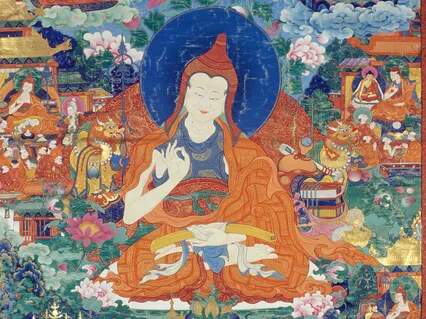
We are still exploring on the theme awakening and the art connection for today's session is this beautiful thangka depicting the life story of Indian master,
Shantarakshita.
In Tibetan,
He's known as Kenshin Shiwatso,
An eighth century scholar from Nalanda University in India.
Thangka is a scroll painting,
Mineral pigments on cloth.
This is origin in Tibet dated 19th century,
About 72 into 41 inches in size.
The connection to theme is stories of awakening.
This Indian scholar,
Shantarakshita,
Was an important figure in establishing Tibetan Buddhist monastic and scholastic tradition in the eighth century,
Along with eighth century King Chisung Detsen and great master Padmasambhava.
In this painting,
The central figure is Shantarakshita,
Which shows him surrounded by scenes from his life.
His spiritual development is illustrated in the first three scenes beginning just over his left shoulder,
Including his ordination as a monk,
His receiving of the gradual path to enlightenment,
And his own spiritual training leading to his realization of the true knowledge.
These episodes are beginning event of the story of Buddhism's arrival in Tibet,
Which begins in the bottom right corner,
Where Shantarakshita is shown traveling to Tibet,
Heavily loaded bags full of books called Pecha in Tibetan word.
As we continue to follow the narrative,
At the bottom center,
We see him greeted by King Chisung Detsen upon his arrival in Tibet.
Here we see Chisung Detsen receiving teachings from Shantarakshita at Lungtsukchen Palace.
At the lower left,
Shantarakshita performs a consecration ceremony at Samye,
Tibet's first monastery.
What's fascinating is that this Samye monastery still exists.
It's one place that all tourists and pilgrims don't miss,
And I too hope to go for pilgrimage someday.
On the lower left,
Shantarakshita ordains the first Tibetan monks,
And at top left shows Shantarakshita establishing Buddhist doctrine in Tibet,
So along with of course Padmasabhava and the King Chisung Detsen.
Shantarakshita plays a very important role in bringing Vajrayana Tibetan Buddhism to Tibet from India,
So this painting exemplifies the stylistic possibilities shortly before the landscape revolution of the mid-15th century.
Now let's bring on our teacher for today,
Lama Aryadroma.
Lama Aryadroma is an ordained Buddhist teacher in the Karmakaju tradition of Tibetan Buddhism,
Who has completed over a decade of monastic study and meditation training.
She's a graduate of the traditional Tibetan Buddhist retreat program spanning three years and three months,
And advanced meditation training program at Palpung Tuttin Choling Monastery in upstate New York.
Lama Aryadroma teaches worldwide,
Leading retreats,
Workshops,
And corporate meditation programs,
And is a popular guest speaker at universities and organizations.
She emphasizes Vajrayana Buddhism and Buddhist principles,
Making them relevant to our everyday lives,
Helping us to cultivate loving kindness and compassion,
And bringing about a transformation of contentment and a genuine sense of well-being.
Lama Aryadroma,
Thank you so much for being here.
Hello everyone,
And welcome.
Thank you all for joining in.
I'm so happy to be here today,
And happy Thanksgiving to everyone.
I hope you all enjoyed the day.
It's so meaningful to me.
And thank you,
Tashi,
For the introduction.
So the image I selected is this amazing painting of the great Indian master,
Shantarakshita,
And the scenes from his life.
So in this painting,
It shows his spiritual development,
His ordination as a monk,
His own spiritual training,
Leading to the realization of enlightenment,
Of awakening.
And it's important to mention the contribution of this great Indian masters made to Tibetan Buddhism,
Which directly shows the path to enlightenment.
So Shantarakshita was a renowned Indian Buddhist philosopher and a scholar who was the abbot of Nalanda Monastery,
One of the greatest centers in ancient India.
And Nalanda Monastery still exists in India.
It's being refurbished to its old glory.
So Shantarakshita was invited to Tibet by King Trasong Detsen around the 8th century,
Where he founded the first Buddhist monastery in Tibet called Samye,
Which still exists today as Tashi mentioned,
And ordained the first seven Tibetan monks establishing the Tibetan Sangha,
According to the Indian Nalanda tradition in Tibet.
So it's very important in a monastery to have a Sangha,
To have practitioners who practice the spiritual path.
It is not an intellectual understanding of Dharma,
But more an experiential understanding.
And so the Sangha plays a very important role in any monastery.
So here in the painting,
It shows Shantarakshita traveling to Tibet with bags full of books.
And at the bottom center of the painting,
We see him greeted by King Trasong Detsen upon his arrival in Tibet.
And we can see also King Trasong Detsen receiving teachings from Shantarakshita at the Lung Subchin Palace.
And Shantarakshita performing the constant creation ceremony at Samya Monastery,
Which was Tibet's first monastery,
And ordains the first Tibetan monks to form a Tibetan Sangha.
Shantarakshita was one of the major figures to also spread Vajrayana Buddhism in Tibet.
And as Tashi mentioned,
He advised King Trasong Detsen to invite the renowned Indian master Padmasambhava to Tibet,
Who further spread Vajrayana Buddhism all over Tibet.
And apparently when Padmasambhava came to Samya Monastery,
When he came to Tibet,
You know,
He performed the Vajra Kilaaya dance,
Which is a spiritual dance to subdue all the negative forces,
Which was against the Buddha Dharma.
And in doing so,
Buddhism blossomed in Tibet,
All over Tibet,
Vajrayana Buddhism really spread.
And to all these great masters who upheld the Buddha Dharma and to lead us to awakening,
I honor them by saying Namo Guru.
And Namo Guru means I bow down to them.
Shantarakshita was also a king's son.
So he took an arduous journey,
You know,
By the invitation of the king of Tibet to Tibet to teach us the spiritual path.
And so all these great masters who are now teaching us the spiritual path,
I really honor them because it's not a easy task.
It's extremely challenging as a nun in the monastery,
You have to be very disciplined.
And the practice is more important.
As I mentioned,
It's not an intellectual experience,
But rather experiencing,
Which is through practice through training.
Of course,
The intellectual books and everything is important,
But it is experiential practice that really puts you to the path of awakening and enlightenment.
So all these great masters had one single common thing that they that to share the spiritual knowledge and to teach the path towards awakening.
Because when you are in the spiritual path,
There arises a great compassion in your heart,
Because you know how you can train your mind when all these emotions that we suffer,
We go through this how to train our mind to get out of those negative emotions.
And these great masters having known the truth,
That's what they feel such great compassion for us.
So they teach us,
You know,
The spiritual path,
They train us.
And so to them,
I really bow to all the great teachers all over the world.
Thank you.
So today,
The theme of the month is awakening.
And what is awakening?
It's waking up to our inherent nature,
Which is the Buddha nature that we all have within us.
A spiritual awakening is when a person intentionally seeks out for greater wisdom and deeper meaning in life.
It's when you ask the question,
What is the purpose of my life?
And one of the most important question we ask ourselves is whom,
Who am I?
At some point in our life that these two questions will arise in our mind.
And this is when I believe your path to awakening happens.
This quest to the answer,
Who am I?
And what is the purpose of my life?
In everybody's life,
In some time in their lifetime,
These two questions will arise.
And this is the beginning of that journey into that spiritual path.
And spiritual awakening,
Your journey towards the spiritual awakening is a cycle and an ongoing process.
And as long as you're in this life and lifetime and lifetime,
Where you will then all these practices leads to your spiritual awakening,
Your highest potential,
Your inherent quality that you have within,
Which is the Buddha nature,
Which is your potential to become enlightened.
So the practice that can activate a greater consciousness awareness or self transformational practice is mindfulness meditation.
So for our own awakening,
Let us now meditate.
So let's start the meditation.
And today we will use the breath as an anchor to focus our mind's attention.
This is a very popular and easy method because we all know how to breathe.
So let's all set up right.
When we start the meditation session,
There are two essential points,
The essential point of the body and the essential point of the mind.
The essential point of the body is you have a very good and steady posture.
So sitting upright is always helpful.
And if you have any issues with pain or something,
Just relax into your straight posture,
But it's really good to have a good posture.
And then the essential point of the mind,
The essential point of the mind is really important.
This is where the mind needs a focus,
An anchor when you start to meditate.
So today's focus or anchor will be on your breath.
All you have to do is I'm going to give you a guided meditation.
All you have to do is sit upright and then maybe it'll be helpful to put your gaze down or close your eyes and just focus your mind's attention on your breath going in and going out.
Or you can,
You just observe,
You just observe the breath going in and going out.
You breathe naturally,
You breathe at your own space and that's how we will start.
But just before we really start the actual meditation,
I want you to come back to the present moment.
You know,
Some of us,
Our minds are still probably in the office or in our homes.
So let's come back to the present moment.
And here initially when we start this meditation,
We'll take three deep breaths.
So the first breath,
Just to be in the present moment.
So the first breath is a deep breath,
Which will inhale.
So we'll all do this,
Sit upright.
So inhale deeply.
And as you exhale,
Bring out all your worries and your thoughts.
Like so,
Like,
Let go of all your concerns.
And just rest in that present moment of awareness.
And now we will do the second breath.
Again breathe in deeply.
And as you breathe out,
Let go of all your concerns,
All your worries and come back to the present moment of awareness.
Now the third breath.
Again breathe in deeply,
All the way in.
And breathe out with a sigh.
And let all your worries and all your negative thoughts and every,
Leave your body and your mind.
And just rest in that present moment of awareness.
And now we'll start the actual meditation.
And now please breathe normally at your own space because everybody breathes differently.
And it's important to actually be in the present moment.
So again,
Sit upright and put your mind's attention on your breath.
Just observe your breath going in and coming out.
And be relaxed.
So with each breath,
You'll inhale deeply.
Watch your breath go in and all the way to your abdomen and breathe out.
So let's meditate for a few moments.
Inhale deeply and exhale.
And as you exhale,
Let your breath permeate the whole room.
And just sit in that present moment of awareness.
Rest your mind in that present moment of awareness.
Inhale and exhale.
Inhale and exhale.
Breathe normally.
And as you breathe out,
Let your breath just fill in the whole entire space in front of you and just rest in that present moment of awareness.
Anytime your mind wanders off,
You notice yourself.
Inhale thinking.
Just say thinking.
Then drop it,
Let it go.
Don't follow your thoughts.
Don't engage in it.
And again,
Return back to your observing the breath.
Inhale and exhale,
Paying attention to your breath.
And rest in that present moment of awareness.
It doesn't matter how many times your mind wanders off.
That's what the mind does.
And that's what we do as we practice meditation mindfulness.
And the minute you catch yourself thinking,
Your mind has wandered off.
Just say thinking.
And again,
Gently bring your mind's attention back to your breath.
Exhaling your attention all the way,
Breathing in and you breathe out,
Observing your breath,
Just observing,
Breathing in,
Breathing out.
It's a very,
It's very simple.
And then as you breathe out,
Let your breath fill the entire space in front of you.
Just visualize that.
And then just rest in that present moment of awareness.
Detached by scout.
Let that cast.
You you Do not follow the past The past is finished Do not think of the future that I must do this or I have to do that Just come back as your mind wanders off thinking of the past of your future Just come back again to your breath observing it going in and going out and And then resting in that present moment of awareness you Inhale and exhale,
Breathe normally,
Relax your whole body and as you breathe out just let your breath permeate the entire room and just rest in that present moment of awareness and just rest in that present moment of awareness Meditation allows you to look inward So when you meditate you will see a lot of thoughts,
List of things you want to complete and so on Thoughts are going to come and go depending on the thoughts,
Emotions going to arise But as soon as you realize that your attention from your breath has wandered off,
You're thinking on some thoughts Just say thinking and then drop the story,
Don't follow your thoughts Again bring your mind's attention back to your breath,
Just inhale and exhale,
Breathe normally Just observe that breath and at some point your whole mind will just relax,
It'll just open and that's when you're in the present moment of awareness And it doesn't matter how many times your mind wanders off,
Only what matters is you catch it,
You observe it and then bring your mind's attention back to observing your breath going in and coming out Thank you for listening The idea is not to block your thoughts When you push them away or block your thoughts,
More thoughts will come We are not stopping our thoughts or blocking them,
We are just not paying attention or following the thoughts So when thoughts come,
Just label them as saying thinking,
Let it go and come back to observing or paying attention to your breath And gently breathe in and breathe out and just observe that breath And just rest in that present moment of awareness as you breathe out The reference is your mind is like a beautiful,
Beautiful,
Beautiful,
Beautiful,
Beautiful,
Beautiful,
Beautiful,
Beautiful Your mind is like a beautiful,
Endless sky and your thoughts are like clouds,
They come and they go And they don't leave any trace and just like that with your thoughts,
We let them go just like the clouds as they pass your mind And you rest your mind in that present moment of awareness And this is the practice That is why we continuously do mindfulness meditation So again,
Inhale and just exhale And as you breathe out,
Let your breath fill this entire space in front of you And again,
Rest in that present moment of pure,
Pristine awareness Thank you for listening to this video.
Please like,
Share and subscribe to the channel.
Thank you.
So again,
Inhale and exhale,
Breathe normally And as you exhale,
Just rest your mind in that present moment of awareness If we can train ourselves during meditation to simply observe the arising of each thought and emotion without grasping at it,
Without clinging to it as being anything other than a temporary play of the mind Like the waves emerging and dissolving back into the ocean and this is the habit we want to cultivate into our ordinary activities in our daily life As we do this formal practice,
It becomes a training We are aware that we can let go of our thought.
So in our day to day activities when we have very stressful thoughts,
We can let go and bring just our mind's observation into our breathing So through this practice of calm abiding in our minds,
We learn to become more relaxed,
More comfortable,
And then joy and contentment will arise So ultimately,
The point of this formal meditation is to familiarize yourself with your mind,
How your mind works So in Tibetan,
The word for mindfulness meditation is gom,
Which means to familiarize with your mind And so ultimately,
The point of formal meditation is to familiarize ourselves with the peaceful state of our mind,
Which is natural,
Inherent in all of us And this is the practice that we can take into our daily activities Thank you so much Thank you,
Thank you so much Lama Arya Doma for that beautiful session That concludes this week's practice If you would like to support the Ruben and this meditation series,
We invite you to become a member of the Ruben If you are looking for more inspiring content,
Please check out our other podcast Awaken Which uses art to explore the dynamic path to enlightenment and what it means to wake up Season 2 hosted by Ravina Arora is out now and explores the transformative power of emotions using a mandala as a guide,
Available wherever you listen to podcasts Thank you for listening,
Have a mindful day