Welcome to the mindfulness meditation podcast presented by the Rubin Museum of Art.
We are a museum in Chelsea,
New York City that connects visitors to the art and ideas of the Himalayas and serves as a space for reflection and personal transformation.
I'm your host,
Dawn Eshelman.
Every Monday we present a meditation session inspired by a different artwork from the Rubin Museum's collection and led by a prominent meditation teacher from the New York area.
This podcast is a recording of our weekly practice currently held virtually.
In the description for each episode,
You will find information about the theme for that week's session,
Including an image of the related artwork.
Our mindfulness meditation podcast is presented in partnership with Sharon Salzberg and teachers from the New York Insight Meditation Center,
The Interdependence Project,
And Parabola Magazine.
And now,
Please enjoy your practice.
Hi everybody,
Welcome.
Welcome to mindfulness meditation,
Our weekly practice.
My name is Dawn Eshelman and I'm here,
Of course,
With the Rubin Museum of Art and thank you for joining us for this weekly practice where we pair meditation with a look at one of the objects from our collection.
Also this month,
We're really trying to pay attention to those moments where we feel most awake,
Most alive,
Most free.
And that's because we're talking about this idea of awakening,
Of really how we can find those moments in our everyday life,
Not just the kind of epic larger than life concept of liberation awakening through the Tibetan Buddhist lens,
But also taking that through different points of view as well,
And thinking about just the ways in which we feel very present in our lives and noticing those moments and cultivating them.
Part of the reason for that is our brand new beautiful exhibition,
Which is up in our galleries now.
It is called Awaken,
A journey towards enlightenment through the lens of Tibetan Buddhism.
We'd love for you to come and take a peek.
If you can't,
You can engage with a multitude of elements online and really get a deep engagement with the exhibition that way.
So for today's session,
We're looking at a work of art together.
We'll hear a brief talk from our teacher,
The wonderful Lama Aryadroma,
Who is here with us,
And then we'll sit together for a short time,
15 to 20 minutes,
And a guided meditation by Lama Aryadroma.
So yes,
This exhibition Awaken,
This is a Tibetan Buddhist journey towards enlightenment,
And it explores the steps in the journey of self-knowledge and transformation.
So we start at chaos,
Facing chaos,
And move through the steps until we come to this place of awakening and,
You know,
Explore everything in between.
So that's what we're talking about here today in mindfulness meditation.
And I'll share my screen once more here,
And we'll look together at this beautiful object.
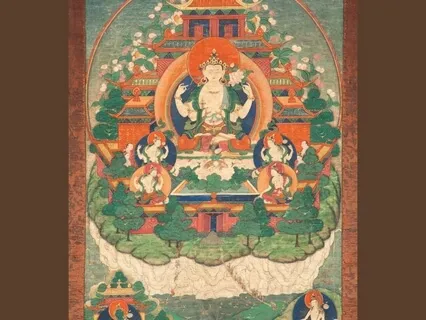
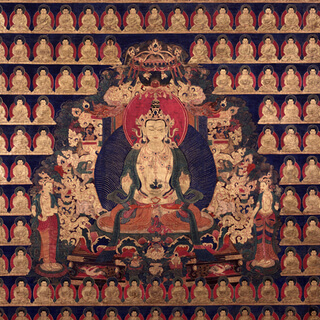
This is Avilukitesvara in his Pure Land.
This is a tanka from late 18th,
Early 19th century,
Made in Tibet and pigments on cloth.
It has a silk brocade around it and a cotton backing,
As many of these tankas do,
As they're meant to be rolled up and transported.
And this is a rather large painting here,
And so you can imagine standing in front of it and,
You know,
Not only with this main deity,
Avilukitesvara here to focus on,
But the surrounding sort of verdant landscape and the flowers above.
So Avilukitesvara is the bodhisattva of compassion.
And here he is presiding in his,
This is his celestial realm.
That's what the Pure Lands are,
These kind of not quite earth,
Really these celestial dwellings that deities and bodhisattvas can inhabit.
And this one is called Potala.
And here is Avilukitesvara adorned in silks and jewels with four arms,
Crystal rosary beads in his upper right hand,
And then a lotus flower in his upper left.
Of course,
Both of these signify a kind of purity and intent.
And his other pair of hands are folded at his heart here.
At the very bottom,
We see Gritantara,
Padmapani,
And really just are looking at this today to evoke this kind of reminder of this example here of awakening.
And you can see actually at the bottom,
You can see these rope bridges that people are using to attain access here to this Pure Land where it is said it's even easier to achieve awakening and enlightenment.
So we'll bring on our teacher today,
Lama Arya Dronma,
Who is an ordained Buddhist teacher and trained in the Karmakagyu and Shankhakagyu traditions of Tibetan Buddhism with over a decade of monastic study and training.
She was born in India and her early years she was a Hindu.
And later she studied under the renowned Buddhist master for his guidance and became a graduate of the traditional three years,
Three months Tibetan Buddhist retreat,
Which she did with Palpang Tuk Teng Choling monastery in upstate New York.
And she's also studied the Dharma path program of mindfulness and contemplation.
And so she leads retreats all over the world.
And we're very lucky to have her here today.
Welcome,
Mama Arya Dronma.
Hi.
Hello and welcome everyone.
Thank you all for joining in today.
I'm really,
Really excited about this exhibition at Rubin called Awaken.
It's very close to my heart.
It's my personal spiritual journey to be awakened,
To be enlightened.
And it's the reason that I gave up everything in my life.
I was living in Manhattan,
I had a wonderful job at the fashion industry.
And one day I realized,
You know,
What is really the purpose of my life?
And who am I?
And when I asked these two questions,
I realized,
I need to make a transformation in my life.
What I was living was just not enough for me.
So I went on,
I found this place where I could go and learn meditation.
It was in upper Manhattan.
And it was also because I got a book called awakening the Buddha within by Surya Das from Rubin Museum,
Which led me to the place I went to the Kagu tradition,
And then to the place at the Upper West where I started my meditation practice.
And then I started coming to the monastery,
Which was upstate and it's pop pop on tipton Chawling monastery,
Where I did my three and a half year retreat practice with the renowned master lama Nola Rinpoche.
And it was the most fulfilling,
But extremely challenging.
And I'm still here.
I've been living here for 13 years and practicing meditation,
Practicing all my spiritual practices.
And so,
Buddha,
In Sanskrit means awakened one.
But those teachings are literally the roadmap to enlightenment.
So here,
The Buddha has given you everything he's shown you the path here is the enlightenment and it's for you to practice,
Dedicate yourself and that's what I am doing right now,
Dedicating myself to be enlightened to be awakened.
So to be awakened,
Or to be enlightened is a highest potential as human beings.
Awakened means being established in the highest state of human consciousness.
It's experiencing the reality of your innermost self as unbound and eternal.
The consciousness of an awakened or enlightened person is no longer subject to the worldly ups and downs of our negative emotions.
It remains in a state of constant bliss and freedom.
Awakened means living in harmony with all nature.
It means experiencing the universe as the expression of your unbound self.
The Buddha thought that to become awakened or enlightened,
A person must develop two qualities,
Two main qualities.
One is wisdom and the other is compassion.
What is wisdom in the Buddhist perspective?
It's not the same as we understand in the Western context.
Prajna in Sanskrit is often translated as wisdom in the Buddhist context,
In the Buddhist perspective.
It is described in the Buddhist commentaries as understanding the true nature of phenomena,
Realizing the true nature of reality,
Seeing things as they are,
But not as they appear.
No example of that is someone,
If an alien had to come and look at us,
They wonder how we are surviving.
They can't see the air that we're breathing in.
It's similar.
It's seeing things as they are,
But not as they appear.
But in the Buddhist perspective,
Wisdom is a direct realization of three characteristics of all things,
Of all phenomena.
It is a realization of impermanence.
It's a realization of dukkha.
Dukkha is translated as dissatisfaction or suffering.
It was the first noble truth.
And this is a realization,
Even though at this moment,
We have probably you have everything we need.
There's always that little dissatisfaction,
That this suffering that goes on within us.
And even Prince Siddhartha,
When he was born in a palace,
He had everything,
But there was always that little suffering as to what is really life about.
And then when he crossed the palace boundaries,
He saw old age,
Sickness,
Death.
And then he also saw a monk who was so happy,
Who was practicing meditation.
And that's when he left the palace grounds in search of enlightenment.
So this is these things as impermanence,
The direct realization of impermanence,
Suffering,
Non-self.
These are not intellectual understanding,
But it is the understanding of the direct realization through meditation.
And also another very important aspect of realization is emptiness.
It's called Shunyata in Sanskrit.
There's nothing intrinsically substantial in all phenomena.
This of course is now being confirmed by the physicist.
For instance,
Take the chair you're sitting in.
It seems to carry your weight,
But if you look at it microscopically,
It's made up of atoms,
Neutrons,
Space,
But to you,
Your body is feeling the chair.
You can sit on it.
It carries the weight,
But if you break it all down,
That's what it is.
And it's something similar like that.
And secondly,
The quality,
The most important quality one must develop is compassion.
Without it,
There cannot be any awakening or enlightenment.
This is because compassion is an inherent quality of enlightenment,
Which is inseparable from wisdom and the Buddhist perspective.
And I do know that enlightenment and awakening is a very,
Kind of a hard subject.
And so today I'm trying my best to simplify it and take as much as you can.
And if you can't,
Just think it's a seed that's planted in your mind.
One day when you are ready and when you have more knowledge,
You'll understand all of these things that I'm talking about.
And today I chose this wonderful artwork of our Lokiteshwara.
It's said to be the embodiment of compassion of all Buddhas.
Even in a monastery,
We pray to our Lokiteshwara on a daily basis.
We recite his sadhana.
Sadhana means spiritual practice.
And the main reason is to transform our mind to mind of compassion.
When I lived in the city,
When I started going to meditation sessions,
This is the first practice I did,
The practice of Chenrezig,
The Sadhana of Chenrezig.
And I really saw the transformation happening within me.
And I knew I had stuck gold and I was willing to dedicate my life into this practice,
The practice of gaining enlightenment,
The practice of becoming awakened.
Because when you're awakened,
You can help millions of people at one time.
So coming back to our Lokiteshwara,
I just saw a wonderful BBC documentary and it's called Light at the Edge of the World,
Where the commentator,
Who's a Buddhist practitioner,
Travels to Tibet.
And there he meets this old Tibetan lady who's in retreat for 45 years.
And she's seen for the first time being interviewed.
So as she opens her window,
You can see this loving and kind lady.
She tells them all,
You know,
When asked,
What is a spiritual practice?
And she says,
My spiritual practice for 45 years has just been the practice of our Lokiteshwara.
And that's why,
You know,
I chose this thangka.
And the practice that she was doing is the mantra of our Lokiteshwara,
Which is Om Mani Pe Me Hong.
And our Lokiteshwara is so very powerful,
Because he is the embodiment of compassion of all the Buddhas.
And if you dedicate yourself to his practice,
You can freely find that transformation.
So today,
In lieu of our Lokiteshwara and his compassion self,
I want to introduce you to this meditation,
Which is called thangka.
You know,
When Dalai Lama was asked from his own experience,
What is it that is,
Brings happiness to oneself?
And he said,
He found that the greatest degree of inner tranquility comes from the development of love and compassion for others.
And here we are in this modern world,
We are taught how to compete with each other.
You know,
When we were young,
It was like,
Sharing is caring.
And then as we became became older,
It was like competition and to get ahead of each other.
But now,
You know,
With the virus,
Coronavirus,
We've seen how life is about helping one another.
It's the all those medical staff that,
You know,
Worked unearthly hours to help us.
It was neighbors who are singing to uplift people,
It was children drawing rainbows on the windows to uplift people.
It's about helping people.
It's about loving people.
And this is a very skillful meditation that I'm going to be teaching today.
The outbreak of this Coronavirus,
It reminds us,
You know,
How important it was all well,
How important it is to be compassion,
And how important it was to love each other to help each other.
So by recognizing the suffering of others and having a sincere desire to elevate that suffering,
We can learn to act compassionately in the world.
And this practice of tongling is just amazing.
So I will now introduce you to this practice of tongling,
Which can be very helpful.
And do know there's no right or wrong way,
Do your best because it's just something very new.
You're not very comfortable about,
You know,
Being cultivating love and compassion.
It's a training.
So today's guided meditation,
We will practice on loving kindness and compassion.
And it will be awkward at first for many people,
But it has great potential and transforming your mind in terms of bringing a sense of loving kindness for all beings and oneself.
So how do we practice tongling meditation,
I will do the guided meditation,
It's very simple to follow,
And just listen and do your best.
And here are some important instructions.
So as we do this practice more and more,
We get better at that.
And all of us at some point or the other,
Have experienced unconditional love towards someone,
It could have been your father,
Your child,
Your aunt,
Your grandparents,
Your friend,
And you were you may have wanted absolute happiness for them.
So when we start the meditation,
Bring to mind that feeling of wanting to help someone,
Your child,
Your mother,
Your parents bring to your mind that feeling so that's very important.
So the instructions are simple as you breathe in,
Feel the suffering of that person,
And then bring into your mind that you really want to help this person.
And so from your heart set center,
Send a brilliant light and of peace and joy and happiness to everyone out there and just rest your mind in that essence.
And also important includes yourself,
That white light even goes to yourself and fills you with peace and love and joy,
Purifying yourself within and totally erasing all your negativity.
And during this meditation,
Put your attention on your breath.
And we need an anchor,
We need a something for a mind to anchor on.
So it's going to be a breath will be putting our attention.
And there are two essential points when you start the meditation setup,
Right.
And your mind is going to be doing the meditation.
So bring your mind to the present moment,
You can leave all your list end of all the things you want to do.
And you can go back to it after the meditation.
So again,
Set up right be comfortable.
And I will give you the guided meditation and put your mind's attention on your breath,
Feeling each breath as it comes in.
And as it goes out and breathe normally.
And imagine as you breathe out,
You're sending out pure loving kindness,
And brilliant light goes out in all direct direction.
It permeates the universe,
You get to be an angel now.
So let's start the meditation.
Please sit upright again,
Comfortable.
Inhale and exhale.
Breathe normally.
So let's do three breaths.
One breath,
Second breath.
And third breath.
You're just putting your mind's attention on your breath,
Okay.
And then as you breathe it now,
Please breathe in normally set up right and as you breathe in,
Bring to your mind,
The feeling of suffering of others,
Anyone,
Your child,
Your mother,
Your father,
Your parents,
Any pets you have.
And then in your mind think I want to heal them,
I want to help this person,
I want to help them all.
So from your heart center,
Visualize a brilliant white light.
And as you breathe out,
Bring that light of unconditional love and kindness and compassion in your mind and let that light permeate the universe and just rest in that present moment of that feeling in that essence.
And sit in that wonderful light of joy,
Happiness,
Kindness,
Love to one another and including yourself,
Just rest in that present moment of awareness.
Breathe in and breathe out and as you breathe in,
Bring to your mind the feeling of sufferings of others.
And as you breathe out,
Bring to mind's attention the feeling of unconditional love,
Kindness and compassion into your mind stream.
And just imagine sending pure loving kindness and compassion in the form of brilliant light goes out in all direction.
It permeates the universe with loving kindness and all beings are filled with happiness and joy,
Including yourself and just rest in that present moment of awareness.
Breathe in and breathe out and as you breathe out,
Bring to mind the feeling of sufferings of others.
Breathe in and breathe out and as you breathe out,
Bring to mind the feeling of sufferings of others.
Breathe in and breathe out and as you breathe out,
Bring to mind the feeling of sufferings of others.
When you see your mind going away into certain different thoughts,
Just say thinking and bring back your mind's attention to your breath.
Again,
Just imagine you're sending out pure loving kindness and compassion in the form of brilliant light and it goes out in all directions and it permeates the universe with loving kindness and all beings just visualize all beings are filled with happiness and joy,
Including yourself and just rest in that present moment of awareness.
Breathe in and breathe out and breathe out and as you breathe out,
Bring to mind the feeling of sufferings of others.
Tongling practice is a very ancient Tibetan Buddhist meditation practice and the practice is extremely,
Extremely important and it's a very simple practice of transforming your ordinary thoughts or your negative thoughts into a compassionate one and this is a training that we do every day here in the monastery.
This is my practice as well and I feel so joyous when I do this meditation and I see the results of my mind being more happier rather than you know having negative thoughts and feeling miserable.
This is such a beautiful practice and it's the practice is called taking and sending and again,
Sit upright.
Breathe in and breathe out and as you breathe in,
Bring to your mind's attention the feeling of suffering of others.
It could be your child,
An animal or someone whom you feel close.
Just bring your mind's attention to the feeling and then as you breathe out,
Bring to the mind the attention,
The feeling of unconditional love and kindness and compassion that you want to help that person whom you feel sorry and sad and you want to be able to help with all of you and just imagine that very feeling.
You're just sending it out to everyone in the universe from you can do it slowly.
You can first do it to the person whom you want to help and then you can enlarge it.
You can make it into a huge feeling of sending out pure loving kindness and compassion in a form of brilliant light that goes out to the whole universe and it permeates the universe and yourself.
Yourself is very important and initially it may feel a little awkward but you get so good at it.
You can play angel all the time sending out these beautiful good vibes,
Beautiful feeling of love and kindness to the whole universe and then just rest your mind in that present moment of awareness.
You don't have to do it on this every breath.
You can just rest and then when you feel comfortable again you can do it to your next breath.
And this is a very gentle practice.
And while you're doing this practice when new thoughts arise do not follow them.
Then you notice those thoughts just say thinking and just let go and bring your attention back to your breath.
And then when you feel comfortable again feel the feeling of loving kindness someone whom you want to help and then send out as a form of brilliant light from your heart to send out loving kindness and compassion and love for that person.
And then you can extend it from your heart to the entire universe that the whole universe permeates with that loving kindness and compassion.
And do your best.
There's no right and wrong and you're not going to do anything wrong.
You will you it's loving kindness and compassion.
So don't worry do your best.
Pay attention to your mind.
Do not follow the past.
The past is finished.
Do not think of the future.
It hasn't arrived yet.
Just rest within the present moment of awareness without distraction.
And it's doing it doing again and again and you'll get better and better each time.
This practice tongling is also very good practice.
You know when you have discord with a family member your friend your someone at work and you can do this even in your own home at your own safe place.
You can visualize that person think of their suffering at you one of the first noble truths of Buddha that everybody has some kind of suffering within them.
And you can do this practice of you know as you breathe in bring to your mind's attention that person you know putting your breath all your attention on your breath and and sending out light of loving kindness and compassion.
You can do it from the safety of your house and you will see the transformation happening because you're in a wonderful loving kindness and compassionate space that people will enjoy being within your with your company.
So this is a wonderful practice.
I can't emphasize more.
And the benefits of tongling meditation is one of the brave it's one of the bravest practice that one can do.
This practice is very beneficial to all kinds of negative emotions you may have in your mind.
It's helped people so many people deal with their pain and their fears and suffering and dying and loss and it's really given them strength and courage.
This is one of the greatest meditation jewel that offers a way for us to cultivate our own compassionate nature bringing about positive energy to oneself and everyone around you.
Thank you all for joining in today.
Thank you so much.
Mama Aria Drolma was really lovely.
That concludes this week's practice.
If you would like to support the Rubin and this meditation series,
We invite you to become a member.
Thank you for listening.