Welcome to the Mindfulness Meditation Podcast presented by the Rubin Museum of Art.
We are a museum in Chelsea,
New York City that connects visitors to the art and ideas of the Himalayas and serves as a space for reflection and personal transformation.
I'm your host,
Tashi Chodron.
Every Monday,
We present a meditation session inspired by a different artwork from the Rubin Museum's collection and led by a prominent meditation teacher from the New York area.
This podcast is a recording of our weekly practice currently held virtually.
In the description for each episode,
You will find information about the theme for that week's session,
Including an image of the related artwork.
Our Mindfulness Meditation Podcast is presented in partnership with Sharon Salzberg and teachers from the New York Insight Meditation Center,
The Interdependence Project,
And Parabola Magazine,
And supported by the Frederick Lentz Foundation for American Buddhism.
And now,
Please enjoy your practice.
Hello and Tashi Delek.
Happy New Year.
I wish you all a very happy,
Healthy,
And meaningful 2023.
Welcome to Mindfulness Meditation Online with the Rubin Museum of Art.
I am Tashi Chodron,
And I'm so happy to be your host today.
It's so wonderful to see so many familiar names on the chat,
And I hope you all had a meaningful holidays.
Yes,
I've missed you too.
Last two Mondays were,
You know,
It fell on the holidays,
So we couldn't meet each other.
But those of you who are first time,
We are a museum of Himalayan art and ideas in New York City,
And we are so glad to have all of you join us for our weekly program where we combine art and meditation online.
Inspired from our collection,
We will take a look at a work of art from our collection.
We will hear a brief talk from our teacher,
And then we will have a short sit,
15 to 20 minutes for the meditation guided by our teacher.
Now,
This month's theme is interconnectedness,
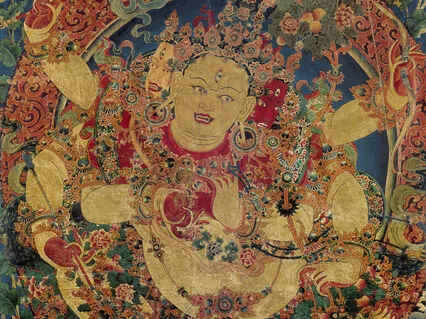
And the art connection for this session is this beautiful mural painting originated from central Tibet,
19th century,
Mineral pigment on cloth,
About 64 by 25,
24 inches actually.
This is Parna Shavari in Tibetan.
She's known as Ritu Loma Jhangma,
English translation is the mountain ascetic wearing leaves,
The goddess who protects from contagious illness and epidemic.
As you see here,
It's natural in color,
Yellowish.
She has three faces and six hands.
The main face is slightly peaceful and semi-wrathful with three eyes and the hair tied with a snake in a top knot on the crown of the head.
The red face on our right is in a desirous mood,
And the white face on the viewer's left is peaceful.
The first pair of hands hold a golden vajra and a vajra lasso held to the heart.
In the second pair is a vajra axe upraised in a manner of striking and a fan of fresh leaves,
And in the lower pair of hands is an arrow and bow adorned with gold and jewel ornaments,
A circlet of fresh leaves around the neck and a long snake necklace.
The lower body is covered with an attached skirt of fresh leaves tied with a yellow silk ribbon.
With the right knee pressing on the sun disc and lotus seed,
She sits in a kneeling posture.
Flames and a dark blue nimbus surrounds the entire form.
The unusually large dimensions of this painting suggest that it was intended as a mural.
The painted cloth would be glued to a temple wall.
This technique is most common from the 19th century onward.
The rich jewelry with thick pearls,
The flower studded background,
The almost abstract rendering of the rocks,
And the variety of halo forms used in this painting are also typical of the 19th century.
She's associated with the practice of healing,
Particularly curing contagious diseases and suppressing epidemics.
Now let's bring on our teacher for today,
And our teacher is Kimberly Brown.
Kimberly Brown is a meditation teacher and author.
She leads classes and retreats that emphasize the power of compassion and kindness meditation to reconnect us to ourselves and others.
Her teachings provide an approachable pathway to personal and collective well-being through effective and modern techniques based on traditional practices.
She studies in both the Tibetan and Insight Schools of Buddhism and is a certified mindfulness instructor.
Her new book,
Navigating Grief and Loss,
25 Buddhist Practices to Keep Your Heart Open to Yourself and Others,
Is published in November,
And an updated edition of Steady,
Calm,
And Brave will be released this month.
Both are published by Prometheus Books.
You can learn more about Kimberly on our website,
Meditationwithheart.
Com.
Kimberly,
Thank you so much for being here.
Thank you,
Tashi.
Thank you,
Everyone.
Happy New Year.
It's nice to be back.
It's a good time to remember the purpose of meditation in the Buddhist tradition.
Some people meditate to get more relaxed for stress reduction,
And those are very useful reasons and purposes for meditating.
But there's a greater reason for doing that,
And this reason is to develop our wisdom.
The wisdom that we're developing enables us to see what's true about our lives.
Not just Kim's life,
But everyone's life.
What's true is,
Well,
Everything is impermanent.
All phenomena,
Sound,
Light,
Taste,
Smell,
Your job,
Your life,
All of this is impermanent and changing.
So that's a truth.
It's also true that all of our actions have outcomes.
So the words that we speak and our behaviors and our thoughts,
You know,
They affect ourselves and each other.
That's another truth.
It's true that all of us have difficulties,
Struggles,
Suffering,
And the tradition dukkha is the word for this.
Another great truth,
Perhaps the greatest,
Is the truth of interconnectedness.
This is also sometimes called interdependence.
The great Zen teacher Thich Nhat Hanh called it interbeing.
This is the truth of our lives that each of us are inextricably bound up with each other.
One of the reasons today that we're using this art of this nature goddess,
This forest goddess,
This goddess with leaves all around and a snake around her neck,
Is because it's easy,
I think,
For many of us to recognize and understand that nature is interconnected.
You know,
Somehow we can see that,
That a forest is not just one thing.
A forest is made up of all,
It's an ecosystem made up of all these creatures,
Right?
But the truth is that we too are nature.
We are not separate from nature and that we live in a great ecosystem that includes us and all other beings.
That is our interconnection.
So another point of meditation or another reason to meditate is to develop compassion.
This is our ability,
A quality that we can cultivate that helps us recognize and attend to our struggles and the struggles of others.
Compassion allows us to be with,
To not look away from pain and suffering and sorrow.
And it also enables us to have this great brave heart like the Buddha.
It's great brave courageousness of being able to also alleviate suffering as we can.
Right?
And here's the thing,
Wisdom and compassion are inseparable.
Okay,
So that means when we develop our wisdom through meditation practices,
Compassion will arise.
When we develop compassion through meditation practices,
Wisdom will arise.
Okay.
And that is because each of these qualities,
When we hold them and perfect them,
They point out our deep interconnectedness.
Okay,
So to,
To use practices like mindfulness and insight techniques,
Which allow us to see impermanence and interdependence will also then have compassion arise with them.
You'll see Zen students sit and just watch a wall.
They open their eyes and sit in front of a wall and just watch the comings and goings of events.
This to this sort of wisdom will enable us to see that we're interconnected,
That we live in our lives in interbeing.
And so compassion arises for this acknowledgement for this knowing that we're not separate from anyone else.
And so to which we'll do today,
We are going to we are going to develop our compassion meditation today.
This allows us,
We'll use Metta,
Of course,
One of the traditional compassion meditations,
Metta,
M-E-T-T-A.
It's also called loving kindness meditation.
That's how it's translated from the Pali word.
It's in the Sanskrit.
Metta is my tree.
So Metta,
My tree,
Compassion,
Loving kindness,
This all has a quality of recognizing that we're the same as everyone else.
We have joys and struggles and difficulties and we are relying on everyone else.
And once that compassion arises,
We see this and that the wisdom of interdependence arises there.
So there are different ways.
And today we're going to use compassion meditation to find our way in to recognize when we open our own heart to ourselves and to each other,
The wisdom of interbeing arises with it.
And to begin to have to have that notice that you have struggles that you have suffering and to bring your wisdom and kindness to it,
This compassion,
That recognition,
When it's when it's a deeply felt,
Not just thought,
But as deeply recognized is also a knowing that every human that's alive today has some sort of suffering,
Just like yours.
Every human that's ever lived has had suffering and every human that will live.
Okay.
So it's very deep,
Deep knowing,
Understanding,
And that we're not separate.
We're not different than others.
Okay.
And further,
That we all deserve compassion and love.
We would have to earn it.
There isn't anyone among us that isn't qualified or has done something so wrong that they would fall outside of our compassion.
And again,
That leads us back to interconnection and interbeing because we all need each other.
Right.
Now,
You know,
We could talk about it on a very,
You know,
A very simple level,
Right?
We're breathing air.
This air comes from our environment,
Right?
From trees,
From this whole earth,
Right?
This planet.
So in that way,
We are interconnected just through air,
Right?
But then as humans,
We're interconnected.
If you're drinking something right now,
Coffee or water,
Whatever it is,
It was brought to you by other beings and the earth.
So all of our food,
Everything that supports us is reliant upon others.
And we can't remove ourselves from this ecosystem.
It is not possible.
People have tried,
You know,
To,
This idea of living off the grid or an idea of creating like a place where you could be totally independent.
But it's not possible.
Even if you're living off the grid,
You are reliant on the sun and you're reliant on the earth.
So we are necessarily,
We live our lives in interbeing and we cannot separate from it.
Today,
Like I said,
We're going to practice some meta meditation.
I'm going to guide us through it so you don't have to,
You know,
Remember anything.
We will be using phrases of kindness.
We're going to offer them first to what is traditionally called a benefactor.
Okay.
This is someone who has loved you very easily with whom you have a very warm relationship with.
It is usually an old friend,
An aunt,
An uncle,
A teacher.
It's not usually a parent,
A spouse,
Or a sibling,
Just because those are kind of complicated relationships.
So this first being that we'll offer to in our meta is going to be this benefactor.
And the benefactor,
Oh,
It could also be a pet,
Just someone who's loved you so easily and delighted.
Then we'll offer meta to ourselves.
Okay.
And then we'll take a few minutes to offer meta to all beings,
Recognizing that we're interconnected because we live in interbeing with all.
So I'd like you to find a spot where you can be undisturbed for the next 15 ish 20 minutes.
Okay.
And that means turn off your devices.
I know you're watching on a computer,
But you don't need to look at me.
You know,
You can either turn away,
You can close your eyes.
Also in this meditation,
Use your wisdom.
Maybe you need to lay down today.
Okay.
Maybe that would make you the most tranquil and alert.
Okay.
Maybe you need to sit and sit up right a little,
Uh,
A little more,
And maybe you need to stand or walk.
Okay.
So just use your wisdom as to what would be best.
Take your time to find your seat.
And I give you a moment and it just starting to notice that you're here,
Allowing sound and light and smell and taste,
Allowing them to come to you,
Allowing the experience of your body.
You might be feeling tightness.
You might be feeling heaviness today.
You might feel very bright.
Okay.
So just for a minute or two,
Practicing,
Allowing,
Allowing yourself to be here.
Noticing that you're breathing.
Much of the time we're trying to figure out we're looking,
We're looking realistic.
You don't all of that has a quality of going out,
Going out and grasping.
Okay.
For just these two minutes,
You don't have to do that.
You can just let sensation come to you.
Okay.
Rest,
Let the sound enter,
Let it go.
Let the smell,
The taste,
The light,
Let your breath rise and fall that inhale and exhale.
And also let thoughts come and go and emotions come and go.
Okay.
Just for two minutes,
We're going to practice this kind of resting here in this moment.
And just noticing,
Using your awareness to notice where your attention is.
Maybe it's in a plan or a thought,
Or maybe you're resting on your breath.
And now making a connection with this benefactor.
Okay.
And you might rest your attention on your heart,
Place your hand there.
And this benefactor,
Like I mentioned,
Is someone who has delighted and loved you very easily.
Could be a pet.
I sometimes use my little cat,
Rigel.
Could be a dear friend,
An aunt,
Uncle,
A teacher.
And call this person to your mind,
To your heart.
You might just feel their presence,
Or you might imagine them.
You might have an image of them.
Okay.
And I'd like you to give them these two phrases.
May you recognize all your good blessings.
May you be content and at ease with yourself.
May you recognize all your good blessings.
May you be content and at ease with yourself.
May you recognize all your good blessings.
May you be content and at ease with yourself.
Repeating these phrases silently.
Imagining maybe you're giving this,
These phrases like a gift to this benefactor.
Just for a few minutes.
Just noticing where your attention is.
If you've strayed,
Gently coming back,
Reconnecting,
Beginning again.
May you recognize all your good blessings.
May you be content and at ease with yourself.
And we'll just continue for one more minute offering this mantra to our benefactor.
May you recognize all your good blessings.
May you be content and at ease with yourself.
Can let go of this connection with this benefactor.
Notice your breath,
Feeling your feet,
Experiencing the sounds entering your ears.
And now connecting with yourself.
Again,
You can place your hand on your heart if you'd like.
Feeling your beautiful presence.
You could imagine yourself as though you're looking in the mirror,
Or maybe imagine yourself as a child.
And give yourself these same blessings.
May I recognize all my good blessings.
May I be content and at ease with myself.
May I recognize all my good blessings.
May I be content and at ease with myself.
May I recognize all my good blessings.
May I be content and at ease with myself.
And continuing now just for a couple minutes here,
Giving yourself this same gift of wisdom by silently repeating these phrases.
Noticing where is your attention right now.
If you've strayed from your connection with yourself or the phrases.
It's okay,
Beginning again.
May I recognize all my good blessings.
May I be content and at ease with myself.
And just for one more minute,
Giving yourself this metta.
May I recognize all my good blessings.
May I be content and at ease with myself.
You could keep this connection with yourself.
Also including that first being,
That benefactor.
Now including everyone that you care about.
Your family,
Your friends,
Your colleagues,
Your pets.
May we recognize all our good blessings.
May we be content and at ease with ourselves.
Beginning to include more beings,
Including everyone on this call.
Everyone that's part of the Rubin Museum.
All the employees,
All of the members,
All of the board.
May we recognize all our good blessings.
May we be content and at ease with ourselves.
We're developing the wisdom of indiscriminate lovingness through the recognition of our interbeing.
Beginning to include everyone that you really don't like or you're in conflict with.
People that you find very frustrating or annoying personally or on the world stage.
Including them too.
May we recognize all our good blessings.
May we be content and at ease with ourselves.
And including all of the strangers,
All the people all over the globe,
Even right here in your city that you're never going to meet.
People of all ages and ethnicities,
Different economic circumstances and languages,
Cultures.
May we recognize all our good blessings.
May we be content and at ease with ourselves.
And finally,
Including all beings,
The animals,
Fish and birds,
And all the mammals,
All the insects,
And all the humans.
May we recognize all our good blessings.
May we be content and at ease with ourselves.
Sabe Sata,
All beings.
Sukhi Hantu.
May all be happy and free from suffering.
Suffering and the causes of suffering.
You can let go of this technique.
Letting yourself just rest here for a moment in the quiet.
In your own heart and mind.
Take a moment to thank yourself for your practice.
I thank you all for using your patience and your wisdom and your compassion today.
Whenever you're ready,
Bringing your attention back to our conversation here.
Back to our Zoom screen.
You can stretch,
You can move,
Whatever way seems useful to you,
Beneficial.
Thank you.
Thank you so much,
Kimberly,
For that beautiful session on Metta,
Warming kindness.
That concludes this week's practice.
If you would like to support the Rubin and this meditation series,
We invite you to become a member of the Rubin.
If you're looking for more inspiring content,
Please check out our other podcast,
Awaken,
Which uses art to explore the dynamic paths to enlightenment and what it means to wake up.
Season two,
Hosted by Raveena Arora,
Is out now and explores the transformative power of emotions using a mandala as a guide.
Available wherever you listen to podcasts.
Thank you for listening.
Have a mindful day.