Welcome to the mindfulness meditation podcast presented by the Rubin Museum of Art.
We are a museum in Chelsea,
New York City that connects visitors to the art and ideas of the Himalayas and serves as a space for reflection and personal transformation.
I'm your host,
Dawn Eshelman.
Every Monday we present a meditation session inspired by a different artwork from the Rubin Museum's collection and led by a prominent meditation teacher from the New York area.
This podcast is a recording of our weekly practice currently held virtually.
In the description for each episode,
You will find information about the theme for that week's session,
Including an image of the related artwork.
Our mindfulness meditation podcast is presented in partnership with Sharon Salzberg and teachers from the New York Insight Meditation Center,
The Interdependence Project,
And Parabola Magazine.
And now,
Please enjoy your practice.
Hello,
Everyone.
Hello,
Hello.
Welcome to mindfulness meditation online here with the Rubin Museum of Art.
My name is Dawn Eshelman.
Thank you for joining us.
We are a museum of Himalayan art in New York City,
Art and Ideas,
And it is wonderful to join with you here for our weekly program,
Our weekly ritual where we combine art and meditation online.
I hope you had a great weekend,
A good Halloween,
Celebrated and enjoyed that full moon,
The blue moon.
And now,
I think many of us,
Especially those of us in the United States,
Are really grappling with some anxiety,
Some anticipation,
Right?
We are on the eve of a big election.
And while it's tempting to come to meditation in the hopes of having a break from some realities and indeed that can be useful,
It's also helpful to turn to meditation as a tool,
Right?
To help us engage intentionally and mindfully with what is going on for us.
So we'll be talking a little bit about anticipation and meditation as such a useful tool when dealing with anxiety,
Which inevitably comes up as we deal with this concept of impermanence,
This idea that everything changes,
Right?
And are living through different examples of that.
So we will look at a work of art together and talk about our theme for this month.
Resilience,
Something that I feel like,
Especially from a mindfulness point of view,
Meditation is simply a resilience practice,
Right?
Just beginning again,
Beginning again,
Beginning again,
And really can be a great metaphor for our own personal resilience.
Let's take a look at the work of art that we are showcasing today.
This is in a moment here,
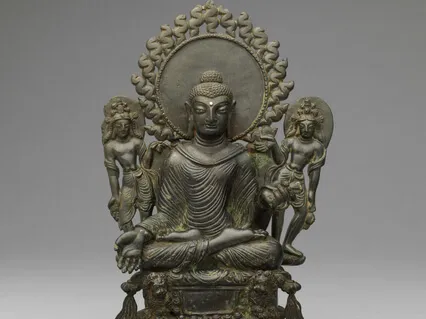
You'll see Buddha Shakyamuni.
This is a bronze sculpture from the eighth century and it's small.
It's just over six and a half inches tall.
And it's kind of nice to know that detail while you're looking at it here,
Just to appreciate all of the detail that is packed in here to this very small little potent sculpture.
This is from the Swat Valley,
Which is in Pakistan,
Abutting Kashmir and Northern India.
And the sculpture gives us a lot of clues that this is where it's from because it bears many characteristics of bronze images from the Swat Valley,
Including the use of this very dark metal alloy,
And also these kind of thick wave-shaped flames that are surrounding this,
What is a head nimbus,
It looks like a halo behind the Buddha's head.
Also these folds in the Buddha's robes are characteristic of sculpture from this area during this time.
And the type of throne,
The throne that Buddha is sitting on has this large central textile with these tassels that hang down and is placed on the lotus throne.
And the Buddha's robe covers both shoulders,
Right off when we see one side,
And forming this very thick and wide collar.
And in this manner that is typical for Swat imagery,
The Buddha performs this gesture of giving,
Right,
And holds the end of his robe.
And on either side of him,
He has two smaller bodhisattvas.
We have Avalokiteshvara to his right,
Symbolizing wisdom,
And then Maitreya,
The Buddha of the future,
To his left.
Maitreya holds a lotus flower,
This other symbol of resilience that we know a lot about by now,
And a flask also.
And most of these features are really typical for this period.
So lots to take in,
Lots of detail here to tell us about where the sculpture comes from.
And then we also have this overarching story,
The story of Shakyamuni Buddha.
And I've told it many times,
I won't go into too much detail today,
But just this reminder of resilience,
This journey that the Buddha,
Shakyamuni,
The historical Buddha took to reach enlightenment and the perseverance and resilience that he embodies and reminds us of.
So with that,
Let's bring on our teacher today,
Lama Arya Drolma.
Lama Arya Drolma is a formerly authorized Buddhist teacher,
Trained in the Karmakayu tradition of Tibetan Buddhism.
Hello there.
Hello.
Hi.
And she has over a decade of monastic study and meditation training and is a graduate of the three-year,
Three-month traditional Tibetan retreat and training program at Palpung Tuktung Choling Monastery in New York.
So she is respected as a leading expert in mindfulness meditation and trained extensively in the Dharma path program of mindfulness and contemplations at Palpung Tuktung Choling New York.
So we're so delighted to have her here to share with us her Vajrayana Buddhist practice.
And how are you doing today,
Lama Arya Drolma?
Wonderful.
Thank you for asking and hello and welcome everyone.
Thank you all for joining in today.
Thank you.
Thank you.
So I want to thank Dawn and the whole team for organizing this webinar.
And thank you,
Rubin Museum,
For giving us this virtual platform to come together.
And I'm absolutely delighted to be here with you all.
So as Dawn mentioned in this beautiful bronze statue of Buddha,
In the center is Buddha and accompanied on both sides,
One is our Loki-Desvara and the other side is Lord Maitreya.
And Lord Maitreya is believed to be the next Buddha.
And so it's wonderful to see our Loki-Desvara on one side,
The Bodhisattva and Lord Maitreya.
So this week in November,
It's one of the holiest months for the Tibetan Buddhist calendar.
And it's known as Laa Bab Duchan in Tibetan.
And in this year,
It falls on November 7th.
And the example is like All Saints Day to Christianity.
So it's a very special and a very,
Very holy month for Tibetan Buddhists all over the world.
And Laa Bab Duchan is celebrated as the day Shakyamuni Buddha descends,
Comes down to earth from the heavenly realm of Tushita.
So according to the legend,
Buddha went to the heavenly realm of Tushita in order to repay his mother's kindness by giving her teachings to liberate herself from samsara.
His mother had died a week after Buddha was born.
And because of a great merit,
She was born in this heavenly realm called Tushita,
Where all the Bodhisattvas,
The noble beings are destined to reach full enlightenment.
And in this heavenly realm is also associated with Maitreya Buddha,
Our Bodhisattva in the statue that you saw.
And it's predicted,
Of course,
That he's going to be the next Buddha,
The future Buddha.
And so Tibetan Buddhist,
Buddhist believes on this auspicious day of Laa Bab Duchan,
And all the positive and negative actions are multiplied 10 million times.
So it's a part of Tibetan Buddhist tradition to engage in virtuous activities,
So we can accumulate merit and we can be also liberated like Buddha.
So during this special time of Tibetan Buddhist auspicious day,
All over the world,
They practice generosity,
Feeding the poor,
Freeing animals,
Fishes,
Birds,
Fasting rituals,
And reciting prayers and meditation.
And so why are all these Buddhists trying to attain enlightenment?
Because it's the highest spiritual state of being,
And it's our true nature and our inherent potential that potential,
Which each individual inherently possesses.
And I feel every one of us in their lifetime has asked,
Who am I and what is the purpose of my life?
And when you have this question,
That is what our innate primordial potential is.
That is why we asked that question.
So in short,
To attain enlightenment,
One has to engage in two accumulations,
One of merit by doing all good deeds,
Positive actions,
And positive thoughts and prayers and chanting.
And also that comes under wisdom.
So there are two accumulations,
One of merit,
Which all positive deeds,
And the second being wisdom,
Which comes under chanting,
Contemplation,
Meditation.
So right now we are going through a lot of things and this lockdown seems never ending and our minds are all over the place,
Constantly worried,
Thoughts of fear,
Anxiety,
Stress,
All these things are coming to us.
But I think this month's theme being resilience,
If we had to get a score,
All of us would get A plus.
We have been so good.
We've handled this pretty well.
And I know we still,
There's a lot going to be going on around the world.
And we still have so many fears and so many thoughts.
And for us to have some mental peace to calm our minds,
Meditation is the best source out there.
So let's begin to meditate.
Because meditation gives your mind spaciousness.
And when you have spaciousness,
There's joy and there's happiness,
Which automatically emerges.
And so today we will use the breath as the anchor to focus our minds attention.
This is a very popular method and it's very easy to use this method.
So when we start the meditation session,
There are two essential points.
One is your mind and the second is your body.
Now the essential point of your body.
So it's always good to sit up right and then keep your spine straight and also be comfortable.
Now for any reason,
It's hard for you to keep your spine straight.
It's okay,
Be as comfortable as you can.
And now the second essential point is your mind.
Now essentially,
The mind is what does the meditation.
So when you start a meditation session,
It's good to have been a little more peaceful,
You know,
Have a calm and peaceful state of mind.
And the mind actually is the mind is actually what does the meditation.
So being calm,
Being present is very important.
And what do I mean by that?
I mean,
Like being present is you can right now be in your office somewhere.
So bring your mind's attention to the present moment.
So today,
As I mentioned before,
We'll focus our attention on a breath and it's very easy to do because we breathe all the time.
So it's very easy.
All you have to do is just sit up right,
Put your mind's attention on your breath,
Follow your breath all the way into your abdomen.
There's a slight pause there.
And then just breathe out.
So every time your mind may wander off,
Just bring your mind's attention to your breath.
Just breathe in deeply pause,
And then the breath will come out.
And as you breathe out,
Let your breath fill the entire space in front of you.
Just visualize that and then rest in that present moment of awareness.
So I'll give you a guided meditation and you don't have to remember anything.
And so let's all get comfortable.
And before we start,
Let's all join in with three breaths.
Now importantly,
I just have to go back a little.
The reason I mentioned the Laa Bab Duchan,
The holiest month is because all the Tibetan Buddhists all over the world will be praying,
Will be chanting,
Will be fasting.
Even here in our monastery,
We are getting ready today.
We are doing all these beautiful offerings and we're getting ready to fast and to chant.
And the chanting and prayers are to benefit all the beings around the world.
So imagine all over the world,
There are Tibetan monasteries and all the monks,
Nuns,
And lay people even outside the Buddhist practitioners will be praying.
So you have nothing to fear.
This whole universe will be the embodiment and the energy of prayers.
So all you need to do is be safe and be careful and embrace this prayers and blessings.
So now we'll go back straight back into the meditation.
The instructions,
We'll do three.
To start,
We'll do three short,
We'll take three deep breaths just to inhale and then just exhale all your stress away.
And then I'll give you a guided meditation.
So sit up right.
So the first breath,
Inhale deeply and watch your breath go all the way to your abdomen.
And then there's a slight pause and breathe out all your stress and anxiety and just rest your mind in that present moment.
Now the second breath again,
Inhale deeply,
Watch your breath go all the way to your abdomen and then pause for a moment.
And then as you breathe out,
Let your breath fill the entire space in front of you.
Just rest in that present moment of awareness.
Again third breath like so.
Inhale deeply and there's a slight pause.
And as you exhale,
Just exhale all your stress and anxiety away.
And just rest in that present moment of awareness.
Wonderful.
All of you all did a great job.
So we'll continue with our meditation.
Now please breathe normally.
And it's also when you meditate,
It's important that to pay attention to your breath and also to breathe a little slowly but not too much.
Just as much as you're comfortable.
Remember we all breathe differently.
Everyone has their own pace and rhythm.
So breathe as slowly as you can but not too slow.
Normally and with your own rhythm and pace.
So let's start.
Check your posture,
Sit upright but be relaxed and comfortable.
You can keep your eyes open or you can keep your eyes closed or you can lower your gaze and just keep your eyes on a spot in front of you.
But you can keep all your ears open and pay attention to the guided meditation.
So let's start.
As you breathe in,
See your breath going in all the way to your abdomen.
And notice there's a slight pause there.
And as you breathe out,
Let your breath come out from your nostrils and into space in front of you and just rest in that present moment of awareness.
So let's rest for a while.
Again,
Inhale and exhale.
Breathe normally.
And as your breath goes in,
Notice there's a slight pause.
And as you breathe out,
Breathe out from your nostrils and let it fill the entire space in front of you.
Just rest in that present moment of awareness.
And as you breathe out,
Let your breath come out from your nostrils and let it fill the entire space in front of you.
Now,
Notice somewhere around this time,
Your thoughts have wandered off.
And the minute you notice your thoughts have wandered off,
It's okay.
Just say thinking,
Acknowledge your mind has wandered off.
That's what the mind does.
And then bring your mind's attention back to your breath.
Inhale and there's a slight pause.
Exhale.
And as you breathe out from your nostrils,
Let it fill the entire space in front of you and just rest in that present moment of awareness.
Now,
Notice somewhere around this time,
Your thoughts have wandered off,
Breathe out from Do not think of the past.
The past is over.
Do not think of the future that I must do this or I must do that.
Just rest in the present moment.
As soon as your mind wanders off,
Say thinking,
Acknowledge it and bring your mind's attention to your breath.
Just pay attention to breathing.
Inhale deeply and there's a pause right there.
Slight pause and breathe out and let your breath fill the entire space.
Meditation allows you to look inward.
So when you meditate,
You'll see a lot of thoughts,
List of things you want to complete and so on.
Thoughts are going to come and go and depending on these thoughts,
Emotions are going to rise.
But as soon as you realize your thoughts,
Just say thinking and gently let go and say to yourself,
It's my time to meditate and bring your minds back to your breath,
Paying attention.
And the more often you start doing meditation,
It feels very peaceful.
It feels very spacious and you'll have more clarity and focus.
Again,
Inhale and exhale.
And as you breathe in,
Notice this a slight pause and then you breathe out.
And as you breathe out,
Let your air fill the entire space in front of you.
And again,
Just rest in that present moment of awareness.
The minute you notice your thinking,
The minute you notice you have thoughts in your mind,
Thoughts arise because of the thoughts,
Emotions will arise.
Do not follow after the thoughts.
Do not make it into a narrative.
That's what the mind does.
Again,
Acknowledge your thought,
Bring your mind's attention back to your breath.
And the idea is not to block your thoughts.
It's very important never to block your thoughts.
Your thoughts are like a beautiful waterfall and you can never block the waterfall.
So it's very important that you don't block your thoughts,
But you acknowledge it,
Let it go and then bring your mind's attention back to your breath.
Inhale and exhale.
Breathe normally,
Breathe gently.
And as you inhale deeply,
Notice there's a slight pause and then breathe out and let your,
The air fill the entire space in front of you.
And just rest in that present moment of awareness.
Your mind is like the space or the sky and your thoughts are like the birds.
They come,
They fly and they go away.
But if you don't engage in it,
The birds that fly,
They don't leave a trace.
So that's the point where we're going to get,
Especially when you're meditating and when you meditate and the thoughts come and linger,
Just let it go.
Acknowledge it,
Let it go and come back to paying attention to your breath.
If you can train yourself during meditation to simply observe the rising of each thought and emotions without grasping,
Without clinging to it and just knowing it's just a temporary play of the mind.
It's like the waves that come and go from the ocean,
The ocean being the mind and the waves being your thoughts.
And then as this habit,
When you sit and meditate,
You make it a habit every day,
Sit for a few minutes.
And then when,
When you are doing your daily routine,
You can do the same when you,
When there are persisting thoughts,
You can acknowledge it and let go.
And this is where you're going to get when you start to meditate every day,
Even for a minute,
Even for two minutes,
And then you can do five minutes and that's how you're going to develop a meditation,
Daily meditation practice.
And this meditation is called calm abiding meditation and calm abiding.
And also I mentioned that we have,
This is a very holy month for the Tibetan Buddhist.
It's lab up to chin.
And it's very important that all of us can also do our share of good activities,
Good deeds,
Having a good frame of mind and trying to be peaceful.
And so what happens is when you,
Especially when you meditate and you're in a peaceful state,
You're spreading that energy.
It's like a ripple effect.
You know,
When you even a small,
Tiny pebble,
When you throw it into a Lake,
You see the ripple effect.
So when you have peace of mind,
When you are calm,
You can go out there and share that to your friend,
Your father,
Your mother,
Too.
And they themselves are able to share that moment of peace,
Which you can do while you're practicing formally.
And like I mentioned,
It's a ripple effect.
And so you can also do your share because I know everyone,
All of us are going through a lot of anxiety and stress and there are many things that are events that are going to be happening in this month of November.
So to be calm,
Be peaceful,
And know that all of us around the world,
Tibetan Buddhists especially,
This is a very holy month and we will all be praying.
And the most important prayer we do every day is to benefit beings.
And all of y'all are in that realm of beings.
So we have three more minutes.
Again,
Let's do this meditation and really well sit up straight.
Inhale and exhale.
And as you inhale,
There's a slight pause.
And then as you exhale,
Breathe out gently and let the air fill the entire space.
Let's visualize that and rest in that present moment of awareness.
Let's go to GitHub.
So again,
When you notice any thoughts,
Say thinking,
Acknowledge it,
Let it go and come back,
Bring your mind's attention back to your breath.
Okay,
I think you all did a great job and I want to thank you all so much.
Thank you,
Thank you so much for that.
That concludes this week's practice.
If you would like to support The Rubin and this meditation series,
We invite you to become a member of The Rubin.
Thank you for listening.
Have a mindful day.