Welcome to the Mindfulness Meditation podcast.
I'm your host,
Dawn Eshelman.
Every Wednesday at the Rubin Museum of Art in Chelsea,
We present a meditation session led by a prominent meditation teacher from the New York area.
This podcast is a recording of our weekly practice.
If you would like to join us in person,
Please visit our website at rubinmuseum.
Org slash meditation.
We are proud to be partnering with Sharon Salzberg and teachers from the New York Insight Meditation Center.
The series is supported in part by the Hemera Foundation.
In the description for each episode,
You will find information about the theme for that week's session,
Including an image of a related artwork chosen from the Rubin Museum's permanent collection.
And now,
Please enjoy your practice.
We are wrapping up this month,
This week and next week,
Talking about transforming obstacles.
And so far,
We've been talking about transforming obstacles as,
Or thinking about obstacles as,
You know,
Perhaps these large events that overtake our lives in some ways.
And we've also been talking about them as,
On a smaller scale as well,
Just distractions during our practice,
That kind of thing.
Today we're talking about a particular kind of obstacle.
We're talking about the Bardo today,
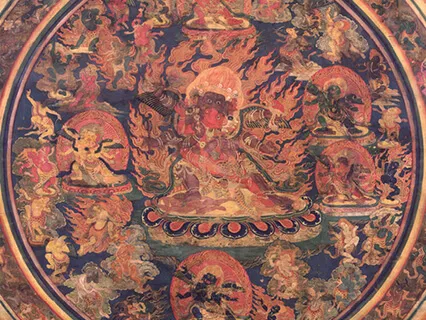
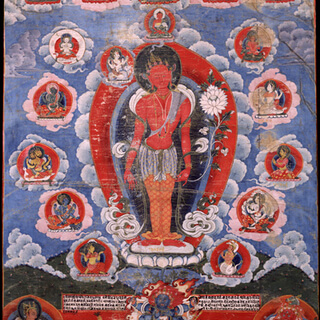
And the image that we're looking at here is peaceful and wrathful deities of the transition state.
This is from Tibet,
18th century,
Pigment on cloth.
This is a Tonka.
And the Bardo is known in the West as the Tibetan Book of the Dead.
But that word Bardo,
And it refers to the transition period between the time when a person dies and the time that they're reborn.
And it is a very crucial stage in the life of a Tibetan Buddhist,
Because during that time,
It's determined how they will be reborn into what kind of life and,
Or will they be enlightened.
So there's a lot at stake going on in this transition period here.
And part of that is what's depicted in this Tonka here.
You can see that,
Again,
The wrathful deities of the transition state are kind of all gathered together in the top here.
You can see it's hard to make out,
I know,
And we'll look at a detail in a second.
But you can probably make out the central figure in the top circle there,
And the flames that are kind of emanating from behind,
Yes?
And surrounding that main figure are several other wrathful deities.
And then on the bottom are the peaceful deities.
And they have a much different feeling that they're conveying.
But you can kind of imagine that this is like going to a wild party and seeing these crazy characters,
Like both fierce and ferocious and totally glamorous and amazing.
And what's interesting about this kind of litmus test in a way is that it's all about how the person reacts to both the wrathful and the peaceful deities.
How grounded can they remain in the face of these temptations?
And how much can they remain true to their true nature?
So it's an interesting thing to talk about,
To think about,
Certainly within that Tibetan Buddhist context of enlightenment and rebirth,
But also just to think about it as a metaphor in terms of transitions that we deal with or obstacles that we face,
Whether they are really small,
You know,
Waiting in line for your ticket today,
And the really challenging ones that are very difficult in our lives.
But that word bardo,
To come back to that,
Really just means transition.
And so I encourage you to think about that imaginatively today as we talk about overcoming obstacles.
Where are we seeing obstacles,
Not just in the sort of main dish of our daily lives,
But in those transition moments.
I also just want to encourage you to really take advantage of the gallery tour,
Especially today,
Because we're looking at an object that is very difficult to reproduce for you here,
Actually.
And there's nothing like seeing any art object in person,
But today in particular,
It's pretty special to look up close and in person.
So Jeremy will be right outside afterwards to lead you up to the sixth floor,
If you'd like to take a look.
Tracy Cochran is back with us,
Our house band,
As we like to refer to her.
She is a writer and the editorial director of the quarterly magazine Parabola,
Which can be found on shop and online and in our shop.
And she has been a student of meditation and other spiritual practices for many years.
In addition to the Ruben,
She teaches at New York Insight,
Where she is still teaching her Monday night mindful writing workshop,
Which is open to drop-ins.
Three more to go,
Right Tracy?
So you are all invited.
And every Sunday at Hudson River Sangha in Tarrytown,
New York,
Her writings and teaching schedule can be found online via Parabola on Facebook and Twitter and on TracyCochran.
Org.
Please welcome her back,
Tracy Cochran.
I'm delighted to be here.
I'm thrilled to be considered the house band for one more week.
And it's always kind of daunting to hear the description of these great sacred artworks and kind of wondering,
How can I relate?
How can I relate?
And it's interesting to remember that bardo means that inner intermediate time,
That downtime.
In other words,
The time you had the rug pulled out from under you.
Have you ever had that happen?
Has anybody in this room ever had that happen?
It's interesting to suddenly realize that every single person in this room has had that experience of getting really shocking and bad news,
Of suddenly losing somebody they loved,
Everybody,
Or losing a job,
Or losing a relationship,
Even being stabbed in the back,
Having your heart broken,
Just out of the blue.
It's extraordinary there isn't one single person in the room who hasn't had that experience.
And what happens in that moment is that suddenly reality seems different than it did the moment before.
In the case of the death of somebody or our own diagnosis,
Things suddenly seem irrevocable,
Where just a moment before it seemed like you had lots of time.
I like to think of myself as now in the afternoon of my life,
Not quite the evening,
But it's like you know those days where you can't quite get out the door until two or three and then you're like,
Oh my heavens,
Where did the time go?
I have to get outside.
But suddenly life looks different and so does the self.
So I wanted to share the example of a teacher of mine,
One of my favorite teachers named William Segal.
He was a New Yorker and I loved him because he was a magazine publisher,
He was a painter,
He loved art and wine and food and fashion and at the same time he became a very great Zen master.
And I always had this dream from the time I was in my teens that life could be a spiritual practice and he seemed to embody that.
But do you know how he did it?
It wasn't because everything worked out.
His time of really coming to grasp something,
To glimpse something happened when he had a devastating car accident.
He was completely smashed up and he was lying in a hospital room,
Just lying there wondering what came next because we all know how it feels when things get smashed,
Don't we?
There's this moment of shock when you just open to receive what comes next and in the midst of that he got a message from a great Zen Roshi named Soen Roshi and the message was,
I picture it as a telegram and I think this was the period when you would get telegrams and Segal had been the first American to stay in a Zen monastery in Japan after World War II.
So he had a very special relationship with Japan and with Soen and the telegram said,
Lucky man,
An accident like yours is worth 10,
000 sittings in a monastery.
Ten thousand.
And for years I wondered what that meant and it was as I've gotten a little more life under my belt,
More and more all the time,
I began to understand that when Segal was lying there,
The first thing he found himself doing was watching carefully what comes next,
What comes next,
That quality of attention and he was there for months and months and he began to notice the care the janitors took cleaning the place,
The confidence and kindness of the nurses.
He noticed things he would never ordinarily notice and last week some of you were here we were talking about the qualities the Buddhists remembered when he was all alone.
His wish for the truth,
It was real and his belief in the power of kindness and his patience and capacity to endure these kind of qualities.
So this is what Segal was noticing.
Stories of the heart like kindness coupled with this openness and this willingness to observe,
To watch,
To wait.
So what he began to see is what we begin to see when we practice that there's a self and there's life.
There's this story that we carry inside our heads,
We're trying to hold it together so that we at least look the way we imagine other people are,
Sane,
Together and you know that feeling inside there might be anxiety or feelings of contradiction or ambivalence but there's this wish to keep the story going,
The story of who we are and yet it's those times when the rug gets pulled out sometimes when we realize that all we really have to do is live,
Breathe,
Open to receive so there can be this vibrancy that comes,
This new life in the wake of that lost job or that lost relationship or that lost capacity even.
Do you know what I mean?
There's this burst of openness,
It can feel quite wild and it's certainly not something we ask for but when it comes it has a very special quality and feeling of possibility and there's a quote that I've used in here before and I once upon a time thought it came from Søren Kierkegaard,
The great Danish philosopher theologian but I have never found it anywhere so I am claiming it,
Going forward it is mine and the quote is,
I would have died if I hadn't died,
I would have died if I hadn't died and from the sound effects in the room I know we feel what that means,
Those times when our world came to an end and we never wanted that to happen and it's very sad but some new possibility appeared including very often the fact that you're sitting here about to practice,
About to practice opening to life so it's really interesting the Bardo is what happens in Tibetan Buddhism after we die and we see that clear light,
They have a whole beautiful wonderful,
You know the way Don described this party I think of those bars in Star Wars you know with all these creatures and but in our own life you know the ones they're bizarre and some of them are very glamorous I suppose and at the same time there's this call to remember,
Remember the breath,
Remember our lives,
Remember what matters,
Don't get pulled it's like the Buddha under the Bodhi tree being threatened by the devil Mara who had all kinds of terrifying visions and seductive visions and the Buddha touched the earth he remembered,
He remembered his life,
He remembered the power of kindness,
He remembered the truth.
Three weeks ago when I was here I was sharing that Andrew Young told me Martin Luther King remembered to prepare himself to face what frightened him,
What's unknown and we can as Don was saying you can even do that on the ticket line or at least notice that the way we usually live our lives is we want to just keep this continuous flow going forward so when there's a snag it's like oh I have to amend my timing next time you know or but there's an invitation with this practice to learn how to just come back no matter what's going on and it's not the booby prize it's slowly acquiring the ability to open to the true vibrancy of our lives and this net of kindness and possibility and these forces that support us.
Lucky man,
Lucky man,
An accident like yours is worth 10,
000 sittings in a monastery think of that it's you're called when things go wrong or even when you just have to wait to see what you're being shown the forces you don't usually see and they're not so supernatural they can be they also probably include very fine and extraordinary things but they also include something right with you your own capacity to open to be patient to watch to respond so now don't we won't listen to me we'll practice and listen to me a little so we take we take our seats feet firmly on the floor in front of us back straight as straight as possible without forcing notice how it feels to be in this body without thinking about it just take in an impression of this body this life as it presents itself in this bringing an attitude of welcome allowing yourself to be here and immediately we notice the thinking we notice sensations and sounds we feel tensions we might have memories or edges of feelings we let everything be exactly the way it is without any judgments and when we notice we're being taken we gently come back to the breath to the rhythm of breathing or the sensation of entering and leaving the nostrils and the sensation of being in a body right now Sati the word for this practice in Pali means to remember to remember the body in the sense of the body and the breath and this moment when we drift we notice this with no judgment and come back again to the breathing and the experience noticing that when we make this movement of coming back to the breath and the body we discover a vibrancy inside a sensation of being present and open to receive the feeling of being present and open to receive the feeling of being present and open to receive the feeling of being present and open to receive the feeling of being present and open to receive the feeling of being present and open to receive the feeling of being present we come home we don't close off we open we soften you noticing that relaxing is letting go softening so that we notice here sensation life we remember we're aliveaf As we continue to relax we notice an energy inside,
A sensation that's not separate from awareness.
It's not thinking but receiving,
Noticing,
Without judgment.
It's not thinking but receiving,
Noticing,
Without judgment.
It's not thinking but receiving,
Noticing,
Without judgment.
It's not thinking but receiving,
Noticing,
Without judgment.
It's not thinking but receiving,
Noticing,
Without judgment.
Noticing how it feels to catch yourself thinking,
Dreaming,
And not touch.
And gently come back to the breath and the body and the vibrancy of this moment.
It's not thinking but receiving,
Noticing,
Without judgment.
Noticing how it feels to catch yourself thinking,
Not just to feel,
But to feel.
Noticing how it feels to catch yourself thinking,
Not just to feel,
But to feel.
Noticing how it feels to catch yourself thinking,
Not just to feel,
But to feel.
As we continue to relax,
To come home,
We may begin to notice.
To notice an energy in the room,
An attention,
A stillness inside and outside.
Noticing how it feels to catch yourself thinking,
Not just to feel,
But to feel.
Noticing how it feels to catch yourself thinking,
Not just to feel,
But to feel.
Noticing how it feels to catch yourself thinking,
Not just to feel,
But to feel.
Noticing that even if we've been thinking this whole time or sleeping,
We can come home and find welcome beginning.
Noticing how it feels to catch yourself thinking,
Not just to feel,
But to feel.
Noticing how it feels to catch yourself thinking,
Not just to feel,
But to feel.
Noticing how it feels to catch yourself thinking,
Not just to feel,
But to feel.
Noticing how it feels to catch yourself thinking,
Not just to feel,
But to feel.
Thank you very much.
That concludes this week's practice.
If you'd like to attend in person,
Please check out our website,
Rubinmuseum.
Org slash meditation to learn more.
Sessions are free to Rubin Museum members,
Just one of the many benefits of membership.
Thank you for listening.
Have a mindful day.