Welcome to the mindfulness meditation podcast.
I'm your host,
Dawn Eshelman.
Every Wednesday at the Rubin Museum of Art in Chelsea,
We present a meditation session led by a prominent meditation teacher from the New York area.
This podcast is a recording of our weekly practice.
If you would like to join us in person,
Please visit our website at rubinmuseum.
Org slash meditation.
We are proud to be partnering with Sharon Salzberg and teachers from the New York Insight Meditation Center.
In the description for each episode,
You will find information about the theme for that week's session,
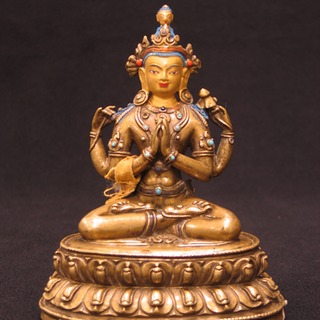
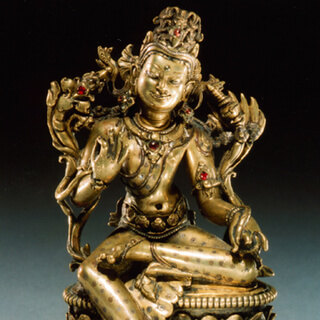
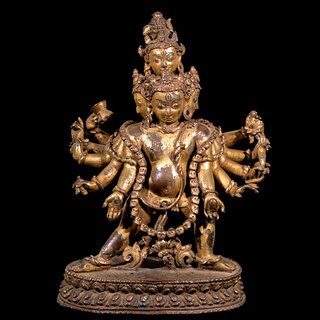
Including an image of a related artwork chosen from the Rubin Museum's permanent meditation collection.
And now,
Please enjoy your practice.
Good afternoon,
Everybody.
Welcome.
Welcome to the Rubin Museum of Art and to today's mindfulness meditation practice.
Great to see you all and to be here with you.
My name is Dawn Eshelman.
I'm head of programs.
I see so many familiar faces.
Hello.
And who is here for the first time?
Welcome.
Who comes every week if they can?
Welcome back.
And somewhere in between.
Great.
Great to have all of you.
Great to have everybody who's listening via podcast.
And yeah,
Just a reminder to those in the room,
We podcast these sessions.
They're available for free.
You can check them out on our website,
Rubinmuseum.
Org slash meditation.
And you can also find them on iTunes,
Insight Timer,
And some other platforms.
So that's pretty cool.
We are engaged in this year-long conversation all about power,
The power within us,
The power between us.
And we've been talking about these ideas of fear and hope as things that can either minimize or bolster our own personal power.
And this month we are focusing on hope.
And I think what is most interesting about both hope and fear is that they are both dealing with things that are beyond our control.
So whether we're fearful about something or hopeful about something,
It's finding our footing in the unknowable,
Really.
And I think that's something that relates so strongly to the experience of meditating,
Right,
When we are just in that place,
Exercising those muscles at the mental gym,
So to speak,
But really,
Really trying to live in that place of curiosity,
Of possibility,
Of not knowing.
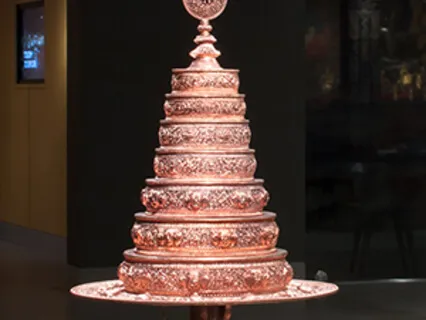
So the artwork we're looking at today really embodies this idea of hope.
This is called The Wish-Fulfilling Tree.
And this is a piece created by the artist Saran Sherpa.
And he created it following the devastating earthquake that struck Nepal in 2015.
And he's originally from Kathmandu,
So he returned to make this artwork with local craftsmen from the area.
This is a seven-layer bronze mandala,
And that's really kind of a 3D version of a painting that we would normally see as a mandala.
And it represents an idealized cosmic universe.
And wish-fulfilling trees are found across Hinduism,
Buddhism,
And Jainism,
And they're meant to satisfy worldly and celestial desires.
And so with that concept of hope in mind today,
I think it's apropos to know that this piece is both a memorial to the destruction wrought by the earthquake,
But also a wish for the future.
Tracy Cochran is here with us today.
So nice to have you back,
Tracy,
As always.
She's a writer and the editorial director of the quarterly magazine Parabola,
Which is right here.
And you can also find it upstairs in our shop or online at parabola.
Org.
This issue is all about mercy and forgiveness,
And has essays from everyone,
From Martin Scorsese to a Sufi master inside.
So this looks like an amazing read,
How to Forgive,
The Art of Mercy.
So enjoy that.
Check it out upstairs.
And in addition to teaching here at the Rubin,
Tracy teaches at New York Insight,
And every Sunday at Hudson River,
Sangha,
And Tarrytown.
You can find her online at tracycockran.
Org.
Please welcome her back,
Tracy Cochran.
I couldn't help but pick a tree of hope that comes right out of desolation,
Right out of the rubble of someone's country.
And if we haven't experienced that quite,
We have experienced it personally.
We have all experienced desolation in our way.
And it's so beautiful that he created a wish-fulfilling tree right in the midst of that.
And as was said,
This is an ancient myth that goes back to the very beginning of Hinduism.
A wish-fulfilling tree.
It had gold roots and a silver trunk and lapis limbs and diamond fruit.
And it was so beautiful and generous.
And eventually Indra,
The king of gods,
Moved it to heaven because human beings kept wishing for such stupid things.
And we do.
We do.
And I was trying to think,
How could I connect with this gorgeous myth?
I didn't grow up with a wish-fulfilling tree.
But I did grow up with trees.
And I remember one in particular.
When I was a little girl,
I had a butternut tree in my backyard that had a limb at exactly the right height for pulling myself up.
So it must have been a low tree.
But I pulled myself up and I could flip around and land on my feet.
And I felt as agile and powerful as a panther.
And the tree gave that to me.
And I would take refuge in this tree typically after I was in some kind of scrape inside the house.
Which happened with great frequency.
Because I was a little girl with a twin brother.
And back in those days,
I had a keen sense of gender inequality.
That behavior that got me in trouble would be praised in a boy.
And being daring.
I remember my mother saying,
You always have to have your face right in the lion's mouth,
Don't you?
Things like that.
So I would go to the tree.
I would go to the tree.
And in the tree,
I would feel like it was good to be brave.
And daring.
And wild.
I would get back in touch with my human nature.
And I remember P.
L.
Travers,
The author Mary Poppins,
Who found Parappala,
Once said that all children have aboriginal hearts.
She was from Australia.
And I think all people do,
Too,
Original heart,
Original body,
Original mind.
So I would play this fantasy game where I was sort of like Mowgli in Jungle Book.
I was fluid,
Girl to boy to panther.
And I could also teleport.
I could go to India to the forest.
I was also,
This is inexplicable,
A spy.
So when this situation called for it,
I could teleport to various trouble spots with my panther to see if I could be of help.
So what does this have to do with wish-fulfilling trees,
With hope,
And with the Buddha?
The Buddha,
The night before he sat down to achieve awakening,
Had a memory of childhood.
He remembered sitting under a tree,
Feeling completely okay.
See,
Not harassed by adults,
Completely free.
And he was depicted as sitting cross-legged,
Playing at being the Buddha he would become.
He wasn't a little girl pretending to be a boy and a panther and a spy.
But what those two things had in common is this feeling that under the words and the stories were part of a bigger story.
We're fluid.
We're not fixed.
We're connected to life.
We're connected to the life of our common humanity,
All the way back to the first people,
Hunters and gatherers.
We have that kind of attention.
And we have a heart like the earliest people who could feel the goodness of life.
And a body that has perceptions and senses just like the first people that can hear birdsong and sense the air and be with the trees and be calmed and informed and steadied by them.
These are gifts that are given to us from our common past.
And we can go back to it in times of desolation and despair.
And we begin to realize that there's a hope that doesn't mean that everything's going to be easy.
It's the hope that we have inside us,
Capacities and strengths and sensitivities will help us through no matter what.
And it's a knowing,
This hope that we're not separate.
We're just like the trees who are not separate.
They're connected intricately with other trees.
In the same way,
We are not alone.
We're part of life,
A much greater life.
And we're capable of a much greater story no matter what.
So why don't we sit together and experience this.
Let yourself take root.
Feel what it's like to have your feet planted firmly.
Taking root,
Taking root here like a tree.
And let yourself stretch up straight and tall.
As straight and tall as you can.
And just notice how it feels to be here right now.
Don't think,
Just sense.
See that this attention begins to soften you.
Let everything be,
But let yourself bask in this attention that doesn't judge.
And let the attention come to the breath without changing it.
Just be with in breath and out breath.
And the sensation of sitting here in a body breathing.
And when you see that you're being taken,
Gently come home again to the body.
And the breath.
And the sense of being here now.
And the sense of being here now.
And see that being still means coming home.
Opening to what's present.
Coming out of thinking.
Back to the body and the moment.
And the sense of being here now.
And the sense of being here now.
See as you soften and open,
There's a presence here inside you.
It isn't fixed,
But something flowing.
And the sense of being here now.
And the sense of being here now.
And the sense of being here now.
When you get taken by thinking or dreams,
Gently come home.
Come home to this river of life inside you.
And the sense of being here now.
And the sense of being here now.
And the sense of being here now.
See how alive this stillness is.
And the sense of being here now.
And the sense of being here now.
And the sense of being here now.
And the sense of being here now.
Coming home to the body,
We discover a presence that's greater than thinking.
That's inside and outside.
That sees without judgment,
With kindness.
And see that you can always come home.
To this presence.
And be welcomed.
You can always come home.
Come away.
And think that you're part of life,
Supported by it.
And to be here.
Thank you very much.
That concludes this week's practice.
If you'd like to attend in person,
Please check out our website,
Rubinmuseum.
Org slash meditation to learn more.
Sessions are free to Rubin Museum members.
Just one of the many benefits of membership.
Thank you for listening.
Have a mindful day.