Welcome to the Mindfulness Meditation podcast.
I'm your host,
Dawn Eshelman.
Every Wednesday at the Rubin Museum of Art in Chelsea,
We present a meditation session led by a prominent meditation teacher from the New York area.
This podcast is a recording of our weekly practice.
If you would like to join us in person,
Please visit our website at rubinmuseum.
Org slash meditation.
We are proud to be partnering with Sharon Salzberg and teachers from the New York Insight Meditation Center.
The series is supported in part by the Hemera Foundation.
In the description for each episode,
You will find information about the theme for that week's session,
Including an image of a related artwork chosen from the Rubin Museum's permanent collection.
And now,
Please enjoy your practice.
So my name is Tashi Chodron.
I oversee Himalayan Heritage Meetup once a month and also lead a guided meditation on selected Saturdays called Awakening Practice.
So very warm welcome to all of you for this mindful meditation session.
So mindful meditation is presented with Sharon Salzberg,
The New York Insight Meditation Center,
The Interdependence Project,
Shambhala Center,
And Hemera Foundation.
Today's theme is community.
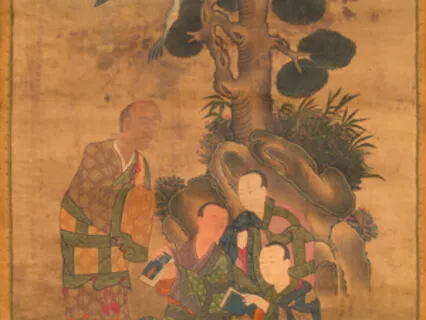
So as you see this beautiful painting,
It's called Thangka,
Mineral Pigment on Silk.
And you see a group of figures in this painting.
What I understand community,
As we all know,
Is a social group of any size,
Small or large,
Just like this mindful meditation community that we all come together as a community.
And there is such thing in the Tibetan Buddhism as collective merit and collective energy.
I think it's all the more now that we need to send these beautiful,
Positive collective energy to all over the world,
Especially where there is so much suffering going on in certain part of the world and in our own backyard.
So I think it's very important to bring positive intention and disseminate this beautiful energy that we bring here.
So what you see in this painting,
It's actually four figures.
They are called arhats,
Who are often addressed as a worthy one.
In Tibetan,
The arhats are called dacchampa.
Basically it stands for being able to withstand and purify all the enemies or negativity,
Whether it's external enemies or internal mental afflicted emotion.
And so traditionally there's known to be 16 arhats.
And of course,
There are so many people in the world,
Especially in New York,
But there's only four in this painting,
Which is like us being gathered here in this community.
And they are all doing different things.
Some are holding books,
Some are listening,
Some are speaking.
So it is all spreading positive energy.
And this is a beautiful 19th century painting from the school of kajuk lineage.
Those of you who remember the Annie who led us meditation probably a month and a half ago.
So she was from the kajuk tradition.
In fact,
In the Tibetan Buddhism,
There are four main schools,
Nyingma,
Sakya,
Kaju,
Geluk.
I don't want to confuse you any further.
And so for this afternoon's teacher is our wonderful teacher,
Tracy Cochran.
Tracy is a writer and editorial director of the quarterly magazine Parabola,
Which can be found online at parabola.
Org and in the Rubin gift shop.
This small gift shop upstairs is fascinating.
I often say we don't have to spend 24 hours in the airplane or tons of money.
We can just go upstairs and find such amazing treasure.
And so the Parabola magazine can be found in the gift shop upstairs as well.
She's been a student of meditation and other spiritual practices for decades.
In addition to the Rubin,
Tracy currently teaches at New York insight and every Sundays at Terrytown insight in Terrytown,
New York.
Her writings and teaching schedule can be found online via Parabola on Facebook and Twitter and on Tracy Cochran.
Org.
So without further ado,
Please help me welcome Tracy.
Thank you.
Hi,
I'm delighted to be back with my community,
My family in a way.
I was speaking to someone just before we started that it does,
The root of the word community means exchange to give and receive.
And I very much feel that here.
But I did want to bring up,
I've had the good fortune of spending a little time with Ram Das who once famously said,
If you think you're enlightened,
Go spend a week with your family.
It's true.
It's really true.
And I really think this bears repeating.
I've said it before and I'm sure I'll say it again.
That when you look at that beautiful image that was projected in our hearts or in Tibetan Buddhism by other words,
These beautiful beings who are contributing positive things.
If you're anything like me,
You might think to yourself,
That's not me.
I'm not bringing positive stuff into this room today.
I'm bringing maybe a feeling of incredible sorrow or a little bit of seasonal depression or some anxiety or some loss or some confusion.
And I feel very moved today to share with you that the older I get,
It's taken me so many years to learn that this basic goodness,
Trungpa Rinpoche,
The great Tibetan Buddhist teacher used the phrase for Westerners,
Basic goodness.
That's what we're here to discover with our practice.
And that's what these great artworks point towards.
But discovering that basic goodness comes through accepting and experiencing this sorrow,
This depression,
This anxiety.
You might be bubbling up with anger.
We mentioned families and communities.
I don't know about you,
But has anybody in this room ever felt wronged?
Really,
Really wronged.
I'm not kidding.
Wronged.
Unfairly characterized or blamed for something.
Have you ever felt completely dismissed and unseen?
Unknown.
There's this expression in English,
Kith and kin.
Kith is an old English word that comes from known,
To be known.
It's like one of our deepest longings,
To be known.
And we all,
Everybody in this room has such painful experiences of times when that hasn't been so.
And does anyone else here know that experience of lying awake at night,
Circling and circling and circling in your thoughts,
Creating an argument for how you are right,
How you are right and how they are wrong.
They're so wrong.
And it's so painfully unfair and it can completely fill you.
And this is a practice that science even shows.
And I don't usually quote science,
But I feel compelled to throw it in there because occasionally people do.
It quiets down that part of the brain that circles,
That circles.
So discovering our basic goodness,
It turns out,
Means coming into this room with your anger if you feel anger,
Your anxiety if you have some of that,
Your sorrow,
Your depression,
Your self-pity.
And instead of trying to get rid of it,
Instead of hearing some good words that help you climb up out of it and think of something more noble,
What we are daring to do is touch it,
Experience it with a kinder attention,
To really allow ourselves to feel the rawness of it.
I've been wronged.
I was misunderstood.
I was treated meanly.
Touch it and feel it and accept it with kind attention.
And we discover that there's an awareness that appears that's majestic.
It restores us.
A friend of mine here was telling me about beholding the mountains in Montana.
We have moments when we sit with ourselves with kind attention where we remember that we're welcome here.
We belong.
We belong to this great nature.
We're part of it.
And we're completely acceptable,
Just as we are,
Including those flare-ups that hurt all of it.
We're welcome here.
I saw a cartoon in The New Yorker,
Which is a great source for Dharma teachings.
And in this cartoon,
God is showing Adam and Eve around the Garden of Eden,
Directing them away from the tree of knowledge of good and evil,
And saying,
Feel free to eat all you would like from the bush of delusion.
And it's this big healthy bush,
All you can eat buffet,
All the time.
And that is kind of what it's like when we're lying in bed at night,
Circling,
Circling,
Circling with our argument,
Our argument about what we're right.
And what we're invited to do here,
This act of meditation,
Is actually an act of courage,
An act of quiet daring,
Daring to just be with our experience in all its raw,
Undefended truth.
Touching in with that for a moment,
And I do emphasize moments,
Just a moment,
Turning away from the words towards the experience.
And we discover a feeling of belonging.
Rumi,
The great Persian poet,
Said,
Out beyond ideas of wrong doing and right doing,
There is a field,
I'll meet you there.
And the poem goes on,
I won't recite it all,
But that feeling like a little kid lying in the grass,
Remember that,
Being with life,
With the clouds and the sky and the earth,
And feeling completely welcome and part of it.
This is what we're here to recover,
To touch,
To turn towards.
And as we do that,
We're here to make friends with ourself.
That's how.
We give ourselves our own kind,
Accepting attention,
Welcome.
Not judging ourselves.
Isn't it a relief?
Completely forgiven for being human,
For doing the best you can.
And from that place,
That experience of welcome,
Of acceptance,
Then you can be friendly with the rest of the world.
We start here.
We become intimate with ourselves.
And as we can begin to do that one moment at a time,
We can feel safe to be intimate with other people,
Even,
I promise you,
Our families.
So we take a comfortable seat now with our feet on the floor and our back straight.
And just notice in the simplest and most direct way how it feels to be here in the body without thinking about it and without asking anything at all of the body.
Just know how it feels to be here.
And notice that as we bring our attention to the body,
We begin to soften a little bit.
The body,
The soft animal of the body,
Begins to relax.
And as that begins to happen,
We bring our attention to the breathing.
Without seeking to change it in any way,
We notice the in-breath and the out-breath where we happen to feel it,
Either as the rise and fall of the chest or diaphragm,
Or as a sensation of air entering and leaving the nostrils,
Allowing this movement of return to the sensation of breathing and the experience of being in a body to be our home.
So we notice sensations on our skin and thinking wells up in the head,
Images,
Dreams.
We allow everything to be there exactly as it is without any judgment or comment.
And when we notice we're carried away,
We gently bring the attention home again to the sensation of being in a body breathing.
Noticing that whatever state we came in with,
There is also a life in the body.
A light of awareness and a natural generosity and responsiveness.
There's something in us that wishes to be here and be part of life.
Great,
Thank you.
Noticing how it feels to give yourself your own kind attention your acceptance without judgment noticing that as we make this movement of return back to the breath and the body in the spirit of welcome,
Of allowing we begin to settle down and open another life begins to appear,
A presence that is innately kind,
Good willing to be with life remembering that there is an awareness in us that is not thinking,
Sati,
The word for mindfulness means to remember the present,
The experience of being here basking in the light of our own kind attention allowing ourselves to feel a stillness in the room that's very alive,
That's letting be,
Allowing,
Opening to receive noticing that no matter what's going on you can gently bring the attention back to the breathing and the body,
Noticing welcome,
It's always waiting for you,
This awareness this sensation of presence no judgment remembering that we're invited at every moment to come as we are to be welcome here with no qualifications,
No judgments We put two hands together with gratitude for this practice and for all who brought this practice here and we dedicate it to the benefit,
The happiness and the welfare of all beings everywhere without exception,
Including always ourselves.
May all beings everywhere be safe from all inner and outer harm and danger.
May all beings everywhere be well in body as well as they can be given their conditions.
May all beings everywhere be happy and at ease and be free.
Thank you.
That concludes this week's practice.
If you'd like to attend in person please check out our website rubinmuseum.
Org slash meditation to learn more.
Sessions are free to Rubin Museum members,
Just one of the many benefits of membership.
Thank you for listening.
Have a mindful day.