Welcome to the Mindfulness Meditation podcast.
I'm your host,
Dawn Eshelman.
Every Wednesday at the Rubin Museum of Art in Chelsea,
We present a meditation session led by a prominent meditation teacher from the New York area.
This podcast is a recording of our weekly practice.
If you would like to join us in person,
Please visit our website at rubinmuseum.
Org slash meditation.
We are proud to be partnering with Sharon Salzberg and teachers from the New York Insight Meditation Center.
The series is supported in part by the Hemera Foundation.
In the description for each episode,
You will find information about the theme for that week's session,
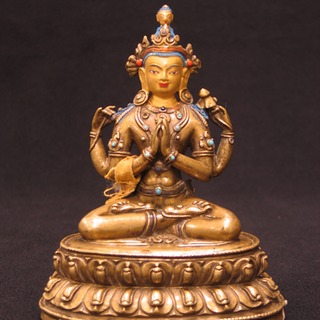
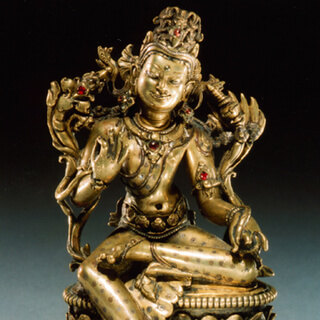
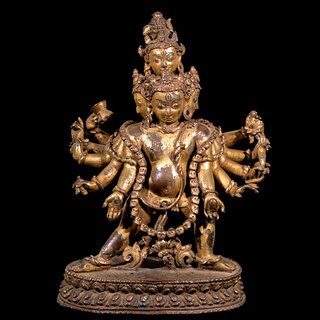
Including an image of a related artwork chosen from the Rubin Museum's permanent collection.
And now,
Please enjoy your practice.
September is Ganesha's birthday month,
And because Himalayan Heritage is first Wednesday,
We are partnering with India Home from Queens and we'll be celebrating Ganesha's birthday.
How I came up with that idea is,
Although I'm a Tibetan,
Of course now American,
But I'm born and raised in the refugee camps in India.
And so in September,
Having grown up in India,
I've seen big festivals.
The whole month there is so much festivities.
And so,
You know,
Working on this Himalayan heritage,
You know,
I thought,
Okay,
In September,
What better than celebrating the most beloved Hindu god,
Elephant-headed,
You know,
Which we all seem to love here,
Who is the remover of obstacle,
Right?
So that's how we started Ganesha's birthday celebration.
Now,
The theme for this month is intentionality,
Kind of like a tongue-twisting,
Intentionality.
So that is intention.
And I was thinking,
You know,
How to,
It's so easy to describe in one way,
And so simple and easy to practice as well.
But yet,
You know,
We need constant reminder.
And the result is so profound.
And it's one of the most simplest thing to practice,
Just giving right intention.
And when I think about that,
It reminded me to,
Like,
As a child growing up in India,
I remember my mom used to say,
When you're wearing a new clothes,
Like a nice clothes or beautiful clothes,
Don't think of it as like,
I want to look the most beautiful,
Or like the,
You know,
Some kind of like,
You know,
That's kind of like giving rise to ego,
I guess,
When I think about it now.
Instead,
She would say,
You know,
Just think of it as giving offerings,
You know,
For all beings benefit,
Or just making offering,
You know,
For people to smile or make happy or kind of that kind of intention.
So it's kind of easy,
Isn't it,
To think that way.
And so,
You know,
When you give rise to such right intention or,
You know,
Noble intention,
Then even when you receive things,
I would think we'll receive it in a positive,
Like a pure perception.
And ultimately,
Who's the winner?
One self,
Right?
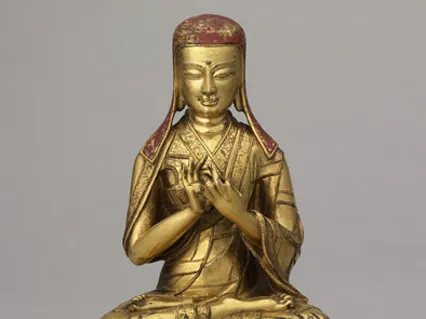
So the art connection for today is this beautiful sculpture,
This great master in the Sakya tradition.
And what you see here is about a 12th century,
Later 12th to mid 13th century sculpture,
A great teacher during that period,
Wearing a pandita hat.
So a pandita hat can come in a couple of different shapes,
So don't get confused.
And this is a very unique and a special kind of pandita hat.
And pandita is actually learned,
You know,
Really a kepa in Tibetan word.
And he's sitting in a teaching gesture.
The hand mudra that you see is a teaching gesture,
Giving teaching and sitting in a full lotus position.
I won't disclose much because my colleague after the meditation will take you up to the shrine room to give you the tour.
And today's wonderful special teacher is Tracy Cochran.
We're very,
Very fortunate to have Tracy back.
Tracy is a writer and editorial director of the quarterly magazine Parabola,
Which can be found online at parabola.
Org and in the Rubin gift shop.
She's been a student of meditation and other spiritual practices for decades,
And obviously for decades teaching as well,
Very humble to write as a student.
In addition to the Rubin,
She currently teaches at New York Insight and every Sunday at Hudson River Sangha in Tarrytown,
New York.
Tracy's writings and teaching schedule can be found on Parabola Magazine,
Parabola on Facebook and Twitter.
So please help me in welcoming Tracy.
I'm glad to be here with you,
My friends.
And I do consider myself a student.
I do also consider myself a teacher since I'm sitting in this golden chair.
And it's always humbling to sit under these beautiful images,
Which symbolize a past tradition.
So in the face of it,
What could I do but turn to my own experience?
So I think I've spent the better part of a couple of weeks sitting with the intention of a teacher,
Which for me is very simple and very direct.
I wish to help create a space right here where you can feel safe,
Where you can feel welcome to be with your experience.
Because I've also been sitting with my deepest intention as a student,
As a seeker,
Which is to be,
To be here.
I think all of us,
Even if you wouldn't pick those exact words,
Have a wish to fully be here before we go.
And I was thinking of what I knew about famous and wondrous Tibetan teachers.
And I could talk about that because it would be brief.
But I thought I would go back to what I knew from my early years.
Because I think that there's something in each of us.
I remember being thunderstruck when I read a footnote that said that the Buddha rediscovered the path in his moment of awakening.
It was like finding an ancient road that Buddhas before him had traveled,
Other wise beings who came to this wonderful place called awakening.
And I thought of that moment in the Buddha's story where he is remembering his childhood.
And he remembers how it feels to be sitting under a tree pretending,
He pretended he was asleep.
So all the guardians went away,
All his nannies.
And he had that delicious experience of being by himself with no adult supervision.
Do you remember that?
The delight of that experience.
So I was thinking about my own experience of going outside,
Sitting in a tree.
And it's not the first time I've mentioned it here,
Where I was free,
Free to be in that tree with nature and to have fantastic fantasies about being jungle princess.
I was heavily influenced by the Jungle Book movie,
I'm sure.
But the point was that I was grounded,
But also light.
In that moment,
I understood what presence is.
That sense that life is alive.
It's alive and it's giving itself to you.
The sun,
The air,
Nature,
That deep sense that you're meant to be here.
You're welcome here.
So I think ultimately presence is the teacher.
That stillness that can enter the room when we feel safe,
When we can be still.
And what came up,
And I have to mention this in particular because she was one of the founders of Prabhala,
The woman who wrote Mary Poppins,
Beale Travers.
And I had the pleasure as I prepared to come here of going back to the book and also to the Disney movie.
So I'm going to restrain myself from bursting into song,
But lacking the voice.
But one thing that struck me and one thing that she has in common with the greatest Tibetan teachers like Marpa,
The teacher of Milarepa,
Is that she never tells those kids what to think ever.
She is not a polite Victorian woman.
She never gives references.
She never explains.
She never apologizes.
And she'll sometimes be taken with her own reflection in the shop windows because she thinks she looks particularly good.
She breaks all the rules of what you might expect.
And she gives these little kids adventures where they get to experience the magic of life.
And inevitably,
When they're done,
They'll be amazed.
And they're coming home on the train back to Cherry Tree Lane saying,
That was amazing the way that guy was floating on the ceiling or the way we went into that picture,
Went into the art.
And she'd say,
What are you talking about?
What are you talking about?
But somehow it gives these little kids an opportunity to know what they know,
To sense what they sense.
And I know those times when you feel challenged and like,
I don't agree with your view of me.
And something in you is sparked to remember who you are.
Do you know what I'm talking about?
That you have life on your side.
And you don't have to agree to be small.
And the thing that touches me,
There was one chapter in particular in Mary Poppins' perfect late summer reading where in the book,
There are baby twins in addition to the boy and girl.
When they're babies,
They can talk to the sun and the birds and everything alive.
And Mary Poppins,
Who never sugarcoats anything in spite of the spoonful of sugar,
Said,
You're going to forget.
You're going to learn how to talk.
And you're going to forget.
And the babies start crying and crying and crying.
No,
No,
No.
We'll never forget.
We'll never forget.
And the mother runs upstairs.
My darlings,
What's wrong?
What's wrong?
And Mary Poppins said,
I think they're just cutting their teeth.
And so the mother soothes them.
Oh,
Those nasty teeth will be cut soon.
Mommy always knows.
And mommy doesn't.
So the babies cry,
And then they let themselves pretend to be soothed.
But Mary Poppins is right.
Because within six months or so,
They forget.
And I think what we do here is remember what it's like to come back and be fully present.
We rediscover the ancient road walked by the great Tibetan teachers and the Buddhas of the past just by sitting down and allowing ourselves to be still,
To open to something besides our own thinking,
Our own words.
And when Travers founded Parabola in one of her essays,
I remember this.
She wrote that all babies have Aboriginal hearts.
And Travers was from Australia.
So she knew Aboriginal people,
People who were more in touch,
Like native people everywhere,
With nature,
With the sun and the wind and the water and the scale of our own lives.
So it made sense to me that her magical nanny was bringing us home.
Because we haven't lost that.
It's here to recall.
So why don't we sit?
So we take a comfortable seat.
Let the back be straight and take a moment to really thank your body for bringing you here.
For all it's lived through so that you can be here.
Without thinking,
Just feeling the presence of the body.
And as the body begins to relax,
Let the breath come,
The focus become the focus.
Without being tight,
Just let the attention come to the breath.
In breath and out breath.
Notice that thinking happens,
Sensation,
Perceptions of all kinds.
And let it be.
No judgments.
No explanations.
And when you find yourself taken,
You gently come home again to the breath and the sensation of being here.
Recalling how it feels to be alive.
And the effort.
Notice that when you're taken by thinking you can gently come home with no judgment and find welcome in the present moment.
Notice that when you're taken by thinking you can gently come home with no judgment and find welcome in the present moment.
We begin to recall the vibrancy inside us,
The energy of life,
Of seeing and receiving and responding.
We begin to recall the vibrancy inside us,
The energy of life,
Of seeing and receiving and responding.
When we get taken,
We come home with no judgment.
No judgment with kind acceptance and begin again.
We begin to recall the vibrancy inside us,
The energy of life,
Of seeing and receiving and responding.
We begin to recall the vibrancy inside us,
The energy of life,
Of seeing and receiving and responding.
Notice that there is a light of attention inside that isn't thinking,
That can open to everything that comes up.
We begin to recall the vibrancy inside us,
The energy of life,
Of seeing and receiving and responding.
We begin to recall the vibrancy inside us,
The energy of life,
Of seeing and receiving and responding.
We begin to recall the vibrancy inside us,
The energy of life,
Of seeing and receiving and responding.
As you soften,
As you open,
Notice a presence inside that also feels as if it's outside.
An attention that isn't separate from compassion.
We begin to recall the vibrancy inside us,
The energy of life,
Of seeing and receiving and responding.
We begin to recall the vibrancy inside us,
The energy of life,
Of seeing and receiving and responding.
Noticing that coming home is also opening to life.
Becoming part of it in this moment.
We begin to recall the vibrancy inside us,
The energy of life,
Of seeing and receiving and responding.
We begin to recall the vibrancy inside us,
The energy of life,
Of seeing and receiving and responding.
No matter how far we go,
We can always come back,
Come home.
Noticing that when we do,
We don't feel alone,
But accompanied.
We begin to recall the vibrancy inside us,
The energy of life,
Of seeing and receiving and responding.
We begin to recall the vibrancy inside us,
The energy of life,
Of seeing and receiving and responding.
We begin to recall the vibrancy inside us,
The energy of life,
Of seeing and receiving and responding.
As we close,
We begin to remember maybe our own wish,
Our own intention to be here,
To open,
To be present.
Thank you very much.
Thank you.