Welcome to the Mindfulness Meditation Podcast.
I'm your host,
Dawn Eshelman.
Every Wednesday at the Rubin Museum of Art in Chelsea,
We present a meditation session led by a prominent meditation teacher from the New York area.
This podcast is a recording of our weekly practice.
If you would like to join us in person,
Please visit our website at rubinmuseum.
Org slash meditation.
We are proud to be partnering with Sharon Salzberg and teachers from the New York Insight Meditation Center.
The series is supported in part by the Hamera Foundation.
In the description for each episode,
You will find information about the theme for that week's session,
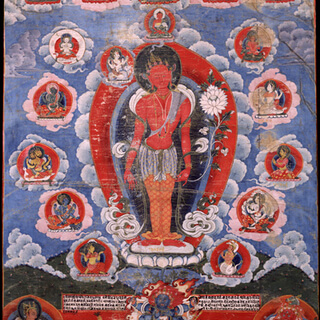
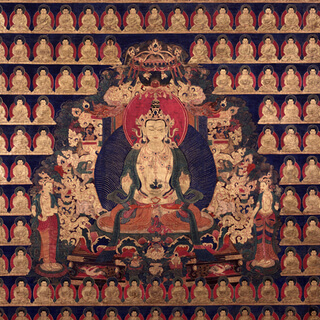
Including an image of a related artwork chosen from the Rubin Museum's permanent collection.
And now,
Please enjoy your practice.
Good afternoon,
Everybody.
Is it raining outside?
You never know these days.
Thanks for being here on a rainy day.
My name is Dawn Eshelman.
Welcome to the Rubin Museum and to our weekly mindfulness practice.
We come together every week here.
And so this month,
We're talking about transforming obstacles.
And this is something that we're talking about under this big umbrella of the future,
How we relate to the future,
What our relationship to it is,
If you know,
If we believe that we can change it,
If we believe that our destiny is set,
There are a lot of different beliefs that we have about the future.
And up on the sixth floor in an exhibition called The Second Buddha,
Master of Time,
There is a figure there who has a very special relationship with the future.
And his name is Padmasambhava.
He's known as the second Buddha.
And he is known for having brought Buddhism to Tibet.
And he's also known for his ability to plant teachings in the future so that people who need them can find them.
So his understanding of time is not as linear as perhaps some of ours is.
It's his relationship to it is that he can see the past,
Present and future all at once.
And this makes his ability to transform obstacles pretty special,
Pretty unique.
And you can take a look at some depictions of that up on the sixth floor.
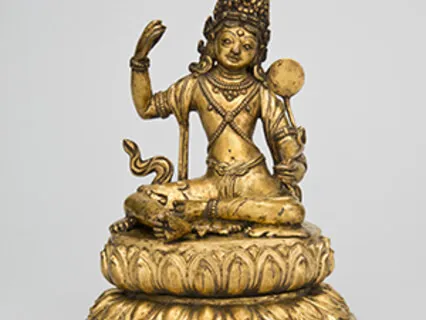
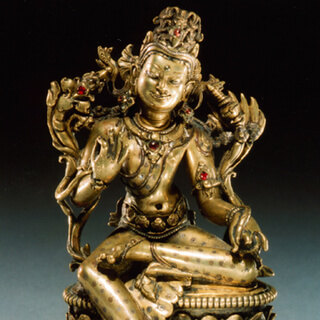
The object we're looking at today is a manifestation of Padmasambhava.
So if you were here last week,
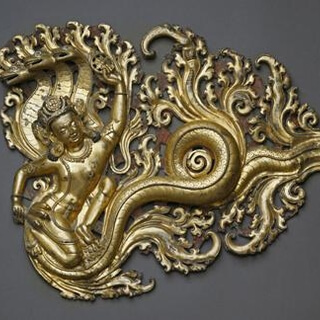
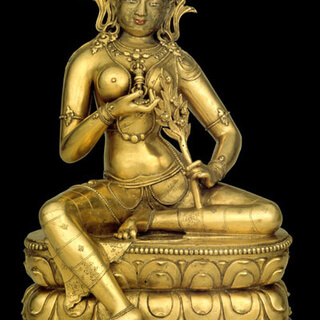
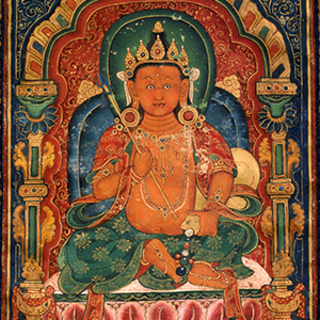
You saw that Padmasambhava has many manifestations.
And today we're taking a closer look at one of them.
This is Nima Osir.
And his name means Ray of Sun.
He is a Mahasiddha manifestation of Padmasambhava.
And Mahasiddhas are a kind of great tantric practitioners from medieval India that are known for kind of some wild times,
Some quote,
Bad behavior.
They really are good at shaking things up and challenging societal norms.
And here you can see that this Mahasiddha figure is seated on a lotus throne as many figures are.
He's got this sort of interesting posture here.
He's seated in what could be a lotus,
Could be a royal ease posture.
It's kind of in between somewhere.
And what looked like serpents coming off of him here are actually some strands of a suggestion of clothing.
Mahasiddhas typically,
One of the ways they can challenge societal norms is by not wearing much clothing.
And in fact,
The cross of fabric or beads across him there is also a suggestion of clothing.
He does have a pretty fabulous crown on,
However,
And some jewelry there.
And then we see this interesting kind of circle behind him.
And that is really his identifying symbol.
His name means Ray of Sun.
And the sun disc that appears over that shoulder is speaking to that.
So this idea of crazy wisdom is really an interesting one,
Especially if you think about it in relationship to obstacles and overcoming obstacles.
And in fact,
It symbolizes a kind of innate ability to transform negative energy into this very essence of enlightenment,
This big letting go and just seeing what is.
Tracy Cochran is our teacher today.
Always great to have Tracy back.
She is a writer and editorial director of a quarterly magazine Parabola,
Which can be found online at parabola.
Org and also upstairs in the shop.
She has been a student of meditation and other spiritual practices for a long time.
And in addition to the Rubin,
She currently teaches at New York Insight and every Sunday at Terry town Insight.
And her writings and teaching schedule can be found online at parabola or on Facebook,
Twitter and Tracy Cochran dot org.
Please welcome her back,
Tracy Cochran.
I'm very glad to be back.
And I'm glad to be sitting under an image of crazy wisdom,
Someone who breaks the rules.
But suddenly last night I was,
I had an idea of what I was going to talk about,
But I was reminded of something else,
Another story of a very great being who broke with the norms of the time.
Today is the 50th anniversary of the assassination of Martin Luther King Jr.
And yesterday was the 50th anniversary of his great speech about going to the mountaintop.
And I want to share with you a little story from New York.
I did not meet Martin Luther King Jr.
But I did meet Andrew Young,
Who walked with Martin Luther King and who stood beside him when he was shy.
So this is my story.
I was in a bad mood,
Which is typical of me.
And I was here in New York.
And I had good reason to be because it was right after 9 11.
And I was a writer as I am now.
And my job was to interview famous writers,
Or famous teachers,
Or famous people.
And I was dispatched to go interview Thich Nhat Hanh,
The great Zen Buddhist teacher at the Riverside Church.
Because Thich Nhat Hanh had a book that came out on September 10,
2001,
On anger.
So it seemed like an auspicious time.
So I went up to this beautiful church where Martin Luther King Jr.
Had preached and was ushered into a small room.
There was Thich Nhat Hanh with a Buddhist nun and Andrew Young sitting beside him and come to pay his respects because King had nominated him for the Nobel Peace Prize in 1967.
So at any rate,
This was my state.
Many of us in the room remember this,
That smell in the air,
That white dust,
And that fear everywhere,
Sorrow and fear,
And this feeling that we didn't know what was going to come next.
So I was ushered into the room in a state where I wasn't going to put up with any fake answers.
And I said,
I really want to talk about fear.
I don't want to talk about anger.
And Thich Nhat Hanh stuck to his guns.
He's faced worse than a middle-aged woman from New York.
But still,
He would deflect and to gesture to the nun beside him,
His good friend,
Who would say,
Dealing with pain and fear,
Open your field of awareness and take in the blue sky,
Take in the green grass.
And I was basically,
I was like,
Yes,
Yes,
Yes.
But sometimes people can be too afraid to open their field of awareness.
Sometimes you can't feel like you can take refuge in the body.
You're distracted.
You're full of tension and full of not knowing.
So I kept pressing and pressing.
In a way,
It was like crazy wisdom right there,
Because I was at a point where I wasn't accepting everything that was given.
I'm not recommending it,
But it does happen.
And it's an opening.
At any rate,
Andrew Young,
Who had been sitting back,
Leaned forward and said,
Would you mind if I say something to this woman?
I swear,
Thich Nhat Hanh looked immensely relieved.
He did.
He said,
Have at her.
I will just repose.
He went back into his noble repose.
And Andrew Young leaned forward and said,
For those of you who may not know,
He was the UN secretary general,
Or not secretary general,
He was our ambassador,
I apologize.
And he was the mayor of Atlanta.
And he was also a minister and he marched with King.
And he was with him in Memphis,
Where King went to represent the sanitation workers.
And he said,
I knew Martin very well.
And Martin got to a point where he would laugh at death.
He would literally make jokes about it.
He would say,
Andrew,
I think you're going to get shot today.
But don't worry about a thing because I will deliver such a beautiful eulogy that it will always be remembered.
And Andrew would be kind of like,
We'll think that's really good to know,
But I would rather live.
And but he said,
Martin knew he was going to die.
He knew it.
And he wasn't afraid.
Do you know how he did that?
And suddenly it's as if I had not thought about that.
How the how of it?
How do you get there?
And he said something I'll never forget he said,
Because it's so simple.
He said Martin knew what was important.
And he made sure he did it every day.
Martin knew what was important.
And he made sure he did it every day.
And so suddenly,
From being a story about a great man remote from me,
Suddenly something became available to me.
But he went on,
Young went on,
And he said,
Martin knew that death could never destroy who he really was.
And suffering could never destroy who he really was.
It can't destroy who any of us really are.
Death can't destroy who we are.
So this sounded in me like a bell.
And afterwards,
I read the sermons and I read up but mostly I lived with it.
And I knew from King's writings,
And from that great speech he gave 51 years ago,
When he said he'd been to the mountaintop,
And he wasn't afraid.
That what he meant is that he felt the presence of a greater truth.
He felt accompanied.
He felt like he wasn't alone.
And this isn't something that just a few people can feel under extraordinary duress.
It's something that we feel when we sit down together.
When we come into this room and we make that movement from thinking about the future and what we think our lives will be and that it's just all downhill from here.
You may not be like me but I tend to think like this.
I'll picture either an immediate disaster or a long,
Slow process of decay and decline.
And always something.
And just realizing for a moment that we can go from this story,
Whatever it is,
Dropping into the warmth of heart that we can sometimes feel.
The sensation of the body,
Of being with an awareness that's greater than our thinking.
And in King's mountaintop speech,
Which you can YouTube,
You can look at some of it,
At one point he said if he was given a choice to live at any time,
He would pick his brief time when he lived.
Because he said,
Yeah,
It's dark.
There's an awful lot to face.
Injustice.
Economic injustice,
Racial injustice,
Systemic injustice.
But it's when it's darkest that something is activated inside.
He said when it's dark you can see the stars.
And yes we can understand that in a big scale but we can also understand it in the small scale of our lives.
Have you noticed that it's when you have to face something a little bit unknown that energy appears sometimes?
Or a fresh appreciation for the power of kindness or a sense of humor?
Or just being in alignment with your truth,
How that can carry you forward?
That'll guide you when there's no other assurance.
This is available to us.
And it's available to us to remember that we can know what's important.
You don't have to have the big picture and you don't have to be the man who volunteers to be on the front lines of social change.
But you can remember that it feels different to sit down and be still,
To drop into a new life,
To be part of something larger than yourself.
And King had that beautiful,
Quote,
That beautiful knowledge of not being able to leave your front door in the morning without being interconnected with the rest of the world.
He knew the truth.
And we can rest in the truth.
We can rest in this life.
And then we can stand up.
We can face whatever we have to face,
Knowing that we're not alone.
So let's sit.
We take a comfortable seat with our feet planted firmly on the ground and our backs straight,
Stretching up straight and tall,
And at the same time,
Giving ourselves to the earth.
And just notice how it feels to be here in the body,
Without thinking about it,
Noticing how it feels to be here in this room right now.
And notice how bringing the attention home to the body begins to relax it just a little bit,
Just soften it up.
And we allow everything to be exactly as we find it.
There can be tensions in the body.
You can feel a bit cold or hot.
You hear sounds,
And my voice and other sounds.
And thoughts bubble up.
We allow everything to be exactly the way it is,
With no judgments,
With no comments.
And when we notice we're being taken away,
We gently bring the attention back to the body and the breath,
Feeling the rhythm of the breath either in the chest or as a sensation of air in the nostrils,
Picking one focus for the breathing.
Noticing how it feels to allow yourself to be without any judgments,
And to gently come home to the body and the breathing and the experience of being here now.
And noticing as we begin to soften just a little to relax that there is a light inside,
A light of awareness in the body and the mind that isn't thinking.
Sati,
The ancient word for mindfulness,
Means to remember,
To remember the living experience of the present moment.
The Noticing as we relax that there is a vibrancy inside us,
An energy,
A sensation of being present.
If you find yourself dreaming or sleeping or thinking,
Notice how it feels to have no judgments about that,
To allow it and come back to the body and the breath in this moment.
Noticing as we settle down that we open.
We begin to remember we're alive.
Part of a larger life.
Noticing that we don't have to make ourselves breathe,
That it just happens.
It's given.
We begin to notice that there's a stillness that doesn't mean perfect silence,
But not resisting,
Allowing.
We begin to notice that there's a stillness that doesn't mean perfect silence,
But not resisting.
Relaxing is also opening to impressions and sensations that are given.
We begin to notice that there's a stillness that doesn't mean perfect silence,
But not resisting.
Noticing how it feels to let be and receive.
We begin to notice that there's a stillness that doesn't mean perfect silence,
But not resisting.
As we prepare to close,
Noticing how it feels to open to a light of awareness inside that's also outside that we share.
And how it feels to be supported by life together here.
Thank you very much.
I look forward to seeing you next week,
If you can.