Welcome to the Mindfulness Meditation Podcast.
I'm your host,
Dawn Eshelman.
Every Wednesday at the Rubin Museum of Art in Chelsea,
We present a meditation session led by a prominent meditation teacher from the New York area.
This podcast is a recording of our weekly practice.
If you would like to join us in person,
Please visit our website at rubinmuseum.
Org slash meditation.
We are proud to be partnering with Sharon Salzberg and teachers from the New York Insight Meditation Center.
The series is supported in part by the Hemera Foundation.
In the description for each episode,
You will find information about the theme for that week's session,
Including an image of a related artwork chosen from the Rubin Museum's permanent collection.
And now,
Please enjoy your practice.
Welcome to the Rubin Museum and to our weekly mindfulness meditation practice.
My name is Dawn Eshelman.
We're talking this month about liberation.
And part of the reason that we have selected this topic for you is upstairs on the sixth floor and that is our exhibition called The World is Sound.
And it explores really the power of sound to transform and through the Tibetan Buddhist lens how sound is used to literally transform and enlighten.
And it is practiced particularly around the time of a death and the state of bardo that that person enters is thought to be this moment of great possibility.
And so the bardo,
The Tibetan Book of the Dead,
Is read for many,
Many days to this person as they pass in the hopes that it will,
The sound of these teachings will liberate them.
So sometimes liberation comes from unexpected sources like this one here.
This is perhaps not the first thing that would come to mind if you're thinking about deities or helpers who might help you to your path to liberation,
However you define that for yourself.
But in the Tibetan Buddhist tradition,
There are deities that come to us in a wrathful emanation and they are fierce and they are scary and they deal with the dark stuff.
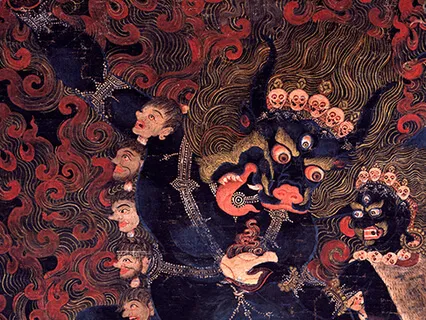
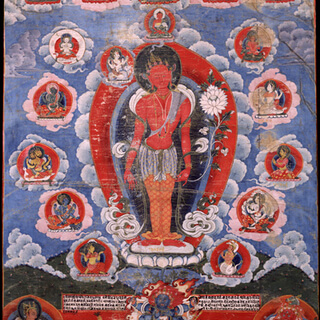
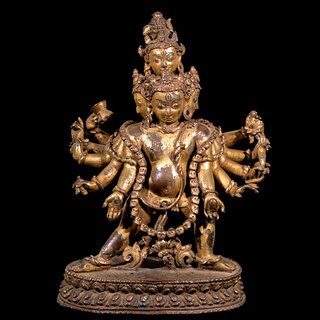
So this right here is Yama Dharmaraja.
He is the lord of death and king of law.
And let's just take a look at him for a second here.
You might have been able to see the detail a little bit better earlier,
But he is really got a quite a grimace on his face here.
He's kind of arched with his hand above him.
He's holding the staff that has a skull on the top of it and he has a crown of skulls on his head and he's wearing a garland of heads around him like a sash there.
His consort is holding on to the side of him here and they're both standing on this black bull.
The Yama figure is also holding a skull in his hand.
So this is quite a gruesome scene here.
And as with all wrathful protectors,
The overarching motivation here is to really startle the viewer into a clarity about really what's at stake and how important it is to stop and really take account of what thoughts you are allowing your mind to have.
So this is often a wrathful figure will be seen outside of a Tibetan shrine room as sort of as a way of inviting the viewer to kind of become aligned into their right mind.
And we often talk about these wrathful deities as figures that are sort of like a parent in an emergency situation who's seeing their kid run into the middle of the street and saying stop right now.
It's that kind of intense and urgent energy that we're seeing here that is above all a protector.
So we'll talk a little bit more about liberation and perhaps unexpected paths to liberation with our teacher today,
Tracy Cochran.
She's back with us and she is a writer and the editorial director of Parabola magazine,
Which can be found online at parabola.
Org and of course upstairs in the shop.
She's been a student of meditation and other spiritual practices really for decades.
And she teaches at New York Insight and every Thursday and Sunday at Terrytown Insight.
Her writings and teaching schedule can be found online at Parabola on Facebook,
Twitter and TracyCochran.
Org.
Please welcome her back,
Tracy Cochran.
Hi,
I have more voice.
I'm glad to be back.
And I would say that liberation always comes from unexpected sources,
Pretty much always.
And almost always when we think it's curtains for us in one way or another.
And to put that in the mildest terms,
I can't help but notice that it's,
Summer is coming to an end and it's quite natural to feel that everybody has had a barbecue somewhere.
Have you noticed that?
Or by the ocean,
Except for you.
So once upon a time I took a man who is now my husband to northern New York to meet my parents and they decided,
It was summer,
That the cool thing to do would be to go to a Renaissance fair.
And I was completely mortified because this man was a city guy and I thought,
Oh my goodness,
Now I'm going to be unmasked as this totally dorky person.
So we went to the Renaissance fair and someone there who claimed to be a druid,
Self-styled,
Who was given the gift of seeing past lives,
I know it got worse by the minute,
Suddenly saw in me that among other past lives I was Alexander Dumas.
And suddenly my day turned around and she said,
You wrote my favorite book,
The Count of Monte Cristo.
And instantly the man who is now my husband was so jealous.
But at any rate,
I always felt an affinity for The Count of Monte Cristo,
Not just because I wrote it,
Thank you very much,
But because it's a story of someone who was plucked from their rightful life and thrown into prison on an island.
And who here hasn't felt somehow at some point plucked from the life you were meant to be having,
Stranded in some dry little cell,
Usually up here.
But we feel this way.
We have this yearning for a larger life.
We know we're meant to live and we feel trapped,
Imprisoned.
So Edmund Dantes was thrown into prison,
Innocent of charges,
And he languished there until a great man,
A priest,
And I watched the movie in preparation for today,
Even though I wrote it,
I thought I should brush up.
And the priest broke into his cell and he was played by Albert Finney,
Who became Dumbledore.
Even though he was just the most marvelous guide.
And he told Edmund Dantes,
Help me get free,
Help us get free,
And I'll teach you.
I'll teach you to read and write and I'll teach you about the greater world.
So suddenly Edmund Dantes had a purpose and a cause.
And day by day they dug their way out of this prison fortress.
And at the same time this marvelous priest opened his eyes to the world.
So one thing led to another and just before the tunnel was finished the priest died.
But not before giving Dantes a treasure map.
So Dantes escaped from prison wrapped in the priest's burial shroud.
He was desperate and he was determined to be free.
And he made his way to the island of Monte Cristo in a great fortune.
And all this vast knowledge he already attained.
What does this have to do with why we're sitting?
Because usually we come into this room,
We begin our practice,
We begin our study.
Because we want something more.
And sometimes we want,
Never underestimate the marvelous power of the expression,
I'll show them.
Great things can start this way.
It sounds like it's going to be negative.
It sounds like it's going to be some desperate bid for a bigger life.
You may not be in the Hamptons,
But damn it,
You can sit.
Whatever it takes to get you in the room.
That's what it takes.
But like the now count of Monte Cristo,
Slowly but surely,
Breath by breath,
We find that this striving for a kind of revenge to make ourselves fancy and better and bigger gives way.
It gives way.
It doesn't really ultimately satisfy us.
And it gives way to greater forces.
Force in the case of the count of love.
Made him let go.
And in the same way that we have this deity,
Or in moments you saw the scary deity,
The specter of death,
That doesn't have to mean your final physical death,
But the death of this dream or that dream.
The death of a relationship or a hope or the passage of time.
And with every single visit,
We have an opportunity to let go of the story of who we think we are.
No matter how carefully wrought it is and how fancy.
To completely let go and be free.
And it seems like something remote,
But it's as close as the next breath.
I was touched in preparing that Albert Einstein used to get letters from people as the smartest man in the world.
The way people would write to Santa Claus.
They would write to Albert Einstein,
Dear smartest man in the world.
Can you imagine that?
And they would bring their life problems.
And some he would answer and some he would not answer,
As you can imagine.
Bags and bags of mail.
But one he answered came from a rabbi whose daughter died.
And the rabbi couldn't understand why.
And Einstein famously said to him,
We belong to a part of a greater whole called by us the universe.
And our sense of separation is an optical delusion of consciousness.
Don't you love that?
An optical delusion of consciousness.
And our task is to widen the circle of our compassion so that it includes all living creatures and the whole world.
Nobody reaches the end of this.
But just striving,
Just like the Count of Monte Cristo digging his way out of that prison with a spoon or some other small tool,
That striving is liberation.
And we do it breath by breath.
I've come to think that,
You know,
There are all these DNA tests now,
That we all yearn to be part of a bigger humanity.
All of us.
I just did the test.
I did the Ancestry.
Com test.
And as I suspected,
I'm mostly a kind of Nordic,
Northern European blend.
But I discovered to my immense excitement that I am 1% European Jewish.
I was so excited I was emailing people.
Like I knew it.
I just,
I knew it.
And like a dash from the Caucasus Mountains.
It's this yearning in us to be part of a larger world,
A larger humanity.
And under that yearning,
It's kind of like traveling without leaving your spot to find out that you're made up of all these different strengths.
And under it,
This yearning for a deeper groundedness,
Rootedness.
P.
L.
Travers,
Who wrote Mary Poppins,
Who is one of the founding editors of PRABHELA,
Which I hope you will all buy and read and enjoy,
Said in an early issue of PRABHELA,
Every baby has an aboriginal heart,
Travers was from Australia.
She might have said indigenous.
I think every adult does too.
There's something in us beneath what the spiritual teacher,
Gajiv,
Called the foreign mind,
The interpreted world,
As Hildegard of Bingen called it,
Beneath all we think we know.
There's a responsiveness.
There was an eclipse this week.
We didn't really get to see the full eclipse,
But the incredible excitement people felt was a demonstration of that indigenous heart in all of us.
I sat out on my little deck and I at least saw it get a little cloudy,
And my husband's like,
No,
It's just a cloud.
But I felt this sympathetic joy for all these people seeing this wonder,
Just like the earliest people who ever lived,
Looking up at the sky,
Recovering that.
And I feel it's not so far from us that when we do this practice,
Hildegard of Bingen,
The great Christian mystic,
Said we can't live in an interpreted world.
We need to win back our listening,
Which is what's so brilliant about the exhibition upstairs,
To step back to the experience of listening in our own voice,
Not the voice you get from school or from the culture,
In our own body.
It's as close as coming in touch with our sensation,
Which we're going to do in a minute,
Giving ourselves the space to remember sati,
Mindfulness,
Means to remember,
To remember the experience of being here,
Which,
And you know,
You all know,
There are moments when you can feel like your whole life is present in a moment.
It can be in a moment of great love or loss.
And there are moments like the eclipse when you can feel like your ancestors are present,
When you know what it's like to be under the sky,
Looking up at a marvel.
So that's what the count found in the end.
All that work and all that striving led him here.
I don't mean in this exact room,
You know,
He may be here,
But here,
Now,
Under the sky,
On the earth,
Inhabiting your portion of the whole,
Your portion of the whole universe.
That's what you really are.
So let's experience it now,
Shall we?
So we take our comfortable seat,
We plant our feet on the floor,
And we let our backs be straight,
Stretching up,
And allow your eyes to close,
Unless it's uncomfortable for you for some reason,
In which case avert them,
But otherwise let them close.
And give yourself a feeling of welcome,
Welcome to this body,
Which has come to you from the distant past,
From ancestors back and back and back,
And from the universe itself,
From star stuff,
Earth stuff.
And just gently notice the marvel of sitting here in this body without thinking about it,
Allowing it to be here exactly as it is,
Noticing that there'll be sensations on the skin,
Thinking in the head,
Tensions,
All kinds of things.
We welcome it with no self-judgment.
And as the body begins to relax,
As it begins to trust that it's safe here to take up space and time,
We gently bring the attention to the breathing without altering it in any way.
Just gently notice the in-breath and the out-breath,
Where you happen to experience it most strongly today,
Either in the rise and fall of the chest,
Or as a sensation of air at the nostrils.
Sitting breathing without thinking.
And when you find yourself thinking,
Judging,
Commenting,
No judgment,
Gently allowing.
When the mind wanders,
And it will,
You bring it home to the true home of the body,
And the sensing awareness,
Which is not thinking.
Appearing the vibrancy inside your body,
That there's a light of awareness that is not thought,
That's given to you.
Noticing that every time you come home,
You are welcome with no judgment.
Accept it exactly as you are right now,
In this moment.
When you stray into thinking and dreaming,
You gently notice this with no judgment,
And come back again to your true home.
The sensation of being present here.
Strokes.
.
.
.
.
.
Noticing that even if you're having difficult thoughts,
There's a radiance to come back to.
.
.
.
.
.
.
.
.
.
Noticing how it feels to come home to the sensation of being here.
.
.
.
.
.
.
.
.
.
.
Noticing that this movement of return is relaxing and quieting.
.
.
.
.
.
.
.
.
.
.
.
.
.
.
.
.
.
.
.
.
.
.
.
.
.
.
.
It really is extraordinary to be able to share the space together and to allow ourselves to feel that we're part of something greater.
Like Einstein said,
That we really are part of a whole.
How wonderful.
So we allow ourselves to feel our heart.
We've been sensing the body.
And we're not asking anything.
We ask nothing of our hearts.
But we welcome them into the space.
And we put our hands together in front of our hearts if we wish to,
Like people have done for thousands of years.
And we offer ourselves to this whole.
All our good intentions and sensitivity and capacity to love and respond and be still.
And we dedicate it to the happiness,
The welfare,
And the freedom of all beings everywhere,
Every creature in this wholeness.
May we all be safe from inner and outer harm and danger.
May we all be well.
May we be happy.
And may we all be free.
Thank you.
That concludes this week's practice.
If you'd like to attend in person,
Please check out our website,
Rubinmuseum.
Org.
Meditation to learn more sessions are free to museum members.
Just one of the many benefits of membership.
Thank you for listening.
Have a mindful day.