Welcome to the mindfulness meditation podcast presented by the Rubin Museum of Art.
We are a museum in Chelsea,
New York that connects visitors to the art and ideas of the Himalayas and serves as a space for reflection and transformation.
I'm your host,
Dawn Eshelman.
Every Monday we present a meditation session inspired by a different artwork from the Rubens collection and led by a prominent meditation teacher from the New York area.
This podcast is a recording of our weekly practice.
In the description for each episode,
You will find information about the theme for that week's session,
Including an image of the related artwork.
Our mindfulness meditation podcast is presented in partnership with Sharon Salzberg and teachers from the New York Insight Meditation Center,
The Interdependence Project,
And Parabola Magazine.
If you'd like to join us in person,
Please visit our website at rubenmuseum.
Org slash meditation.
And now,
Please enjoy your practice.
Today,
We are talking about impermanence.
And this is this rich and not simple topic that we are exploring throughout the year here at the museum.
So we're really focusing on it here near the beginning of the year in our mindfulness meditation sessions together.
So we really can come to understand it in some different ways because impermanence is not just about death or birth or change that is difficult.
It can be.
But it can also be about the idea of when we embrace change,
When we accept this reality,
We are suddenly very awake,
Very present in the moment,
And very in tune with each other.
So we're exploring that here and really encouraging ourselves to engage with change and see what happens.
So we are looking at a stupa today.
And are we?
Can we look at a stupa today?
We were.
I know you've been looking.
Thank you.
There we go.
So a stupa is a marker.
It is a monument.
It is a memorial.
It can be this itty bitty or it can be as tall as a tower.
The early stupas were mounds of earth that looked like burial mounds.
And in fact,
That is what they were and what they are.
Stupas are made to hold precious relics of the Buddha,
Of important religious leaders in Buddhism.
And not just their ashes,
Their bones,
But their sacred texts,
Maybe clothing,
Articles of worship.
And they're held inside.
And the stupa is often a point of pilgrimage for practitioners or a place of gathering.
And what's interesting as well about a stupa is that it also represents the body of the Buddha and the divine body,
Which harkens us to these ideas of divine speech and mind.
And thus the Buddhahood.
The stupa represents enlightenment.
It represents the realization of suffering and impermanence and that we can end that cycle.
And impermanence is actually one of the ways,
One of the tools that Buddhists use to gain enlightenment or that they accept.
So it's interesting that we have this marker,
This in a way,
This attempt at impermanence,
Something large and that can stand up to time and weather and this actual physical object that is there to memorialize someone or ideas.
But that is really kind of working both with and against this idea of impermanence,
Which is really actually what that's all about,
Right,
That complexity,
Holding all of those things.
So Tracy Cochran is here to talk to us about impermanence.
And she is a writer and the editorial director of Parabola Magazine,
Which can be found in the Rubin gift shop or online at parabola.
Org.
And Tracy,
In addition to teaching here at the Rubin,
She teaches at New York Insight and every Sunday at Hudson River Sangha in Tarrytown,
New York.
She also happens to be introducing movies at the Jacob Burns Center in the coming weeks,
Which we'll hear more about,
I hope.
And you can find her writings and teaching schedule online at tracycockran.
Org.
Please welcome her back,
Tracy Cochran.
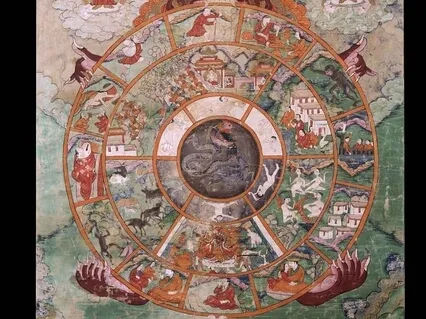
So last week I talked about impermanence and the great wheel of existence,
How everything changes,
Everything is in movement.
And it seems like a paradox that this week I'm talking about stupas,
About things that stay.
What stays?
What stays if everything is in movement?
And years ago I visited a Buddhist monastery to see a very special tiny stupa.
They actually put it on people's heads.
It was very Star Trek-like.
They bless you with it.
And to my Western psyche.
And inside this tiny stupa were the ashes of an enlightened one,
A Buddha.
And within those ashes there were crystals or pearls.
And they're held to be very special and very sacred.
And regardless of what you might think about those,
Like,
Oh,
There must be scientific explanation that when the body is cremated sometimes they're crystals.
But a very beautiful way to think about it that I've been thinking of is what is crystalline in your memory?
What pearls of insight or wisdom stay with you?
And the interesting thing that I've discovered is that the pearls,
The crystals,
Are never the things I think they're going to be.
Have you noticed?
Søren Kierkegaard said,
Life can only be understood backwards but it must be lived forwards.
It's so confounding that when you look back something stands out.
Just today,
It's a dark and rainy day in New York.
I came down on the train and for some reason having to do with the light in the train car,
I suddenly remembered having coffee with my little daughter.
She was a toddler.
She wasn't having coffee in a cafe in Brooklyn.
And in fact she was having Nutella on toast with banana.
And she had just been introduced to it and hated me for years for introducing her to Nutella because she could not quit.
But it was such a sweet moment,
Just an ordinary moment of sitting at a table in a cafe with my toddler daughter.
And that would never be something I would seek,
I would plan.
And I invite you to think about people you love who you may have lost and what you remember about them.
And it's rarely some great accomplishment or even something they said but it has to do with how you felt in their presence.
You felt met just for one moment completely heard or seen,
Completely with them.
And they're the kind of moments that we often can only see looking back.
Because we discover then that what stays in a world where everything is impermanent and subject to change is consciousness itself and not in a clinical cold sense of feeling,
Of warmth.
It turns out that what's outside the wheel is love.
And when we sit here together we invite ourselves to bask in an attention that doesn't touch us,
That sees us with kindness and acceptance.
And in that gesture we're opening ourselves to what stays.
They translate this practice in Tibetan and in Pali by a word that means to remember,
To remember the present moment.
But isn't that interesting if you begin to experiment with opening to your life as if it's something you are remembering?
I invite you to try this because that means that part of the mind that isn't striving,
That isn't checking things off on a list.
I didn't set out that day to score Nutella on toast.
It was something that just happened.
And this practice is a way to open our lives to that kind of mindful caring.
And we discover when we lose people that they have an enormous presence about them,
That had nothing to do with anything they said or did,
Do you know what I mean,
When they leave.
And I remember when my mother died I had among her relics this tiny little vial of perfume,
A wonderful perfume.
And I remember her saying,
When I have something I love I want to share it,
So please take this.
So I had this vial and one day I missed her so much I opened it to smell this perfume that I associate with her.
And then I decided to leave the top off.
And for years at unexpected moments when I woke up at night feeling anxious there would be this scent in the room that reminded me of her presence.
And it wasn't a thing.
It wasn't something from a list.
It wasn't an accomplishment.
It was opening to a memory of how it felt to be in a caring presence.
So I invite us to see that our relics,
Our stupa can be an intention to remember,
To remember our lives,
Our meaning,
Open to them,
To everything that's present.
Because you never know when something jewel-like is going to be given.
So let's sit together.
Let your feet be firmly on the floor and your back straight.
Let yourself come home to yourself.
Just notice how it feels to give your attention to the body.
Exactly as you find it.
You might have tension or fatigue or some cares in your head.
All kinds of thoughts.
Let everything be exactly as it is.
Completely accepted.
Completely acceptable.
And begin to see how the attention softens and opens you.
No striving,
No care about what you achieve.
Just be with what is.
See that the stillness is not an absence.
It's alive.
It's full of vitality inside.
And also outside.
And when you find that you're thinking and dreaming,
Just gently,
Just gently,
Just gently come home again to the body and to this moment.
And notice how it feels to be completely accepted in whatever state you're in.
Okay.
Okay.
Okay.
Okay.
See that there's a light of attention in you.
And a feeling of presence that doesn't cling,
It's open.
Okay.
Okay.
Okay.
Okay.
Okay.
Okay.
Okay.
See that bringing the attention home to the body doesn't close you.
It opens you to life.
Brings you down out of the head into life.
Okay.
Okay.
Okay.
Okay.
See how it feels to be seen by an attention that doesn't judge.
Okay.
Okay.
Okay.
Okay.
Okay.
Okay.
Okay.
Okay.
And notice that even if you have pain or sorrow or some problems you're thinking of,
You can still come home and be in the light of an attention that is loving,
Accepting.
Okay.
Okay.
Okay.
Okay.
Okay.
Okay.
Tempering presence.
Okay.
Okay.
Okay.
Okay.
Okay.
Okay.
Thank you.
Thank you.
That concludes this week's practice.
If you would like to support the Rubin Museum in this meditation series,
We invite you to become a member and attend in person for free.
Thank you for listening.
Have a mindful day.