Welcome to the mindfulness meditation podcast.
I'm your host,
Dawn Eshelman.
Every Wednesday at the Rubin Museum of Art in Chelsea,
We present a meditation session led by a prominent meditation teacher from the New York area.
This podcast is a recording of our weekly practice.
If you would like to join us in person,
Please visit our website at rubinmuseum.
Org slash meditation.
We are proud to be partnering with Sharon Salzberg,
The teachers from the New York Insight Meditation Center,
The Interdependence Project,
And the Shambhala Center.
The series is supported in part by the Hemera Foundation.
In the description for each episode,
You will find information about the theme for that week's session,
Including an image of a related artwork chosen from the Rubin Museum's permanent collection.
And now,
Please enjoy your practice.
Welcome to the Rubin Museum and to our weekly mindfulness meditation practice.
My name is Dawn Eshelman.
We meditate for all kinds of reasons and different reasons each of us.
Often we meditate for that experience of refuge,
Which is so helpful and important.
And we also often meditate in order to face challenges,
Face difficult things,
And to engage more intentionally with the world around us.
And so it is in that spirit that I just simply want to acknowledge the number of tragedies that have been going on in the world around us.
And I will do that in a second,
But also with a caveat to just nod to each of you individually.
Of course,
We all don't know what's going on in the lives of each of us individually.
And there's so much that we all bring here into the space.
And I just want to honor that and just make space for that here,
The joys and the challenges.
So just to acknowledge the tragedies of hurricanes,
Harvey,
Irma,
Maria,
The monsoon floods in Nepal and Bangladesh,
And the violent shooting in Las Vegas this last week.
And it is always a refuge to be here with you in times that are good,
In times that are challenging.
But just want to say for those of you who are affected,
Whose families or loved ones have been affected,
That our hearts go out to you here at the Rubin Museum,
And we appreciate meditating with you.
So this month,
We are embarking on a new theme,
Which is light and dark.
And I want to explain that to you a little bit because it might not be exactly what you expect.
So from time to time,
We sync our thematics here with the natural world,
The seasons around us and really tapping into those cycles of life.
And so this month,
We are experiencing a shift in the light as the days get shorter and the nights get longer.
And we're also coming up on Diwali,
Which is a celebration of light in many traditions in throughout the Himalayan region,
And that will occur later in October.
And this concept of light and dark is something that I think is really interesting to explore in many Himalayan traditions,
Particularly the Tibetan Buddhist tradition,
Where it's not really set up as a dichotomy.
It's light and dark in everything.
Light and dark are both valuable and good and important.
And with that,
We will turn to our art object today.
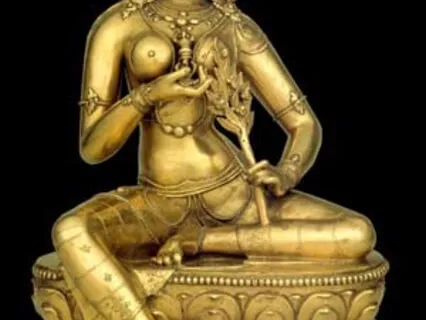
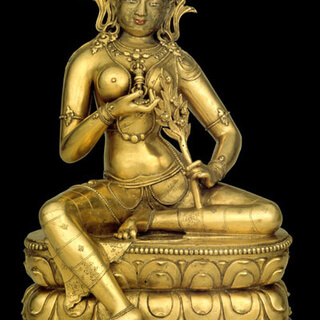
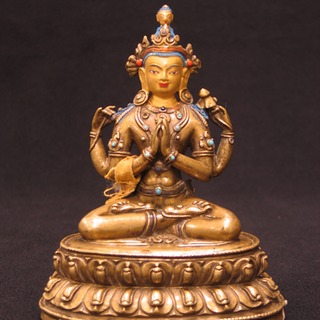
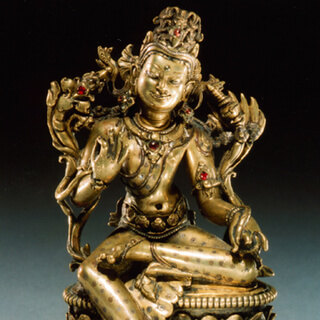
This is the beautiful goddess of the dawn,
Marichi.
This is a sculpture from Mongolia,
Late 17th century.
And she is seated here in that pose that may be familiar to some of you by now.
It is called the pose of royal ease.
And she's holding a vajra up by her heart and a branch in her left hand.
And along with representing the literal sunrise,
She represents the dawn of awakening and the moment when a practitioner commits to their spiritual development.
So it symbolizes that meditation practice itself as well.
And this form was one of two attendants accompanying a larger sculpture of the goddess Tara.
And of course,
That link,
That connection between her and Tara emphasizes her connection to all things enlightened,
Emphasizing the light there.
So as always,
We are delighted to have Sharon Salzberg back with us.
Sharon is the co-founder of the Insight Meditation Society in Barre,
Massachusetts.
She has been studying and teaching for over 45 years.
And she's the author of many incredible publications and books,
Some of which you can find upstairs in her shop,
Including her most recent,
Real Love.
Please welcome her back,
Sharon Salzberg.
Welcome all of you.
So I'll just begin echoing maybe a little bit of what Dawn said in that a lot of times people in really turbulent times when others are suffering mightily feel kind of guilty,
You know,
Like,
I'm going to go look at beautiful things or I'm going to go take care of myself and have this period of restoration of respite.
But really,
I think when we are realistic,
When we take a look,
How could we not take that time both to come back to balance and have a sense of renewal?
Because after all,
I think realistically one can't go on and on and on and on and on and keep perspective and keep good-heartedness and keep a good motivation and not get exhausted,
You know,
Without doing that.
And so how fantastic you all came here today.
And I hope you keep coming back to this experience and other experiences like just being in the exhibit and being reminded.
I get reminded,
Like,
Wow,
Look at that.
One of the things that I just loved about what Dawn said is that this is the figure of an attendant,
Right?
This is not like the main goddess.
And I have a friend who's 19 in California,
And he's just starting to help out different teachers and kind of be an attendant,
You know,
In different ways.
So I tell him,
You know,
In the old tales,
The old stories,
The attendant always gets enlightened first because they're humble and they're full of love.
They're into service.
And sometimes,
I mean,
Not in the case of Tari,
You know,
But sometimes the master gets more and more cerebral and out of touch and in their heads and arrogant even,
You know,
Like look at me,
I'm renowned for whatever.
And it's that humble assistant who's really doing the work and gets enlightened first.
So just to turn another hierarchy on its head for a moment.
Okay,
Light and dark.
So I have two weeks in which I'm going to be discussing this same theme.
So I'm going to try to do it from different angles.
In this first time around that theme,
I was thinking of the light as that which we know and the dark as that which is not yet known to us,
More mysterious,
Holding more secrets,
Maybe more possibilities than we can imagine.
And so it's actually an interesting reflection,
Like what do I actually know?
What have I seen for myself that is true?
What seems something I can rest on that I can be confident with?
Not that I always remember the deepest truths I've seen,
But if asked,
I know.
I don't get confused.
And not all of these things were known from birth either,
You know.
There's the saying of the Buddhas,
Hatred will never cease by hatred.
Hatred will only cease by love.
This is an eternal law.
If you had asked me that like 730,
000 years ago when I first started practice,
Is that true?
I'll just find that very funny,
45 years ago.
It went by quickly.
If you said,
Is that true?
I'd say,
I'm not sure about that.
I don't really know.
And now I feel like I do know.
Not that I can always live by that or not that it's easy to know or sometimes you look and you think,
Really?
You're too?
But my whole sense of what love is has changed.
And it doesn't in any way imply to me giving in or being acquiescent or being like a doormat.
I think it's one of the greatest strengths we can have because it is recognizing this interdependent universe.
And it's not asking that we behave in a particular way,
Like always smiling or being meek or saying yes or anything like that.
Love is like an inner state of freedom.
And it may manifest in a whole variety of different ways depending on the circumstance we find ourselves in or the context we find ourselves in.
But were you to ask me,
Do you really know?
I would at this point say,
Yeah,
I kind of do know.
And the only way to know is through experience.
It's through embodied wisdom,
Even if you can't ever find the words.
So what do we know?
For sure.
We only know life is changing,
Right?
I mean,
That somebody can introduce me and say she's been practicing for over 45 years.
Like,
Wow,
That is so bizarre.
How can that be?
I was in England a few years ago.
And so I was a little bit younger then,
But still,
You know,
Still over 60.
And with a friend who was over 60.
And we went to some park or garden or something like that where you had to buy a ticket to enter and they had a senior discount.
So she said to the guy,
Two senior discounts,
Please.
And he just handed over the tickets.
And she was really offended.
She said,
You're not supposed to say that.
You're supposed to say,
Madam,
Stop trying to like con the system,
You know,
Like,
Sure you don't warrant a senior discount.
And show me some ID,
Prove it.
He was like such a gentleman.
He immediately did that.
He said,
I don't believe you.
Which he did.
And of course,
We got senior discounts.
But how can that be?
When the entire world,
The society certainly is designed to protect us from that truth.
If you buy enough,
Whatever,
You'll be safe from the ravages of time.
You can control if you hold on tightly enough,
Something or other won't change.
It's like a totem against change against death.
But really,
What do we know when we pay attention?
And I think we can draw greater and greater strength from that which we know as we continue to look.
Because it is a continuing process.
There's also that element,
You know,
When we get kind of complacent.
Like I've known this person forever.
I don't have to listen to them anymore.
I know how that story is going to end.
You know,
I've heard that joke.
And this person,
Whatever the relationship happens to be,
Ceases to surprise us in any way.
But that's not because they don't have surprises there.
It's because we're not looking,
Right?
We're not listening anymore.
So there are all kinds of ways in which we need to rest on what we know and not hold on to it.
Because there is that which we don't know.
If we know everyone is changing all the time,
We actually can't know exactly how they'll be in a little while.
Maybe they have a better joke they've been practicing.
I don't know.
Something's going on.
Maybe they're not the same person precisely they were,
You know,
Three jobs ago or whatever it is.
There's all that we don't know.
I can remember when I was 18,
Actually,
When I went to India the first time.
And I went,
As we all pretty much did in those days,
Overland through Europe and the Middle East.
So you'd fly to some country in Europe.
And then I got on the Orient Express,
You know,
And went to Istanbul and got off.
And it was all like trains and buses from there through Iran,
Afghanistan,
Pakistan,
And then finally India.
And I remember in Istanbul,
And I'd never been anywhere before.
I'd never even been to California before.
I'd been to Florida once,
But it had been New York City,
Buffalo,
New York.
That was my world.
And I remember in Istanbul standing on the banks of the Bosphorus River.
And the river is said to divide Europe and Asia,
Which is of course a kind of manufactured divide,
But that's what it's known for.
So there I was standing on the European side,
Looking at Asia across the way,
Thinking,
What's it going to be like?
It's totally unknown to me.
And there was such a sense of wonder.
Like look at this,
You know.
I'm about to do this like dramatic thing.
Go to this other place.
And it could be completely different.
And it was,
It really was a sense of adventure.
And it was amazing.
That moment,
That really was awe and wonder.
Not the way we use the word awe now,
You know,
Which is like,
I'm awed,
You know,
My yogurt is awesome or whatever,
You know,
Like.
But that really was awe.
And that's an incredible state,
That not knowing,
That openness to discover,
That sense of mystery.
And little did I know in that moment standing there that Asia and the countries of Asia and the traditions of Asia were going to be in the center of my life from then on,
You know,
Lo these many years.
So think about that spirit of adventure.
Sometimes we have it primarily when we're traveling,
You know,
The kinds of minor travails and adversities and setbacks that we undertake in a certain spirit when we're traveling are not the same,
It's not the same spirit when it's the F train or something,
You know.
I remember when I finally got to India,
And I was living in India for some time.
And there was one time when most of my early practice took place in this town called Bodh Gaya,
Which itself is a very magical place.
So magic has a lot to do with what we don't know,
Right?
And Bodh Gaya is the town that's grown up around the descendant of the tree that said the Buddha was sitting under when he became enlightened.
And it's an extraordinary place.
In those days,
Of course,
It was much simpler and smaller and just a few temples and a few chai shops and so on.
And the nearest rail station is called Gaya,
So it's about 45 minutes away.
So the train from New Delhi to Gaya was about 17 hours or something like that.
So it was an overnight trip and then some hours.
I remember getting on the train in New Delhi,
Going to sleep,
Traveling the whole time,
And waking up in New Delhi.
The train had gone a long way,
Apparently,
And there was a cow or something,
Literally a cow or something,
On the tracks.
They didn't know how to move,
So we went all the way back.
And that was so common,
That kind of thing then.
So I woke up and I'm back in New Delhi.
Now you could freak out,
You know,
And this is before computers,
Before,
You know.
We did have electricity,
But it was a long time ago,
You know,
Before cell phones.
And I can remember that moment of actually waking up and just feeling,
OK,
Maybe something special is going to happen here in New Delhi.
Or maybe it was just important for God knows what reason,
You know.
Or you know,
I don't know why this happened and I'm not going to fume about it.
I'm going to try to be here,
Really be here,
For whatever might unfold,
Because it's out of my hands and it's like magic.
And so that is an uncommon feeling when you're trying to get a cab in New York or whatever it is,
You know.
But it's also possible to bring a little of that at any rate,
Just a sense of discovery,
Just paying attention in a different way,
No matter what might come our way.
OK,
So let's sit together with some of that feeling.
Not taking anything for granted,
Not even the next breath.
That much presence and that much interest and without saying,
Yeah,
I know what the breath feels like,
You know,
Like done it before,
It's like so boring,
You know,
Really being there in a spirit of discovery.
So you can sit comfortably,
Close your eyes or not,
However you feel most at ease.
And start by listening to sound.
Just let the sounds wash through you.
And bring your attention into your body.
Whatever sensations you discover.
And then to your breath,
Just the normal natural breath.
Wherever you feel it most distinctly,
Nostrils,
Chest or the abdomen.
Find that place,
Bring your attention there and just rest.
See if you can feel one breath.
If you like,
You can use a quiet mental notation like in,
Out or rising,
Falling to help support the awareness of the breath,
But very quiet.
So your attention is really going to feeling the breath,
One breath at a time.
And if you find your attention's wandered off,
You've gotten lost in thought or whatever,
Really don't worry about it.
See if you can just gently let go and bring your attention back to the feeling of the breath to begin again.
BCE.
.
.
.
.
.
.
.
.
.
.
.
.
.
.