Welcome to the Mindfulness Meditation Podcast.
I'm your host,
Dawn Eshelman.
Every Wednesday at the Rubin Museum of Art in Chelsea,
We present a meditation session led by a prominent meditation teacher from the New York area.
This podcast is a recording of our weekly practice.
If you would like to join us in person,
Please visit our website at rubinmuseum.
Org slash meditation.
We are proud to be partnering with Sharon Salzberg and teachers from the New York Insight Meditation Center.
The series is supported in part by the Hamera Foundation.
In the description for each episode,
You will find information about the theme for that week's session,
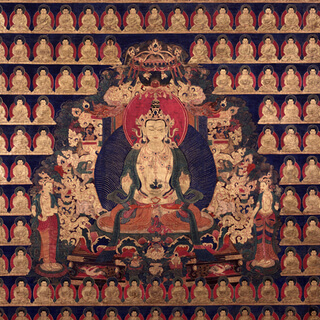
Including an image of a related artwork chosen from the Rubin Museum's permanent collection.
And now,
Please enjoy your practice.
We've been talking this month about change.
It is a concept that is really central to this conversation we've been having all year long about the future.
So when we think about the future,
Change inevitably comes up.
And we consider our relationship to this idea of change.
Change being,
As is said,
Often the only constant,
But also something that can create a lot of hope,
Anxiety,
Avoidance,
That can be a struggle to incorporate into one's life.
And this month we've been talking about change in the world around us.
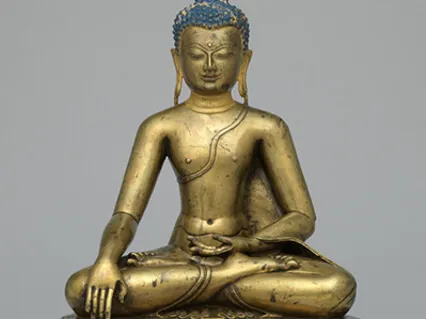
When we look at Shakyamuni Buddha,
I can't help but think about the power of personal change,
Change of the person and that kind of personal journey through ongoing change.
And certainly the Buddhist story reflects that.
We can kind of get some clues to his story through the iconography here.
We can see those elongated earlobes where the jewels of a prince once lived.
In fact,
He was a prince.
And upon discovering suffering after a very sheltered youth,
Decided to give it all up to go after this idea of what was possible beyond suffering.
And here we have him seated in a kind of meditation posture.
It's a very kind of simple and beautiful,
Elegant statue here.
There is not a lot of adornment and that really represents this stage that he's in as he's gone through this aesthetic period of really having given everything up to investigate the power of what was beyond.
And he's seated here on his lotus throne.
He has one of his hands kind of cradled in his lap there and kind of meditative gesture.
And the other hand is touching down upon the earth.
And this clues us in that it is depicting the statue,
That beautiful moment where he asks the earth to witness him.
He kind of turns away from this moment of fear and asks the earth to witness him in this,
In this present moment.
And in that gesture becomes enlightened.
And of course,
Through this personal change that the Buddha achieves,
He creates so much change in the world around him as well.
So Sharon Salzberg is here with us and we're going to talk with her about this idea of change in the Buddha and we'll meditate together.
Sharon is the co-founder of the Insight Meditation Society in Berry,
Massachusetts,
And such a renowned and loved teacher and author of many incredible books and really useful and practical books that are great gifts,
By the way.
And I received one as a gift once and I really loved it.
You can find them in the shop or online.
And her most recent book is Real Happiness.
Please welcome her back,
Sharon Salzberg.
Actually,
My most recent book is Real Love.
Maybe the last one you read was Real Happiness.
If anyone wants to get her a copy of Real Love for the holidays,
You know.
The gift you were given?
Well,
May you be happy and full of love too.
They're all kind,
I hate to say this,
They're all kind of similar in a way.
As well as one message or two.
But I do it differently too.
It's not all the same.
Speaking of art,
I want to go back to that gesture that Dom was just talking about and also just for a moment talk about the statue in itself because I was sitting here looking at it for quite some time before you came in and I just find it so beautiful and really alive in some way.
I thought at one point I thought,
Is that breathing?
And I thought,
Are you hallucinating?
But it just felt so alive to me.
And what I thought of actually was this one time I was at Emory University and the Dalai Lama was visiting.
He was on a panel that had been sponsored by the art department.
And the question,
Interestingly enough,
It was the Dalai Lama,
Alice Walker and Richard Gere that was the panel.
And the question was something I had been asked a billion times so I was happy to hear it.
Which was basically,
Do you think great art,
Great creativity has to be born of tremendous suffering?
And first Alice Walker answered and she said,
I think Langston Hughes had been her mentor at some point and she said,
He thought so.
So that's how I sort of came into creativity.
But she said,
Now that I'm older and happier than I've ever been,
I think I'm doing better.
I think I'm writing better.
I think it's better.
Richard talked about being an angry young man and all that.
And there's the Dalai Lama sitting there looking incredibly puzzled.
And he said,
That was kind of a confusing notion to him.
That in Tibet,
He said,
People are always taking me to look at things and saying isn't that beautiful?
Isn't it amazing?
And he said,
In Tibet,
The worth of a piece of art was based on the transformation of the creator in the process of creating it.
And so if the creator themselves got more open,
More loving or faced something they hadn't faced before,
What I write,
What I wrote,
I just saw myself quoted somewhere,
We don't count on artists for their suffering,
We count on them for their courage.
And so in that process of inner transformation,
That's how things were measured.
So I was just sitting here looking at that and thinking,
Wow,
You know,
It feels as though the mind that ultimately emerged from the creation of this was maybe commensurate with the incredible serenity of the creation.
And so that was in my mind.
So the gesture of the Buddha,
Then actually Bodhisattva,
He's not yet the Buddha,
Putting his hand over his knee is also a testament to not only change,
But continuity in some way.
And it is my favorite depiction of the Buddha.
As the legend goes,
And it's all legend,
But it has like the power of myth,
Therefore,
The Bodhisattva means someone who is aiming toward enlightenment,
Sometimes described as someone aiming toward enlightenment for the sake of all.
And the Buddha had been born a prince and had a very pampered,
Indulgent life for 29 years,
And then spent six years in the jungles doing these incredible fierce austerities and kind of went to the opposite extreme.
He went from selfishness and self-indulgence to kind of mortifying himself.
The belief was that if you could punish your body enough,
Your spirit would soar free and you would become an enlightened person.
And I find that interesting too,
Because certainly we at the very least have psychological equivalence to that.
You know,
If we can only judge ourselves enough,
If we can only be down on ourselves enough,
Something would open and it would be to our benefit.
And then after six years of that,
The Buddha,
As Bodhisattva,
Decided,
No,
Wrong,
Wrong turn.
And so he ate,
He'd been kind of starving himself and he ate here milk rice,
If you ever go to an Indian restaurant,
I recommend it because he ate it just before you got enlightened.
And then he went and sat under this tree to meditate.
He sat down with the aspiration to not get up until he'd become fully enlightened.
And as the legend goes,
He was then attacked by this figure called Mara,
Sort of like the satanic figure in Buddhist teaching who tried to get him to get up.
That was his whole goal.
So he would try to tempt him,
Like with his dancing girls,
And frighten him with these terrible shrieking sounds and did all these things.
And then the last attack of Mara basically was one of self-doubt,
Where Mara more or less said,
Who do you think you are?
Like who do you think you are to even imagine you could be free,
That you could break through the bonds of conditioning,
That you don't have to be so limited,
That you could really be free.
And in response,
The Bodhisattva reached his hand over his knee and touched the earth and asked the earth to bear witness to what they would describe as many lifetimes of his practicing generosity,
Morality,
Kindness,
Patience,
Truthfulness,
All these other qualities.
And earth shook,
Affirming that indeed,
He in a way had a moral right to have that big an aspiration.
He didn't have to hold himself back.
And Mara seeing the earth shake,
Fled into the night.
And that's when the Buddha went on and became enlightened.
So we're sitting here in Chelsea,
You know,
2,
600 years later,
Because of that gesture,
Which I love for every reason,
It symbolizes certainly one's right.
It's like our innate dignity that can be manifested in ways beyond our ordinary imagination,
When we allow ourselves to kind of let go of those limitations that are just either externally imposed or self-imposed.
It symbolizes that no work is wasted,
You know,
And that it's all unified.
You know,
When you are kind to somebody,
It is not a different sort of mental energy and physical energy,
Psychophysical energy,
Than when you're kind to yourself.
When you're kind to yourself,
It also manifests externally.
When you practice patience,
When you're sitting there,
Sometimes when I practice,
It felt like for the umpteenth hour,
Nothing was happening.
I think at least you're practicing patience,
Sort of.
You could be practicing patience.
You know,
We practice it with ourselves.
We practice it with someone who's fumbling and trying to get something done for us.
With an airline,
For example.
We practice truthfulness in admitting to ourselves what our experience is,
Not trying to disguise it or distort it or deny it.
And we practice truthfulness externally,
And not always taking what sometimes seems like the easy way or the conventional way and saying,
You know,
I just can't go there.
That would weigh on me if I actually distorted the truth in that way.
And so it's all kind of seamless in what we do.
And in that framework,
Their cosmology,
The Bodhisattva was reaching back through many,
Many lifetimes.
But if that's not your worldview,
It doesn't matter.
You know,
It's like nothing we do is kind of wasted.
And so even though we live in a reality of constant change and this sort of tumultuous arising and passing away,
There are these threads of meaning that are absolutely stable and reliable and therefore can be like a refuge for us.
So let's sit together.
You can just sit comfortably,
Close your eyes or not,
However you feel most at ease.
See if your back can be straight but not strained or over arched.
You can start by listening to sound,
Whether the sound of my voice or other sounds.
Just let the sounds wash through you.
And bring your attention to the feeling of your body sitting,
Whatever sensations you discover.
And bring your attention to your hands.
This itself by the way is described as a good stress reduction technique.
Just feel your hands and move your attention from the more conceptual level,
Hands,
Fingers,
To the world of direct sensation,
Picking up warmth,
Coolness,
Pulsing,
Throbbing,
Whatever it might be.
You don't have to name those things.
In fact,
It's kind of a drag if you try to name them all,
Or at all,
But just feel them,
Those different sensations.
And bring your attention to the feeling of your breath,
The actual sensations of the in and out breath,
Just the normal natural breath,
Wherever you feel it most distinctly,
The nostrils,
The chest or the abdomen.
Bring your attention there and just rest.
See if you like,
You can use a quiet mental notation like in,
Out,
Or rising,
Falling to help support the awareness of the breath,
But very quiet.
So your attention is really with the sensations of each breath.
And if you find your mind is wandered,
You've gotten lost in thought,
Spun out in a fantasy,
Or you've fallen asleep,
Don't worry about it.
See if you can let go gently,
Bring your attention back to the feeling of the breath.
Printing Thank you.
Thank you.
Thank you.
Thank you.
Thank you.
Thank you.
Thank you.
Thank you.
Thank you.
Thank you.
Thank you.
Thank you.
Thank you.
Thank you.
Thank you.
Thank you.
Thank you.
Thank you.
Thank you.
Thank you.
Thank you.
So thank you.
Thank you.
Thank you.