Welcome to the Mindfulness in Meditation podcast.
I'm your host,
Dawn Eshelman.
Every Wednesday at the Rubin Museum of Art in Chelsea,
We present a meditation session led by a prominent meditation teacher from the New York area.
This podcast is a recording of our meeting in practice.
If you would like to join us in person,
Please visit our website at rubinmuseum.
Org slash meditation.
We are proud to be partnering with Sharon Salzberg and teachers from the Shambhala Center.
The series is supported in part by the Hemera Foundation.
In the description for each episode,
You will find information about the theme for that week's session,
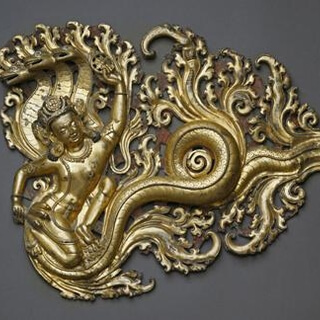
Including an image of a related artwork chosen from the Rubin Museum's permanent collection.
And now,
Please enjoy your practice.
Welcome everyone to our weekly mindfulness meditation practice.
My name is Dawn Eshelman.
I see a lot of familiar faces in the audience,
But I'm curious if anybody is here for the first time.
A few,
Great.
Welcome.
Great to have you.
So throughout the month,
We have been delving into this theme of focus and really coming to understand it through a few different perspectives and also finding some articulation for this idea of focus and how we might approach it in different ways.
So we've used the words attention,
Mindfulness,
And words that have maybe some different kind of feeling or energy to them and really kind of been exploring types of focus that are most helpful to us in our meditation practice.
And as we practice here using mindfulness technique,
Our focus is often the breath or there might be another object that receives our focus,
But often it's the breath.
And we will continue to practice that way today,
But we're going to talk about a different approach through the object that is featured here.
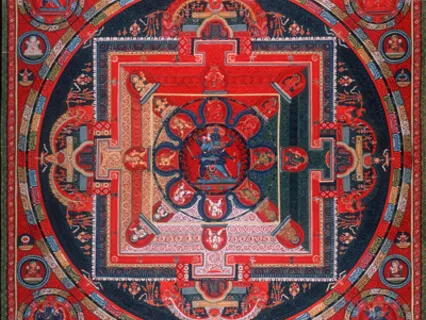
So we're looking at a mandala,
And we took a look at a different mandala last week.
This week we're going to look at this particular mandala and talk a little bit more about its symbolism,
What it means,
And how it's used sometimes as an object for particularly tantric meditators that have reached a certain level in their practice.
So that's what we're looking at here today.
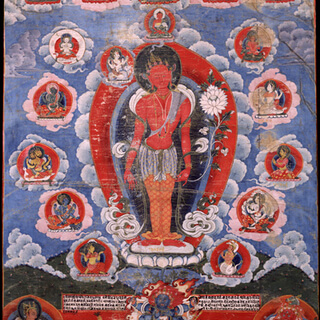
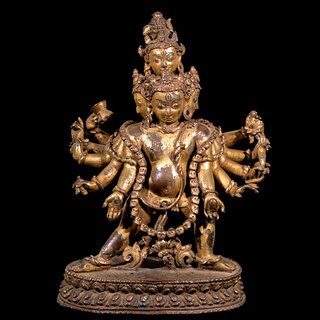
This is a mandala of Haruka Krishna Yamari,
And that is a wrathful form of Manjushri.
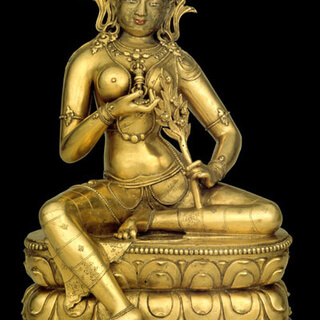
So we've seen the Manjushri figure several times.
Manjushri is often seen carrying a sword,
And that is so that he can slice through ignorance.
He represents wisdom.
And his wrathful form is here in the very center of this mandala.
And then he is embracing his consort.
His consort represents compassion,
So we have there wisdom and compassion,
These elements that give rise to enlightenment from the tantric Buddhist perspective.
He also has six arms and six faces,
And this alludes to his ability to see clearly in many directions and to take lots of different kinds of action.
And the Manjushri figure here is known as a yidam,
And again this refers to those types of deities that are created really just like this one is in this painting here,
This thangka,
That are meant to be these visual objects of focus.
And this is something that a practitioner will work on for years and years,
Perfecting their skill of visualization so that when they're ready to encounter and experience this object,
They have really reached a significant level of skill in their practice.
And that's a really pretty amazing dedication to focus.
We are delighted to have Shantae Paradigm Smalls,
Dr.
Smalls,
Back here with us today.
She is a teacher and meditation instructor in the Shambhala lineage of Tibetan Buddhism.
And I also just want to say a shout out and thank you to the Shambhala Center for partnering with us and in bringing Dr.
Smalls here today.
And also to Sharon Salzberg,
Our partner in this program,
And the Hemera Foundation for supporting us.
Shantae is a student of Sakyong Mipham Rinpoche and has been a member of Shambhala and the New York City Shambhala Sangha since 2006.
She's an assistant professor of English at St.
John's University in Queens.
Please give her a warm welcome back.
Good afternoon,
Everyone.
It feels like one of those TED Talks I should run up.
I'm glad you're all here.
Thank you for being here in your lunch hour.
I want to thank Don and Camilla and all the staff at the Rubin for having me back,
Having me here in the first place.
And I'm going to talk a little bit about not so much this mandala because you'll get in too much detail because you'll get the sort of details of that in your tour if you go on it.
But I'm going to talk about the mandala principle,
The kind of way that it's used in Tibetan Buddhism and some of the symbolism.
But can I just ask if there's anyone here,
Well,
Let me ask it this way.
Who meditates regularly,
Whatever that means to you?
OK,
Great.
Thank you.
Who does not meditate regularly,
Whatever that means to you?
OK,
OK.
Is there anyone here who's never meditated before?
Right.
It's pretty unusual in this day and time to find someone who hasn't meditated,
Although it does happen.
Well,
Maybe in New York it's unusual to find someone who hasn't meditated.
So I'm just going to read my notes here.
So as Don said,
This is Manjushri in his wrathful form.
Manjushri is the bodhisattva of prajna,
Or wisdom,
And one of the three major bodhisattvas in the Tibetan tradition,
Manjushri Avalokitesvara,
Who you might have heard of before,
The bodhisattva of compassion and vajrasattva,
The bodhisattva of power.
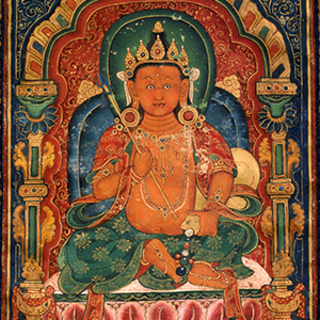
So I actually have a small,
I forgot,
I have a small tanka of Manjushri hanging to the left of my shrine,
Home shrine,
And I actually totally forgot about it.
And then I was practicing this morning,
I looked up and I saw it,
And I thought,
OK,
This is how fortuitous and also how sort of funny.
Sometimes I remember I have one of Manjushri and one of Avalokitesvara.
I used to have one of Vajrapani,
I don't know where it,
Or vajrasattva,
I'm not sure where it is,
But this thing about focus,
Too,
Is that sometimes one of the really lovely things about this mandala and its principle is that you can't possibly take it all in at one time.
And so sometimes what happens is that you're actually refreshed a little bit when you notice parts of it or a part of it.
So when I noticed my sweet little tanka of Manjushri this morning,
I felt this sense of delight.
It was like,
Oh,
Yeah,
I see it every day,
But I don't always pay attention to it.
And Manjushri,
It is said that,
So I don't know how much you know about Tibetan Buddhism,
But it is said that there's a system of,
Obviously of reincarnation,
It's Buddhism,
And it's a system of reincarnated high teachers called tukuls,
And it is said that in this 19th century,
There was a teacher named Mipham,
Jamgunju Mipham Gyatso,
Or he's known as Mipham the Great,
And he lived from about 1846 to the early 1900s,
1912.
And he was called Mipham the Great because he produced over 32 volumes of writings,
Intellectual writings,
Poems,
Songs,
Tantric writings,
Sutras related to dharma.
And he was really a high teacher in one of the major schools of Tibetan Buddhism,
The Nyingma School,
Which is the school that's dedicated to kind of learning and scholarship.
And I say all this to say because in Chivala,
And it is said that our teacher,
Sakyam Mipham Rinpoche,
Is a reincarnation of Mipham,
Who is a reincarnation of Manjushri.
So Manjushri is a very special place in my,
Both in Tibetan Buddhism,
But also in my lineage,
Because Sakyam Mipham Rinpoche is the manifestation of Manjushri on earth.
So the mandala principle,
In part,
There are a lot of things to say about it,
But in part,
The principle of mandala is working with strengthening and developing the mind through generosity.
So I don't know if any of you have ever seen monks making,
Or sort of sangha members making a sand mandala.
Have you ever seen videos of that or people doing it live,
Right?
And that can take hours or days or weeks or months to make very ornate mandalas that are representative of a kind of cosmology,
Sometimes of a deity or a bodhisattva,
Sometimes of a kind of world or the universe.
And so these,
I remember seeing it happen for the first time and being kind of totally blown away at the kind of skill and the time and the excitement and the generosity,
And then being almost horrified when it was dissolved.
Like,
Where's it going?
Can't we take a picture of it and glaze it,
I don't know what,
And keep it?
But part of working with sand,
Too,
Is that it's really,
Really super impermanent,
And really working with that quality of impermanence and not grasping,
But really making this,
When you make a mandala,
It's an offering.
And there's also this aspect of collaboration that one really can't make something this ornate by oneself.
So there's this kind of principle or underlying principle of generosity,
Camaraderie,
Discipline,
Attention to detail,
And really giving of your time and your effort and your energy.
And then,
Of course,
When they dissolve it,
One that we're really working with our sense of how we work with attachment and achievement.
And so what happens when the thing that you've built up,
The cosmos that you've created,
Dissolves,
Right?
It doesn't last,
It doesn't stay.
And working with all those feelings that actually come up and the sensations of kind of dissolving or hard work and beauty and achievement and the kind of praise that comes with all of that.
So if you've never watched this process,
I totally suggest,
Like,
Go on YouTube,
And there's plenty of,
You know,
You don't have to watch the whole whatever many hours it takes,
But just see a little bit of what it takes to make these.
Mostly you'll see recorded depictions of people making sand mandalas.
But this mandala principle is also working with this quality of offering.
And traditionally,
You would offer,
Say,
A mandala of manjushri when you're about to receive a high teaching,
A tantric or a vajrayana teaching.
And so you would make that in the sense of as a kind of way of recognizing that you're about to receive some kind of really generous and abundant set of instructions and practices,
Usually with an abhisheka,
Which is an empowerment.
So you would make this,
Monks or the students who would receive this,
Would make this ornate mandala in order to,
As a way of,
A form of gratitude,
And also as a form of kind of working with one's own sense of achievement,
Right,
For what you're about to receive.
And I'll just say this very briefly.
There are five types of offerings.
One is offering,
In relationship to the mandala,
One is offering your possessions.
The other is offering our imagination,
All that we can imagine.
The third type is offering praise or gratitude.
We also can offer our accomplishment or sense of things that we've done or our achievement.
And then finally,
We also offer all the,
What they say,
The unsurpassed offering,
Which is basically all of the Buddhas of past,
Present,
And future.
And there's a kind of sense of,
It's not that necessarily you literally have to give away everything you have,
But that you're in that frame of mind.
And working with a kind of relationship to your own,
One's own sense of lack,
Not enough time,
Or even turning your thoughts toward someone other than yourself,
Right,
And how challenging that can sometimes be.
And it's not necessarily about offering money or riches,
But even the difficulty of perhaps,
Well,
Some of you can identify with this,
The difficulty of taking space in your day to meditate sometimes.
That's also an offering,
A way of carving out a little bit of space,
Five,
10,
15,
Or more minutes to commit to your own sense of well-being.
So the first thing I would like you to do is to just take a comfortable seated position in your seat.
Perhaps if you're a little slouched,
You might wanna just feel a sense of your own dignity and self-worth.
And maybe that feeling is in your heart center,
Which is also in the Tibetan Buddhist tradition considered the seat of the mind.
So the heart and the mind occupy the same space.
And you can just relax your hands on your thighs or your knees or on the arms of your chair.
And you can feel your feet on the ground,
Feel your connection to the earth and feel your sits bones connections to the earth through the seat of the chair.
Just feel that position for a little while.
And then you can begin to just feel the sensation of your body as it breathes.
What does it feel like to experience the breath in your body?
And if you'd like to work with your eyes open,
You can just have your gaze tilted downward maybe four to six feet in front of you.
Maybe you might see the back of your neighbor's head or back,
But you can just sort of look through the spaces and just let your eyes touch what they see.
So you're seeing,
But you're not looking.
And just feel your body as it experiences breath.
And when thoughts arise as they do,
You can notice those thoughts and return your attention to the sensation of your body as it breathes.
Okay.
Thank you.
Have a wonderful day.
That concludes this week's practice.
If you'd like to attend in person,
Please check out our website,
Rubinmuseum.
Org slash meditation to learn more sessions are free to Rubin museum members.
Just one of the many benefits of membership.
Thank you for listening.
Have a mindful day.
We'll see you next time.