G'day,
My name is Rachel Grace.
Thanks for joining me for this practice.
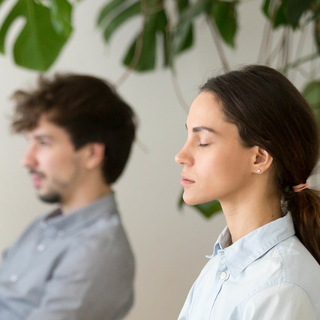
I invite you to take a moment now to prepare for this practice by finding a posture that supports you to be both alert and relaxed.
Allowing your eyes to gently close or softening your gaze down to the floor if that feels right for you.
We'll start the practice with the ring of a gong.
GONG The first step in exploring the breath as an anchor is finding where you can most easily feel it in the body.
So starting with the area beneath the nostrils and above the upper lip to see if you can notice and detect any sensations there as you breathe in and out.
Perhaps there's a sensation of warmth or coolness or tingling.
Shifting attention now to the belly,
Noticing if you can feel the rising and the falling of the belly.
And finally bringing attention to the chest,
Noticing whether you can feel the rising and the falling of your chest as you breathe in and out.
If the breath feels faint or hard to sense,
It's okay,
That's not a problem.
You can actually place your hand on your belly to feel the rise and the fall of the breath in the palm of your hand.
And if you choose to,
You can let this be how you anchor your attention with your breath.
Now I invite you to choose whichever of these three options is the easiest location for you to feel the physical sensations that accompany your breathing.
Either the area beneath your nostrils and above your upper lip or the belly or the chest.
And exclusively focus your attention there now for each in-breath and every out-breath.
There's no need to control or manipulate the breath in any way.
Simply allowing the breath to breathe in its own natural rhythm.
Each time your mind wanders away from the breath,
There's no need to worry,
That's totally normal.
Just gently and kindly bring your attention back to the breath.
Letting the rhythm of the breath change as it will,
Sometimes long and sometimes short.
Curiosity sharpens attention.
So now with curiosity,
See if you can track the entire cycle of a breath.
Noticing how it feels as you're inhaling.
And then in the pause between the in-breath and the out-breath.
And how it feels in your body as you breathe out.
Track the entire breath.
Noticing what it is like for you to use awareness of the breath as your anchor to the present moment.
Does it help to still your mind and focus your attention?
Now I invite you to shift the anchor of your practice from the breath to noticing sounds.
Paying attention to sounds.
Taking a few moments to let hearing happen.
What sounds can you be aware of now?
Near sounds,
Far sounds,
Soft,
Loud.
Noticing them all as well as the quiet sounds,
The silence between the sounds.
We can only hear sounds in the present moment,
So attending to the sense of hearing sounds anchors our attention directly in the present moment.
What can you hear right now?
Noticing if and how the sounds change in volume or pitch.
No need to strive.
Just let the sounds come to you.
Sounds are arising and passing away all the time,
Just of their own accord.
There's no need to reach out to search for them.
Just let the sounds come to you.
Of course,
We like certain sounds more than others,
But we don't have to chase sounds away or.
.
.
We can just pay attention to the sounds without interference and without judgment.
We can just let the sounds be.
What can you hear right now?
Where is your attention right now?
Noticing where your attention goes in the silent moment.
Noticing if the attention drifts away.
And if it does,
Simply reconnecting with the sounds around you.
Using the soundscape as an anchor for your attention to this moment,
Right here,
Right now.
Notice what it's like for you to use sound and hearing as an anchor for your attention.
Does it serve you as a tool for focusing and settling the mind?
The last anchor we will explore now is the feet and hands.
So right now I invite you to bring your attention to your feet.
Notice what kinds of physical sensations you can feel there.
Perhaps there's pressure or numbness,
Tingliness,
Warmth or cool.
There's no right or wrong,
Just feeling the physical sensations in your feet right now.
Now shifting your attention to your hands,
What sensations can you feel in your hands right now?
Heavy or light?
Tight?
Relaxed?
You're not looking for anything special,
You're just anchoring your attention right here,
Right now,
By paying close attention to the physical sensations in your hands right now.
Notice what it's like for you to use the sensations in your feet and hands as an anchor for your attention.
Does it serve you as a tool for focusing and settling the mind?
As we approach the end of our practice now,
I invite you to join me in taking a deep breath in,
Filling the lungs,
Then relaxing your body and your mind as you breathe out.
Let the corners of the mouth rise ever so slightly into a gentle half smile,
Savouring this moment.
And to conclude,
I will ring the gong three times.
Allow your eyes to open,
Gently bringing your attention back up into the environment around you.
Take a moment now to stretch or perhaps sit back a little and just notice how you feel.
Do you feel the same right now as you did before the practice?
Or has something changed?
Take a moment to notice and perhaps savour the impact of this practice on the state of your body and your mind.
You can also take a moment to appreciate yourself for the dedication to your own wellbeing that you've just demonstrated.
Each time you practice,
You are changing your brain for the better and building your capacity to handle life more skilfully.
So well done.
May mindfulness positively impact you,
What you do and all of those around you.
Thank you for practicing with me.
I hope you'll join me again.