Thanks for joining us here on Pretty Spiritual where we're attempting the unthinkable about how to navigate this messy,
Beautiful,
Imperfect life with spiritual tools,
Principles,
And our own personal stories.
So we're not experts,
We're not religious,
We're definitely silly.
We're honest,
Real,
And willing to share.
So join us as we connect,
Bond,
And grow together.
Hello sweet spiritual friendies.
Hello.
Hey.
It's an honor and a treat to be back together again.
We are so excited.
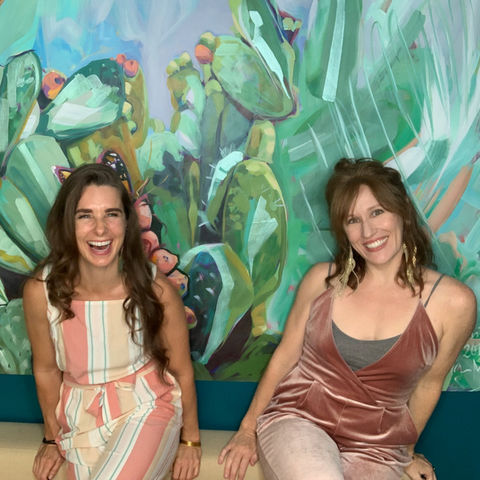
I'm Lindsay Pony and I have my lovely co-host Ella.
Hello,
I'm Ella.
And also Annie.
Hello.
Go ahead and settle in with us as we attempt to balance emotions today.
We had an amazing topic suggested from an incredible listener.
Here I'm going to paraphrase what their email said.
I want to learn more about emotional regulation.
I would love to hear your experiences around that and any tools you have.
I have PTSD and find myself getting super overwhelmed with emotions,
Especially sadness,
And then am just like stuck forever.
Not forever,
But it feels like forever.
My main tools are to just feel the feelings and by distracting myself.
Mostly I feel so overwhelmed in those moments.
I don't know how to communicate about it or how to connect with my adult rational self.
I'm curious how to get better at regulating myself and your thoughts on how to connect with others about experiences where you feel disconnected with yourself,
Whether it be in the moment or afterwards.
Okay.
So emotional regulation,
What is that?
It is a process of changing the emotion we are experiencing.
Can we change or have an impact on our emotions?
Whether it's a comment at work you'd rather let roll off your back or attempting to express disappointment to a friend or partner in a more constructive way,
Can we be an active participant in our emotional lives?
Let's share about what it's like when we are swept up in emotions.
What does emotional dysregulation look and feel like in the body?
Can I ask a quick question?
Is emotional dysregulation something that applies only to the really big emotions where you get swept up and totally destroyed by something or does it also refer to smaller emotional stuff?
I was under the impression that even the smaller,
It's not just for flooding or who knows?
I too am not a psychiatrist nor a doctor,
But we shall get into it.
So cool.
I'm so excited.
I just don't,
I don't know.
Yeah.
Maybe for the context of this podcast,
We'll talk about the whole range.
So cool.
Okay.
Let's just get into the ranges of emotions,
Regulation,
Dysregulation,
All of it.
Annie,
Would you love to start us off?
Yes,
Lindsay.
Thank you so much for leading us and thank you also for sharing that we are not medical professionals.
We sure aren't.
We are definitely not.
We have experience being on the receiving end of mental health,
Professional help.
But if we just,
It's I think good for us to just state it out loud that these are tools that we,
These are personal experiences and tools that we're working with,
But also always we don't ever want to harm anybody.
So getting help with a professional can be really useful.
And I'm so grateful to our listener who wrote in with that email.
It was so vulnerable and brave to open up to us.
And I also have PTSD or I've been diagnosed with it and it's something I've been healing from in the last couple of years.
I am so grateful to hear about other people's experiences because I will read things online and just try to connect,
But it's really nice to connect with an individual and kind of understand what they've gone through,
What it looks like in their life now and know that,
You know,
As we work with emotional regulation,
It's something that many people go through.
So we're not alone.
So until a couple of years ago,
I didn't know that I had a lot of dysregulation and like Ella was saying there would,
There was of course always the like bumps and bruises of just kind of how emotions came through my body.
But then there was also the trauma related emotional dysregulation.
And I think I'll talk more to that today just because that's what I've been working on.
And so I knew I was really anxious in my life and that I was uncomfortable.
I had a lot of fear and I'd go through these mushy periods where I just I couldn't be hard to take a shower.
I'd be in my pajamas for multiple days.
But I didn't know that if a wave of sadness hit me and my emotional dysregulation didn't look often like anger,
But it was this really inward collapsing.
So it'd be really deep sadness,
Crying,
Anxiety and overwhelm.
It felt like it was just happening to me when I think she how she was describing it sounded like a wave,
You know,
So I would feel like this huge tsunami would hit me.
And I was like,
Well,
This is just how I'm going to feel for however long this lasts.
And then when I started working with a somatic therapist who's a mental licensed therapist,
She started giving me some tools to identify what was happening and then also some tools so that when it started to happen,
I wouldn't get so consumed by it.
And then as we built on those tools and like my foundation started getting stronger,
I started to be able to recognize the signs that an overwhelm was even coming so I could see the tidal wave coming before it even hit ground.
And so I could prepare myself.
And so it's just been this really slow process of starting to understand that I can have things pass through me or I can manage how much I let through.
And it's not this denial of my experience,
Which is what I used to do.
But it's more like managing it in a way where it is healthy and I don't get overwhelmed.
So that that was totally big.
When we talk about tools,
I'm going to share about what I mean when I talk about managing emotions and noticing the tidal wave before it hits or and then also a few tools for if you are actually just trying to keep your head up and you're in the middle of the tidal wave.
Beautiful.
I'm excited for those.
I need those right now.
Please.
Awesome.
Well,
Ella,
Why don't you get into what it's like for you?
Sure.
I am also really grateful for this topic.
Thank you so much for everyone who writes in who listens.
We are so grateful.
Just generally as a person,
I'm very sensitive and I get swept up in big feelings pretty easily.
And I've gotten that feedback from a lot of people over my lifetime that I can sort of disappear into these feelings where they just get so big,
They displace everything else and kind of take over.
What happens when I'm overcome by an emotion like sadness or disappointment is that I really wear that experience in my body language and my tone.
And even if more recently I've been working on how to have that experience and not let it take over.
But even when I'm doing that,
I have found that it still kind of leaks out of me onto other people.
Often the way that that's perceived by others is as me being quote unquote mad.
People think I'm mad at them.
I sense myself getting kind of like stern and curt in my responses.
But really what's happening for me is I'm having a big feeling.
And usually for me what happens when something big happens like that eclipse of everything else,
I start doing an internal self-care exercise like rain.
When the big stuff happens,
I'm pretty good at hunkering down and like really taking loving care of my internal experience.
But the thing I don't know how to do is take loving care of my internal experience and not shut out other people.
Because it feels like in order to take care of myself inside,
This must be a fear response that I have to block out the kind of other people.
Especially if I'm with,
For instance,
My partner and he says something that disappoints me.
Then it's like he needs to be outside of my hunkering down self-care situation.
But it doesn't really work for relationships to do that.
I really want to learn how to take care of my internal experience without shutting other people out.
So yeah,
That's something I would really like to learn how to do.
And I'm hoping maybe you guys can teach me.
Thank you both for what you've shared.
It's interesting how I thought that my own experience with emotion was uniquely mine.
And as you two are both talking,
I'm understanding so much.
So I really appreciate you sharing and it's given me a lot to consider my experience with emotions.
I guess my strategies from when I was younger was just to not feel,
Not trust my feelings and then not talk about my feelings.
Feelings would come up,
I would find somewhere to shove them down or push them away or pretend they weren't there and as can happen when doing that,
They would come out sideways,
Just kind of seeping out.
And because I had disassociated,
That's been a big strategy of mine that I've learned this year.
I didn't realize that the feeling would come.
I would see it coming.
I would just disassociate from my body,
Not be connected with it.
And then I wouldn't be able to contact those feelings anymore.
And then I would be a big yeller,
Really aggressive.
I used to actually break a lot of stuff.
That was one of my strategies of slamming doors and breaking things.
And it was just because there were so much these huge emotions in my body that needed to be expressed.
And the feeling of throwing something or breaking something or slamming a door would help me a little bit to release some of that energy.
Emotions stand for energy in motion.
And when I try to stop those emotions from being expressed,
Then that's I'm learning.
I feel like I've learned so much this year about this just by labeling the emotions,
Figuring out that I have emotions.
It's okay to have feelings.
It's okay to feel those feelings.
It's okay to express feelings.
This is all so new for me.
My best strategy was to just shut it down,
Lock it down.
And then I would be so disconnected from myself.
I couldn't understand why I couldn't even hear my tone.
That was very aggressive,
Mean,
Hurtful.
The feelings would be really flooding,
Would just take over me.
They come in,
They flood over,
I get the wave.
It's more of like a tsunami that just takes me away.
And then I have a lot of physical action,
Whether it's violence or breaking stuff.
I'm constantly yelling and then disassociating.
And then what I will do is I will continue to keep thinking about the situation that produced these emotions.
So then I get into this loop where I just keep doing the same thing,
Where I have these big waves of emotions.
I'm flooded.
I go with them.
I'm yelling.
Maybe I'm breaking something.
And then I just keep thinking again about what it is that has caused these.
So I just stay in that cycle.
And I'm also really confused,
Like I'll have moments of clarity where I don't want to act this way anymore.
I'm confused on why I'm acting this way and I don't know how to get out of it.
My most recent example is when I had found out some things about my mom and about her situation with her getting older and her capacities and feelings started to come up and I just pushed them away.
And then I needed to go out of town.
I needed to go be with my partner and his family.
And so I just push all those feelings away.
They don't exist.
It's not there.
All of it's fine.
Everything's going to be fine.
And then it cut to me needing to be with them and their friends.
And what happened for me is that I started projecting the feelings that were going on inside of me.
I was projecting them at the family.
I thought they need me to be better.
I need to be better.
I need to be doing all these things.
When it was inside of me was like,
You can't have these feelings.
These can't be here.
You need to show up.
You need to be this different person.
So it was so interesting to have this real time experience of all the pressure that then came back on top of me that I thought was coming from these other people.
It was me just from trying to push these feelings away and not have them.
I actually just needed to express these emotions and let the emotions and this energy move through me.
And it could have been a whole other process.
And I'll talk more about that when we get into the tools.
Are there tools that can bring us back into our bodies and help us integrate regulated emotions so we can show up in the world as our ideal whole selves instead of an outwardly expressed exaggerated emotion?
Well that just explained what I was trying to say right there.
Mm hmm.
That was great.
Just wrapping it right up.
All different ways.
Who wants to put their tools in first?
I'm ready.
Do it girl.
Okay.
Thank you Boney for sharing that personal history story.
It's really helpful.
I have a lot of tools actually.
And I actually was in communication with the person who emailed us about the PTSD and being overwhelmed and feeling really emotionally dysregulated.
I emailed them a lot of the tools that I use.
And so if you would like me to send you this email,
I would be happy to forward it to you.
Just contact us through prettyspiritualpodcast.
Com and I can send this off to you.
And it's a longer list of things that I have used over the last year and a half that have really helped me stay grounded.
I'll just share two or three of them.
Boney you're doing such a great job of describing the title way of just getting swept up into something.
So if you're in the state where you're feeling swept away a lot,
Maybe something that would help is and this helped me is just doing fewer things.
Because for me when I was constantly getting that tidal wave hitting me,
It was because everything was really heightened inside of me and there was trauma and things that were up that needed to be tended to and healed.
But because of that,
I had fewer resources and stability to manage stuff when it made me knocked off balance.
The suggestion I got was to just have one social engagement a day.
And I know I've talked about this on here before.
And whenever that my therapist made that suggestion to me and made me really annoyed and felt like she was talking,
Trying to talk to me like I was a little kid,
But I needed it because I didn't have the capacity.
I just needed to be a lot more gentle with myself and I was trying to run through life full steam and overcompensate for the fact that I was running on empty.
So I would just pour insane amounts of caffeine in my body and karate chop through the day.
And so then of course,
If I got overwhelmed,
It would hit extra hard because I'm already kind of running from empty.
Rest a lot.
Do one social engagement a day.
If you are going to have a conversation with someone who you know flips your emotions,
Plan for it.
Don't just let it happen to you and say,
Oh,
Wow,
I'm going to talk to this person.
That's usually pretty hard for me.
I'm going to plan it for a time when I know that I can rest before and after,
Or maybe I won't do it right before my job interview.
Maybe there'll be too many things at once.
So that's my first one is just to get enough rest.
Prayer and meditation is a really great tool.
When I use it even now,
When I feel myself getting overwhelmed,
And this is for more minor emotional overwhelm,
But say I get agitated with my wife and I can feel myself like flaring up inside,
I will just remove myself and I can go say a prayer.
And it's just this like grounding into my body of like,
I'm right here.
This is okay.
I'm not getting carried away into that heated electric storm of my thinking.
So that is the tool that you can use kind of regardless of what's happening.
And then this is a really great tool for me kind of across the spectrum,
But it especially helps with emotional dysregulation around trauma stuff and that kind of fuzzy brain and dissociation that can happen.
And Pony was talking about how hers kind of expresses outward and mine looks like an inward collapse,
But they're different versions of the same thing.
It's sequencing.
And I've talked about this tool before.
Again,
When I was taught to me,
I was like,
This is a tool for babies.
Never going to work on my brain.
But there's actually it's very helpful for bringing the brain back from that,
Like centering on that reptilian amygdala part at the base of our brain and coming back up to the prefrontal cortex and it's sequencing.
So you just look at three things.
You name it,
You name the color of it.
You look at a second thing,
Name it,
Name the color of it and look at a third thing,
Name it and name the color of it.
And then you go backwards,
But you start with the third thing first and name it and its color.
The second one,
Name and its color and then back to the first one and name and its color.
And so I'll do that in rapid succession.
And I do this far less than I used to.
But about a year ago,
I would go into these swampy dysregulated states a lot and I would use that tool and it kind of like would pull my brain out of the emotional muck.
And again,
I thought it was a dumb tool,
But it's a name.
Name what in its color.
So Lindsay's wearing a yellow sweater.
I'll say the color and the thing.
So yellow sweater,
Ella's wearing a fuchsia sweater,
Fuchsia sweater.
And then she's sitting by a turquoise pillow,
Turquoise pillow.
So I'd go yellow sweater,
Fuchsia sweater,
Turquoise pillow,
Turquoise pillow,
Fuchsia sweater,
Yellow sweater.
And then I'll jump to the next thing.
Blue plant pot.
That's not a blue plant.
It's a.
.
.
That would be cool.
That's blue planter,
Wood cabinet,
White mirror frame.
White mirror frame,
Wood cabinet,
Blue pot holder.
Oh,
To orient yourself into the room instead of in your feelings.
Exactly.
And I have to also concentrate.
So it brings my brain power back up to this prefrontal part of my brain instead of back in the fight or flight terror dome of my amygdala.
My favorite place to be,
Y'all.
I live there.
I didn't know we could go somewhere else.
It's really useful because also it kind of distracts me because if I'm in emotional dysregulation and I'm just like,
Oh my gosh,
I'm so overwhelmed.
But this is just like,
Oh,
I have to concentrate on this sequencing.
So those are my tools.
Get lots of rest,
More than you think you need,
More quiet time than you think you need,
More calming activities than you think that you need.
Even for stuff that you know is going to make you uncomfortable,
Like buffer it with self care time.
Try prayer meditation.
And then when you're caught by the tidal wave,
Use that sequencing.
And it can help bring me down out of that foggy electrical storm.
I'm going to try that one.
That sounds like the perfect tool for what happens to me.
Oh,
Cool.
What I end up doing when I get really,
Really overwhelmed like that,
Especially if I'm like sad about something,
Is I will kind of be in my body,
Which feels like a spiritual action,
But then it'll get twisted up with my mind.
So I'll be in my body and I'll be feeling my feelings,
But then my mind will say stuff to me.
This was happening recently when I was feeling kind of heartbroken.
I felt the initial kind of like gut punch and I was being really present with my body.
And then I kind of started to cry and I cried for a little bit and then I sort of stopped crying.
And then my mind went,
But meh meh meh meh.
And it was like,
Oh yeah,
I should be really sad about that.
And then it kind of like got into this weird like closed loop where I would be in my body,
But in this kind of altered way where it was really being directed by my mind and there wasn't the same kind of relief,
Because for me the relief of being in my body is that it's only what's happening right now in reality right here.
It's not a catastrophe.
It's just some sensations inside my body.
But when my brain was doing that,
It felt really like I couldn't get the relief of being right here because I was still sort of like hooked into this story.
So that sounds,
Your tool sounds like a real,
The last one sounds like a really great thing to try.
Thank you.
I don't know how many tools I really have,
But I was reflecting on what helps me to let go a little bit when I'm in a state like that.
And the biggest thing is to share my feelings,
To tell the truth about what's happening for me right now.
And most of the time that feels so out of bounds.
That feels so like something I'm not allowed to do.
It's like I have to suffer in silence and like be,
You know,
Scornful,
But not communicative about what's happening right now.
And so when I tell the truth about it,
I get a lot of relief because then I don't have to pretend like nothing's wrong.
And that's the thing that messes with me because I have these really big feelings and I don't want to feel dishonest,
But I also don't know how to do any kind of like spiritual compartmentalization.
But so when I share about how I'm feeling,
Then I get this extra space where whether the person I'm sharing that with likes hearing it or not,
All of a sudden we're on the same page and that for whatever reason makes me feel more authentic.
It makes me feel more connected and it helps me not to get totally hijacked by the story.
And then the other thing which helps but is one of those benefits of meditation that's really hard to calculate or work for or there's no regimented program to get this,
But it just seems like one of those fruits of meditation is that once in a while in the middle of that hijack or sometimes after I get to witness the internal narrative that's driving that loop.
And when I can do that,
I actually have a chance of unhooking from whatever that usually it's a story about victimhood.
That's my flavor.
That's the good one.
But if I can see,
So the like victimhood story would be like this person is out to get me or this person isn't safe.
This person doesn't care about me.
This person doesn't love me.
We're not on the same team.
And as long as that's the track that I'm listening to,
I will feel the need to disconnect and shut myself off from the other person.
And I just want to say this is not an unsafe relationship.
It's one where this person actually does care about me a lot and is on my team.
And I've just gotten hijacked by fear.
But if you're having a trauma response to a relationship that doesn't feel safe,
Get out of there.
Do whatever you got to do to keep yourself feeling safe and taken care of.
I just want to say that because I think sometimes it's possible to hurt or re traumatize ourselves trying to do something quote unquote spiritual that actually doesn't feel good to us.
So trust yourself.
There's a lot of tools I feel like you guys covered pretty much all of them.
Tell us what it's like when you practice it.
Most recent time luckily for me I was with really safe people because I've been in family situations so I'm really glad that you're talking about that where it's actually not the place to be really vulnerable and open up about that because oftentimes it can lead to more pain or opportunity for others to hurt you.
So that's something to look at.
But with my partner's family is very safe sweet place.
So it was the I really think because of that that's why I really was able to get such a foothold on being able to work through this.
So what I did was I didn't know that I was really triggered and that I just like Ella was talking about recognizing the ways that I personally get stuck or what our particular flavor is of how we're seeing things that are happening and how you can do that is just by investigating the moments where you have reactionary emotions whether it be fear panic or rage or if you're where you're disassociating.
And I just feel I really hate this episode.
I'm like really not liking this.
Hold hands.
It's been such a long time since one of us felt like this.
I forgot.
Oh,
I think I feel this way all the time.
Really?
Okay.
I live here.
You're doing a great job.
I live.
It's great.
I really are you feeling emotionally dysregulated?
Annie,
How dare you?
That is upsetting.
I can't hit her because she's holding my hand.
It's all part of the plan.
I don't hit people anymore.
No,
I know.
I didn't mean that.
Pony.
Pony.
Pony.
I'm feeling a lot of pressure with timing and like that this should be succinct and that- No,
Forget about all that.
We've got lots of time.
No,
Because we do need a timer.
Okay.
And there's plenty of time.
All the time in the world.
That's all the time we've got.
We're almost done with this episode.
Yeah.
We're like five minutes away or 10 minutes.
You can talk for as long as you want.
Or 20.
No,
We're ending this.
Isn't it great that during the talking about all our tools of how to regulate our emotions,
I've become very emotionally dysregulated?
That's so funny.
That's so reasonable.
Oh my God.
It's an uncomfortable topic.
Okay.
So I'm uncomfortable.
I'm noticing that.
I want to get this whole thing done.
And so I'm just pushing the feelings away.
So that's what happens for me.
And in the moment,
What I wanted to talk about in some of the tools that I'm now telling myself are not tools.
So I'm just going to say what I had to say.
Say it,
Honey.
Is that emotions that we have,
Just like we've all been talking about the wave.
I learned this in my somatic therapy.
They start and then they really ramp up and it feels like it's too much to handle and hold.
And maybe for me,
That's when I start disassociating and where I just cut myself off and I push the feelings and emotions away.
And what I've learned is that they last for 90 seconds if we don't interrupt them.
If we can really just hunker down and feel safe enough in our bodies and do our deep belly breathing,
Really helpful to know what type of flavor you have.
I'm not good enough.
This isn't right.
People need something from me and I'm not showing up and being able to do that.
These are the stories that go on for me that then because those narratives are going on,
I can't actually just settle in and feel the feelings that are here.
And so if we take a deep breath and then we really just go along for the wave.
So instead of just leaving my body and disassociating and pretending there aren't any feelings here,
Just really settling in and being like,
Okay.
And then going with it and feeling like the apex of it.
So if it's just going to be 90 seconds,
Okay,
I'm feeling really uncomfortable right now.
I am so incredibly uncomfortable.
I just want to leave my body.
I don't want any of this to be happening.
And then if I ride the wave of like,
My God,
I have to leave right now.
But instead I promised myself to like be here with it and ride all the way up to the top of the wave.
And I'll be like,
Oh my God,
I feel my hands vibrating.
I'm sweating.
I'm forgetting to breathe.
And then I take like some big breaths.
And then I noticed that the wave then kind of starts to die down.
And so then I go along with it.
And then I think this is a part that really helps when we want to orient ourselves back into the room,
Which was where Annie's tool comes into a lot of help because I've just gone on like this big roller coaster ride of emotions,
Like had this big upheaval.
So then if I can orient myself back into the room.
And then the other piece that Ella was talking about is for me to be able to share with people around me that this is going on with Annie and Ella.
And I just edited it all out,
But I had to let them know that I was having a bunch of feelings.
If you have your safe people around you and just let them know what's going on,
Then that's another way not only for you to share with them where they can come in and they can help you,
But to be able to say that out loud and be able to hear that out loud also signals to yourself.
For me,
When I'm able to,
There's something,
It's like the same way with like a prayer.
When I take that moment,
Connect with inside this really intimate thing that's going on for me that maybe doesn't feel okay or like I'm really afraid or I don't want it to be happening when I voice it out loud to the people around me,
Then I get to hear it in a different way and I'm able to move with it or join the wave or be able to participate in a way before when I was just pushing away pretending it didn't happen,
It wasn't letting the emotions and the feelings be in motion.
I would stifle them and then it would come out sideways.
That was so cool how we got the real time emotional dysregulation walkthrough.
Thank you so much.
Thank you,
Pony.
Couldn't have been more perfect.
Boy,
We really just went through that.
Thank you for staying with us if you did.
We appreciate our real time emotional dysregulation regulation station.
Yay.
Hooray.
Thank you so much,
Everyone.
Let's talk about where you can find us on the internet,
All over that place,
PrettySpiritualPodcast.
Com and all the other social places.
At Pretty Spiritual Podcast on Instagram and Facebook.
Get excited.
Oh,
This is so great.
Do we have a little topic to tease?
Yes,
We do.
Next time,
We're going to talk about something that's very close to my heart.
If you find being a human messy and spirituality,
This other kind of plane of existence where we're clean and blame this all the time,
Then you should listen to this episode because it's going to be all about spiritual bypassing.
Very exciting.
Can't wait to see you next week.
Bye.
Love you.